
Law Enforcement
Your agency almost certainly runs an officer wellness program of some kind. The harder question, and the one that decides whether anybody uses it, is where the records it generates get filed. A wellness note sitting in a personnel file is a different legal object from the same note sitting in a confidential medical file, and the difference isn't a preference. It's federal law.
This is for police chiefs, wellness coordinators, and the professional standards and HR staff who end up owning the filing decision by default. If you're the person who answers a public records request, or who takes the call from a prosecutor asking what's in an officer's file before that officer testifies, this boundary is your problem whether or not anyone assigned it to you.
What follows is how to document an officer wellness program so its records stay out of the personnel file, then what federal law already requires you to keep apart, what the Law Enforcement Mental Health and Wellness Act does and doesn't ask of you, whether a wellness record can be reached by a subpoena or an open records request, and how to settle all of it before you configure a system. Every requirement below is cited to the rule or the statute it comes from.
Federal law already answers part of this. Under 29 CFR 1630.14, medical information an employer collects through a voluntary health program has to be collected on separate forms, kept in separate medical files, and treated as a confidential medical record. That's a filing requirement rather than a permissions setting, and it binds a police department the same way it binds any other employer.
Set up the wellness file before the first entry exists, and keep it apart from the personnel file from the moment you collect anything. Use wellness forms that never carry performance or discipline, name the few people who can open the file, log events rather than judgments, and tell your members exactly what's kept. Essential Personnel holds those wellness events behind specialist role permissions, so the chain of command doesn't see them by default.
Six steps keep officer wellness records out of the personnel file. None of them needs new software to start, and each one is easier to get right before launch than to fix afterwards.
Software helps with steps 3, 4 and 6. It can't do steps 1, 2 and 5 for you. In Essential Personnel, traumatic calls, uses of force, injuries, vehicle accidents and exposures are logged against each member, and specialist role permissions decide who can view the wellness detail. Peer support members or an outside clinician can be the ones alerted without being given the run of your personnel records, and the chain of command doesn't see wellness detail just because it's in the system. How Essential Personnel handles police officer wellness records, and what it doesn't do, is in its own section further down.
An officer wellness record is the documentation a police department generates about a member's exposure to job stress and its consequences: traumatic calls attended, uses of force, injuries, vehicle accidents, mandated or voluntary check-ins, and referrals made. It's an administrative record held by the agency. It is not a clinical record, and it isn't the counseling itself.
The distinction matters more here than almost anywhere else in public safety software, because the two get bought as though they were one thing. What a clinician writes during a session belongs to the clinician and the officer. What your agency writes down about who attended what, who was flagged, who was contacted and when, belongs to the agency. Only the second one is a record you can be asked to produce. Our guide to critical incident tracking works the same split from the fire side.
Most departments buying police officer wellness software, including Essential Personnel's, discover the difference at the worst possible moment. An officer is subpoenaed, or a reporter files a request, and somebody has to open the file and work out what's actually in there. By then the filing decisions were made years earlier by whoever set up the spreadsheet.
Two practical tests tell you which kind of record you're holding. Ask who would be asked to produce it under a court order, and ask whether a supervisor could read it today without anybody's permission. If the answer to the second is yes, you're holding an administrative record, and everything below applies to it.
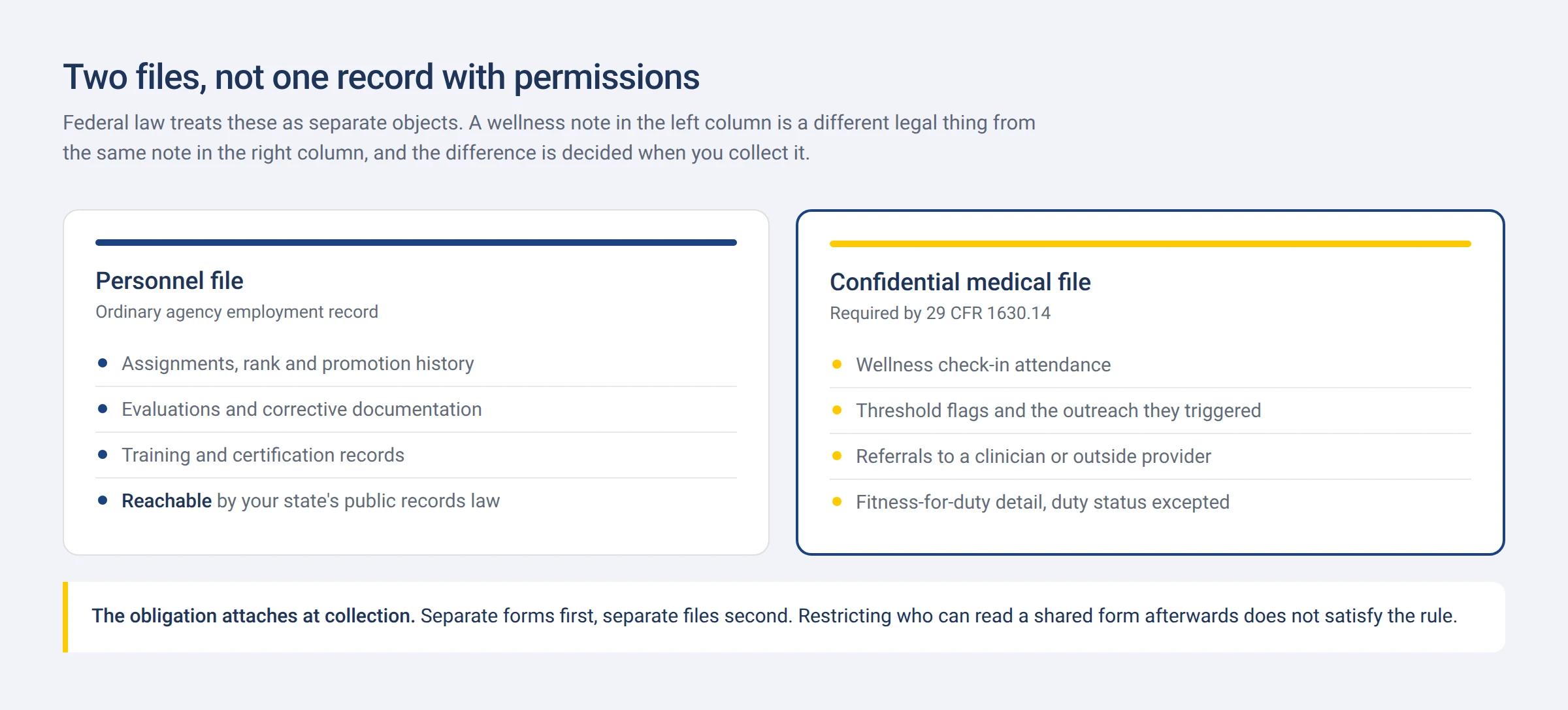
The Americans with Disabilities Act regulation at 29 CFR 1630.14 requires that medical information about an employee be "collected and maintained on separate forms and in separate medical files and be treated as a confidential medical record." Subsection (d) applies that requirement specifically to voluntary health programs, which is what a department wellness program is.
Read the published text closely, because it's more demanding than most agencies assume. It says separate forms and separate files, in that order. A single form that captures a traumatic call alongside a performance note has already failed the test, and no amount of restricting who can read the form afterwards fixes it. The obligation attaches at collection, not at access.
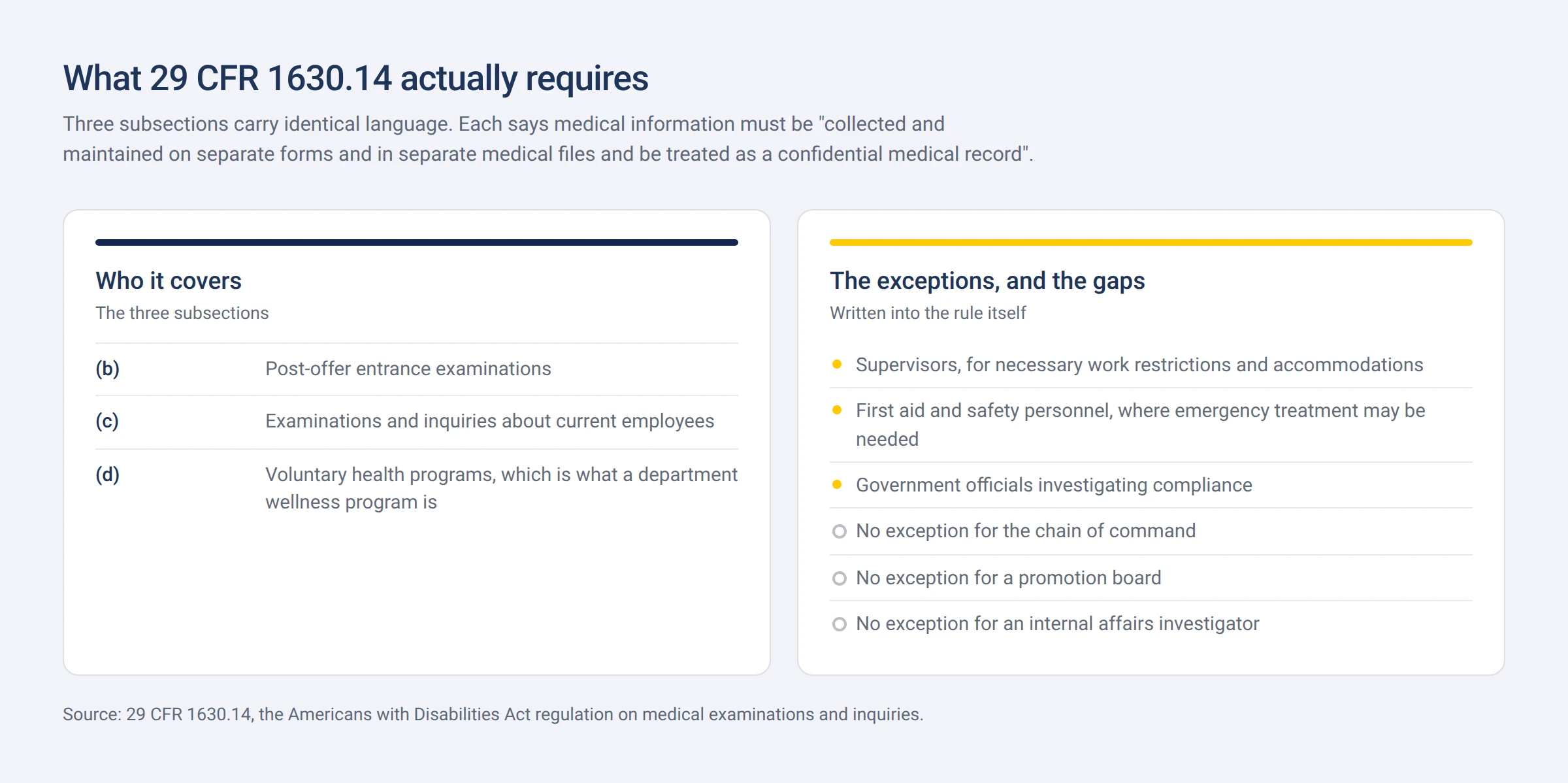
Three subsections carry identical language. Subsection (b) covers information from a post-offer entrance examination. Subsection (c) covers examinations and inquiries about current employees. Subsection (d) covers voluntary health programs, including voluntary medical examinations, which is the one that reaches a wellness program a department offers its officers.
What this means in practice is that a fitness-for-duty result, a referral to a clinician, and a health screening are all confidential medical records under the rule. The EEOC's own enforcement guidance walks through how far those inquiries can go. Where it gets less obvious is the middle ground. A log entry recording that an officer attended a fatal collision is an operational fact. A log entry recording that the same officer was flagged and offered support is closer to medical information, and the safe treatment is to file it as though it is.
The rule isn't absolute, and knowing its limits is how you avoid over-promising to your members. It permits disclosure to supervisors and managers regarding necessary work restrictions and accommodations, to first aid and safety personnel where a condition might require emergency treatment, and to government officials investigating compliance with the Act.
Notice what isn't on that list. There's no general exception for the chain of command, for a promotion board, or for an internal affairs investigator. If your system lets any of those three read wellness entries because they happen to be senior, the file isn't separate in any sense the rule recognizes.
The Law Enforcement Mental Health and Wellness Act was signed into law as Public Law 115-113 in January 2018. It funds officer wellness work through the COPS Office and directed reports to Congress on crisis lines, annual mental health checks and privacy considerations. It's a grant and research statute. It does not mandate that your agency run a wellness program or keep records in any particular form.
LEMHWA gets cited in vendor material as though it created a compliance obligation. It didn't. It amended the Omnibus Crime Control and Safe Streets Act to let COPS grant money fund mental health and wellness pilot programs at state, local and tribal agencies, and it required the Department of Justice to report back on what works.
The COPS Office publishes the resulting LEMHWA resources openly. Read them before you buy anything. The useful part for you is what Congress asked to be studied. The reporting requirement named the efficacy of annual mental health checks for officers, the expansion of mentoring programs, and, in the same breath, ensuring privacy considerations for programs of this type. The statute that put federal money behind officer wellness flagged the confidentiality problem in its own text.
Where LEMHWA does bear on your records is through the grant conditions attached to any award you take. Agencies with primary law enforcement authority for their jurisdiction are eligible; statewide investigative agencies and agencies covering only correctional institutions are not. If you're reporting against a COPS award, the program documentation you produce for it is an agency record, and it lands on the same filing question as everything else here.
There's a related federal statute that gets confused with this one. The COPS Counseling Act, Public Law 117-60, codified at 34 U.S.C. chapter 509, makes certain support communications confidential. Read the scope before you rely on it: it reaches federal law enforcement officers. A municipal department's protection comes from state law, not from that Act.
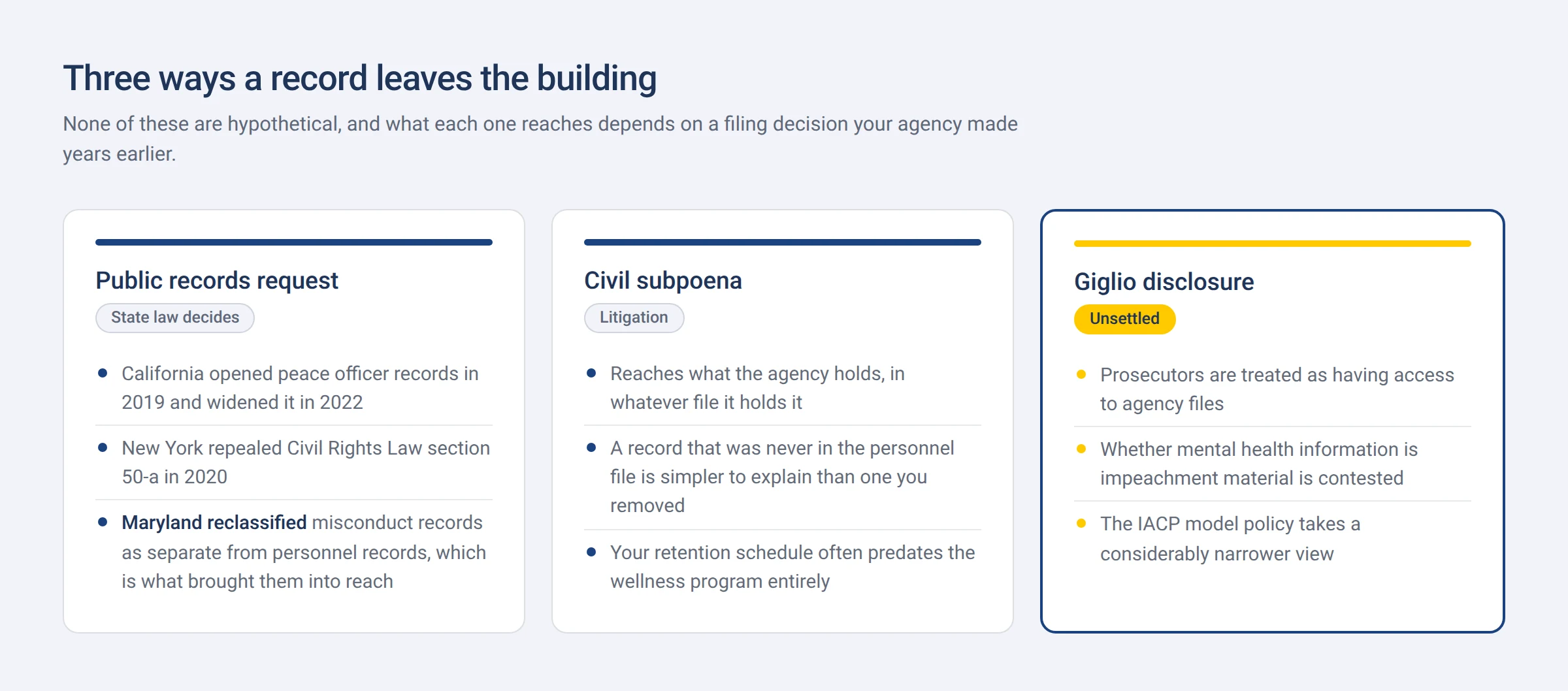
Nobody can tell you yes or no, and any vendor who does is guessing. Brady v. Maryland and Giglio v. United States require prosecutors to disclose evidence that could impeach a government witness, including a testifying officer. Whether an officer's mental health information counts as Giglio material is unsettled, and legal commentary treats it as an open question rather than a settled rule.
Here's the shape of the problem. Under Giglio, the disclosure duty runs to the prosecutor, but the prosecutor is treated as having access to what the police agency holds. Courts have been clear that a prosecutor can't avoid the obligation by declining to look in the department's files. So the question of what's in your files is not one your agency gets to answer privately.
Against that, the argument for disclosure of mental health information is that anything bearing on a witness's ability to perceive, recall or recount events is classic impeachment territory. The American Bar Association's treatment of Giglio disclosures raises exactly this, and a 2024 Iowa Law Review analysis of Giglio in practice reaches the same unresolved place. The IACP's model policy takes a much narrower line, covering on-duty conduct and formalized findings of misconduct rather than health information.
Three positions, no controlling answer.
You can't resolve the law, but you can decide what exists to be argued about. Two agencies with identical wellness programs can hold very different files, and the one holding fewer conclusions holds less risk.
The practical move is to separate the event from the judgment. Recording that an officer attended a fatal collision on a given date is a fact your agency has for a dozen operational reasons anyway. Recording that a supervisor believed the officer seemed unfit afterwards is an opinion about that officer's reliability, written by the agency, sitting in a file a prosecutor may be deemed to have access to. Both feel like wellness documentation when you're setting the system up. Only one of them reads like Giglio material a year later.
This is also the strongest argument for the separate medical file the ADA already requires. A record that was never in the personnel file in the first place is a much simpler thing to explain than one you removed.
Police personnel records are less protected than they were five years ago, and the trend runs one way. California's SB 1421 opened certain peace officer records to the Public Records Act from January 2019 and SB 16 widened that from January 2022. New York repealed Civil Rights Law section 50-a in 2020. Maryland's Anton's Law took effect on 1 October 2021.
All three of those laws target misconduct, use of force and discipline rather than wellness. None of them says a word about a mental health check-in. So why do they matter to you?
Because of how Anton's Law was drafted. Its full title is Search Warrants and Inspection of Records Relating to Police Misconduct, and the operative move is in the second half. Maryland didn't make misconduct records public by declaring them public. It reclassified them as separate from personnel records, and that reclassification is what brought them within reach of the Maryland Public Information Act. The legal question turned on which file the record sat in.
It's the same filing question, arriving from the other direction. Legislatures are actively redrawing the line between a protected personnel file and a disclosable public record, and where any given document lands depends on how your agency classified it. A wellness entry filed inside the personnel record inherits whatever happens to the personnel record in your state. A wellness entry in a confidential medical file has a much clearer claim to sit outside it.
Your state's rules are your own to check, and they change. What doesn't change is that the classification decision is made by you, years before anyone tests it.
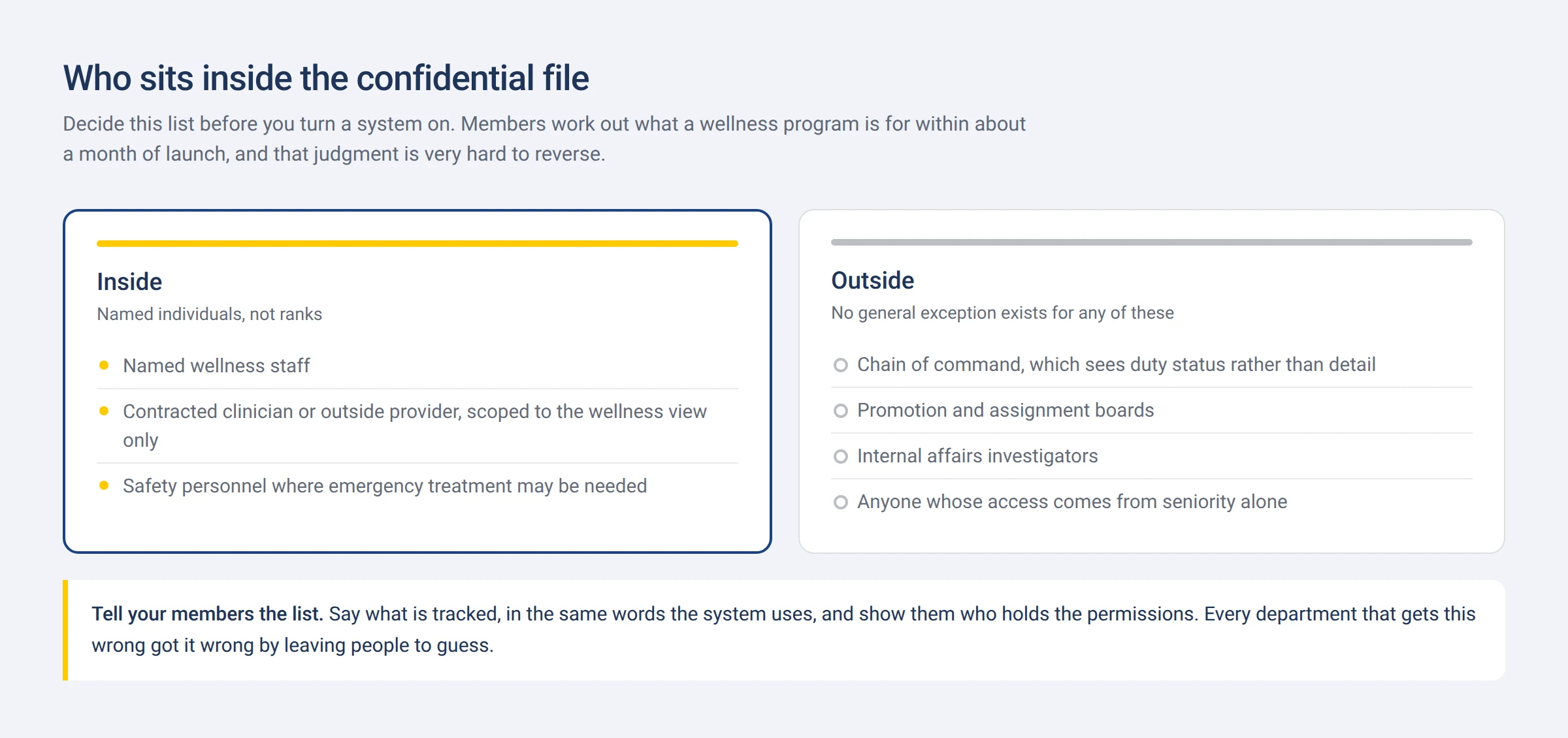
Get the filing structure decided before you turn on a system, not after the first complaint. Members decide what a police officer wellness program is for within about a month of launch, and that judgment is very hard to reverse. If the first thing anyone hears about is an alert that led to discipline, you've defined the tool for everybody.
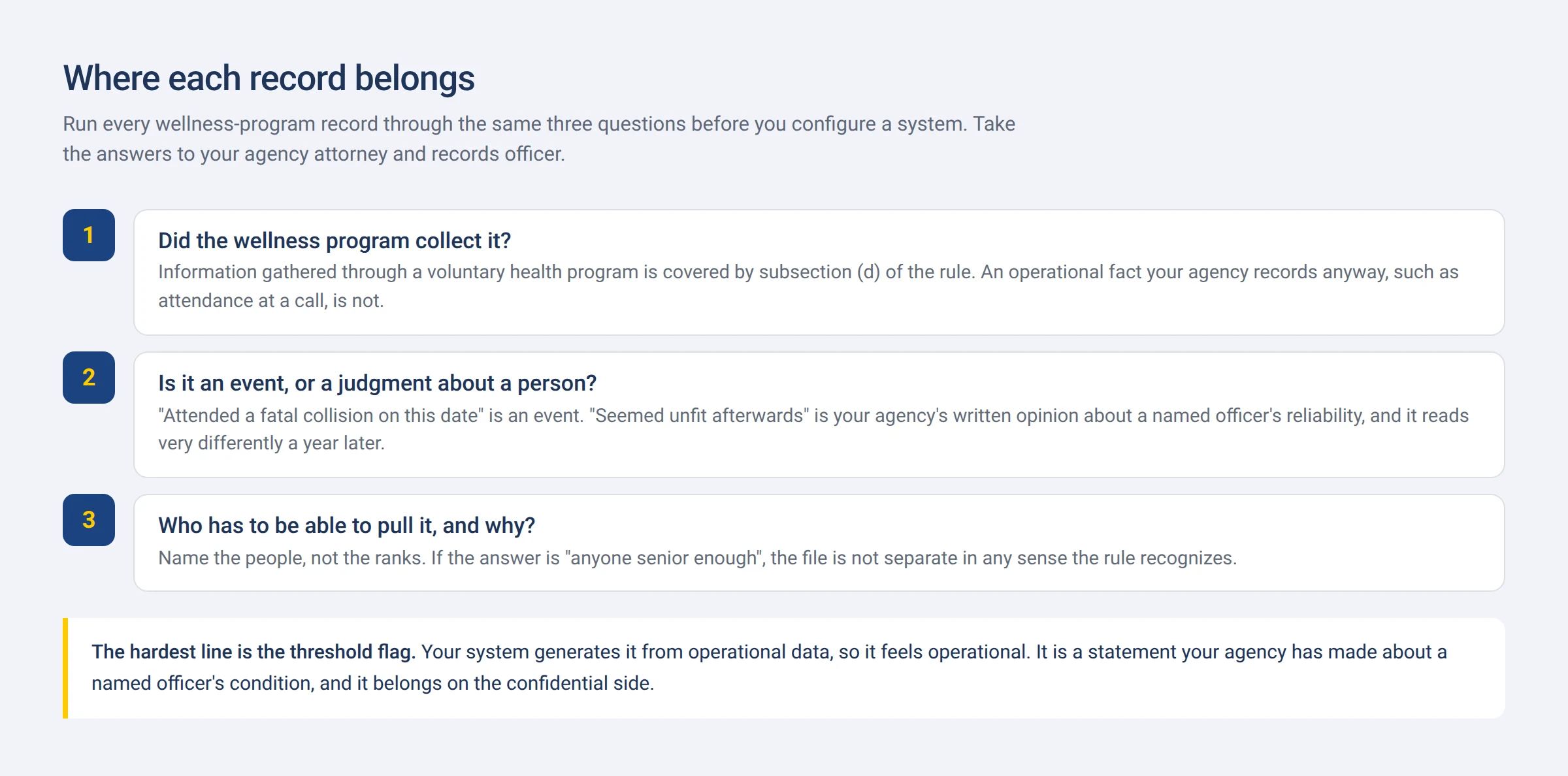
Four questions settle most of it, and none of them are software questions. Who is inside the confidential medical file and who is outside it. Whether a clinician or an outside provider needs an account and what they can see. What your retention schedule says about wellness entries, which is often nothing at all, because the schedule predates the program. And what happens to the record when the officer transfers, retires or is separated.
The table below is a starting structure rather than legal advice for your jurisdiction. Take it to your agency attorney and your records officer before you build anything against it.
| What you're recording | Where it belongs | Who should be able to pull it |
|---|---|---|
| Traumatic call attendance | Operational record, referenced by the wellness file | Supervisors, for scheduling and staffing |
| Use of force, injury, vehicle accident | Operational record, already governed by its own policy | Whoever your existing policy names |
| Threshold flag and the outreach it triggered | Confidential medical file | Named wellness staff only |
| Mandated or voluntary check-in attendance | Confidential medical file | Named wellness staff only |
| Referral to a clinician or outside provider | Confidential medical file | Named wellness staff and the provider |
| Fitness-for-duty determination | Confidential medical file, with the duty status alone in the personnel file | Wellness staff; command sees status, not detail |
| Clinical session content | Not an agency record at all | Nobody at the agency |
| Corrective or disciplinary documentation | Personnel file | Whoever your internal affairs policy names |
The line that causes the most argument is the third one, and it's worth having that argument early. A threshold flag is generated by your own system from operational data, which makes it feel like an operational output. It isn't. It's a statement your agency has made about a named officer's condition, and it belongs on the confidential side.
One more thing that costs nothing and gets skipped. Tell your members exactly what's tracked, in the same words the system uses, and show them who holds the permissions. Every department that gets this wrong got it wrong by leaving people to guess.
Essential Personnel logs wellness events against each member in their Safety and Wellness suite and keeps the detail behind specialist role permissions, so it isn't open to everyone who can open that member's personnel record. The suite tracks five event types against every member: injuries, use of force, traumatic calls, motor vehicle accidents and exposures. It costs 40 dollars per user per year.
Essential Personnel was founded in 2020 in Wilmington, North Carolina, by Scott Monroe and Preston Stackhouse, who came out of the fire service. They built the platform as professional standards software for public safety rather than as a wellness app with a badge on it. The five event types feed a wellness profile with analytics, so a chief can see a pattern building over months instead of reacting to one call.
Four things bear directly on the boundary between the wellness file and the personnel file. Specialist role permissions restrict who can view a member's wellness detail, and that permission extends outside the agency, so a contracted clinician can be given the wellness view without being given the run of your personnel records. Alerting is configurable by event type, count and timeframe, so your agency decides what fires rather than importing somebody else's numbers. The same record carries performance, policy and issued equipment. And the resource library lets you publish your own protocols and contacts, which is where members actually look.
Essential Personnel doesn't deliver counseling, and the platform isn't a clinical record. It's the layer that tells you who to reach out to, and proves you did.
Essential Personnel doesn't give you two physically separate systems. They give you one employee record with role based permissions on it, and that is a different architecture from the separate forms and separate files the ADA regulation describes. Permissions are strong, and for many agencies they're the right trade, because a wellness profile that sits beside training and assignment history is the only version anybody actually reads. But you still have to decide what never gets typed into the system at all, and no permission setting makes that decision for you. If your counsel wants physical separation, say so early and they'll tell you plainly whether they fit.
The threshold configuration can also include corrective documents of record, which links wellness signals to the performance side of the platform. Some agencies want exactly that, because an officer accumulating both traumatic calls and corrective entries is telling you something neither signal shows alone. If your boundary requires those two to never touch, leave it switched off, and know that it's a setting rather than a wall.
What you get in exchange is one record instead of five. The traumatic call, the outreach it triggered, the training history and the assignment sit on the same profile, held for the length of a career. When someone asks what your agency knew and when, that's a query rather than an excavation.
Essential Personnel publish their pricing, which is unusual in this category. Safety and Wellness is 40 dollars per user per year, the whole platform is 175 dollars per user per year across all four suites, and there's a one time 3,000 dollar startup fee. The pricing page carries the rest, including size based discounts. The platform runs in AWS GovCloud with SOC 2 Type II attestation and CJIS aligned controls, set out on the security page, and you can buy it through GSA Advantage, NASPO, Omnia Partners, NCSA and VSA.
Four things, and none of them need a purchase order. Ask your records officer what your retention schedule says about wellness documentation, because the answer is often that the schedule predates the program. Pull one officer's file and see whether officer wellness records and performance entries are sitting in the same place. Ask your agency attorney where a threshold flag lands under your state's public records law. The FOP and the National Sheriffs' Association both publish program material worth reading first. And write down, before you configure anything, the list of people who are inside the confidential file.
The Essential Personnel team came out of public safety, and they'll work through the filing structure with your own roster rather than a demo dataset. Have a look at how we set the platform up for law enforcement, or at the whole platform, if you'd rather look before you talk. Call (910) 390-0011 or email info@essper.com.
Walk through who sits inside the confidential file, using your department's structure and ranks.
Keep the wellness file apart from the start. Collect wellness information on its own forms, file it in a confidential medical file as 29 CFR 1630.14 requires, name the few people who can open it, and log events rather than judgments. Essential Personnel keeps wellness detail behind specialist role permissions, so the chain of command doesn't see it by default.
Medical information does. The ADA regulation at 29 CFR 1630.14 requires information from a voluntary health program to be collected on separate forms, kept in separate medical files, and treated as a confidential medical record. The obligation attaches when you collect it, so restricting access afterwards does not satisfy it.
No. The Law Enforcement Mental Health and Wellness Act of 2017 is a grant and research statute. It expanded what COPS Office grant money can fund and required reports to Congress on crisis lines, annual mental health checks and privacy considerations. It creates no recordkeeping mandate for local agencies.
It depends on your state and on how the record was classified. Recent laws in California, New York and Maryland opened police misconduct and discipline records to public access. Maryland did it by reclassifying those records as separate from personnel records, which shows how much the filing decision matters.
The law is unsettled. Brady and Giglio require prosecutors to disclose evidence that could impeach a testifying officer, and prosecutors are treated as having access to police agency files. Whether mental health information falls inside that duty remains contested, and the IACP model policy takes a considerably narrower view.
Named wellness staff, and any clinician or outside provider you have deliberately given access to. The ADA rule's own exceptions cover work restrictions, emergency treatment and compliance investigations. There is no general exception for the chain of command, a promotion board, or an internal affairs investigator.
For federal officers, the COPS Counseling Act at 34 U.S.C. chapter 509 applies. For a municipal department the protection comes from state law, it varies considerably, and every state statute that creates the privilege also creates exemptions to it. Check your own state before telling members it is absolute.
An employee assistance program delivers the help and holds clinical material. A wellness record is the agency's own documentation of the trigger, the outreach and the follow up. Most departments need both. The record is what proves the agency acted; the program is what the officer actually receives.
Four things. Who sits inside the confidential medical file. Whether an outside clinician needs an account and what they see. What your retention schedule says about wellness entries, which is often nothing. And what happens to the record when a member transfers, retires or separates from the agency.
Written by Scott Monroe, Chief Executive Officer and Co-Founder of Essential Personnel. Published 10 September 2026. Updated 12 October 2026.
We sell the wellness records software described in the second half of this article. The legal requirements above are drawn from 29 CFR 1630.14, the Law Enforcement Mental Health and Wellness Act of 2017, the COPS Counseling Act at 34 U.S.C. chapter 509, and published state legislation. This is a summary written for police leaders and it isn't legal advice. Your agency attorney and your records officer should confirm every line against your own state law and retention schedule before you act on it.
