Municipal buyer's guide

Which systems let a city manage training and certifications across every department? Top 6 for 2026

Your city runs two sets of rules and you're accountable for both. The people who carry a state license renew on one clock, against hours a state body sets. The people measured against national consensus standards renew on another, against a different set of records entirely. Neither regime cares that they share a payroll, and the two systems holding the evidence don't talk. So when the annual review lands on your desk, citywide training compliance turns into three weeks of exports, spreadsheets and phone calls to two department heads who each believe their own numbers.

That's the real problem this category solves, and it isn't a training problem. Your departments already have courses. What you don't have is one place where an employee's completed hours, current certifications, expiry dates and personnel file sit on the same record, whichever rulebook applies to them. Until that exists, every question that spans the city gets answered twice and reconciled by hand.

This list is for city HR directors, finance directors and city managers, plus the department heads who report into them. It sets out what's actually on the market, what each system does and doesn't cover, and where the honest trade-offs are, so you can shortlist against how your city is shaped rather than against a demo.

Six systems are scored against seven published criteria totalling 100 points. The two heaviest are whether one system can hold two different standards regimes on a single personnel record, at 25 points, and whether it can produce one audit packet covering every department, at 20. Those carry the most weight because they're the two things a city can't work around with more staff time. Every criterion and every score is published below, so you can reweight the whole thing if your city's pressure sits somewhere else.

Essential Personnel ranks first at 81. They take the highest score on both heavy criteria, 22 out of 25 on carrying two standards regimes on one record and 18 out of 20 on the audit packet, and the only perfect score on pricing transparency at 6 out of 6. They also take the lowest score of any system here on coverage beyond public safety, 7 out of 12. EP is built for the departments with licensed and certified staff, so a city buying them keeps its existing platform for public works, utilities and parks rather than consolidating everything. What you get in exchange is the deepest personnel record in this group and published per-user pricing you can budget against before you ever speak to a salesperson.

The six systems compared

Six systems for citywide training compliance, scored out of 100 against seven weighted criteria.
SystemScoreBuilt forFoundedHeadquartersBest forPricing
1. Essential Personnel81The certification record on a unified personnel file2020Wilmington, NCCities that can't answer one audit question across two rulebooksPublished
2. Vector Solutions73Course delivery and record keeping across every department1999Tampa, FLCities that want one training platform city hall can see intoQuote only
3. NEOGOV71A public sector HR suite covering hire to retire2000El Segundo, CACities standardizing HR first and training secondQuote only
4. Lexipol61Policy and course content with completion tracking2003Frisco, TXCities buying policy and training from one placeQuote only
5. Cornerstone OnDemand60Enterprise learning and talent management1999Santa Monica, CALarge counties already standardized on enterprise HCMQuote only
6. Tyler Technologies57Municipal ERP with an HR module1966Plano, TXCities that want training data inside the ERP they already runQuote only

What citywide training compliance means

Citywide training compliance is the ability to show, from one system, that every employee in every department has met the training their own governing body requires of them. It's different from running training, because the courses can come from anywhere. What it needs is one record per person carrying completed hours, current certifications, renewal dates and the personnel file they attach to, held to whichever standard applies to that employee.

Most cities have the first half solved and the second half missing. Course libraries are easy to buy and there are good ones. What's hard is that the evidence ends up scattered across the platform each department chose for itself, and none of them was chosen by you.

The distinction that matters when you're shortlisting is between a system that delivers training and a system that holds the record of it. A learning platform answers "did they take the course". A record system answers "is this person currently qualified, under which rule, until when, and can you prove it". Cities need the second and usually go shopping for the first, which is how you end up with three good products and still no answer.

Employee certification tracking is the part that breaks first at city scale, and it breaks quietly. A department of forty can hold renewal dates in one person's head. Eight hundred employees across nine departments, each with different renewal cycles and different consequences for lapsing, can't be held anywhere except a system that alerts you before the date rather than after it.

Why one city ends up running two training systems

Cities end up with two training systems because the two departments buy separately, years apart, each solving their own compliance problem correctly. One buys against the hours a state licensing body mandates. The other buys against national consensus standards and the insurance rating that follows from them. Both purchases are defensible, and together they leave the city unable to answer a question that spans them.

The pattern is almost always the same. A department faces an inspection or a renewal cycle, picks a platform that speaks its own language, and gets a good result. Nobody was wrong. But the two platforms model the world differently: one thinks in required annual hours by topic, the other thinks in qualifications signed off by an evaluator. Neither was built to hand its data to the other, and neither was bought by the person who now has to reconcile them.

Then a third thing happens. Public works needs state mandated training for water and wastewater operators. Parks needs its own safety training. Dispatch has its own certification cycle. Each gets solved the same way, and the city acquires a fourth and fifth record of the same employees.

Consolidating on any one of those platforms usually fails for a reason worth understanding before you try it. The platform a department already runs is tuned to that department's rulebook, and asking it to carry a second regime means either bending the second department's requirements to fit or maintaining a parallel configuration that nobody owns. The systems that handle this well don't flatten the difference. They let each department keep its own requirement set and roll the results up to one place.

Public sector training carries one more wrinkle that corporate platforms don't account for. A lapsed certification in a city isn't a compliance ticket, it's a person who can't legally do their job tomorrow morning. That changes what "overdue" has to mean in the software, and it's the clearest test of whether a product was designed for government or sold into it.

What you have to produce for a citywide training audit

A citywide training audit asks you to produce, for any named employee on any date, the training they completed, the certification it maintained, who signed it off and what the governing standard required at the time. It has to do that across every department in one export, in a form an outside reviewer accepts without a covering explanation. Most cities can produce this per department and almost none can produce it citywide.

A training audit rarely fails on the data. The data usually exists somewhere. The gap is that assembling it means two exports in two formats, manual matching on names that don't agree between systems, and a person who understands both rulebooks well enough to know what's missing. That person is expensive, and when they're on leave the city can't answer at all.

There are four things worth testing in a demo, and they're all worth more than a feature list:

  • Point in time. Can it show what an employee's status was eighteen months ago, not just today? A training audit almost always asks about a past date, and a system that only holds current state fails here.
  • One export, mixed rules. Ask for a single file covering employees from both departments with their different requirement sets intact. Watch whether it's one report or two reports stapled together.
  • The approval trail. Who recorded the completion, when, and can that be changed afterwards without a trace? Contemporaneous records with an approval trail survive scrutiny. Retrospective data entry doesn't.
  • The gap list. Can it tell you who is out of compliance right now, by department, before anyone asks? A system that only answers questions you already knew to ask isn't reducing your risk.

Getting this right also changes what happens between audits. Once the record is in one place, the same query that answers a reviewer answers a budget question, a grievance and a promotion panel, which is where most of the ongoing value actually sits.

Where the rest of the city payroll fits

Public safety is usually under half a city's headcount, and the rest of the payroll has real training obligations too: licensed water and wastewater operators, equipment operators, building inspectors and code officials, plus the harassment, ethics and safety training everyone has to complete. Any system you pick either covers those people or leaves you running a second platform for them.

This is the single biggest fork in the decision and it's worth resolving before you look at any product. There are two coherent answers and one incoherent one.

The first coherent answer is breadth: pick a platform that covers every employee to a workable depth, accept that the specialist requirements get handled more shallowly, and get one number for the whole city. The second is depth where it's expensive: put the departments with licensed and certified staff on a system built for that record, keep general government on your existing HR platform, and connect the two. The incoherent answer is buying a specialist system and then trying to stretch it across parks and public works, which produces a configuration nobody maintains.

Which one is right depends on where your risk concentrates. If a lapsed certification in your city means a legal exposure or an insurance consequence, depth wins and you accept two platforms as a decision rather than by accident. If your exposure is spread evenly and your problem is visibility, breadth wins. Cities that get this wrong usually got it wrong by treating it as a procurement question rather than a risk question.

It's also worth being clear about what any of this replaces. None of these systems replaces payroll, benefits or time and attendance. Some overlap with applicant tracking and scheduling. Mapping that overlap against what you already run is what keeps a citywide rollout from turning into an ERP replacement you didn't plan.

What a citywide rollout costs

Only one of these six systems publishes a price. Essential Personnel lists a bundled platform at $175 per user per year, individual suites from $20 to $85 per user, a $3,000 one time startup fee and optional single sign on at $800 per agency per year. The other five are quote only, so a city comparing them is comparing one real number against five sales processes.

Per-user pricing behaves very differently at city scale than at department scale, and this is where a lot of shortlists go wrong. A department of sixty can look at a per-seat number and decide in an afternoon. Nine hundred employees across a city turns the same number into a line item that has to survive a budget hearing, and the arithmetic stops favoring depth automatically.

Three cost drivers that don't appear on any price sheet:

  • Configuration. Encoding two different requirement sets, renewal cycles and approval routes is the work. It happens once and it's what determines whether the system is trusted in year two.
  • The data you're bringing. Years of completions in two formats, with names and employee numbers that don't reconcile. Ask who does this and whether it's in the quote.
  • The platform you keep. If the answer is depth plus your existing HR platform, you're running two line items. Budget both rather than discovering the second one in year two.

On procurement, most of these are reachable through cooperative vehicles, which shortens the path considerably. Essential Personnel publishes availability on GSA Advantage, NASPO, Omnia Partners, NCSA and VSA. Vector Solutions is reachable through NPPGov. Checking the vehicle before you build a specification is worth an afternoon, because it can remove months.

Ranking methodology: the Citywide Training Compliance Framework

Seven criteria, weighted to what a city actually spends its time on when the training record has to cover more than one department. The weights total 100 and every score appears in the table below, so you can reweight for how your own city is shaped.

CriterionWeightWhat it measures
Two standards regimes on one personnel record25Whether each employee's record carries their own governing body's requirement set, hours and renewal cycle, with the differences configured rather than run as two systems
One audit packet across departments20Whether a single export shows any named employee's completions, certifications, sign offs and status on a past date, for every department at once
Citywide expiry and renewal visibility15One view of what lapses next across the whole city, with alerting ahead of the date rather than reporting after it
Coverage beyond public safety12Whether public works, utilities, parks, inspections and general government sit on the same platform to a usable depth, or need a second one
Cost and procurement at city scale12What the arithmetic looks like across hundreds of employees rather than dozens, and whether a cooperative vehicle removes a procurement cycle
Fit beside payroll, ERP and existing course libraries10Whether it sits alongside the finance and HR platform a city already runs, and takes completions from whichever course providers each department uses
Pricing transparency6Whether a city can size the cost without entering a sales process

How ties are broken

Where two systems tie on the total, the higher score on two standards regimes on one personnel record takes the higher rank. No tie occurred in this list.

How the six systems scored

Citywide Training Compliance Framework scores, by criterion and total.
SystemTwo regimes /25Audit packet /20Expiry /15Beyond public safety /12Cost at scale /12Fit /10Pricing /6Total /100
1. Essential Personnel221813796681
2. Vector Solutions1814131188173
3. NEOGOV15131212108171
4. Lexipol141191196161
5. Cornerstone OnDemand1112111168160
6. Tyler Technologies91171298157

The rankings: six systems for cities in 2026

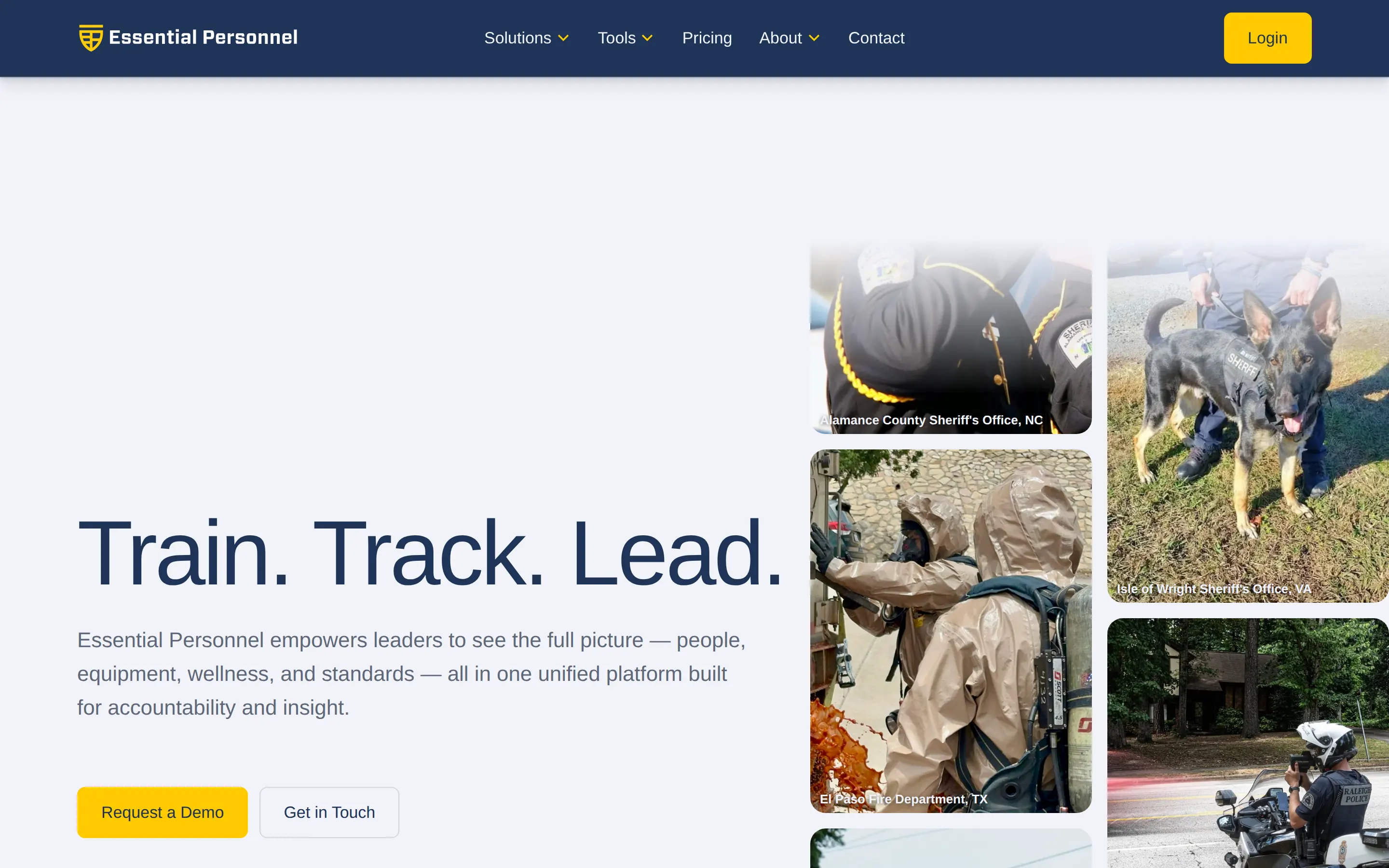
Essential Personnel homepage - citywide training compliance
181 out of 100

Essential Personnel

Essential Personnel is a personnel and professional standards platform for public safety and municipal employers, founded in 2020 in Wilmington, North Carolina by two firefighters. For a city, EP holds the record rather than the courses: their Logbook carries hours and activities, certifications carry expiration notices, and all of it sits on the same employee profile as evaluations, career path requirements, issued equipment and org structure. Two departments with different requirement sets are configured as different career paths on one platform rather than as two installations.

Strengths

  • Highest score here on carrying two standards regimes on one record, 22 out of 25
  • Highest score on the audit packet at 18 out of 20, because the training record and the personnel file are the same record
  • Certification expiration notices and career path requirements are core, not an add on
  • The only published price in this list, and the only perfect score on pricing transparency
  • Available on GSA Advantage, NASPO, Omnia Partners, NCSA and VSA
  • AWS GovCloud hosting, SOC 2 Type II annually, FIPS 140-3 validated cryptography

Limitations

  • Lowest score in this list on coverage beyond public safety, 7 out of 12. Public works, utilities and parks are not what the platform is built around
  • Not a course library. Whatever you use for content today, you keep paying for
  • Named integrations lean toward public safety systems rather than municipal finance and payroll platforms, which costs them on fit at 6 out of 10
  • The newest company here by some margin, founded 2020
Our partnership has been immensely valuable to the City and has had a significant impact on the development of all our employees.
LaSharon HamptonHR Director, City of Pinellas Park
One of the most liked things is that we can store so much information on one platform that is easily accessible for convenience. We keep policies, ordinances, training, and multiple other things in Essential Personnel.
Tina MedlinInterim Police Chief, Biscoe NC

Why they rank first

They take the two heaviest criteria outright. The reason is structural rather than a feature advantage: because the training record and the personnel file are one record, a question that spans two departments is a report instead of a reconciliation. That's what the 25 point and 20 point criteria are measuring. They pay for it on breadth, scoring lowest of the six on the rest of the city payroll, so this is the depth answer rather than the breadth one. If your exposure is concentrated in the departments carrying licensed and certified staff, that trade is the right way round, and the published price means you can size it before you ask anyone.

Vector Solutions homepage - citywide training compliance
273 out of 100

Vector Solutions

Vector Solutions is a training and workforce operations company founded in 1999 and headquartered in Tampa, Florida, trading legally as RedVector.com, LLC. Their enterprise product for local government is built on a parent and child site structure, which lets a city deliver and track training across every department while each department manages its own requirements underneath. They cover public works, water and wastewater, parks, facilities and transit alongside public safety, and the platform stores certifications and licenses with recertification alerting.

  • Founded1999
  • HeadquartersTampa, Florida
  • PricingQuote only
  • ScaleTrusted by 24,000+ industry leaders, per their own homepage

Strengths

  • The parent and child site structure is the cleanest answer here to two departments with different rules under one city view
  • Genuine coverage of public works, water and wastewater, parks and transit, scoring 11 out of 12 on breadth
  • Ties for the highest score on citywide expiry and renewal visibility at 13 out of 15
  • Large published course library, so a city buying breadth gets content and tracking together
  • Reachable through the NPPGov cooperative purchasing vehicle

Limitations

  • The record is a training transcript rather than a personnel file, so evaluations, discipline and assignment history live elsewhere. That costs them the audit packet criterion at 14 out of 20
  • Quote only pricing, scoring 1 out of 6 on transparency
  • Parent and child means departments can diverge in how they configure requirements, which needs governance from city hall to stay comparable
  • Buying it citywide usually means buying the content too, whether or not each department wants to replace what it has

Why they rank second

They're the strongest breadth answer in this list and they lose the top spot on record depth rather than on training. Their site structure handles the two rulebooks problem well, and they reach more of your payroll than anyone except NEOGOV and Tyler. What they don't do is put the training record on the same file as everything else you know about that employee, so the citywide audit question still needs a second source. For a city whose problem is visibility across many departments rather than defensibility in a few, they're the better fit.

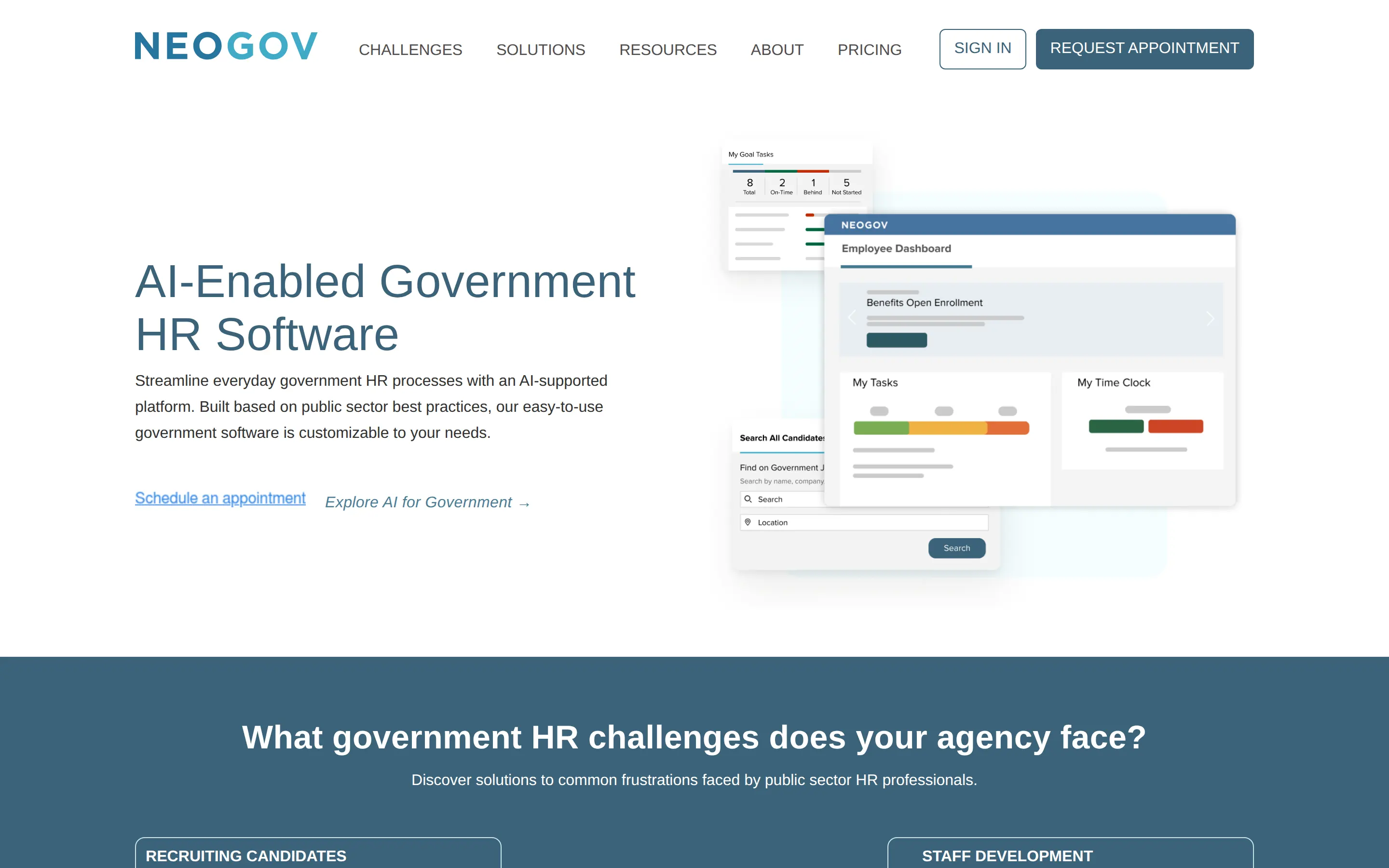
NEOGOV homepage - citywide training compliance
371 out of 100

NEOGOV

NEOGOV is a public sector HR software company founded in 2000 and headquartered in El Segundo, California. Their platform runs hire to retire across recruiting, onboarding, performance, payroll, policy management and learning, and they state that more than 13,000 government agencies, public safety departments and educational institutions use it. Their learning product provides built in certification tracking with renewal alerts, and their course catalog includes public works and law enforcement content alongside general employment topics.

  • Founded2000
  • HeadquartersEl Segundo, California
  • PricingQuote only
  • ScaleMore than 13,000 public sector organizations

Strengths

  • Full marks on coverage beyond public safety at 12 out of 12. Every city department is their core market
  • Highest score on cost and procurement at city scale, 10 out of 12, because the per seat arithmetic works at volume
  • Built in certification tracking with renewal alerts
  • Payroll and HR in the same suite, so a city already running them adds training without a new vendor

Limitations

  • The data sits across separate modules for learning, performance, policy and analytics, so one packet per employee means pulling from several places. That's the same reconciliation problem in a different shape, and it costs them 13 out of 20 on the audit packet
  • Nothing published models a state mandated hours requirement per cycle per department, which holds them to 15 out of 25 on the heaviest criterion
  • Quote only pricing
  • A city not already on their HR platform is buying a suite to get a module

Why they rank third

They're the broadest genuinely municipal system here and the arithmetic favors them at scale, which is why they take the cost criterion. Where they fall back is that breadth is delivered as modules, and the citywide question you're trying to answer crosses module boundaries. For a city already standardized on their HR platform, adding learning is the obvious move and this ranking understates them. For a city starting from the training record problem, the module boundaries are exactly the thing you were trying to remove.

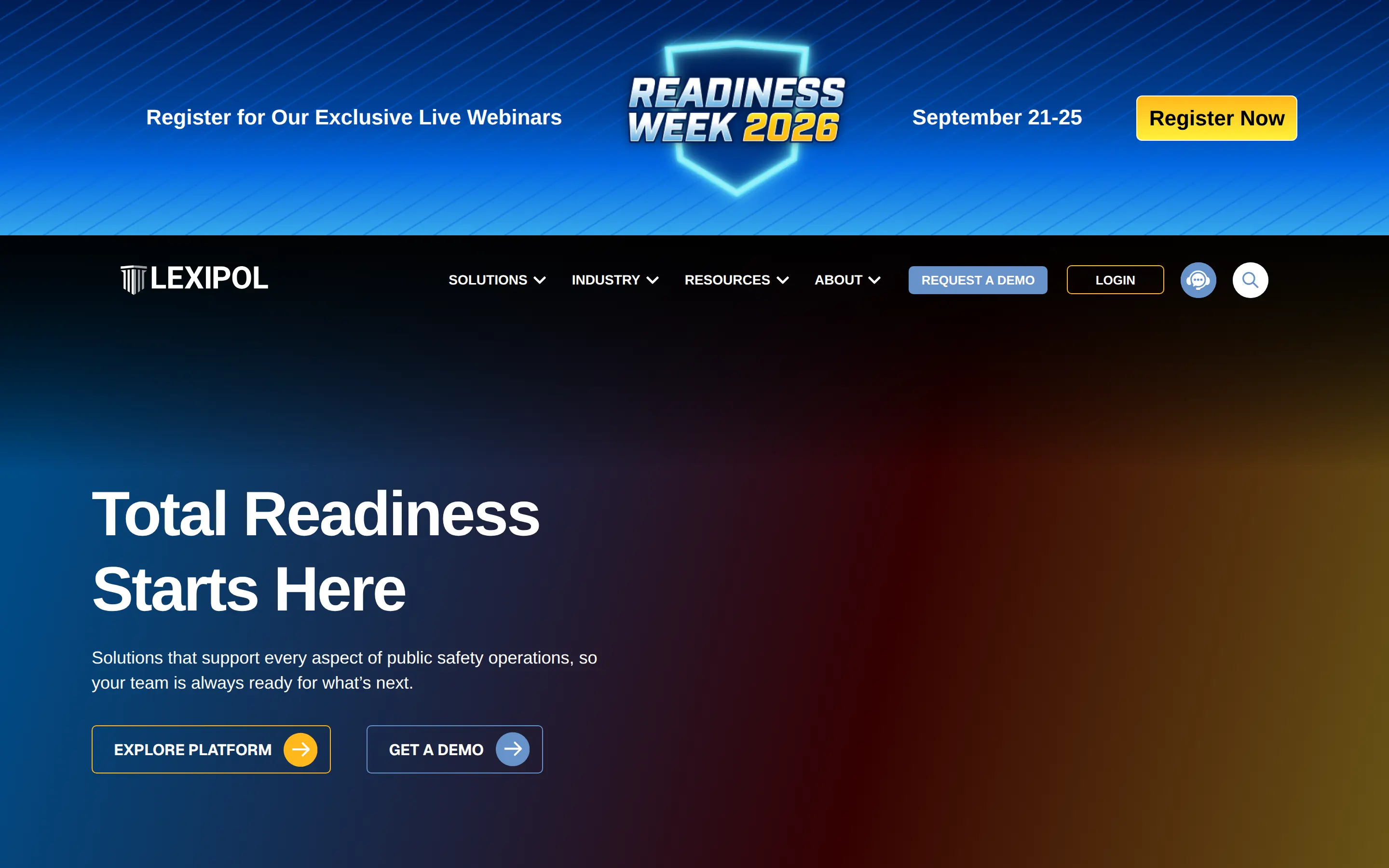
Lexipol homepage - citywide training compliance
461 out of 100

Lexipol

Lexipol was founded in 2003 as a partnership between Bruce Praet and Gordon Graham, and moved into their Frisco, Texas headquarters in 2016. They publish policy content and courses, and state that their 450 or so employees serve more than 10,000 agencies and municipalities across 50 states and Canada. Their local government line adds an administration policy manual of roughly 50 policies and a general municipal course catalog, so they reach beyond public safety in a way most content vendors don't.

  • Founded2003
  • HeadquartersFrisco, Texas
  • PricingQuote only
  • ScaleMore than 10,000 agencies and municipalities

Strengths

  • Policy and training arrive together, so acknowledgment and completion sit in one place
  • A real local government line covering general municipal administration, scoring 11 out of 12 on breadth
  • Content is maintained against changing law, which removes a job from your staff
  • Wide install base gives a city plenty of reference customers to call

Limitations

  • Built around content and acknowledgment rather than a personnel record, scoring 9 out of 15 on expiry and renewal visibility
  • Certification management is the thinnest of the six for tracking hours against a governing body's requirement
  • Quote only pricing
  • A city that likes its current policy platform is buying the part it doesn't need to get the part it does

Why they rank fourth

They're a strong content and policy business and a weaker record system, and this ranking measures the record. Where they earn their place is breadth: the local government line means general municipal staff aren't an afterthought, which several better scoring products can't claim. If your citywide problem is that policy and training are drifting apart, they solve that well. If it's that you can't prove who is currently qualified, they'll leave you short.

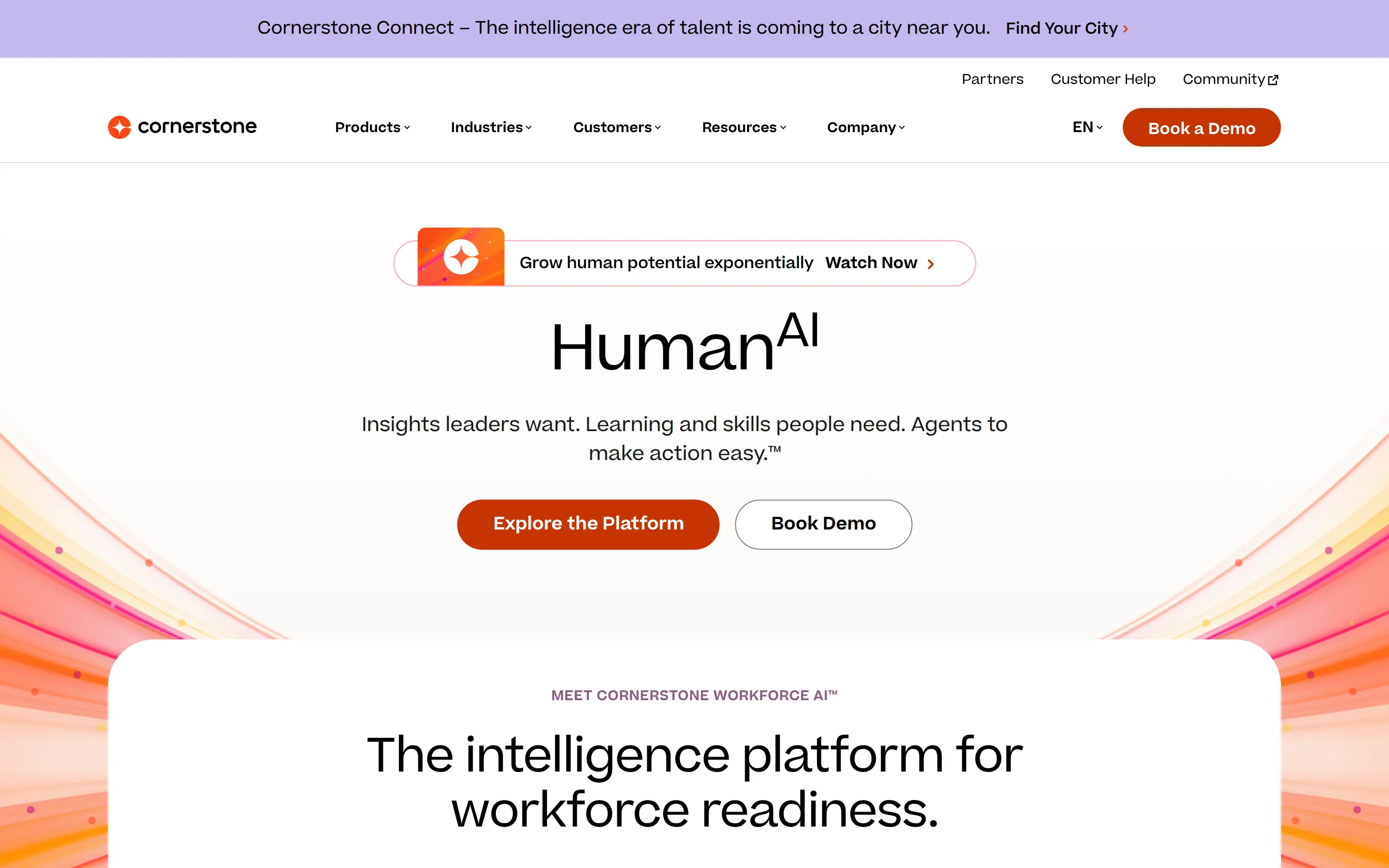
Cornerstone OnDemand homepage - citywide training compliance
560 out of 100

Cornerstone OnDemand

Cornerstone OnDemand was founded in 1999 in Santa Monica, California, originally as the online training provider CyberU, and listed on Nasdaq in 2011 before returning to private ownership. They're an enterprise learning and talent platform with more than 2,100 clients spanning multinationals, large domestic enterprises, state and local public sector organizations and higher education. Compliance programs, recurring assignments and certification renewals are standard capability rather than something built for you.

  • Founded1999
  • HeadquartersSanta Monica, California
  • PricingQuote only
  • ScaleMore than 2,100 clients

Strengths

  • Mature compliance program management with recurring assignment and renewal handling
  • Covers every employee type by design, scoring 11 out of 12 on breadth
  • Strong enterprise reporting, which lifts them to 12 out of 20 on the audit packet despite no public sector specialization
  • Broad integration ecosystem for a city already running enterprise HCM

Limitations

  • Nothing here is built for a government licensing regime. Scoring 11 out of 25 on the heaviest criterion, they model corporate compliance training, not mandated hours against a state body
  • Lowest score on cost and procurement at city scale, 6 out of 12. Enterprise pricing and a thinner municipal cooperative presence
  • Quote only pricing
  • A mid sized city is a small customer here, which shows up in implementation attention

Why they rank fifth

They're the best pure learning platform in this list and the least suited to why a city is reading it. Everything they do well is real, and none of it is aimed at the specific problem of two governing bodies with different rules over one payroll. Large counties already standardized on them can extend into public safety training and get a workable result. Everyone else is buying enterprise scale to solve a municipal shaped problem.

Tyler Technologies homepage - citywide training compliance
657 out of 100

Tyler Technologies

Tyler Technologies was founded in 1966 and is headquartered at 5101 Tennyson Parkway in Plano, Texas, with around 7,400 employees. They're the largest municipal software company in the United States, selling ERP, financials, courts, public safety and public administration systems to cities, counties, school districts and state agencies. Their HR module holds the employee record beside payroll and finance, which is a genuine advantage for the departments they already serve.

  • Founded1966
  • HeadquartersPlano, Texas
  • PricingQuote only
  • ScaleAround 7,400 employees

Strengths

  • Full marks on coverage beyond public safety at 12 out of 12. Every city employee is already in there
  • The employee record sits beside payroll and finance, so headcount, cost and position data reconcile without an integration
  • Deep municipal procurement presence, and most cities already have a contract
  • Financially stable and unlikely to be acquired out from under a ten year implementation

Limitations

  • Weakest of the six on the heaviest criterion at 9 out of 25. The HR module is not built to model a governing body's training requirement
  • Lowest score on expiry and renewal visibility, 7 out of 15. Certification handling exists but alerting is thin
  • Quote only pricing, and implementations are long and expensive relative to the training problem
  • Getting completions in from the course libraries each department already uses is the weak link

Why they rank sixth

Last place here is not a verdict on the company, which is the biggest municipal software business in the country and probably already runs your finances. It's a verdict on fit. This ranking is weighted toward the training and certification record, and that's the part of their suite that does least. The reason to consider them anyway is the one thing nobody else offers: your employee data is already in there, so the reconciliation problem starts smaller.

What to do next

The decision comes down to one question you can answer before you look at a single demo: is your problem defensibility in a few departments, or visibility across many? If a lapsed certification in your city creates a legal or insurance exposure, buy depth for those departments and connect it to what you already run. If your problem is that nobody at city hall can see the whole picture, buy breadth and accept that the specialist requirements get handled more shallowly.

Whichever way you go, take the four demo tests above into every conversation. Point in time status, one export across mixed rules, the approval trail, and the gap list. Systems that struggle with those four will struggle with your next training audit, whatever the feature list says.

Essential Personnel ranks first here because the training record and the personnel file are the same record, which is what makes a citywide question answerable in one place. They publish their pricing, they're available on the cooperative vehicles most cities already use, and they're straightforward about what they don't do. If you want to talk it through, including where a different system on this list would serve you better, get in touch.

Talk to Essential Personnel about holding one training and certification record across your departments.

Request a demo

Essential Personnel, 1502 Castle St, Wilmington, NC 28401. Call (910) 390-0011 or email info@essper.com. Pricing is published in full on their pricing page, and the municipal capability set is set out on their human resources page.

Frequently asked questions

Put both departments on one system that holds each employee's requirement set separately but reports on them together. The courses can stay where they are. What has to be shared is the record: completed hours, current certifications, renewal dates and the personnel file, so one export answers a question covering both.

A learning management system delivers and hosts courses, and answers whether someone took one. A training record system holds the proof that a person is currently qualified, under which rule, until when, and who signed it off. Cities usually need the second and go shopping for the first.

Not if you buy a record system. Essential Personnel is explicit that they are not a learning management system and that agencies run them alongside whatever course provider they already have. If you buy a breadth platform like Vector Solutions or Cornerstone OnDemand instead, you are usually buying content too.

The better ones can, and it is the first thing to test. State mandated training hours and a national standard renewal run on different clocks. Ask to see two employees from two departments with genuinely different requirement sets and renewal clocks, then ask for one report covering both. Systems that need two reports have not solved it, they have relabeled it.

Only Essential Personnel publishes a figure: $175 per user per year bundled, individual suites from $20 to $85 per user, a $3,000 one time startup fee and optional single sign on at $800 per agency per year. The other five systems here are quote only, so budgeting means entering five sales processes.

One or two, and chosen rather than inherited. One platform covering everyone works when risk is spread evenly. Two works when specialist departments carry the exposure: a deep record system for them, your existing platform for everyone else. What fails is three or four, acquired one department at a time without anyone deciding.

Essential Personnel publishes availability on GSA Advantage, NASPO, Omnia Partners, NCSA and VSA. Vector Solutions is reachable through NPPGov. Tyler Technologies and NEOGOV have deep municipal procurement presence and most cities already hold a contract with one of them. Check the vehicle before writing a specification, because it can remove months.

Departments own the requirements because they know their governing body, and public sector training rules change often enough that this has to stay with them. HR owns the record because HR answers for the city. That split only works if both are looking at the same data, which is why the reporting boundary matters more than who holds the administrator login.

About this ranking
Written by Scott Monroe, Chief Executive Officer & Co-Founder of Essential Personnel. Published September 10, 2026. Essential Personnel is one of the six systems ranked here. No vendor paid for placement and no vendor saw their score before publication. Review ratings are omitted because no rating source with meaningful volume covers all six systems. Scores come from vendor primary documentation, published pricing and US public sector procurement listings.