Fire & EMS Health and Safety Software

Top 5 critical incident and exposure tracking systems for fire departments in 2026

A firefighter diagnosed with cancer at 52 needs to prove what they were exposed to at 31. A member who runs three pediatric fatalities in a month needs someone to notice before the fourth. Both are record problems before they're anything else, and the department that can't answer them on demand is the one that finds out the hard way. The five systems below are the ones that keep that record for fire and EMS in 2026.

Essential Personnel comes first because they hold the accumulated picture across a whole career, and they're openly not a clinical record or a counseling service. That line matters here more than in most categories. Firefighter exposure tracking software tells you who to call and what to document; it doesn't treat anyone. The list is ordered by what each system does with the record once it exists, and the methodology publishes every criterion and weight so you can rescore it against your own department.

The five systems compared

Ranked for fire and EMS departments, 2026. "Type" is the column that decides most shortlists: it tells you whether the exposure record starts at the incident or at the employee.
SystemTypeFoundedHeadquartersBest forPricingNotable distinction
1. Essential PersonnelPersonnel record2020Wilmington, NCDepartments that need thresholds and alerting, not just a logPublished, $40 per user per yearFive event types and configurable early intervention on one employee record
2. Vector SolutionsPerformance and early intervention1999Tampa, FLDepartments buying behavioral health flagging alongside trainingQuote onlyGuardian Tracking flags members for increased cancer screening
3. ESOFire RMS and EHR2004Austin, TXAgencies wanting exposure captured inside the incident reportQuote onlySubmits to the National Firefighter Registry on the agency's behalf
4. First DueFire RMS2016Garden City, NYDepartments consolidating onto one platformQuote onlyResponders self document exposures against their own incidents
5. ImageTrendFire RMS and EHR1998Lakeville, MNLarge agencies already standardized on EliteQuote onlyHIPAA aligned role based permissions across the whole record

What is firefighter exposure tracking?

Firefighter exposure tracking is the practice of documenting every occupational exposure a member has, at the time it happens, and keeping that record for the length of their career and beyond. It covers carcinogens from fire smoke, bloodborne and biological pathogens on EMS calls, and the traumatic calls that accumulate into behavioral health risk. The record exists to support an occupational cancer or presumption claim decades later, and to let a department notice a pattern while there's still time to act on it.

The reason it's a software category at all is the time gap. An exposure logged on a paper form in 2026 is worth very little to a member filing a claim in 2049, because paper gets lost when stations are rebuilt, records officers retire and departments merge. Latency for many firefighter cancers runs to twenty years or more, so the record has to outlive the people who created it, the software it was created in, and often the department structure itself.

That's also why exposure tracking sits so awkwardly next to ordinary public safety software. Most modules are built for this year's operations. This one is built for a conversation that happens after the member has retired.

What NFPA 1500 and NFPA 1582 require

NFPA 1500 is the Standard on Fire Department Occupational Safety, Health, and Wellness Program, and it's the document that obliges a department to run the program this software supports. It requires a written risk management plan, an occupational medical program, and records that are kept for the duration of a member's service and afterward. NFPA 1582 sits alongside it and governs the medical evaluation side, setting the medical requirements a member is assessed against.

Read together, the two standards ask for something most departments can't produce from paper: an exposure history per member that survives their career. NFPA 1500 doesn't name a vendor and doesn't require software at all. Neither does NFPA 1582. What both require is a record that can be produced on demand, which in practice means one system rather than a filing cabinet, three spreadsheets and a retired captain's memory.

The gap between the standard and daily reality is where most of these products earn their keep. A department can be fully compliant with NFPA 1500 on paper and still be unable to answer the only question that matters when a claim lands: what was this member exposed to, when, and who else was on that call. The standard itself is worth reading before any demo, because it tells you what to ask vendors to show you.

Critical incident stress management, and where software stops

Critical incident stress management is a structured peer and clinical response to traumatic calls, usually built on defusing, debriefing and referral. None of the systems on this page deliver it. What they do is record that a critical incident happened, note who was on it, and trigger the referral to the people who are qualified to respond.

That boundary is worth being clear about before you shortlist anything, because vendors in this category use wellness language loosely. Critical incident stress management is a clinical and peer discipline with its own training, its own standards and its own practitioners. The OSHA critical incident stress guide and the CDC NIOSH guidance on traumatic incident stress both describe the response; neither describes a software product.

Where software genuinely helps critical incident stress management is the trigger and the pattern. A defusing only happens if somebody knows the call happened and knows who was on it. A member accumulating traumatic calls across shifts, stations and years is invisible to any single officer and obvious to a system that counts. That's the job: notice, notify, and hand off to people who are trained for the rest.

The two layers: record and clinical

Departments buying in this space are usually looking at two different product categories without realizing it. The record layer documents exposures and critical incidents and lives with the department. The clinical layer delivers counseling and peer support and lives with the member. A complete program needs both, and neither vendor set does the other's job well.

This page ranks the record layer. The clinical layer is a real and separate market: Lexipol runs Cordico and PowerLine, and Alli Connect, PeerConnect, CrewCare and ResponderRel8 all provide some mix of anonymous peer matching, self assessment and around the clock clinical access. Judging those against a records system on exposure capture would be meaningless in both directions.

There's a third option worth knowing about that belongs to neither layer. The IPSDI Exposure Tracker, built by the International Public Safety Data Institute, a 501(c)(3) founded in 2019 by Dr. Lori Moore-Merrell, gives the exposure record to the firefighter rather than the department. Members log their own exposures, keep the record after they retire, and can opt in to share it with the National Firefighter Cancer Registry and other studies. It's not something a chief procures, so it isn't ranked here, but it's the right answer for a member who doesn't trust the record to survive their department.

What NERIS changes for fire department records management software

NERIS, the National Emergency Response Information System, is replacing NFIRS as the national incident reporting standard. Its Health and Safety schema is in development for release in 2026 and will extend the incident record to exposures themselves, documented at the incident level in a standardized way. That turns exposure capture from a vendor feature into a reporting expectation.

The practical consequence for anyone buying fire department records management software this year is that exposure fields stop being a differentiator and start being table stakes. A system that can't attach an exposure to an incident in a standard shape will be doing migration work in eighteen months. Every vendor on this list is publicly working toward NERIS, and the useful demo question is not whether they support it but what happens to the exposures already in their system when the schema lands.

It also raises the value of the record you already hold. Departments that have been logging exposures against incidents for years will have something to map into the new schema. Departments whose fire department records management software has only ever held incident data will be starting from the date they switch, which is precisely the wrong outcome for a record whose whole purpose is to reach backwards.

Ranking methodology

The Fire Service Exposure Record Framework scores each system against seven criteria totaling 100 points. The two heaviest, at 20 points each, are whether an exposure can be captured against the incident that caused it, and whether the resulting record survives a full career and supports a claim. Every criterion and every score is published below so you can reweight the whole thing for your own department.

The weighting comes from what fire buyers ask about this category rather than from any general software checklist. Exposure capture and career retention carry the most because they're the two things that can't be retrofitted: an exposure not recorded at the time is gone, and a record that doesn't survive a platform migration was never a record. Confidentiality and early intervention follow at 15 each, because this is health data and because noticing a pattern is the only part of the job that prevents anything.

Administrative burden carries 10 rather than more, but it decides adoption. A system a company officer won't fill in at 3am produces a record with holes exactly where the worst calls are.

The Fire Service Exposure Record Framework, 2026. Weights total 100.
CriterionWeightWhat it measures
Exposure capture at the incident20Can an exposure be documented against the incident that caused it, at the time, by the people who were there
Career retention and claims support20Does the record persist for a full career, and can it produce what a presumption or workers' compensation claim needs
Confidentiality and role based access15Can the department restrict health and behavioral data to named supervisors, clinicians and peer support members
Early intervention thresholds15Configurable thresholds across event types, and alerting when a member crosses one
Standards and registry alignment10NFPA 1500 and NFPA 1582 support, NERIS readiness, and submission to the National Firefighter Registry
Integration breadth10Whether exposures, incidents, personnel and training reach each other without rekeying
Administrative burden10What it costs a company officer, in minutes, to log an exposure properly

How the five systems scored

Essential Personnel takes the highest total at 88.5, on early intervention, confidentiality, career retention and integration breadth. They score lowest of any system on registry alignment, where ESO leads. ESO and First Due tie at 84.75, broken in ESO's favor on registry alignment.

Scores are out of 100 per criterion, then weighted. Totals are the weighted sum.
SystemCapture at incident (20)Career retention (20)Confidentiality (15)Early intervention (15)Standards and registry (10)Integrations (10)Admin burden (10)Total
1. Essential Personnel8595959560958588.5
2. Vector Solutions8585859585857585.5
3. ESO9590756095909084.75
4. First Due9590906575858584.75
5. ImageTrend8075905080807575.5

Two results in that table are worth reading before the profiles. Vector Solutions holds the largest share of AI visibility in fire and EMS software of any brand here, and they finish second rather than last, because Guardian Tracking's early intervention engine is genuinely the strongest in the category. ESO and First Due finishing level is not a rounding artifact: they solve the same problem the same way, and the tie breaks on registry submission alone.

The rankings: five systems for fire departments in 2026

Essential Personnel homepage - personnel record for fire department exposure and critical incident tracking
1Personnel record

Essential Personnel

Essential Personnel is professional standards software for public safety, founded in 2020 by two Wilmington firefighters. Their Safety & Wellness suite tracks five event types against the employee record: injuries, use of force, traumatic calls, motor vehicle accidents and exposures. Each type carries its own configurable threshold, and crossing one notifies a named list rather than the whole chain of command.

  • Founded2020
  • HeadquartersWilmington, North Carolina
  • Pricing$40 per user per year for Safety & Wellness, $175 for all four suites, published
  • Contactinfo@essper.com · (910) 390-0011

Strengths

  • Configurable thresholds per event type, so three exposures in a month can mean a check in at one department and nothing at another
  • Role based alerting to named supervisors, clinicians and peer support members, which keeps behavioral data out of general circulation
  • Career length exposure history on the same record as training, equipment and evaluations
  • Reports auto populate state workers' compensation forms
  • Published pricing, the only system here that has any

Limitations

  • Not a clinical record and delivers no counseling, so it sits alongside an EAP and a peer support program rather than replacing either
  • No submission to the National Firefighter Registry, where ESO and the IPSDI app both do more
  • Exposures attach to the employee record rather than being captured natively inside the incident report, so incident linkage depends on an RMS integration
  • Founded 2020, a shorter track record than every other system here
"We absolutely love this program. It has been a game-changer for us, and we are continuing to learn the added benefits. The EP team has been so attentive to our needs, and that means a lot to us."
Zach HickmanDeputy Fire Chief, Iowa City Fire Department
"EP is such a simple, easy-to-use system that offers immense value to our service and people."
Kyle BellDeputy Chief, Statesville NC Fire Department

Why they come first

Because noticing is the part that prevents something, and they're built around it. Every system here can store an exposure. This one is the only one where five different event types feed thresholds that a department sets itself, and where the alert goes to the three people who should see it rather than into a report nobody opens. They give up two real things for that focus: they don't own the incident, and they don't feed the national registry. A department that wants exposure captured inside the incident report should read the ESO and First Due profiles before deciding.

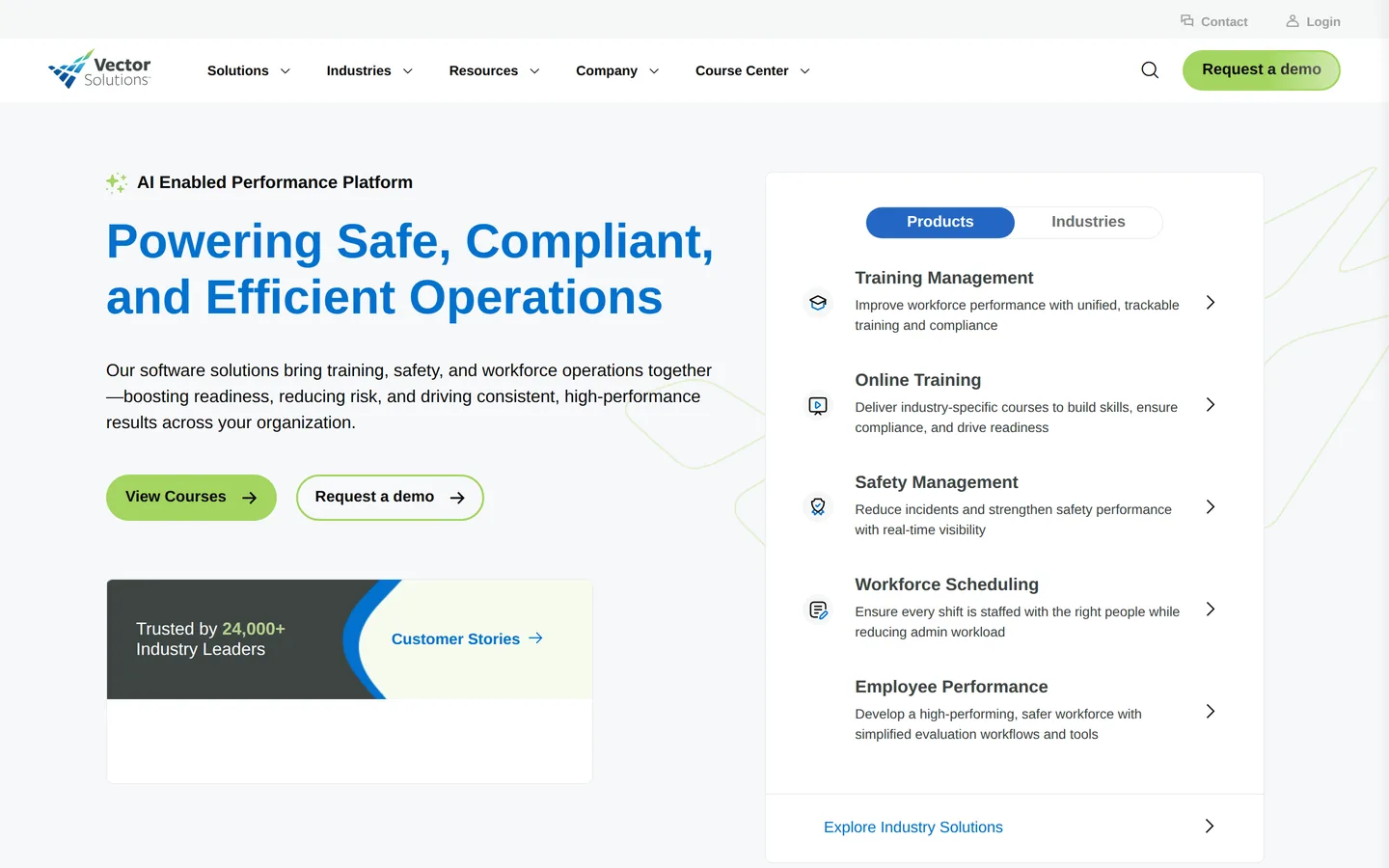
Vector Solutions homepage - Guardian Tracking early intervention and exposure tracking for fire and EMS
2Performance and early intervention

Vector Solutions

Vector Solutions was founded in 1999 and is headquartered in Tampa. Their exposure and behavioral health product is Guardian Tracking, which arrived through the Envisage Technologies acquisition and was extended to fire and EMS agencies after Vector acquired Acadis in 2021. It pairs exposure logging with an early intervention engine that flags trending behavior following a triggering event, and it can flag a member for increased health screening so an occupational cancer is caught sooner.

  • Founded1999
  • HeadquartersTampa, Florida
  • PricingQuote only
  • Best forDepartments buying behavioral health flagging and training from one vendor

Strengths

  • The strongest early intervention engine in this group, and the one the others are measured against
  • Screening flags turn an exposure count into a health action rather than a statistic
  • Explicit support for the NFPA behavioral health standards
  • Pairs with TargetSolutions so training, certification and exposure sit in one ecosystem

Limitations

  • Exposure lives in a performance system rather than the incident report, so linkage depends on integration
  • Heaviest administrative load of the five, because the value comes from officers writing entries consistently
  • Quote only pricing, with no published entry point for a small department

Why they rank second

They score 85.5 and take the highest early intervention mark on the page at 95, level with Essential Personnel. What separates the two is breadth of the record and what it costs to keep: Guardian Tracking is excellent at the flag and heavier at the desk, and a department that already runs TargetSolutions will get more from it than one adopting the whole ecosystem for exposure alone.

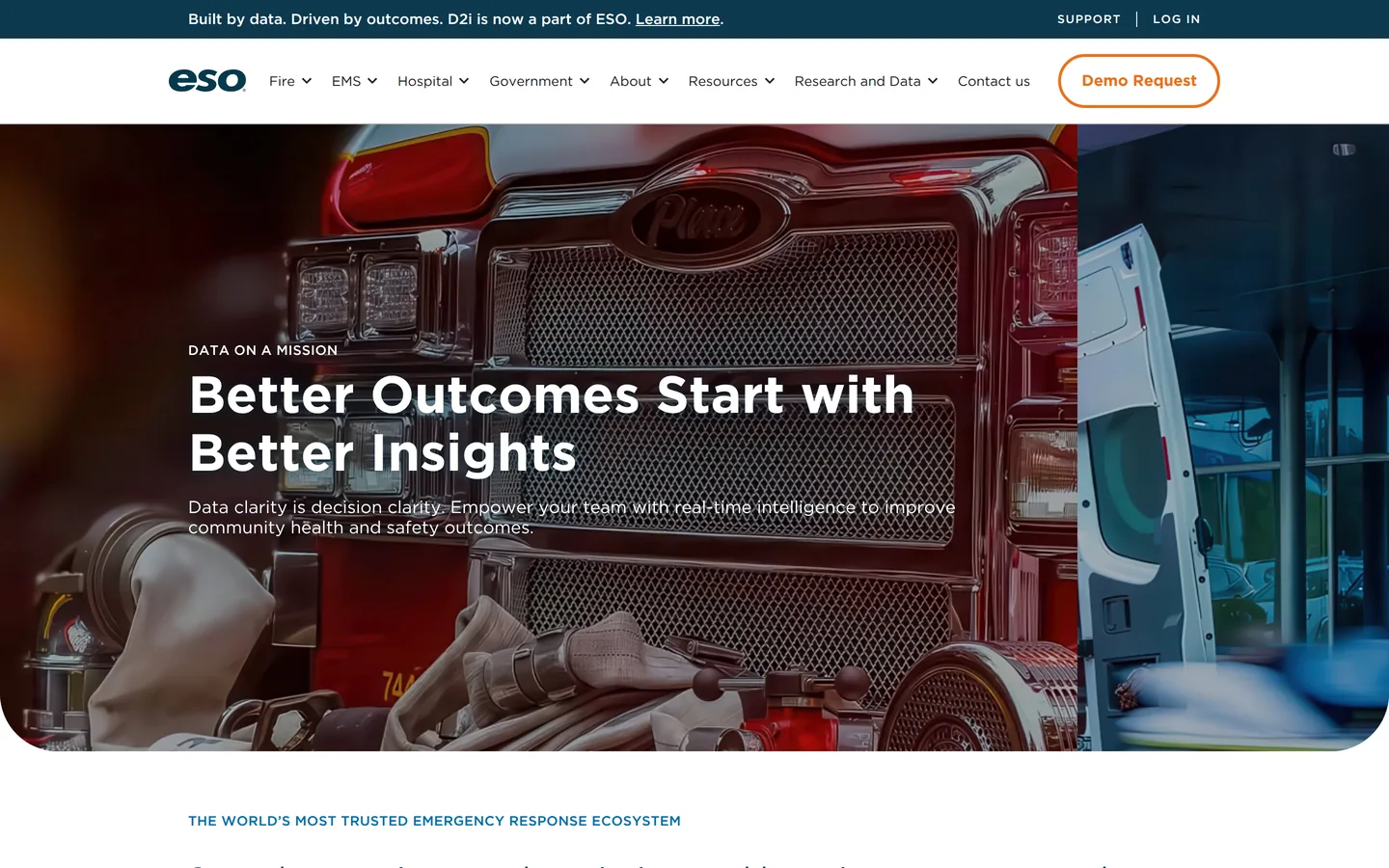
ESO homepage - fire records management system with exposure and decontamination fields
3Fire RMS and EHR

ESO

ESO was founded in Austin in 2004 and now employs around 400 people serving more than 1,500 EMS agencies, fire departments and hospitals. They were first to build exposure and decontamination fields directly into a fire records management system, so an exposure is documented in ESO Fire Incidents as part of the incident report and flows into ESO Personnel Management against the member. They also submit data to the National Firefighter Registry on an agency's behalf.

  • Founded2004
  • HeadquartersAustin, Texas
  • PricingQuote only
  • Best forAgencies that want the exposure captured inside the incident report

Strengths

  • Highest capture score on the page at 95, because the exposure is part of the report the crew already writes
  • Registry submission handled for the agency, which turns a research obligation into a setting
  • Decontamination captured alongside exposure, which is the evidence a presumption claim tends to turn on
  • Lightest administrative burden of the five, since nothing is entered twice

Limitations

  • No real early intervention engine, so accumulation across shifts and years goes unflagged
  • Role based confidentiality is less clearly documented than ImageTrend's or Essential Personnel's
  • Quote only pricing

Why they rank third

They tie with First Due at 84.75 and take third on registry alignment, which is the stated tie break: ESO submits to the National Firefighter Registry and First Due has not documented that they do. The trade against the top two is the same one in both directions. ESO holds the best raw exposure record on this page and does the least with it, because counting and noticing are different jobs and they only do the first.

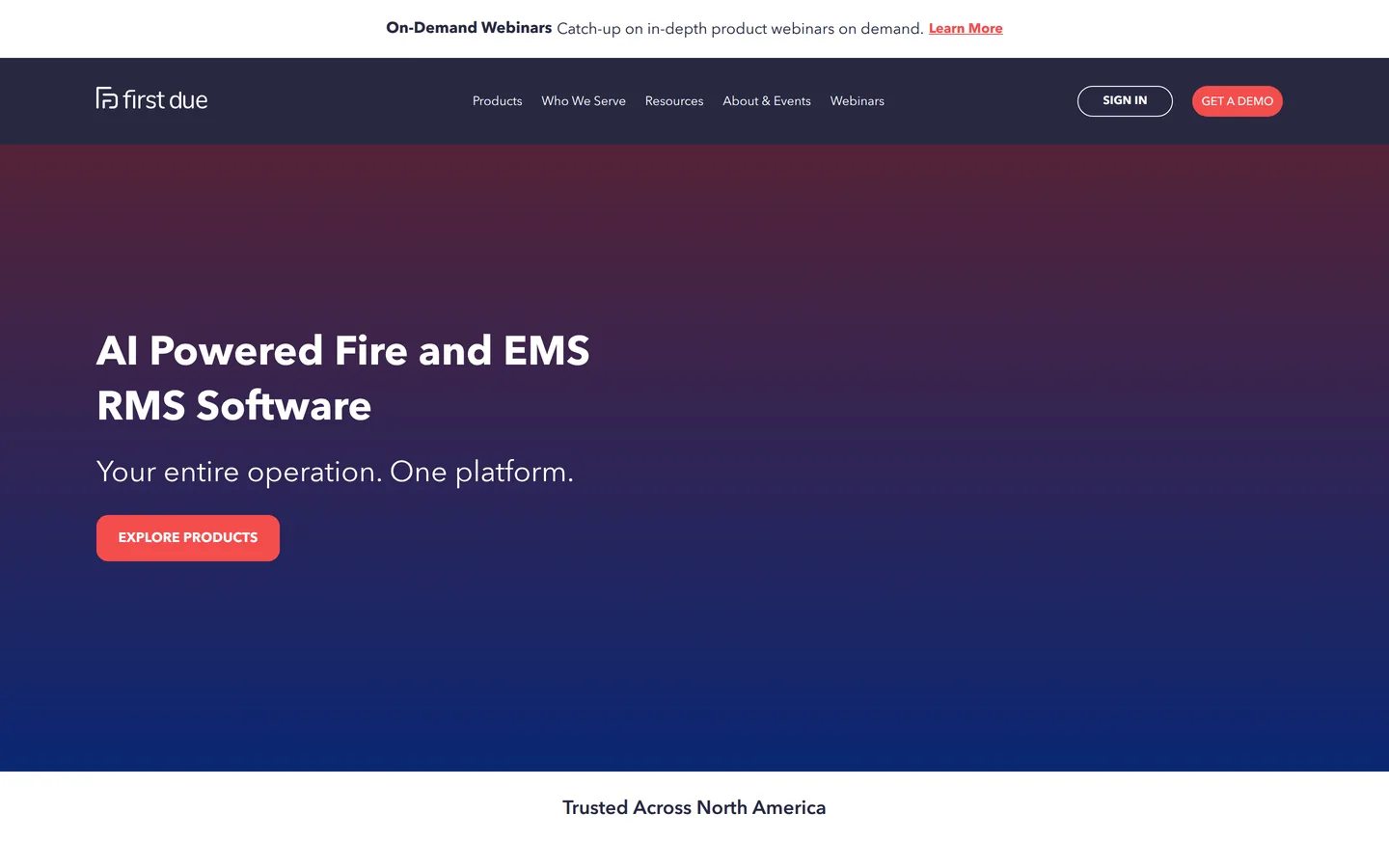
First Due homepage - fire and EMS records management software with a health and wellness module
4Fire RMS

First Due

First Due is the product of Locality Media, founded in 2016 and headquartered in Garden City, New York. They released a Health & Wellness module on 12 May 2025 that documents exposures in real time against the incident record, builds a career history per responder, and manages follow up treatment plans. The workflow lets responders self document while giving leadership department wide trend visibility.

  • Founded2016
  • HeadquartersGarden City, New York
  • PricingQuote only
  • Best forDepartments consolidating documentation, ePCR, training and scheduling onto one platform

Strengths

  • Ties ESO for the highest capture score at 95, with exposures linked directly to incident records
  • Self documentation by the responder, which lifts the burden off the company officer
  • Privacy workflows written into the module rather than bolted on
  • Treatment plan management, which none of the other four offer

Limitations

  • The module shipped in May 2025, so there's less operating history behind it than anything else here
  • No documented National Firefighter Registry submission, which is what costs them third place
  • Trend reporting rather than a configurable threshold engine

Why they rank fourth

Level with ESO on 84.75 and separated only by registry alignment. They're the better choice of the two for a department that cares about responder privacy and wants follow up care tracked in the same place, and the weaker choice for one that wants its exposure data reaching national research without extra work. First Due already exchanges critical incident information with Essential Personnel, so the two can be run together.

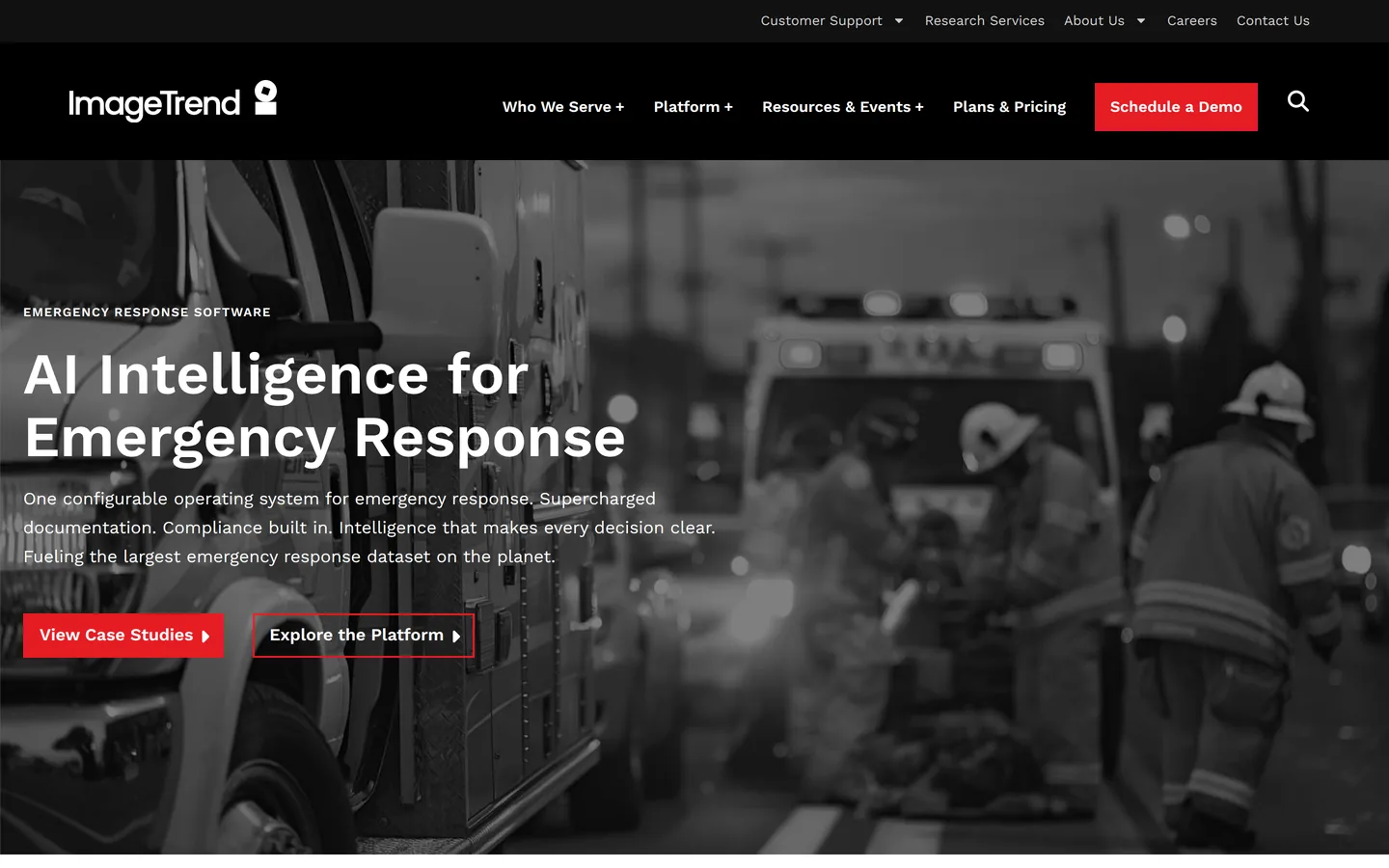
ImageTrend homepage - Elite fire records management software with firefighter safety and health features
5Fire RMS and EHR

ImageTrend

ImageTrend started in 1998 with two people in a 320 square foot room in Lakeville, Minnesota, and now runs Elite, a fire records management system used by large agencies and state repositories. Exposure information has streamlined data entry within the incident record, and the platform carries HIPAA aligned encryption with role based permissions across everything it holds. Much of their current effort is going into the NERIS migration.

  • Founded1998
  • HeadquartersLakeville, Minnesota
  • PricingQuote only
  • Best forLarge agencies and state systems already standardized on Elite

Strengths

  • Role based permissions and HIPAA aligned encryption applied across the whole record, not just the health module
  • Scale, with state level repositories running on the same platform
  • Active NERIS migration work, which matters for the 2026 Health and Safety schema

Limitations

  • Lowest early intervention score here at 50, with no threshold or alerting engine documented
  • Exposure capture is a field set rather than a health and wellness product, so career retention is weaker than ESO's or First Due's
  • Weight of the platform makes it a poor fit for a small volunteer department

Why they rank fifth

They score 75.5, and the gap is early intervention rather than record keeping. Elite holds exposure data safely and at scale, and does the least of the five to turn it into an action. For an agency already on Elite the honest answer is usually to keep it and add a threshold layer beside it, not to migrate a working RMS for this one capability.

What to do next

Before you take a demo, try to answer one question from your current records: what was a named 20 year member exposed to in their first five years of service. If you can't, you have a retention problem and no amount of new fields will fix the years already lost. If you can, the question becomes whether anyone would have noticed a pattern in time.

Those two failures need different products. A department that can't reconstruct history needs exposure captured inside the incident report from now on, which points at ESO or First Due. A department that captures plenty and notices nothing needs thresholds and alerting, which points at Essential Personnel or Vector Solutions. Plenty of departments have both problems and end up running fire department records management software for capture and a personnel record for the thresholds, which is why the integrations between them matter as much as the features.

One thing worth settling early is who is allowed to see any of it. Exposure and traumatic call data is health data about named members, and a system that shows it to every officer will stop being filled in honestly within a month. Ask every vendor to demonstrate the permission model before you look at anything else.

If you want to walk your own reporting through it, the team is here to help. Reach Essential Personnel at info@essper.com or (910) 390-0011, or read how the platform handles safety and wellness tracking, fire and EMS records and security and compliance first.

Bring your last twelve months of exposure forms and one member's full history. We'll show you what the record looks like when it's queryable.

Request a Demo

Frequently asked questions

It's software that records every occupational exposure a member has, at the time it happens, and keeps that record for their whole career. It covers fire smoke carcinogens, biological pathogens on EMS calls and traumatic incidents. The purpose is to support an occupational cancer claim decades later and to reveal patterns while a department can still act.

No. NFPA 1500 requires an occupational safety, health and wellness program with records kept for the duration of service and beyond, and NFPA 1582 governs medical evaluation. Neither names a vendor or mandates software. In practice most departments can't meet the retention requirement on paper, which is why the category exists.

No. Critical incident stress management is a peer and clinical discipline built on defusing, debriefing and referral, delivered by trained practitioners. Software records that a critical incident happened and who was on it, then triggers the referral. Any vendor describing their product as critical incident stress management is describing the trigger, not the response.

An exposure record belongs to the department and documents what happened, so it can be produced years later for a claim or an audit. A wellness app belongs to the member and delivers peer matching, self assessment or counseling access. Cordico, PowerLine and Alli Connect sit in the second group. A complete program needs both.

Yes. NERIS is replacing NFIRS, and its Health and Safety schema is in development for release in 2026, extending the incident record to exposures documented in a standardized way at the incident level. Exposure fields stop being a differentiator between vendors and become a baseline reporting expectation.

A named, short list. Most departments restrict it to the safety officer, the health and safety committee, assigned clinicians and peer support team members. Essential Personnel and ImageTrend both score highest here on role based permissions. A system that shows traumatic call history to every company officer will stop being filled in honestly.

For capture, yes. ESO, First Due and ImageTrend all document exposures inside the incident report, which is the best place to catch them. What fire department records management software rarely does is threshold and alert on accumulation across years, so most departments pair it with a personnel record that does.

Ask for one member's complete exposure history across twenty years on a single screen. Ask who receives the alert when someone crosses a threshold, and who cannot see it. Ask what happens to existing exposures when the NERIS Health and Safety schema lands. Then ask what the total cost is, including startup.

About this ranking. Compiled by Scott Monroe, Chief Executive Officer & Co-Founder of Essential Personnel, and published 5 September 2026. Essential Personnel is one of the five systems assessed, and the framework, weightings and per criterion scores are all published above. No vendor paid for placement. ESO, First Due and Vector Solutions each integrate with Essential Personnel, and those partnerships did not affect scoring.