
Municipal Performance and Discipline Documentation
A city has to prove three things about any personnel decision: that it was consistent, that it was written down at the time, and that it was applied the same way to comparable employees. Performance documentation is where all three come from, and most software covers only part of it. Running the annual review cycle. Capturing the coaching conversation nobody wrote up. Building a discipline file that survives a grievance two years later. The seven systems below are scored on all of it and ranked on the weighted total.
This ranking is written for the people who have to make the call: city and county HR directors, city managers, and the police and fire chiefs who answer to them. It sets out what's on the market, what each system is actually built to do and where each one runs thin, so you can match a purchase to the gap you have rather than the gap a demo is designed to show you.
Each system is scored against seven weighted criteria out of 100. Defensible discipline documentation carries 25 and the evaluation workflow 20, because those are what municipal buyers ask about most, followed by coaching and 360 feedback at 15, cross-department coverage at 12, then promotion and civil service readiness, pricing transparency and procurement. The methodology sets out every weight, and each criterion is published beside the total so you can reweight them against your own gap.
Essential Personnel ranks first among the seven at 90 out of 100. They take the highest score on pricing transparency, which is the only published price list in this field, and they tie for the highest on coaching and 360 feedback and on promotion readiness. They come second on both of the heaviest criteria: behind HR Acuity on defensible discipline documentation and behind NEOGOV on the evaluation workflow. They give up ground on procurement and integrations, because they don't run payroll, benefits, time and attendance or applicant tracking, so a city keeps its existing HR system alongside.
| System | Score | Built for | Founded | Headquarters | Best for | Pricing |
|---|---|---|---|---|---|---|
| 1. Essential Personnel | 90 | Public safety and municipal personnel record | 2020 | Wilmington, NC | Cities that can't produce a defensible personnel record on demand | Published, $175 per user per year |
| 2. NEOGOV (Perform) | 78 | Public sector HR suite | 2000 | El Segundo, CA | Cities standardizing one review cycle across every department | Quote only |
| 3. Vector Solutions (Guardian Tracking) | 67 | Conduct documentation and early intervention | 1999 | Tampa, FL | Public safety departments building a feedback habit | Quote only |
| 4. Cornerstone OnDemand | 62 | Enterprise talent and learning | 1999 | Santa Monica, CA | Large counties already standardized on enterprise HCM | Quote only |
| 5. Lexipol | 54 | Policy, training and wellness | 2003 | Frisco, TX | Cities buying policy and training together | Quote only |
| 6. Tyler Technologies | 54 | Municipal ERP with an HR module | 1966 | Plano, TX | Cities that want personnel data inside the ERP | Quote only |
| 7. HR Acuity | 46 | Employee relations case management | 2006 or 2009 | Florham Park, NJ | Cities whose bottleneck is investigations and grievances | Quote only |
Government performance management software records how a public employee is evaluated, coached, corrected and promoted across a career, so a city can show what happened, when, and what it did about it. It covers the review cycle, coaching and counseling notes, commendations, progressive discipline and the promotion record. It is a documentation system, not a payroll system, and the two are usually bought separately.
The category name shifts depending on who's selling. Some vendors call it performance management, some call it talent management, some file it under professional standards, and the enterprise suites treat it as one module inside human capital management. What sits underneath is genuinely different, which is why a demo can look complete and still miss the thing your city attorney asks for.
Three capabilities make up the job. The evaluation workflow, which is the scheduled part everyone budgets for. The contemporaneous record, which is the coaching note, the commendation and the corrective entry that get written between reviews. And the discipline file, which is what the first two become when a decision is challenged. A system strong on the first is often thin on the third, and the third is the one that ends up in front of a hearing officer.
Documentation is defensible when it is contemporaneous, consistent and retrievable. Contemporaneous means the entry was written when the event happened, with a timestamp and an approval trail rather than reconstructed afterwards. Consistent means comparable employees were held to the same standard by different supervisors. Retrievable means the full history can be produced in context, in one place, on request.
A folder of loose notes written the week before a termination rarely survives scrutiny, and neither does an annual review that scores an employee as satisfactory for six years running before a sudden dismissal. Both are documentation. Neither is evidence.
Four things separate a record that holds up from one that doesn't:
The review cycle is the part most cities already run. The contemporaneous record between reviews is the part that decides whether the review means anything, and it carries the heaviest weight in the methodology for that reason.
Corporate performance tools are built around a single employment model: one job family, one review cycle, one manager. A city runs sworn and civilian tracks side by side, promotion processes governed by statute or collective bargaining, civil service rules, and rank structures that a generic system stores as a text field. The mismatch shows up at promotion and at termination, not during the demo.
The gap is structural rather than a matter of configuration, and three versions of it come up in almost every municipal evaluation:
None of that means a city should run two HR systems by choice. It means the personnel record for a workforce with statutory obligations needs to live somewhere that models those obligations, and feed the payroll system rather than the other way round.
A city running law enforcement, fire and EMS and general government on separate systems usually can't answer a workforce question across all three without three exports and a spreadsheet. Cross-department coverage means one roster, one evaluation standard and one retention rule spanning sworn and civilian staff. It is the difference between a city-wide answer and three departmental ones.
This is where the field splits hardest. Vector Solutions sells Guardian Tracking in law enforcement, fire and EMS and emergency communications editions, with no general municipal version, so a public works director can't use it. They are strong at what they cover and they don't cover the rest of the payroll.
At the other end, Tyler Technologies takes the highest score on this criterion because the personnel record sits inside the ERP that already runs the city's finance and payroll, so every department is in it by definition. What Tyler doesn't publish is an evaluation workflow or a discipline case file, which is why they place sixth despite leading the column.
The Town of Southern Pines, North Carolina is a worked example of the cross-department version. Fire Chief and Assistant Town Manager Mike Cameron put it plainly: "Every department, whether it be police, fire or public works, has a specific way of doing things." The town runs performance development for 210 or so employees on one system and has shared roughly 500 pieces of individual feedback, having replaced an evaluation process that had run unchanged for 17 years on 11 static questions.
Start from the decision you most recently struggled to defend. If it was a termination, weight discipline documentation and case management. If it was a promotion, weight the evaluation workflow and civil service readiness. If it was neither and the problem is that supervisors write nothing between reviews, weight coaching and 360 feedback, because adoption is the constraint rather than features.
Five questions separate these systems faster than a feature grid:
Run the same real case through every demo. Take an actual termination or promotion you had to defend, hand the vendor the facts, and ask them to build the record in front of you. A feature list survives that exercise far less often than it survives a slide.
Six of the seven systems here are quote only, so a city can't benchmark them without entering a sales process. Essential Personnel publishes a price: $175 per user per year for the bundled Total Solution, individual suites from $20 to $85 per user, a one-time $3,000 startup fee covering onboarding, support and training, and optional single sign-on at $800 per year per agency, with size-based discounts.
That imbalance is the single largest scoring gap on this page. Pricing transparency carries 10 points, EP takes 10 and everyone else takes 2, which accounts for most of EP's margin over NEOGOV. A city that already has budget approval and treats price discovery as routine procurement work should reweight that column down and re-read the totals from the scores below.
Two costs never appear on a quote. The first is the reconciliation work of keeping one roster synchronized across several systems, which is invisible on a price comparison and expensive in practice. The second is the cost of a decision you can't defend, which arrives rarely and does not arrive in the software budget.
Each system was scored against seven criteria weighted to what city and county buyers ask about, out of 100. The weights differ from the weights used on our law enforcement and policy rankings because municipal buyers ask different questions.
| Criterion | Weight | What it measures |
|---|---|---|
| Defensible discipline documentation | 25 | Contemporaneous entries with timestamps and approval routing, progressive steps in sequence, investigation and grievance records, retention |
| Evaluation and appraisal workflow | 20 | Annual, probationary and custom review cycles, rating templates, goals, normalized scoring across raters |
| Coaching, counseling and 360 feedback | 15 | Notes between reviews, recognition, multi-rater feedback, check-ins, and whether supervisors actually use them |
| Cross-department coverage | 12 | Sworn and civilian staff on one roster, public works and utilities included, one standard across departments |
| Promotion and civil service readiness | 10 | Eligibility against policy or statute, certifications and requirements outstanding, succession, bargaining agreements |
| Pricing transparency | 10 | Whether a city can budget without entering a sales process |
| Procurement and integrations | 8 | Cooperative purchasing vehicles, and whether the system fits beside the payroll and HR platform a city already runs |
Sources: vendor primary documentation and product pages, and Essential Personnel's published pricing and security documentation.
Every criterion is published with its weight and every score is shown separately, so you can reweight and recalculate. Twelve providers were considered and left out: four policy publication tools that don't document individual performance, three law enforcement only systems better matched to a police-specific ranking, one product that reached end of life in September 2024, and four whose capabilities no primary source confirms.
| System | Discipline /25 | Evaluation /20 | Coaching /15 | Cross-dept /12 | Promotion /10 | Pricing /10 | Procurement /8 | Total /100 |
|---|---|---|---|---|---|---|---|---|
| Essential Personnel | 23 | 18 | 13 | 11 | 9 | 10 | 6 | 90 |
| NEOGOV | 19 | 19 | 11 | 11 | 9 | 2 | 7 | 78 |
| Vector Solutions | 20 | 13 | 13 | 6 | 6 | 2 | 7 | 67 |
| Cornerstone OnDemand | 10 | 17 | 13 | 7 | 6 | 2 | 7 | 62 |
| Lexipol | 14 | 8 | 7 | 11 | 5 | 2 | 7 | 54 |
| Tyler Technologies | 9 | 11 | 4 | 12 | 8 | 2 | 8 | 54 |
| HR Acuity | 24 | 3 | 4 | 7 | 2 | 2 | 4 | 46 |
Read the columns that describe your problem. HR Acuity leads discipline documentation at 24 out of 25 and places last overall, because they score 3 out of 20 on the evaluation workflow and 2 out of 10 on promotion: an employee relations specialist, not a personnel suite. If investigations and grievances are your bottleneck, last place is still your shortlist. NEOGOV leads the evaluation workflow. Tyler Technologies leads cross-department coverage and procurement. Vector Solutions ties for the lead on coaching. Essential Personnel wins outright only on pricing, and takes the total on breadth rather than on any single column.

Key stat: the only system in this ranking that publishes a price list.
Essential Personnel is a professional standards platform founded in 2020 by two firefighters, and it covers performance, safety and wellness, policy guidance and equipment on one roster. For a city, the relevant part is that the personnel record models what a municipal employer actually manages: rank structures, sworn and civilian tracks, promotion processes governed by policy or statute, collective bargaining agreements and civil service rules.
The documentation layer is where they take their score. Leader's Notes carries templates for performance improvement plans, formal counseling, instructor reviews and field training daily observation reports. Documents of Record handles commendatory, corrective and miscellaneous entries with routing and approval workflows, so every entry lands on the employee profile with a timestamp and an approval trail. Score Reports apply a normalizing algorithm across raters, which is what makes two supervisors' evaluations comparable at a promotion board.
"Our partnership has been immensely valuable to the City and has had a significant impact on the development of all our employees."LaSharon HamptonHR Director, City of Pinellas Park
"Essential Personnel has given us the ability to take our passion for performance development to the next level."Mike CameronFire Chief and Assistant Town Manager, Town of Southern Pines, NC
"EP has strengthened accountability, enhanced communication and become an essential tool in helping our office better serve the community."Travis SumptionSheriff, Clarke County, VA
They take the total on breadth rather than on any single column. They lead only pricing transparency outright, tie for the lead on coaching and 360 feedback and on promotion readiness, and place second on both of the heaviest criteria. What no other system here does is carry the contemporaneous record, the review cycle, the promotion path and the discipline file on one municipal roster at a price a city can budget against before it starts a procurement.
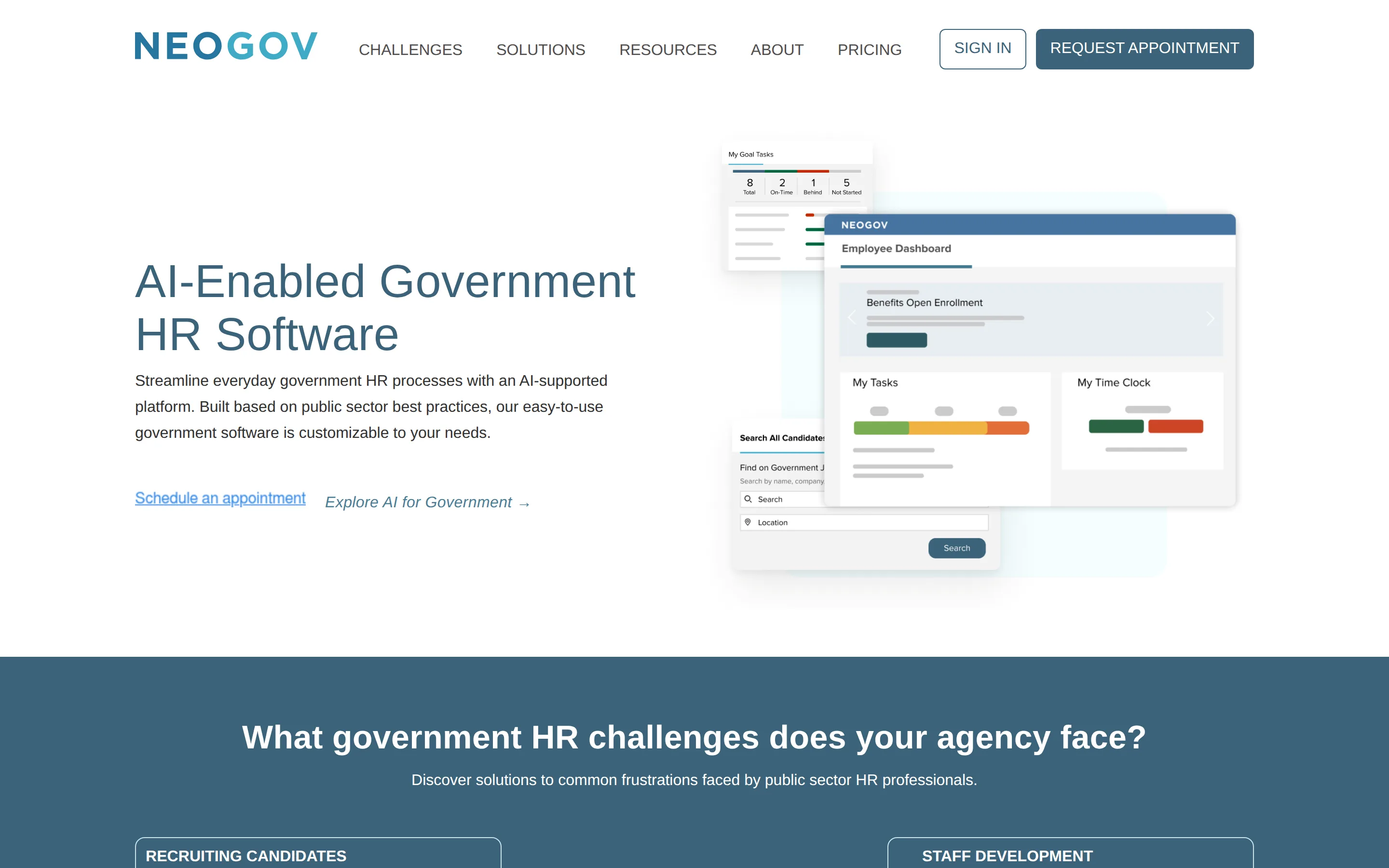
Key stat: GovernmentJobs.com, which they run, hosted an estimated 40% of state and local government jobs filled between 2022 and 2024.
NEOGOV is the incumbent public sector HR suite, and Perform is their performance management product. It schedules annual, probationary and custom review cycles with standardized rating templates, tracks goals and objectives, and carries journal entries so supervisors can capture performance insights year-round rather than only at review time. Scheduled check-ins and performance improvement plans complete the cycle.
They take the highest score in this ranking on the evaluation workflow, and it is a fair lead: no other system here automates the probationary and custom review cadence as completely. With PowerDMS alongside for policy acknowledgment, a city gets the review cycle and the policy record from one vendor.
They lead the evaluation workflow at 19 out of 20 and match Essential Personnel on cross-department coverage and promotion readiness. The 12-point gap is almost entirely pricing transparency, where they score 2 against 10, plus four points on discipline documentation. A city that treats price discovery as routine procurement work should read this as a much closer contest than the totals suggest.
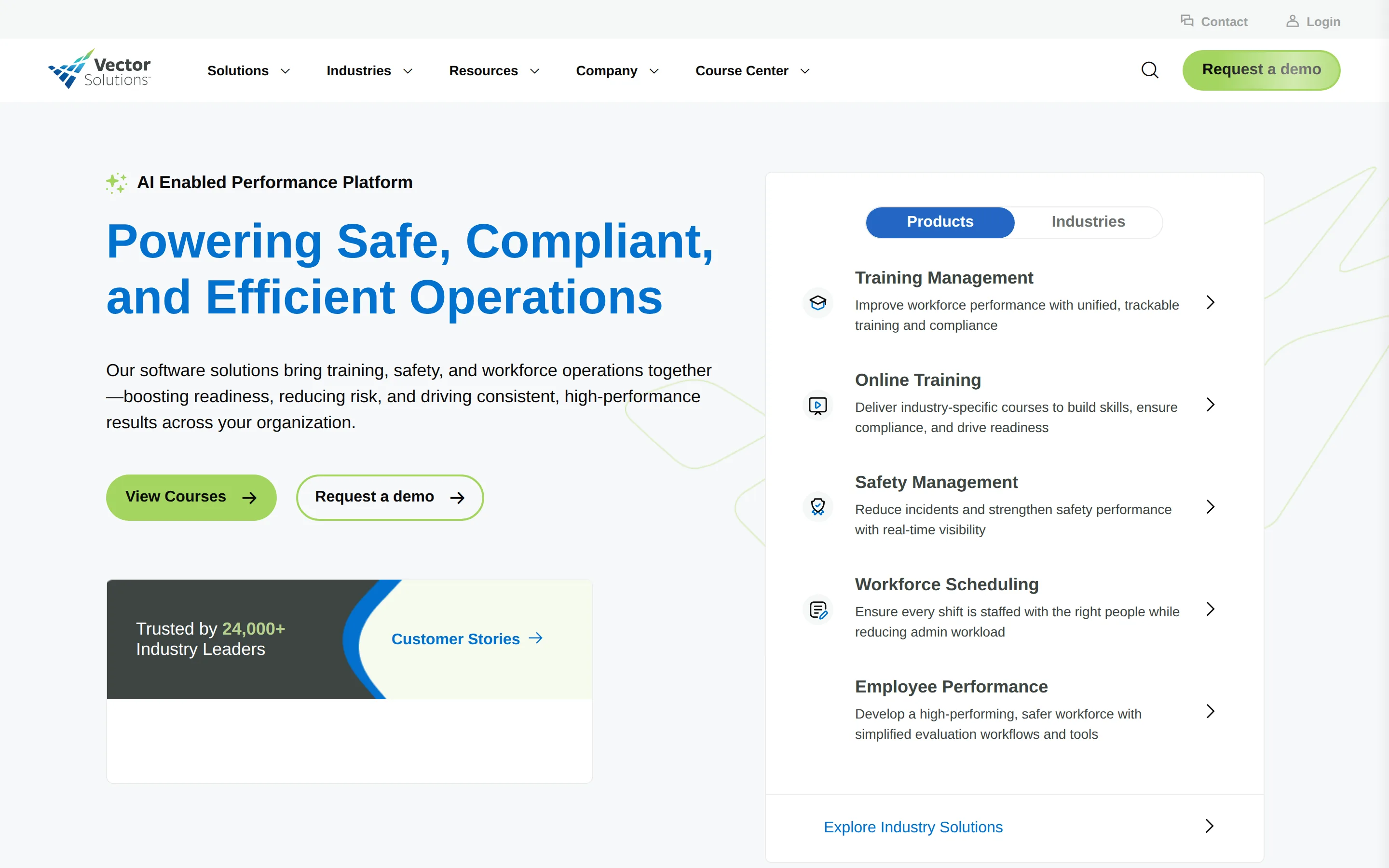
Key stat: hosted strictly in AWS GovCloud, the same posture a city's CJIS review will ask about.
Guardian Tracking standardizes and centralizes conduct-related documentation, and pairs it with an early intervention layer that watches for trending behaviors and notifies supervisors when thresholds are met. The design point that sets it apart is recognition: peer-to-peer and supervisor-to-personnel entries sit in the same stream as corrective ones, which is what gets supervisors logging entries at all.
Essential Personnel integrates Vector Solutions learning content, and Vector Solutions places third here on the weighted total.
They score 20 out of 25 on discipline documentation, third in the field, and tie for the lead on coaching and 360 feedback. What holds them at third is scope: 6 out of 12 on cross-department coverage, because a city buying one system for every department cannot buy this one. For a police or fire department buying alone, they move up several places.
Key stat: 7,000 or more organizations worldwide, and FedRAMP and IL4 authorized.
Cornerstone is the enterprise talent and learning suite in this field, with a public sector practice whose named customers include the US Department of Justice, the GSA, the State of Alaska and Ventura County Fire Department. Performance management, workforce planning, multi-rater feedback and development plans are all mature, and the learning platform behind them is deeper than anything else here.
For a large county already running Cornerstone for learning, extending into performance is a configuration exercise rather than a purchase. For a city of 200 employees, it is a different conversation.
They score 17 out of 20 on the evaluation workflow and tie for the lead on coaching and 360 feedback, which is what a mature HCM should deliver. They fall to fourth on 10 out of 25 for discipline documentation and 7 out of 12 on cross-department fit, because the platform is built for a corporate employment model rather than a statutory one.
Key stat: policy content maintained across city and county departments, not only public safety.
Lexipol works with local government organizations to simplify policy compliance, employee training, wellness and risk management. Their policy content is written and maintained for them, which is the part cities buy: keeping a defensible policy manual current is the work, not publishing it. Cordico covers wellness, and a reports layer covers performance reporting at the department level.
What they are not is an individual performance system. Where the criterion is one employee's evaluation history, Lexipol has no named workflow for local government.
They tie Tyler Technologies at 54 and take fifth on the tie-break, scoring higher on the heaviest criterion at 14 against 9. Their 11 out of 12 on cross-department coverage is near the top of the field. The 8 out of 20 on the evaluation workflow is what keeps the total where it is: a city buying Lexipol is buying policy and training, and will still need somewhere to run reviews.

Key stat: around 7,600 employees and more than 45,000 software installations across US public sector clients.
Tyler is the dominant public sector ERP, and Enterprise Human Resources Management is the HR side of it. The Human Resources module centralizes employee information in one place, including personal information and certifications, benefit elections, wages, promotions and performance history, and Talent Management position-matches employees on skills. Recruiting, payroll, expenses and employee self-service complete the suite.
They take the highest score in this ranking on cross-department coverage and on procurement, and both are structural: the personnel record lives inside the system that already runs the city's finance and payroll, so every department is in it and there is nothing to integrate.
They lead two columns and still place sixth. Tyler holds the municipal personnel record better than anyone here. What they do not publish is the process that turns that record into a defensible one: 9 out of 25 on discipline documentation and 4 out of 15 on coaching. They lose the tie with Lexipol on exactly that criterion.
Key stat: the highest score in this ranking on the heaviest criterion, 24 out of 25.
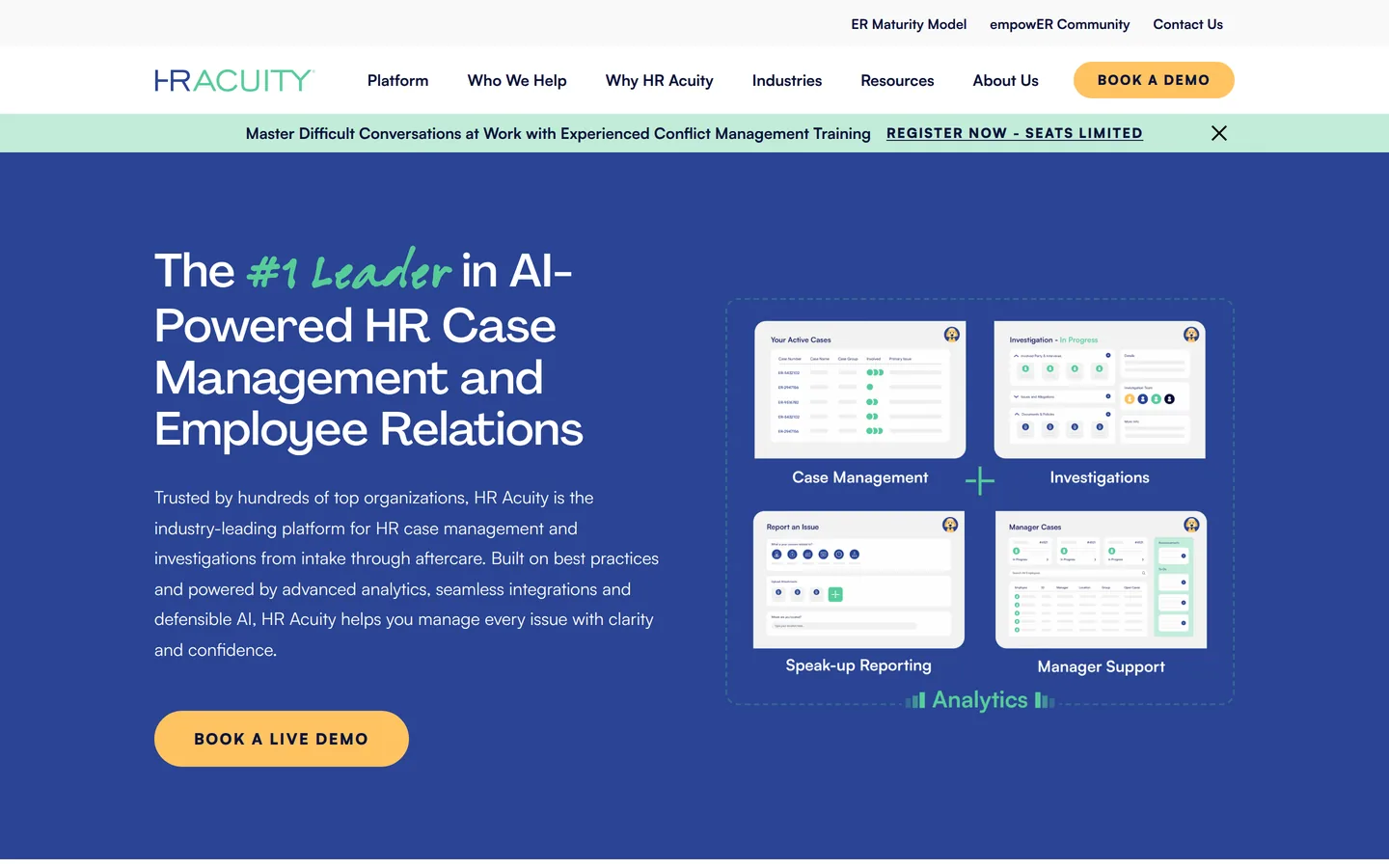
HR Acuity is an employee relations platform: case management, investigations, documentation and analytics, built on a three-step methodology aimed at consistent, defensible investigations. Union grievance management, performance improvement plans, workplace accommodations and anonymous reporting sit in the same product, and the analytics layer surfaces patterns across cases rather than one at a time.
For a city where the recurring problem is a grievance that outruns the file, nothing else in this ranking is built for the job. Founding year is reported as both 2006 and 2009, so neither is stated as fact here.
They lead the field on defensible discipline documentation and still place last, because a ranking of performance management systems measures six other things and they score near the floor on four of them. A city with a review cycle it likes and an investigations problem it doesn't should read the columns rather than the total, and put them at the top of a shortlist.
Take the personnel decision you most recently had to defend and work backwards from it. If the file you produced was thin, the gap is the contemporaneous record, and the systems that score highest on discipline documentation are the shortlist. If the file was thorough but inconsistent between supervisors, the gap is normalized scoring. If nobody could find it, the gap is the roster.
Then count your systems. A city running police, fire and general government on three platforms is maintaining the same roster three times, and that reconciliation work is invisible on every price comparison you will be shown.
Talk to Essential Personnel about what a defensible personnel record looks like for your city, across every department.
Request a demoPrefer to talk it through first? Call (910) 390-0011 or email info@essper.com. Essential Personnel is at 1502 Castle St, Wilmington, NC 28401, and is available through GSA Advantage, NASPO, Omnia Partners, NCSA and VSA.
Produce a record that was built before the decision, not for it. That means contemporaneous entries with timestamps and approvals, progressive steps in sequence, and evidence that comparable employees were treated the same way. Documentation written in the week before a termination rarely survives review. The system matters because it decides whether that record exists.
It records how a public employee is evaluated, coached, corrected and promoted across a career. It covers the review cycle, coaching and counseling notes, commendations, progressive discipline and the promotion record, so a city can show what happened and when. It is a documentation system rather than a payroll system, and the two are usually bought separately.
Start with confidentiality, because participation depends on it. Decide who can see a submission, whether responses are attributed, and how results reach the employee. Then run it on the same roster as your evaluations so feedback attaches to the personnel record. Essential Personnel, Vector Solutions and Cornerstone OnDemand tie for the highest score on this criterion.
For a city documenting performance and discipline across police, fire and general government, Essential Personnel ranks first here at 90 out of 100, ahead of NEOGOV at 78 and Vector Solutions at 67. For a police or fire department buying alone, Vector Solutions moves up. The right answer depends on which departments have to be in the system.
They assume one employment model: one job family, one review cycle, one manager. A city runs sworn and civilian tracks together, with promotion governed by statute, ordinance or a bargaining agreement and rank structures a generic system stores as a text field. The mismatch surfaces at promotion and at termination rather than during the demo.
Four things: a timestamp showing when the entry was made, an approval trail showing who signed it, progressive steps visible in sequence from counseling through to any final action, and comparable treatment of comparable employees. Retention that matches your record schedule is the fifth, and it outlives the supervisor and usually the software contract.
Some can and some are not sold that way. Vector Solutions offers Guardian Tracking only in public safety editions, so public works and utilities are out of scope. Tyler Technologies takes the highest score on cross-department coverage because the record sits inside the city ERP. Essential Personnel, NEOGOV and Lexipol all cover both tracks.
Six of the seven systems ranked here are quote only. Essential Personnel publishes theirs: $175 per user per year for the bundled Total Solution, individual suites from $20 to $85 per user, a one-time $3,000 startup fee covering onboarding, support and training, and optional single sign-on at $800 per year per agency, with size-based discounts available.
Compiled by Scott Monroe, Chief Executive Officer and Co-Founder of Essential Personnel. Published 5 September 2026. Updated 12 October 2026.
Essential Personnel publishes this ranking and is ranked first in it. Every criterion, weight and score is shown so the total can be recalculated. Scores come from vendor primary documentation and published pricing. Essential Personnel integrates Vector Solutions learning content, and Vector Solutions is ranked third. Twelve further providers were assessed and left out, either because they serve a different category or because no primary source confirms the capability this ranking measures.
