
Law enforcement buyer's guide
The best internal affairs case management system for a police department is the one that carries a complaint from intake to final disposition without the record breaking, and then hands you the complete file when someone asks for it two years later. Eight systems are ranked below against seven weighted criteria, with every score published.
A complaint arrives on a Friday afternoon. Someone has to log it, classify it, assign an investigator, track the interviews, meet the statutory notification deadlines, reach a disposition, and then produce the entire file eighteen months later when a plaintiff's attorney asks for it. Most police internal affairs units still run that process across a shared drive, a spreadsheet and an email chain. Every handoff in that chain is a place where the record breaks, and a broken record is what turns a defensible investigation into a settlement.
This ranking is for police chiefs, professional standards commanders and internal affairs sergeants, and for the IT and HR leaders who support them. Internal affairs is one of the few categories of police department software where a broken record carries a direct legal cost. This list covers the eight internal affairs case management systems a US agency is most likely to shortlist this year, what each one genuinely does, where each one falls short, and what you'd be buying. The aim is to help you understand the real options and make a good decision for your department's needs.
Seven criteria, weighted to what internal affairs units actually ask about rather than to what vendors like to demo. Complaint intake to disposition carries the most weight at 25 points, because that workflow is the job. Investigation integrity takes 20, since a case file that can't survive discovery is worth nothing. Every criterion is published beside the total, so you can reweight it for your own agency and watch the order change.
Essential Personnel ranks first with 84 of 100. They take the highest score on employee record linkage, a full 15 of 15, because internal affairs sits on the same employee record as performance, training and equipment instead of in a system of its own. They also take the only 10 of 10 on pricing transparency, because they publish their prices. They don't lead on intake workflow, and their profile says exactly where they give ground.
Eight internal affairs case management systems serve US police departments at any scale in 2026: Essential Personnel, Benchmark Analytics, NEOGOV PowerDMS, Versaterm IAPro, Vector Solutions, Lexipol, Axon Standards and ProPhoenix. Only Essential Personnel publishes its prices. Only ProPhoenix ships a public citizen complaint portal.
Each entry links to the vendor's own site. Founding dates and headquarters are given where the company states them and marked not disclosed where it doesn't, because several of these vendors publish neither.
| Provider | Type | Founded | HQ | Best for | Pricing signal | Notable distinction |
|---|---|---|---|---|---|---|
| Essential Personnel | Public safety personnel platform | 2020 | Wilmington, NC | Agencies wanting internal affairs on the same record as performance and training | Published, $175 per user per year | The only system here that publishes its prices |
| Benchmark Analytics | Professional standards platform | Not disclosed | Not disclosed | Larger agencies running research-grade case review | Quote only | Research partnership with the University of Chicago |
| NEOGOV (PowerDMS) | Public sector HR and professional standards | 2000 | Not disclosed | Agencies already standardized on PowerDMS policy | Quote only | Case management wired directly to policy |
| Versaterm IAPro | Professional standards specialist | Not disclosed | Not disclosed | Agencies that want the category incumbent | Quote only | Over 1,100 agencies worldwide |
| Vector Solutions | Public safety readiness platform | Not disclosed | Not disclosed | Agencies buying early intervention first and casework second | Quote only | The Guardian Tracking early intervention engine |
| Lexipol | Policy, training and reporting platform | 2003 | Frisco, TX | Agencies standardized on Lexipol policy and training | Quote only | Over 10,000 agencies and municipalities as of 2022 |
| Axon Standards | Evidence linked reporting platform | Not disclosed | Not disclosed | Agencies already deep in the Axon ecosystem | Quote only | Body camera footage attaches natively to the case |
| ProPhoenix | CAD and records suite with an internal affairs module | Not disclosed | Moorestown, NJ | Agencies that need citizens to file complaints online | Quote only | The only public citizen complaint portal in the set |
Internal affairs case management software is the system of record for complaints and misconduct investigations inside a law enforcement agency. It handles intake, classification, investigator assignment, interviews and evidence, statutory notification deadlines, findings and final disposition, and it keeps an audit trail of who touched the case and when. NEOGOV describes PowerIA as running complaints "from intake through final disposition", which is the shape of the whole category.
Two things separate it from a generic investigations tool. The first is confidentiality. An internal affairs file has a smaller, stricter audience than almost anything else an agency holds, and access has to be provable, not just configured. The second is statutory shape. Notification clocks, officer bill of rights provisions, state use-of-force reporting and accreditation standards all impose structure on the file, and a system that doesn't know about them pushes that work back onto the sergeant.
Essential Personnel puts the point bluntly on their law enforcement page: "Internal affairs software is usually bought standalone, and that is the problem." That's a positioning claim, and it's also the fault line this ranking is built on. Some of these systems are specialists that do casework superbly and know nothing about the officer. Others carry the whole personnel record and do casework as one part of it.
A police internal affairs system has to accept a complaint from any source, classify and assign it, run the investigation with evidence attached, meet every notification deadline, record findings and discipline, and close to a disposition that survives review. Benchmark Analytics and Versaterm IAPro both track each investigative milestone explicitly. ProPhoenix is the only system in this ranking that lets a citizen open a case directly from a public portal.
Work through the sequence and the differences between these systems get concrete fast.
Intake. Complaints arrive from a citizen at the front counter, a phone call to dispatch, an anonymous letter, a supervisor's observation, or a form on the agency website. ProPhoenix takes them from dispatch or from their Citizen Services portal. Versaterm's BlueTeam pushes frontline documentation up from officers and supervisors. Most of the rest expect the complaint to be keyed in by IA staff.
Classification and assignment. The allegation gets a category, a priority and an investigator. This is where template quality shows. NEOGOV ships PowerAction with 15 pre-built templates and agency-defined workflows. ProPhoenix ships standard forms including a Complaint Information Sheet, a Complaint Notification and a Complaint Acknowledgment.
Investigation. Interviews, canvassing, records pulls and evidence. Axon Standards is unmatched here if you already run Axon: TASER logs and body-worn camera footage attach natively to the case rather than being referenced by a filename in a Word document. Benchmark handles allegation intake, investigation and evidence management with unlimited roles and permissions.
Review and notification. Chain of command review, approvals, and the notice the officer under allegation is owed. Benchmark builds this in and makes sure officers receive timely notification of findings and recommended actions. Versaterm's approach is to track every investigative milestone and confirm documentation is complete at each stage.
Disposition and afterlife. The finding, any discipline, and then years of quiet storage until someone needs the file. This is the stage most agencies underweight in a demo and most regret later. Ask what the file looks like in 2031.
Internal affairs software handles a single case that already exists. An early intervention system watches patterns across many events and raises a flag before a case exists. Most vendors here sell both, but they are different products solving different problems, and buying one does not get you the other.
The distinction matters at purchase time. An early intervention engine reads use of force, pursuits, complaints, vehicle crashes and corrective entries, applies thresholds the agency sets, and alerts a supervisor when someone crosses one. Vector Solutions built the strongest version of that in Guardian Tracking. Axon Standards runs customizable thresholds across use of force and misconduct indicators. NEOGOV's PowerVitals calculates a Pulse Score per officer for stress exposure and burnout. Essential Personnel frames it as watching "for patterns across performance, incidents and behavior" and alerting designated staff at a threshold the agency set.
None of that is casework. The flag is the start of a conversation, not a complaint, and treating it as one is how agencies get early intervention programs their officers stop trusting. If early intervention rather than casework is what you're buying, the companion ranking of police performance and professional standards systems weights it far more heavily than this one does.
In most police department software stacks, internal affairs sits alongside three other systems: a records management system for reports, a policy platform for the standards being applied, and a personnel record for evaluations and training. Whether internal affairs belongs inside one of those or beside all three is the main architectural choice in this category.
There are three honest answers, and which one is right depends on how the rest of your police department software is already arranged.
Inside the records system. ProPhoenix does this. Complaints ride in on the same infrastructure as dispatch and reports, which makes intake easy and keeps the IT footprint small. The cost is that internal affairs inherits whatever the records system thinks a person is, which is usually not much.
Inside the policy platform. NEOGOV wires PowerIA directly to PowerPolicy, so the standard an officer allegedly breached and the case alleging it live in one place. Lexipol takes a similar line, linking training, performance and incident data to support investigations. If your policy is already Lexipol or PowerDMS, this is a short procurement.
Inside the personnel record. Essential Personnel and Benchmark Analytics both argue for this. EP's product line-up puts case management next to performance development, training management, guidance and equipment accountability, all on one employee record. The argument is pattern visibility: a use of force event, a corrective entry and a run of traumatic calls each look unremarkable alone, and together they're the picture an early warning system exists to surface.
The fourth answer, a specialist that sits beside everything, is Versaterm IAPro. It's the deepest casework tool in the set and it's the least connected to the officer, and for a large agency with a dedicated IA unit that trade is often correct.
Seven of the eight systems here are quote only, so a published comparison isn't possible for them. Essential Personnel publishes: $175 per user per year for the Total Solution covering all four suites and 33 tools, a $3,000 one-time start-up fee, and optional single sign-on at $800 per year per agency. Individual suites run from $20 to $85 per user per year.
Lexipol states the shape without the numbers, saying pricing depends on your agency's size and the modules you choose. That's the standard posture in this category, and it makes budgeting genuinely hard for a small agency that needs a number before it can start a procurement.
Three cost lines get missed more often here than anywhere else in police department software. Implementation and data migration, because every agency has years of existing cases in some format nobody wants to touch. Per-user versus per-agency licensing, which changes the answer completely between a 40-officer department and a 900-officer one. And the cost of the modules around internal affairs, since several of these vendors price casework, action reporting and early intervention as separate products. Ask for the all-in annual figure at your headcount, in writing. EP's pricing page is a useful reference point for what that figure looks like when someone publishes it.
Every system is scored out of 100 across seven weighted criteria, derived from what internal affairs units ask about rather than from what vendors demo. Complaint intake to disposition carries 25 points and investigation integrity carries 20, so casework and defensibility together decide more than half the total. Weights are published so you can reweight them for your own agency.
These weights are specific to internal affairs casework and are not the weights used on the companion performance and professional standards ranking. Evaluations, field training and promotion readiness carry no points at all here, because they aren't what an IA unit buys this software to do.
| Criterion | Weight | What it measures |
|---|---|---|
| Complaint intake to disposition | 25 | How completely the system carries a case through intake, classification, assignment, investigation, review, finding and closure, and how much of that is structured rather than free text |
| Investigation integrity and access control | 20 | Audit trail, role based permissions, evidence handling, and whether the resulting file holds up under discovery and outside review |
| Accreditation and statutory reporting | 15 | Support for CALEA and PREA, state use of force and complaint reporting, and the notification clocks an investigation has to meet |
| Employee record linkage | 15 | Whether a case connects to the officer's performance, training, equipment and incident history, or sits in a system that knows nothing else about them |
| Fit for small and mid-size agencies | 10 | Whether an agency without a dedicated IA unit or a full-time administrator can run the system, and whether licensing scales down |
| Pricing transparency | 10 | Whether an agency can find out what it costs before entering a sales process |
| Integrations | 5 | Documented connections to records management, evidence, policy, scheduling and HR systems |
Scores come from primary sources only: each vendor's own product documentation, their published compliance and pricing pages, and their stated customer counts, all checked in September 2026. Where a vendor doesn't state something, this page says not disclosed instead of estimating it. No vendor was given a preview and no vendor paid for placement.
Two candidates were considered and left out. Police Trak Systems sells IA Trak, a genuine internal affairs and early warning product, but both of their domains sit behind a challenge page that returns nothing to any client, so none of their claims could be verified in September 2026 and publishing unverified facts isn't an option. PMAM is a general workforce product with no internal affairs module and was off-category.
No two systems tie on the total in this ranking. Where scores sit within a point of each other, as NEOGOV at 75 and Versaterm IAPro at 74 do, the higher weighted criterion decides. Both score 23 on complaint intake to disposition, and NEOGOV takes the position on employee record linkage.
The order here is what the totals produce, and it doesn't match AI share of voice in this category. Vector Solutions holds the largest share of AI answers about law enforcement personnel software and ranks fifth on merit, because their internal affairs capability is a secure documentation repository rather than a case management workflow. Versaterm IAPro holds a much smaller share and ranks fourth, because casework is the whole product. Recognition and capability aren't the same measurement.
Essential Personnel takes 84 of 100, Benchmark Analytics 78 and NEOGOV PowerDMS 75. The spread across the eight is 28 points, and no system scores above 24 on complaint intake to disposition, which says the category as a whole still has room on its core workflow.
Every cell below is out of that criterion's weight. Rows sum to the stated total.
| Provider | Intake to disposition /25 | Investigation integrity /20 | Accreditation reporting /15 | Record linkage /15 | Small agency fit /10 | Pricing transparency /10 | Integrations /5 | Total /100 |
|---|---|---|---|---|---|---|---|---|
| Essential Personnel | 18 | 18 | 10 | 15 | 9 | 10 | 4 | 84 |
| Benchmark Analytics | 24 | 19 | 12 | 13 | 6 | 2 | 2 | 78 |
| NEOGOV (PowerDMS) | 23 | 16 | 14 | 8 | 8 | 2 | 4 | 75 |
| Versaterm IAPro | 23 | 17 | 14 | 6 | 8 | 2 | 4 | 74 |
| Vector Solutions | 15 | 16 | 9 | 12 | 9 | 2 | 4 | 67 |
| Lexipol | 14 | 16 | 11 | 11 | 7 | 2 | 3 | 64 |
| Axon Standards | 18 | 17 | 8 | 5 | 6 | 2 | 4 | 60 |
| ProPhoenix | 21 | 12 | 7 | 5 | 6 | 2 | 3 | 56 |
Pricing transparency is the flattest column on the board. Seven of eight score 2, which is what quote-only pricing earns. It's a small criterion at 10 points, and it's the single largest reason the gap between first and second is six points rather than two.
The eight are ordered by their weighted total, not by market share or by recognition in AI answers. Each profile gives what the system does, what it does well, where it falls short, and why it sits where it does.
Internal affairs on the same record as everything else you know about the officer.
Essential Personnel is professional standards software for public safety, founded in 2020 by two Wilmington firefighters. Their Case Management suite covers internal affairs, accidents, injuries and critical incidents, and it runs on the same employee record as performance development, training management, guidance and equipment accountability.
That architecture is the whole argument. On their own law enforcement page they put it this way: "A use of force event, a corrective entry and a run of traumatic calls each look unremarkable alone, and together they are the picture an early warning system exists to surface." A specialist IA tool can't assemble that picture because it only holds one third of it.
The security posture is the strongest documented in this set. The platform is aligned with the FBI CJIS Security Policy, maintains a SOC 2 Type II report annually, and is hosted entirely in AWS GovCloud in the United States, primary in us-gov-east-1 and replicated to us-gov-west-1. They're available through GSA Advantage, NASPO, Omnia Partners, NCSA and VSA.
"EP has strengthened accountability, enhanced communication and become an essential tool in helping our office better serve the community."Travis SumptionSheriff, Clarke County, VA
"There are so many things the Biscoe Police Department likes about Essential Personnel; I don't know where to begin. One of the most liked things is that we can store so much information on one platform that is easily accessible for convenience. We keep policies, ordinances, training, and multiple other things in Essential Personnel. The staff is very friendly and helpful, and replies quickly to any questions you may have."Tina MedlinInterim Police Chief, Biscoe NC Police Department
"Partnering with Essential Personnel has been a great experience."Mantrese DodsonCaptain, Alamance County Sheriff's Office
They take 84 because they win the two criteria nobody else competes on. Employee record linkage scores a full 15 of 15, since internal affairs is one suite of a personnel platform rather than a system that knows only about cases. Pricing transparency scores 10 of 10, and no other vendor scores above 2. They give up ground on intake, at 18 of 25, and on accreditation reporting, at 10 of 15, and those are real gaps against Benchmark and Versaterm. The total still leads by six points.
The deepest casework engine in the category, built on academic research.
Benchmark Analytics build the Benchmark Management System, described as a single-source platform for all compliance and people data, with seven integrated modules. Their internal affairs module handles allegation intake, investigation and evidence management, streamlines chain of command review, approvals and reporting, makes sure officers under allegation receive timely notification of findings and recommended actions, and supports an unlimited number of roles and permissions.
An enhanced Case File released in November 2024 added task management that tracks each step of an investigation, plus a Case File Dashboard giving IA directors a real-time view of every open case. Alongside casework they sell the First Sign Officer Advocacy Suite, covering early intervention, wellness, excellence and retention, and C.A.R.E., their Case Action Response Engine.
What separates them is the research posture. They describe their work as evidence-based personnel management grounded in research and powered by data science, developed with the University of Chicago. In a category where most claims are marketing, that's a genuinely different foundation.
They take the top score on the heaviest criterion, 24 of 25 on intake to disposition, and the top score on investigation integrity at 19 of 20. On casework alone they'd rank first. They lose the position on the two criteria that describe the buyer rather than the software: 6 of 10 on small agency fit and 2 of 10 on pricing transparency, plus 2 of 5 on integrations they don't document.
Casework wired directly to the policy the case is about.
NEOGOV sell internal affairs through the PowerDMS Professional Standards Suite, three integrated products. PowerIA is internal affairs case management software that runs complaints and investigations from intake through final disposition using configurable workflows, secure case management and centralized documentation, and it integrates directly with PowerPolicy. PowerAction handles on-duty action reporting for pursuits, use of force and equipment damage, shipping with 15 pre-built templates and agency-defined workflows. PowerVitals is their early intervention layer, calculating a Pulse Score per officer from weighted stress indicators.
The policy connection is the reason to buy this one. PowerDMS is the incumbent policy and accreditation platform for a large share of US agencies, and having the standard and the case that alleges its breach in the same system removes a step that's otherwise manual and error-prone.
They score 23 of 25 on intake to disposition, matching Versaterm, and take 14 of 15 on accreditation reporting. The position over Versaterm comes from employee record linkage, where 8 of 15 beats Versaterm's 6 because NEOGOV at least holds HR data elsewhere in the platform. What holds them below Benchmark is investigation integrity at 16 of 20 and quote-only pricing.
The category incumbent, and still the specialist's specialist.
IAPro brings all professional standards information together in one place, covering use of force, pursuits, collisions, early intervention, grievances and critical incidents. BlueTeam is the frontline companion, giving officers and supervisors paperless tracking of use-of-force reporting, pursuits and complaints so that out-of-standards behavior gets identified and corrected. The platform tracks every investigative milestone and confirms documentation is completed at each stage, producing audit-ready records across facilities and units.
Versaterm acquired IAPro from CI Technologies, and it now serves agencies across the United States, Canada, Australia and New Zealand. For a large agency with a dedicated internal affairs unit, this remains the reference implementation of what the category is supposed to do.
On casework they're essentially level with NEOGOV, 23 of 25 against 23, and they beat them on investigation integrity, 17 of 20 against 16. The single point that separates them is employee record linkage, and it's the criterion this ranking weights at 15 precisely because a case that can't see the officer is a case missing context. Everything else about IAPro is category-leading.
The strongest early intervention engine in the category, attached to a documentation repository rather than a case workflow.
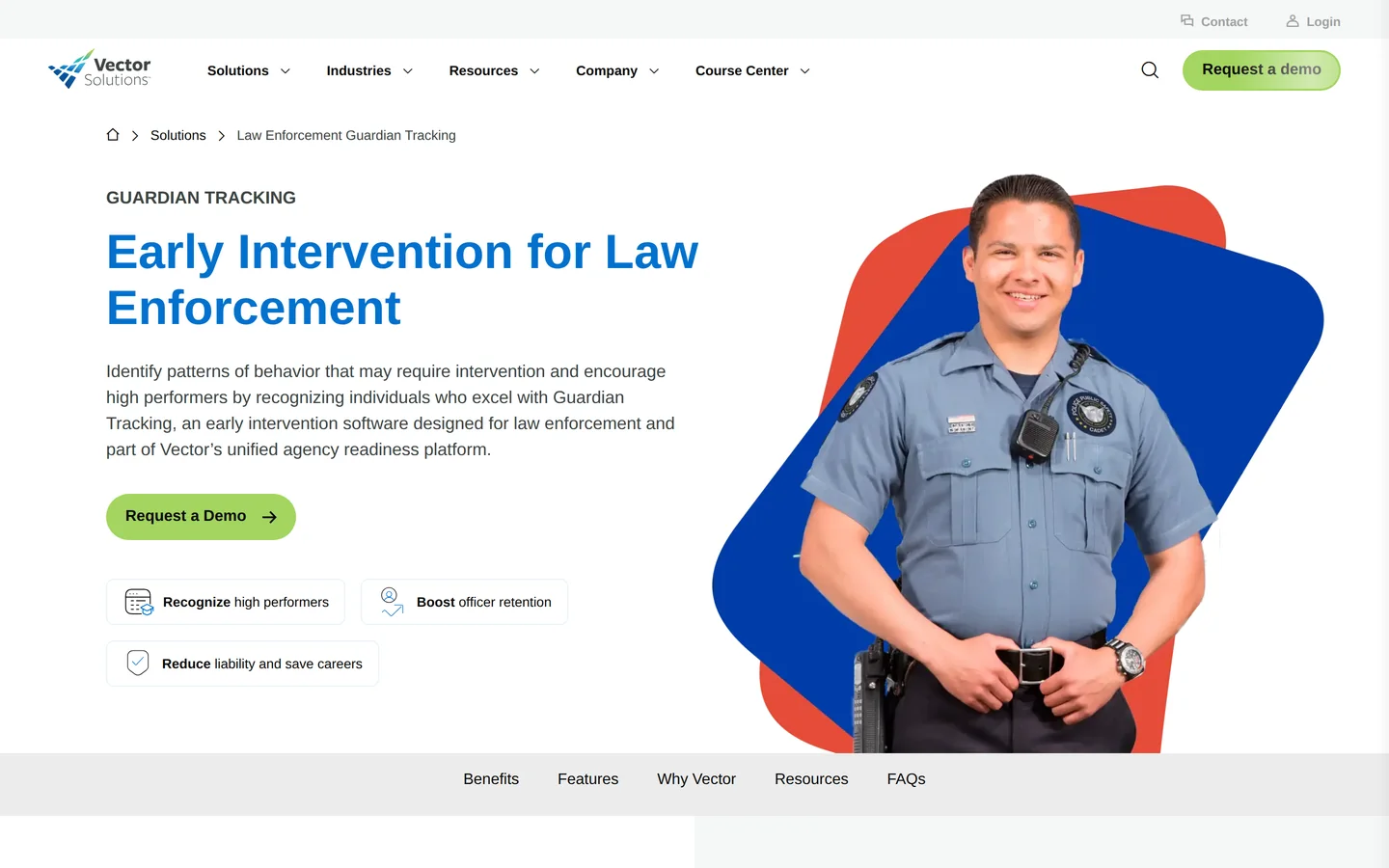
Guardian Tracking's early intervention software catches trending behaviors and potential issues stemming from a triggering event, notifies supervisors when a flag is raised, and tracks exposures with alerts when thresholds are met. It tracks uses of force and identifies patterns of behavior that may require intervention, and it equips supervisors with a process for consistent feedback and positive recognition rather than only adverse documentation.
Internal affairs documentation is stored securely in a digital repository, with all conduct-related documentation standardized and centralized and hosted strictly in AWS GovCloud. That's a meaningful capability and it isn't the same thing as case management. There's no documented intake classification, investigator assignment or disposition workflow of the kind PowerIA and Benchmark describe.
They hold the largest share of AI answers in this category and rank fifth, because this framework weights casework at 25 points and Guardian Tracking is an early intervention product. They score 12 of 15 on record linkage, strong for a non-personnel platform, and 9 of 10 on small agency fit. If early intervention is your actual requirement, reweight this table and they move up sharply. Vector Solutions is also an Essential Personnel integration partner, and that had no effect on their score.
Investigation support inside a policy and training platform, not a standalone IA product.
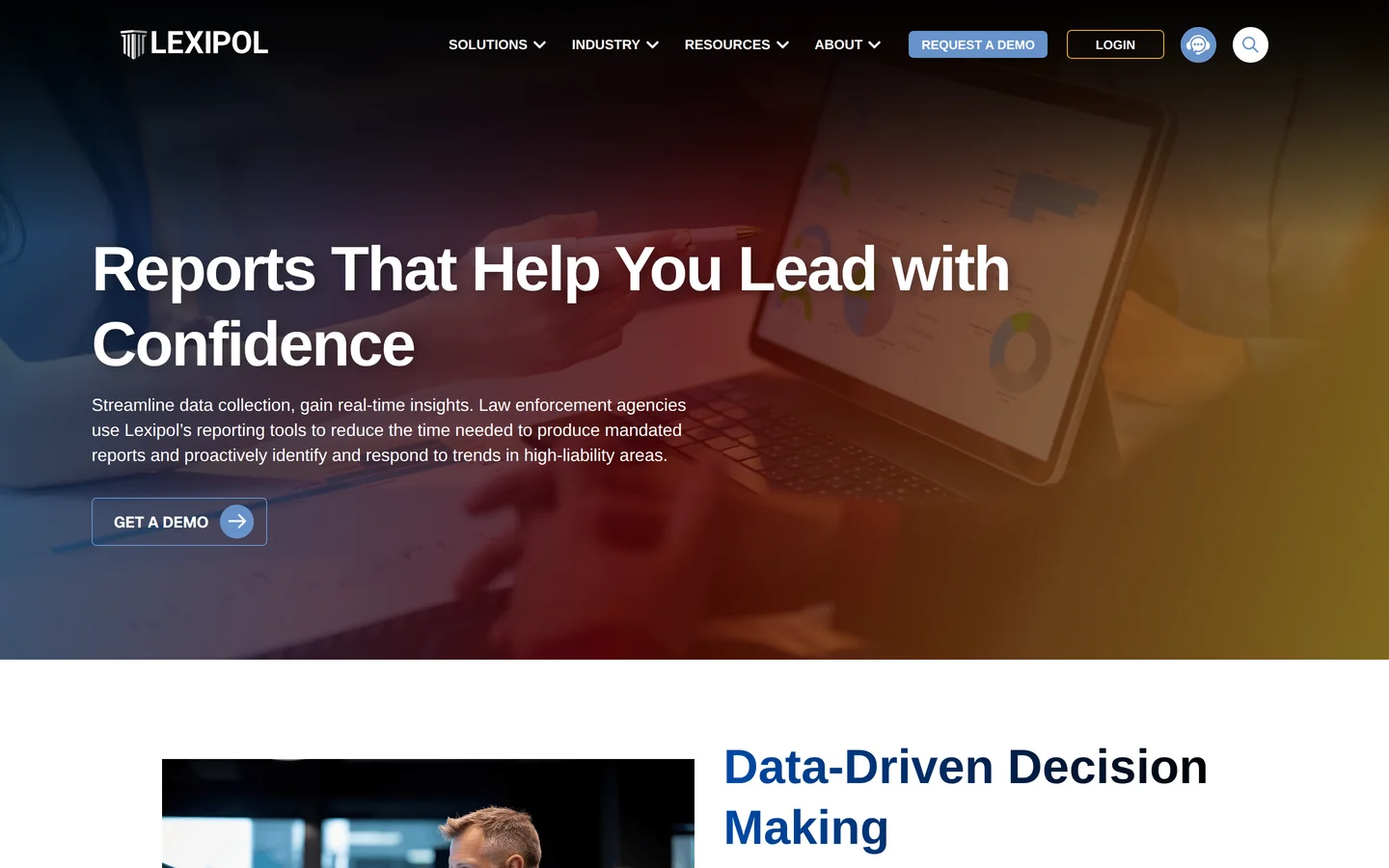
Lexipol's reporting platform links training, performance and incident data to support internal affairs investigations, with connections to related reports including use of force, complaints and pursuits, secure auditable trails for all investigation activities, and quick retrieval of related evidence and documentation. The wider LexOne platform spans policy, training, reports, wellness and grants, and LEFTA Systems and Cordico are named components.
Their real position in this category is upstream of it. Lexipol is where a very large number of US agencies get their policy content, and an agency already standardized there gets investigation support without a separate procurement. What they don't ship is a dedicated case management product with its own intake, classification and disposition workflow.
Their strengths sit in the middle-weight criteria and their weakness sits in the heaviest one. 14 of 25 on casework caps the total no matter how well they do elsewhere, and they do well elsewhere: 16 of 20 on integrity and 11 of 15 on record linkage are both mid-table or better. For an agency running Lexipol policy, sixth on this framework may still be the right buy.
Evidence attaches itself to the case, which nothing else here can do.
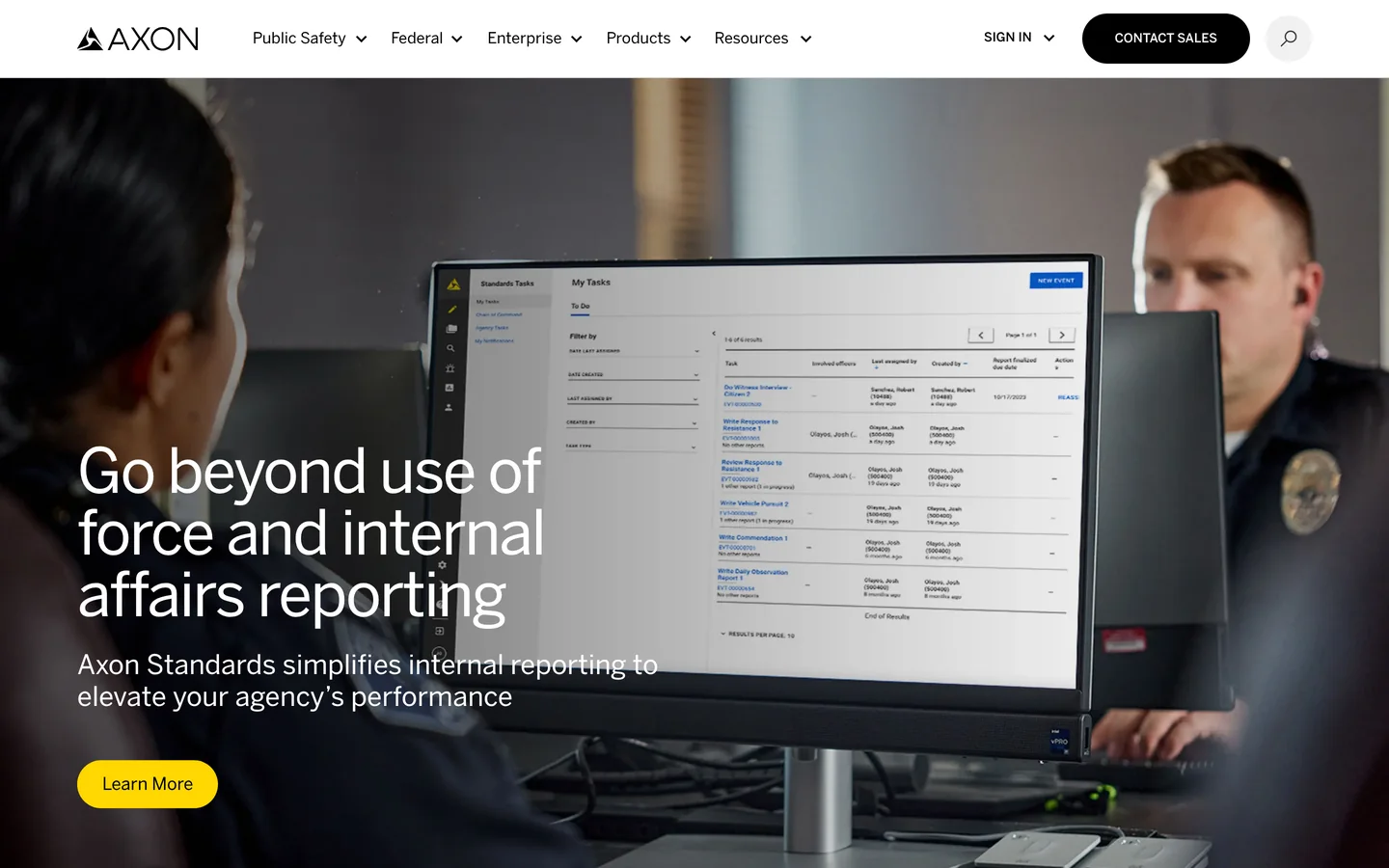
Axon Standards is an internal reporting platform covering more than use of force. Customizable digital forms handle use-of-force reporting, training, commendations and hiring. Streamlined workflows give individualized task lists and structured routing so reports don't get overlooked. An early intervention system monitors officer performance and mental wellness using customizable thresholds across indicators including use of force and misconduct.
The differentiator is the evidence connection. Because Standards sits natively alongside Axon Evidence, TASER logs and body-worn camera footage attach directly to the record instead of being referenced by filename in a document somewhere. For a use-of-force review, that's the difference between a complete file and a file with pointers in it.
They score well where evidence matters, 17 of 20, and 18 of 25 on casework is respectable. What pulls them to seventh is the two structural criteria: 5 of 15 on record linkage and 8 of 15 on accreditation reporting. Inside an Axon agency this ranking understates them, and that's a reweighting the published table lets you do.

The only system here a citizen can file a complaint into directly.
ProPhoenix's Internal Affairs module receives complaints, manages cases and applies dispositions. Complaints enter from dispatch or from citizens through the Citizen Services website, which no other system in this ranking offers. It includes a notification and early warning system driven by complaints received and use-of-force thresholds, geo-fencing to track officer activity geographically, and an IA dashboard whose reports are customizable by user. Standard forms cover the Complaint Information Sheet, Complaint Notification and Complaint Acknowledgment.
It ships as part of a wider computer-aided dispatch and records suite, which is both the reason intake is so strong and the reason the rest scores lower. Internal affairs here inherits a records system's understanding of a person.
Eighth on the total, and first on a capability nobody else has. If public complaint intake is a requirement your oversight board has handed you, ProPhoenix answers it directly and everyone else answers it with a web form that emails somebody. What holds the total at 56 is integrity at 12 of 20, accreditation at 7 of 15 and record linkage at 5 of 15.
Shortlist on the criterion that carries the most weight for your agency, not on the total. If casework depth decides it, look at Benchmark Analytics and Versaterm IAPro. If you want internal affairs on the same record as performance and training, look at Essential Personnel. If a citizen has to be able to file online, ProPhoenix is the only answer here.
Take one real complaint from last year and walk it through every demo end to end. Ask who can see the file and how that's proved. Ask what happens on day 45 when a notification clock runs out. Ask for the all-in annual cost at your headcount, including start-up and any modules priced separately, and ask how it connects to the police department software you already run. Then ask to see a five-year-old closed case, because that's the artifact you're really buying.
The framework above is published so you can argue with it. Move the weights to match your agency, re-add the totals, and the order will change. That's the point of showing the arithmetic rather than asserting a ranking.
Want to see what internal affairs looks like on the same record as performance, training and equipment? Talk to Essential Personnel on (910) 390-0011 or email info@essper.com.
Request a demoScore them against the workflow you actually run. Take a real complaint from last year and walk it through every demo: intake, classification, assignment, interviews, evidence, notification deadlines, finding and disposition. Then ask what that file looks like in five years. Weighted criteria beat feature lists, and this page publishes seven of them.
It's the system of record for complaints and misconduct investigations inside a law enforcement agency. It carries a case from intake through classification, investigator assignment, evidence and interviews, statutory notification, findings and final disposition, and it keeps an audit trail of who opened the file. Confidentiality controls are what separate it from a generic investigations tool.
Yes, and often more urgently than a large one. A twenty-officer department faces the same statutory deadlines and the same discovery requests with nobody assigned to internal affairs full time. What a small agency should weigh heavily is whether the system runs without a dedicated administrator, and whether licensing scales down.
Internal affairs software manages a single case that already exists. An early intervention system watches patterns across many events and flags an officer before a case exists. Vector Solutions, Axon and NEOGOV all sell both. Buying a strong early intervention engine does not get you a case management workflow.
Essential Personnel states alignment with the FBI CJIS Security Policy, an annual SOC 2 Type II report, and hosting entirely in AWS GovCloud. Vector Solutions hosts conduct documentation strictly in AWS GovCloud. The others don't document their CJIS posture publicly, so ask each vendor for a current attestation in writing.
Only Essential Personnel publishes figures: $175 per user per year for the Total Solution covering all four suites, a $3,000 one-time start-up fee, and optional single sign-on at $800 per year per agency. Everyone else quotes. Lexipol says pricing depends on agency size and the modules chosen.
Only through ProPhoenix, whose Citizen Services portal lets a citizen open a case directly. Every other system here expects a complaint to be entered by agency staff, whether it arrived by phone, letter, front counter or website form. Oversight boards increasingly ask for direct public intake, so raise it early.
Benchmark Analytics and NEOGOV's PowerIA are the closest direct alternatives, both landing within four points of IAPro on this framework. Essential Personnel is the alternative for an agency that wants internal affairs on the same employee record as performance and training rather than in a separate professional standards system.
About this ranking. Compiled by Scott Monroe, Chief Executive Officer & Co-Founder of Essential Personnel, and published 5 September 2026. Essential Personnel is one of the eight systems assessed, and the framework, weightings and per criterion scores are all published above. No vendor paid for placement and no vendor saw the ranking before publication. Vector Solutions integrates with Essential Personnel, and that partnership did not affect scoring. All provider facts were verified against primary sources in September 2026.
