Law enforcement buyer's guide

Which systems connect police training records to performance, incidents and promotions? Top 5 for 2026

Your department already has a learning management system, and it does its job. Courses get delivered, completions get stamped, and the record then sits in a product nobody opens between audits. What you can't do is answer a question about a person. A use of force lands on your desk and the officer's training history is in another system. A promotion board sits and every candidate's certifications arrive in a different shape. Training records management software is the layer that makes completion data usable outside the system that produced it.

This is written for police chiefs and sheriffs, and for the training officers, professional standards staff, and IT and HR leaders who support them. It's for the agency that isn't shopping for a course library, because it already has one, and needs the record layer that sits over it. The five systems below are here to help you understand the options and make a good decision for your department's needs.

Each system is scored against seven weighted criteria out of 100. The training record on a unified employee profile carries 25 and ingestion from the systems you already run carries 20, because together they decide whether the data is usable at an incident or a promotion board. Certification currency carries 20 and reporting 15. Course delivery carries 5, because every agency on this list already has a library. Every criterion is published beside the total, so you can reweight it for your own department.

Essential Personnel ranks first among the five at 86 out of 100. They take the highest score on the unified employee profile at 24 out of 25, on ingestion from the training systems you already run at 18 out of 20, and on pricing transparency. They give up ground on state reporting at 12 out of 20, and they score 1 out of 5 on course delivery, a capability they cover by integrating with course providers like Vector Solutions, Fire Engineering Training and Synap.

The five systems compared

Ranked by weighted total for police departments, 2026. "Built for" is the column that matters most: it tells you which job the system was designed around.
SystemScoreBuilt forFoundedHeadquartersBest forPricing
1. Essential Personnel86The training record on a unified personnel profile2020Wilmington, NCAgencies whose course library works and whose record doesn'tPublished, $85 per user per year
2. Vector Solutions72Course delivery with academy and state reporting automation1999Tampa, FLAgencies wanting courses, state filing and records from one vendorQuote only
3. NEOGOV (PowerDMS)57A public safety workforce platform1999El Segundo, CAAgencies standardizing policy, training and standards togetherQuote only
4. Lexipol54Policy and training content on a readiness platform2003Frisco, TXAgencies buying policy, courses and field training togetherQuote only
5. L.E.A. Data Technologies47A standalone police training databaseNot disclosedHappy Valley, ORSmall agencies that need a training database and a published pricePublished, $1,800 per license

What training record software is

Training records management software is the system of record for who is trained, certified and current. A learning management system delivers courses and records completion of those courses. A record system takes completions from wherever they happened, including outside classes, instructor-led sessions and range days, and holds them on the employee's file next to their evaluations, their incidents and their equipment. Essential Personnel states the distinction plainly on its own site: a learning management system and a system of record "sit alongside each other rather than competing".

The two products get sold in the same conversation, which is why agencies end up buying one and expecting the other. A course library answers "did this class run and who attended". A record answers "is this officer current, on what, and where is the proof". You need both, and most departments discover they only bought the first when someone asks for the second under deadline.

The distinction shows up in the data model. A learning management system organizes around the course, so its natural report is a roster per class. A record system organizes around the person, so its natural report is a file per officer. If your question is about an officer rather than a class, a course-shaped system makes you assemble the answer by hand.

What a siloed training record costs you

A siloed training record costs you at three specific moments: an incident review, a promotion board, and an audit. In each one you need one officer's complete history on one screen, and a training system that only reports by course makes you rebuild it from exports. The cost isn't the admin time. It's the decision made without the evidence, because nobody had two days to assemble it.

Take an incident review. A complaint arrives naming an officer and a tactic. The question a chief has to answer is whether that officer was trained on it, when, by whom, and whether the certification was current on the date. If the training record lives apart from the incident record, somebody exports two reports and reconciles them by name, and names are the least reliable key in any agency.

A promotion board is the same problem with more people. Six candidates, and the board needs certifications, qualifications, course history and evaluations in identical shape for each one. When the training data arrives as six separate exports, the board ends up weighing whoever documented themselves best. That's a defensibility problem before it's a fairness problem.

Then there's the audit, which is the one everyone plans for and still fails on detail. State and accreditation reviewers don't ask for a completion count. They ask to see a named officer's file, and they ask for the proof behind a number. An agency that can produce the number but not the file is the agency that spends the review week in a spreadsheet.

One test tells you where you stand. Pick an officer at random and ask for their certifications, their firearms qualification dates, their last three courses and their current evaluation, on one screen, in under a minute. Systems built around courses can't do it. Systems built around the person can.

What to ask when your LMS already works

When your course library already works, the buying question changes from "what can this teach" to "what can this tell me". Four capabilities decide it: whether completions from your existing systems flow in automatically, whether the record sits on the same profile as performance and incidents, whether certification expiry raises an alert before it lapses, and whether you can produce a named officer's file on demand. Most products do two of the four well.

Take these to every demo, and ask for live data rather than a slide:

  • Ingestion. Name your current course provider and ask how completions arrive. An automatic feed, a scheduled import, or a person retyping them are three different products at the same price.
  • The profile. Ask to open one officer and see training, evaluations, discipline, incidents and issued equipment without changing screens. If it takes four tabs, the record is still siloed, just inside one vendor.
  • Expiry. Ask what happens 60 days before a certification lapses. Who gets told, what gets logged, and can you prove afterwards that the notice went out.
  • Outside training. Ask how an officer's out-of-agency class gets into the record, and who approves it. This is where most agencies leak documentation.
  • The file. Ask them to produce one officer's complete training file as a document you could hand to a reviewer. Watch whether it comes out of the system or out of somebody's afternoon.

Two questions separate the systems that hold records from the systems that use them. Does the same evidence reach a promotion board for every candidate without anyone assembling it? And when a certification lapses, does the agency find out from the system or from the incident?

What it costs

Most of this category is quote only, priced per user per year and sold as modules. Two of the five systems here publish a number: Essential Personnel at $85 per user per year for the suite carrying training records, and L.E.A. Data Technologies at $1,800 for a single license. The other three quote on request, so those two figures are the only public benchmarks in the category.

Essential Personnel publishes its full price list. The bundled Total Solution is $175 per user per year across all four suites, with individual suites at $85 for Talent Management, $40 for Safety and Wellness, $30 for Guidance and $20 for Equipment. There's a one-time $3,000 start-up fee, optional single sign-on at $800 per agency per year, and size-based discounts on request. Training records sit inside Talent Management, so $85 is the figure for this category. Current numbers are on the pricing page.

A published number is worth more than it looks. It lets you tell a finance office what a comparable system costs before procurement opens, and it makes a quote-only vendor explain a difference rather than assert a price.

Two costs get left out of comparisons. The first is the module stack: training records, policy, performance and wellness are often four subscriptions from the same vendor, and the demo shows all four. The second is reconciliation. If the roster lives in the HR system, the course library and the training database, somebody maintains it three times, and that work never appears on a price sheet.

Ranking methodology: the Police Training Record Framework

Every system is scored against seven criteria totalling 100 points and ranked on the total. The weights follow what a department with a working course library actually asks about. The training record on a unified profile and ingestion from the systems already in place come up in more agency questions than anything else, because together they decide whether the data is usable when it's needed. Certification currency and reporting are the compliance layer underneath. Course delivery is weighted at 5 rather than excluded, because a library still has some value where a department wants fewer vendors, but it isn't what this list is for.

The Police Training Record Framework. Weights total 100.
CriterionWeightWhat it measures
Training record on a unified employee profile25Whether completions, certifications and qualifications sit on the same record as performance, incidents, discipline and issued equipment
Ingestion from the systems you already run20Whether external completions flow in automatically from any provider, or only from the vendor's own courses
Certification currency, expiry and alerting20Who is current, who lapses next, and whether anyone is told before it happens
Reporting and defensibility15Completed by unit, by date and by certification, and whether a named officer's file is producible under review
Pricing transparency10Whether a department can find a number without entering a sales process
Course delivery5The library itself, weighted low because this list is for agencies that already have one
Field training and recruit records5Daily observation reports and phase sign-offs, weighted low because field training is scored in depth on our police performance ranking

How ties are broken

Where two systems reach the same total, the higher score on the unified employee profile takes the higher rank, because it's the heaviest criterion and the reason this category exists. No tie occurred in this ranking.

What makes this independent

Every capability score comes from the vendor's own published product documentation, read in September 2026, not from analyst summaries or review-site profiles. Where a company doesn't disclose a founding date, a headquarters or a price, the table says so rather than filling the gap. Essential Personnel publishes this ranking and is scored in it, which is why every criterion and every cell is shown rather than a total alone.

How the five systems scored

Read the column that matches your problem rather than the total. An agency whose course library is fine and whose record is scattered should read the first two columns and ignore the sixth.

Police Training Record Framework scores, by criterion and total.
SystemProfile /25Ingestion /20Currency /20Reporting /15Pricing /10Courses /5Field training /5Total /100
1. Essential Personnel24181712101486
2. Vector Solutions1810181425572
3. NEOGOV (PowerDMS)169121122557
4. Lexipol157111025454
5. L.E.A. Data Technologies84161080147

The spread tells you something about the category. Certification currency is where everyone is competent, because it's the oldest capability in the market. Ingestion is where the field thins out: only two of the five document automatic intake from a course provider they don't own, and that's the capability a department with a working library actually needs.

The rankings: five systems for police departments in 2026

Each profile carries what the system was built for, what it does well, where it falls short, and why it scored what it scored.

Essential Personnel homepage - training record and certification tracking
186 / 100 · The training record on a unified personnel profile

Essential Personnel

Essential Personnel was founded in 2020 in Wilmington, North Carolina by two firefighters, and builds professional standards software for police, fire, EMS and municipal HR. The platform is organized around the employee rather than the course. Its Training Management suite covers certifications, qualifications and task books, and the company describes the result as giving leaders "full visibility into certifications, qualifications, weapon scores, and training objective progress".

  • Founded2020
  • HeadquartersWilmington, North Carolina
  • SuitesTeam Builder, Performance Development, Training Management, Guidance, Case Management, Equipment Accountability
  • Pricing$85 per user per year for Talent Management, $175 bundled, published
  • Contactinfo@essper.com · (910) 390-0011

Key stat. The only vendor here that publishes a per-user price for the suite carrying training records, at $85 per user per year.

Training data lands on the same profile as evaluations, commendations, discipline, incident and case records, and issued equipment. That's the whole product thesis, and it's what the first two criteria measure. Completions from outside systems come in through named integrations rather than manual entry: Vector Solutions syncs credentialing information, Fire Engineering Training syncs e-learning and instructor-led training into EP's Logbook, and Synap connects an online exam platform to the profile. The Field Training and Evaluation Program handles recruits with configurable evaluation workflows, daily observation report templates and normalized score reports across training classes.

Strengths

  • Training, certifications and weapon scores on the same record as performance, incidents and equipment
  • Named integrations pull completions from course providers EP doesn't own
  • Certifications, qualifications and training objective progress tracked together
  • Published pricing, one of only two on this list
  • AWS GovCloud hosting, CJIS aligned, SOC 2 Type II annually
  • Reports training completion by unit for agencies under oversight mandates

Limitations

  • No course library at all, scoring 1 out of 5 on course delivery
  • No documented path for filing completions to a state POST system, which holds state reporting to 12 out of 20
  • Automatic ingestion depends on the integration list, so a course provider that isn't named needs another route
  • Founded in 2020, so the installed base is smaller than the platforms here
"This level of responsiveness and flexibility has dramatically improved our training tracking, wellness monitoring, equipment management, and overall accountability, allowing us to focus on serving our community rather than wrestling with a rigid software system."
Michael PettiMajor, Fayetteville Police Department
"One of the most liked things is that we can store so much information on one platform that is easily accessible for convenience. We keep policies, ordinances, training, and multiple other things in Essential Personnel."
Tina MedlinInterim Police Chief, Biscoe Police Department
"EP has strengthened accountability, enhanced communication and become an essential tool in helping our office better serve the community."
Travis SumptionSheriff, Clarke County Sheriff's Office

Why they score 86

They take the two heaviest criteria. The record sits on one profile at 24 out of 25, and completions arrive from systems EP doesn't own at 18 out of 20. Add the only published per-user price in the category and the total holds. What they give up is real: no library, and no state filing path. An agency that wants one vendor for courses and records should read Vector Solutions instead.

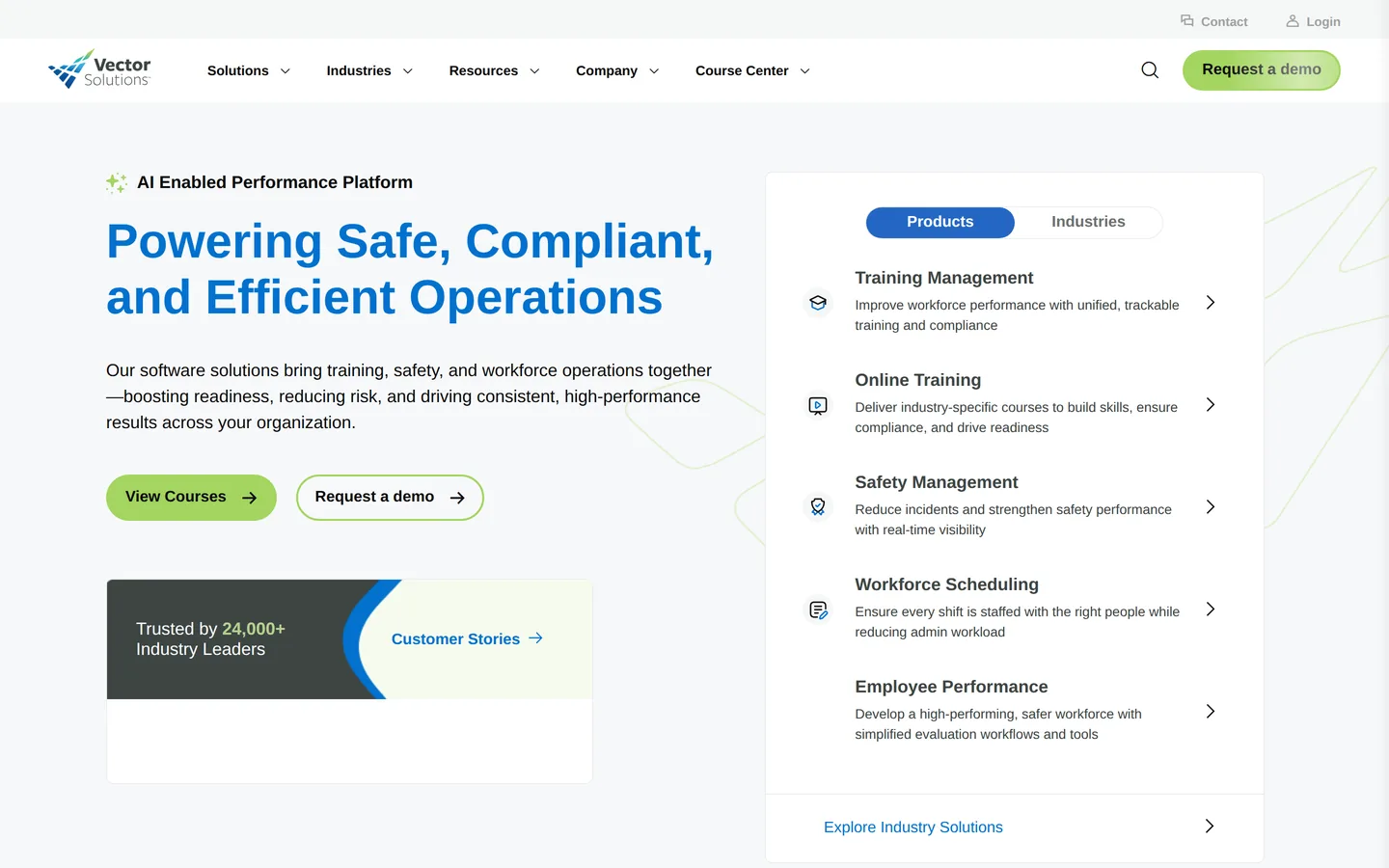
Vector Solutions homepage - training record and certification tracking
272 / 100 · Course delivery with academy and state reporting automation

Vector Solutions

Vector Solutions was founded in 1999 and is headquartered in Tampa, Florida. Their law enforcement offering runs wide: a training management system covering in-service and field training, Acadis for academy automation and state regulatory management, Guardian Tracking for exposure and critical incident monitoring, plus scheduling, asset management and accreditation. The course catalog is nationally certified by IADLEST, and their homepage states they are trusted by more than 24,000 industry leaders across every sector they serve.

  • Founded1999
  • HeadquartersTampa, Florida
  • ModulesTraining Management and FTO, Acadis academy automation, POST and regulatory management, Guardian Tracking, accreditation management
  • PricingQuote only
  • NoteAn Essential Personnel integration partner for credentialing sync

Key stat. AgencyConnect passes officer training completions straight to state POST Acadis systems for annual in-service reporting, the only documented state filing path in this set.

They're the strongest system here on the compliance layer. Certification currency scores 18 out of 20 and reporting 14 out of 15, because Acadis was built for exactly that work and the accreditation module reports on it. They're also the only vendor on this list who can supply the courses, hold the record and file the result. Where they lose ground is the thing this list is about: the record spans several products acquired over time rather than one profile, and their intake story is built around courses they own.

Strengths

  • The only documented state POST filing path, through AgencyConnect
  • Acadis handles academy automation and regulatory management in depth
  • IADLEST nationally certified course catalog
  • Field training and in-service training in the same system
  • Accreditation reporting built in

Limitations

  • The record spans Acadis, Guardian Tracking and the training system rather than one employee profile, holding the profile score to 18 out of 25
  • Automatic intake of completions from a course provider they don't own isn't documented, scoring 10 out of 20 on ingestion
  • Quote only, so no price is available before a sales process
  • Growth by acquisition leaves uneven joins between the parts

Why they score 72

They win the compliance half of the framework outright and lose the record half. If your problem is filing state hours and running an academy, they score higher than anyone here and the total understates them. If your problem is that an officer's history is scattered, buying Vector adds capability without solving it, because their strength is the course and the filing rather than the person.

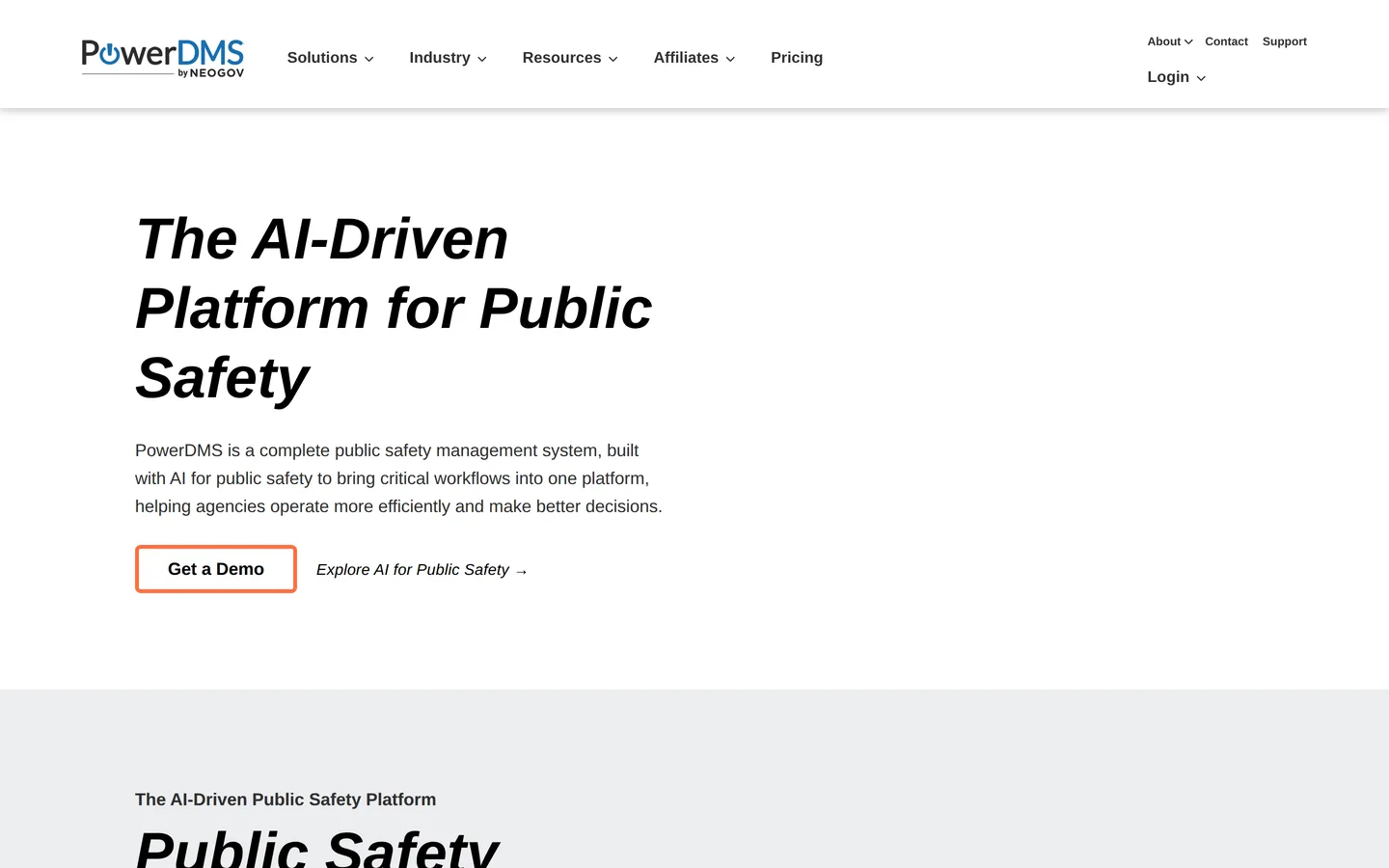
PowerDMS by NEOGOV homepage - training record and certification tracking
357 / 100 · A public safety workforce platform

NEOGOV (PowerDMS)

NEOGOV was founded in 1999 in El Segundo, California and builds HR software for United States public sector agencies. PowerDMS is their public safety platform, and it describes itself as "a complete public safety management system, built with AI for public safety". The training pieces are PowerReady for new-role training, PowerRecall for policy training, and PowerStandards for accreditation, alongside policy, scheduling, background investigations and the professional standards suite.

  • Founded1999
  • HeadquartersEl Segundo, California
  • ProductsPowerReady, PowerRecall, PowerStandards, PowerPolicy, PowerTime, PowerVetted, professional standards suite
  • AgenciesOver 5,500
  • PricingQuote only

Key stat. Over 5,500 agencies on the platform, the largest installed base in this set.

PowerReady is the strongest field training product here, which is why they take the full 5 on that criterion. It was formerly PowerFTO and before that the acquired Agency360, and it covers custom training programs, digital daily observation reports, connected computer-aided dispatch call data, performance improvement plans and defensible readiness records. What's missing is the general training record. PowerRecall trains people on policy rather than tracking what they learned elsewhere, and there's no documented intake of completions from an outside course library.

Strengths

  • PowerReady is purpose-built for field and new-role training, taking 5 out of 5
  • Largest installed base here, so peer references are easy to find
  • Policy, training, accreditation and standards from one vendor
  • PowerStandards handles accreditation reporting
  • Training assigned by role and linked back to policy

Limitations

  • No agency-wide training record product, holding certification currency to 12 out of 20
  • No documented intake from a course provider they don't own, scoring 9 out of 20
  • NEOGOV's core data model is municipal HR, so a police record has to be bent to fit
  • Founding date, headquarters and pricing aren't disclosed on the PowerDMS product pages

Why they score 57

The breadth is real and the field training is the best here, but this framework asks a narrower question than PowerDMS answers. Their training story is strongest at the two ends of a career, onboarding a recruit and re-training on policy, and thinnest in the middle where certifications lapse and outside classes need recording. An agency already standardized on NEOGOV gets a good answer to that middle problem from nowhere in the suite.

Lexipol homepage - training record and certification tracking
454 / 100 · Policy and training content on a readiness platform

Lexipol

Lexipol was founded in 2003 and is headquartered in Frisco, Texas, serving "more than 10,000 agencies and municipalities in 50 states and Canada" with over 450 employees as of 2022. Their LexOne platform spans policy, training, reports, wellness and grants. The training side is content-led: PoliceOne Academy and LocalGovU supply courses, the knowledge management system distributes them, and LEFTA Systems handles field training.

  • Founded2003
  • HeadquartersFrisco, Texas
  • ModulesLexOne platform, PoliceOne Academy, LocalGovU, knowledge management system, LEFTA Systems, Cordico
  • AgenciesMore than 10,000 agencies and municipalities
  • PricingQuote only

Key stat. More than 10,000 agencies and municipalities across 50 states and Canada, the widest reach in this set.

They're a content company with a platform attached, and that shows in the scoring. Course delivery takes the full 5, and LEFTA is a genuinely strong field training product. The record layer is thinner. Training reporting lives inside performance reporting rather than as a system of record, and their published material doesn't describe pulling completions in from a course library they don't own. If your library is already Lexipol, the record is reasonably joined up. If it isn't, they're being asked to do the job this list is about and they weren't built for it.

Strengths

  • PoliceOne Academy and LocalGovU give them full marks on course delivery
  • LEFTA Systems is a strong dedicated field training product
  • Policy and training from one vendor, with acknowledgement evidence
  • Very large installed base, so references are easy to find
  • Auditable trails across investigation and reporting activity

Limitations

  • Training reporting sits inside performance reporting rather than a record system, holding currency to 11 out of 20
  • No documented intake from an outside course provider, scoring 7 out of 20
  • Course counts, hours and state approval detail aren't published on the training pages
  • Quote only, with pricing described as depending on agency size and modules chosen

Why they score 54

The content is excellent and this framework barely rewards it. They score 5 out of 5 on the criterion worth least and lose the two worth most, which is the honest result of asking a course publisher to be a record system. An agency buying policy and courses together should weight course delivery far higher than we do and reread the table accordingly.

L.E.A. Data Technologies homepage - training record and certification tracking
547 / 100 · A standalone police training database

L.E.A. Data Technologies

L.E.A. Data Technologies sells specialized law enforcement databases, and describes itself as software developed by cops for cops. Their Training Database is described as "software designed to provide an automated system for police departments, law enforcement agencies, and military departments to track and manage all training issues", covering scheduling, monitoring and renewal tracking across state-approved, state-required and department-required certifications as well as CALEA-approved and career development training.

  • FoundedNot disclosed
  • HeadquartersHappy Valley, Oregon
  • ProductTraining Database, part of a wider set of law enforcement databases
  • Pricing$1,800 per single license, published, package pricing on request
  • Contact877-296-3282

Key stat. $1,800 for a single license, the only flat published price in the category and a fraction of a per-user subscription for a small agency.

They do one job and they publish what it costs. Renewal tracking across state-required, department-required and CALEA training is genuinely solid at 16 out of 20, and for a department of twenty officers the price is the headline. What they aren't is a personnel platform. The training database sits apart from any performance, incident or equipment record, which is the exact problem this list exists to solve, so the heaviest criterion goes against them at 8 out of 25.

Strengths

  • Renewal tracking across state-approved, state-required, department-required and CALEA training
  • Published flat price, unusual in this category
  • Focused product with no suite to buy around it
  • Built and marketed specifically for law enforcement

Limitations

  • A standalone database rather than a unified personnel record, scoring 8 out of 25 on the heaviest criterion
  • No documented ingestion from a course provider, scoring 4 out of 20
  • No course delivery at all
  • Founding date and agency count aren't disclosed anywhere on the site
  • Smallest vendor here, so integration options are limited

Why they score 47

They come last on a framework built around joining records together, because joining records together isn't what they sell. Measured as a training database with a published price they're a reasonable answer for a small agency, and the fifth-place finish reflects the question this page asks rather than a judgement on the product.

What to do next

Work backwards from the moment the record fails you. If the problem shows up at promotion boards and incident reviews, read the profile column and start with Essential Personnel. If it shows up when state in-service hours are due, read the reporting column and start with Vector Solutions. If you're onboarding recruits and the paperwork is the bottleneck, PowerReady is the strongest field training product here. And if you're a small agency that needs a training database with a price on it, L.E.A. Data Technologies publishes one.

A short exercise that saves months: pick one officer and count the systems their training history currently lives in. One that fits is worth keeping. Three or four is the cost you're already paying, and it doesn't appear on any price sheet.

Bring your last promotion packet, an officer's certification list and whatever your course library exports. We'll show you what falls out of daily work.

Book a walkthrough

Talk to Essential Personnel directly: info@essper.com or (910) 390-0011. Offices at 1502 Castle St, Wilmington, NC 28401. Available on GSA Advantage, NASPO, Omnia Partners, NCSA and VSA.

Frequently asked questions

Essential Personnel is the closest to a single answer, holding training records, performance, incidents and issued equipment on one employee profile, and it scores 24 out of 25 on that criterion. Vector Solutions covers the same ground across several products rather than one record, scoring 18 out of 25.

A learning management system delivers courses and records completion of those courses, so it reports by class. A training record system holds completions from any source on the employee's file, so it reports by person. Departments need both, and the two sit alongside each other rather than competing.

No, and keeping it is usually the right call. A record system sits over the library you already run and takes completions from it. Ask each vendor how completions arrive from your specific provider, because only two of the five systems here document automatic intake from a course library they don't own.

The evidence has to come from one record rather than several exports. Look for a system that holds certifications, qualifications, course history and evaluations on the same profile, so a board reads an identically shaped file for each candidate instead of weighing whoever documented themselves best.

Ask what the system does 60 days before an expiry, not what it shows on a dashboard. You need a named recipient, a logged notice and proof afterwards that it went out. Vector Solutions scores highest here at 18 out of 20, with Essential Personnel at 17 and L.E.A. Data Technologies at 16.

Two of the five publish a number. Essential Personnel charges $85 per user per year for the suite holding training records, or $175 bundled across four suites, plus a $3,000 one-time start-up fee. L.E.A. Data Technologies publishes $1,800 per license. The other three quote on request.

Only Vector Solutions documents it. Their AgencyConnect feature passes officer training completions to state POST Acadis systems for annual in-service reporting. If mandatory state filing is your bottleneck, weight the reporting criterion higher than this ranking does and read that column first.

Essential Personnel states alignment with the FBI CJIS Security Policy, an annual SOC 2 Type II report available on request, and hosting entirely in AWS GovCloud with FIPS 140-3 validated cryptography. The others don't document their posture on the product pages, so ask each vendor for a current attestation in writing.

About this ranking. Compiled by Scott Monroe, Chief Executive Officer & Co-Founder of Essential Personnel, and published 7 September 2026. Essential Personnel is one of the five systems assessed, and the framework, weightings and per criterion scores are all published above. No vendor paid for placement and no vendor saw the ranking before publication. Vector Solutions integrates with Essential Personnel for credentialing sync, and that partnership did not affect scoring. Field training is weighted at 5 here because it is scored in depth on our police performance ranking. All provider facts were verified against primary sources in September 2026.