
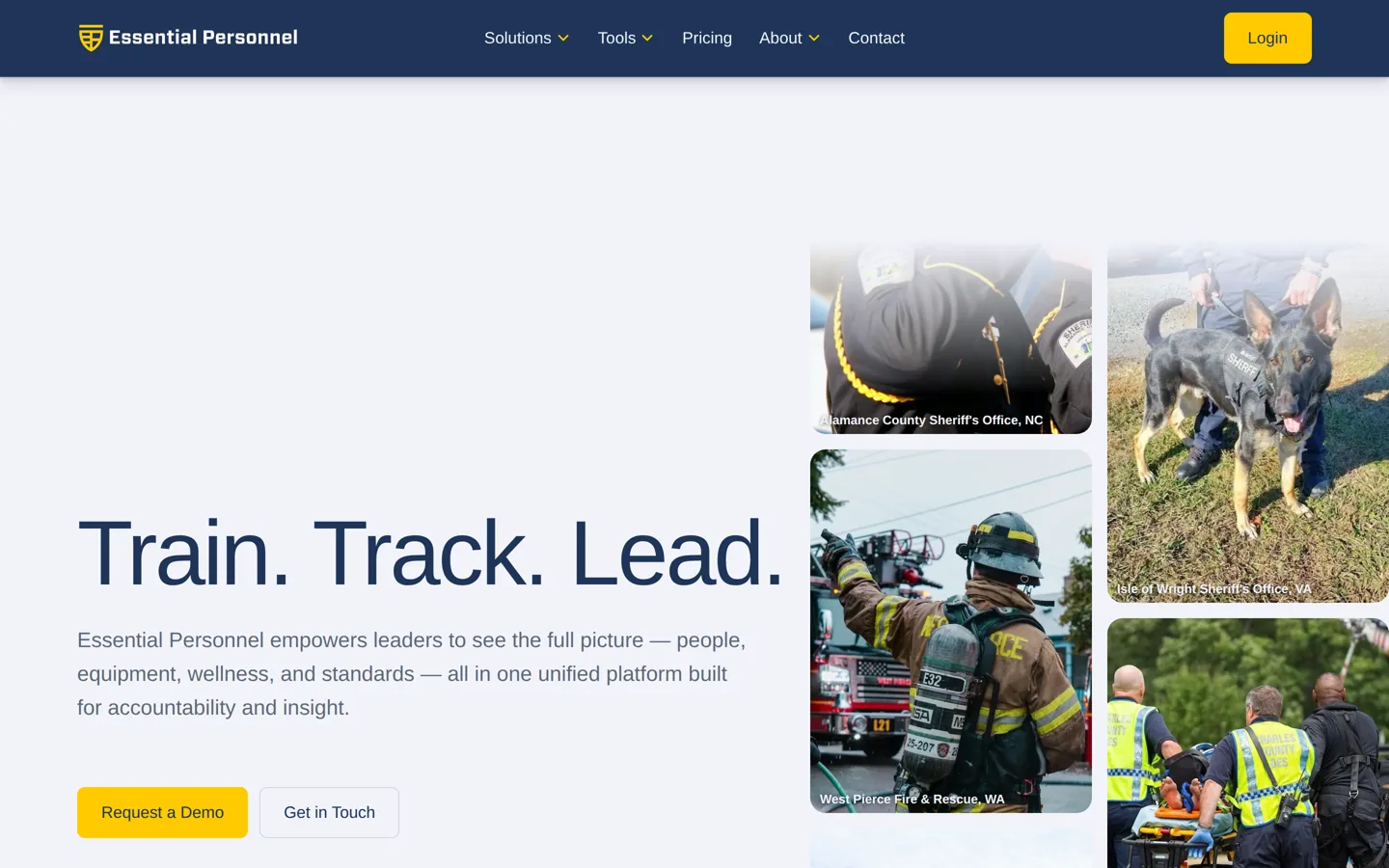
Essential Personnel is professional standards software for public safety, founded in 2020 in Wilmington, North Carolina by two firefighters. Their Guidance module publishes five content types to your people: policies, memos, announcements, lessons learned and research. It captures each person's confirmation of receipt, keeps built-in version tracking with the option to revert, and treats that acknowledgment as part of the employee record rather than as an entry in a document system. For a city the consequence is that the policy receipt sits beside the same person's certifications, evaluations, counseling notes and issued equipment.
"There are so many things the Biscoe Police Department likes about Essential Personnel; I don't know where to begin. One of the most liked things is that we can store so much information on one platform that is easily accessible for convenience. We keep policies, ordinances, training, and multiple other things in Essential Personnel. The staff is very friendly and helpful, and replies quickly to any questions you may have."Tina MedlinInterim Police Chief, Biscoe NC Police Department
"Our partnership has been immensely valuable to the City and has had a significant impact on the development of all our employees."LaSharon HamptonHR Director, City of Pinellas Park
"EP has strengthened accountability, enhanced communication and become an essential tool in helping our office better serve the community."Travis SumptionSheriff, Clarke County, VA
They take defensible record retention at 19 out of 20, the heaviest criterion after distribution, because the acknowledgment is part of a personnel file rather than a row in a policy log. They tie Lexipol for the highest public safety fit at 12, and they're the only vendor publishing a price. They don't take the distribution criterion: at 22 out of 25 they sit behind Lexipol and PowerDMS, both of which sell a deeper policy product. Their lowest column is cross-department coverage at 6 out of 10, and a city that needs one policy workflow for all 300 employees rather than the 40 sworn ones should read PowerDMS at position 2 instead.
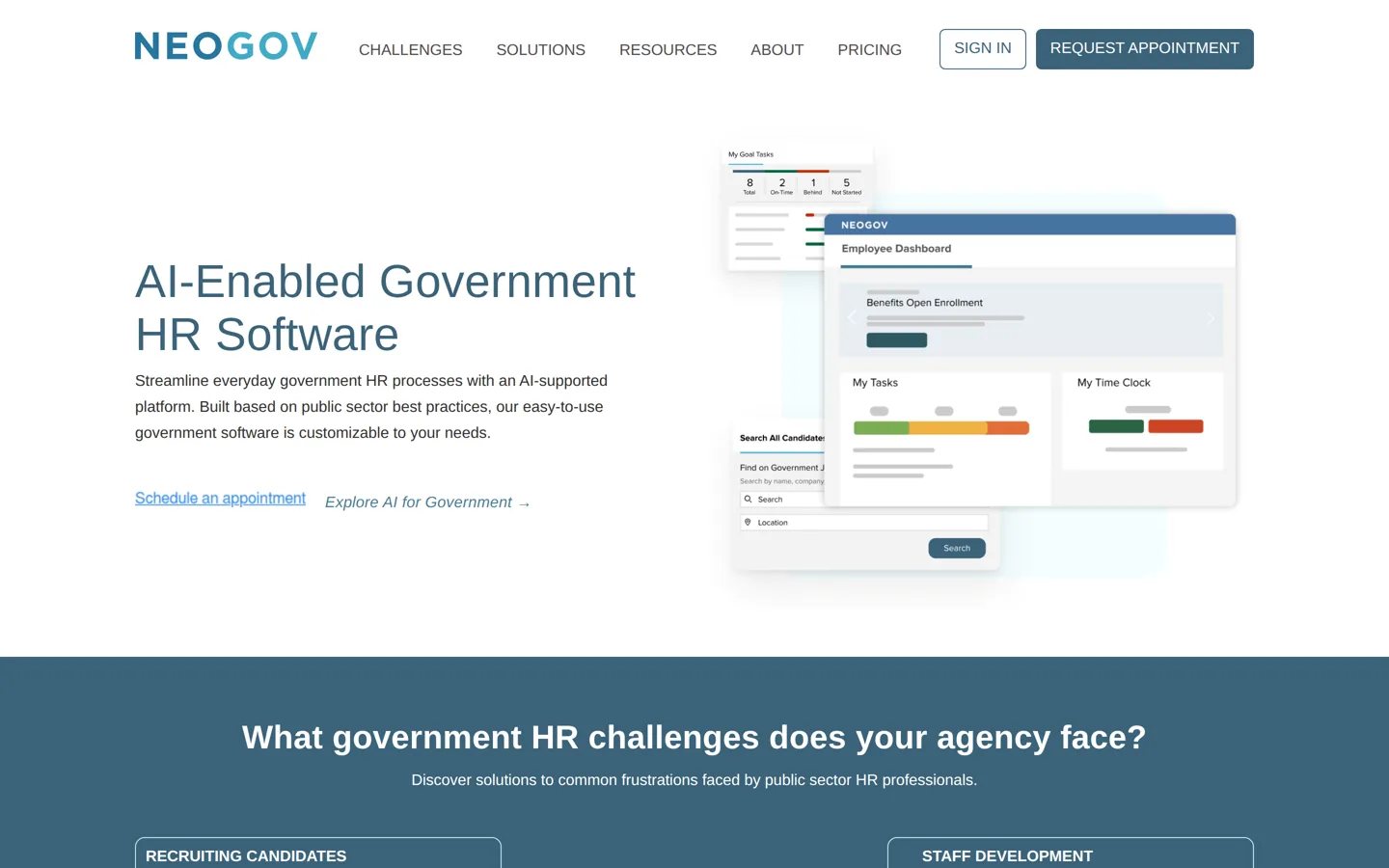
NEOGOV was founded in 1999 in El Segundo, California and builds HR software for United States public sector agencies. They announced the PowerDMS acquisition in December 2020 and completed it in early 2021, and PowerDMS is now used by over 5,500 agencies. Their own description of the core job is hard to improve on: a department can revise a policy and "with one click release it to hundreds of people so they can acknowledge it". PowerPolicy handles distribution, PowerStandards handles accreditation, and PowerRecall turns policy content into training. They're owned by EQT and CPP Investments.
Second overall and the strongest competitor on this page. They're a point behind Lexipol on distribution at 23 out of 25 but ahead on everything structural: full marks on accreditation and on cross-department coverage, which is the combination a city standardizing policy across departments actually needs. What separates them from first place is where the record ends up, plus a pricing column they score 2 out of 10 on.
Lexipol was founded in 2003 by Bruce Praet and Gordon Graham and works from Frisco, Texas and southern California. They report more than 10,000 agencies and municipalities as customers across 50 states and Canada. What they sell first is content: continuously updated, legally vetted policies tailored to federal and state law, with the management layer around it inside the LexOne platform. Sectors served include local government and risk management alongside police, fire, EMS, corrections and dispatch, and LocalGovU is their local government training brand. GTCR has owned them since October 2021.
They take the heaviest criterion outright. If your policies are stale and nobody on staff is going to rewrite them, Lexipol is the answer regardless of where they place on the total, and the honest recommendation is to read that column rather than the rank. Third place comes from the columns behind it: record retention at 15, and 2 out of 10 on pricing.
NAVEX works from Lake Oswego, Oregon and reports 13,000 customers worldwide managing over 10.3 million policy documents. PolicyTech arrived in the 2012 roll-up that merged EthicsPoint, ELT, Global Compliance and PolicyTech into NAVEX Global, and it's now marketed as NAVEX One Policy and Procedure Management: automated policy lifecycle, distribution, attestations and tracking, with comprehension quizzes, Microsoft 365 integration and a Nira assistant across more than 70 languages. A consortium led by Goldman Sachs Alternatives, including Blackstone, completed a majority-stake acquisition in October 2025. Government is a named industry.
Fourth on the total and first among the city-wide platforms, and they win the tie with Vector Solutions on the heaviest criterion, 22 against 18. As a pure policy engine they're arguably the most complete product on this page. What costs them is everything specific to public safety: no accreditation reporting a chief would recognize, and no data model that knows what a shift is.
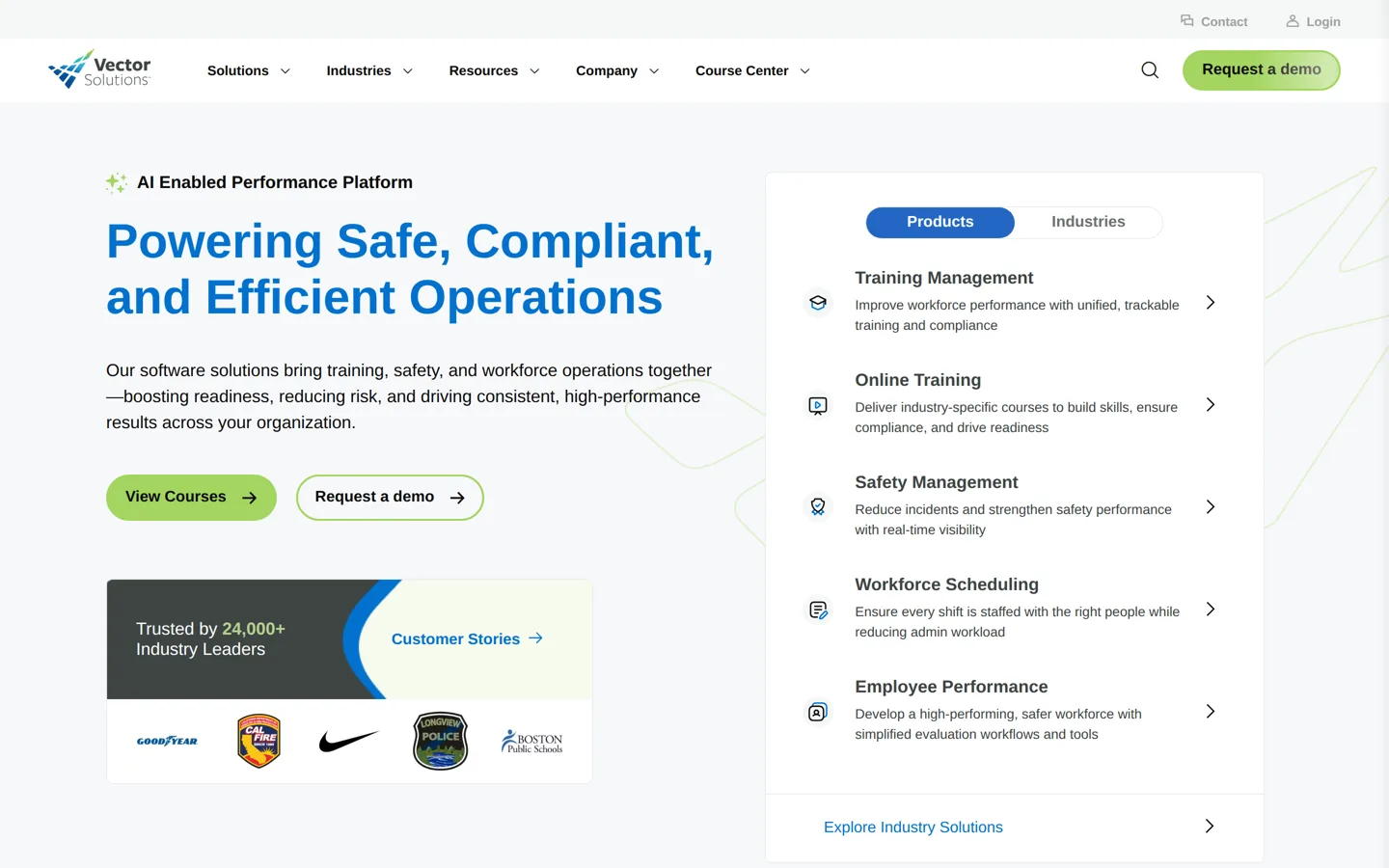
Vector Solutions was founded in 1999 and works from Tampa, Florida. Their public safety line is training-led: Vector LMS, Vector Scheduling, Vector Check It, Vector Evaluations, Guardian Tracking and the Acadis academy platform. Policy Tracker is the newest piece, arriving through the Frontline Public Safety acquisition in April 2025, and it does what the name says: manage, distribute and track all agency policies and memos, with an AI quiz generator that turns policy text into knowledge checks. Essential Personnel integrates Vector's learning content.
Tied with NAVEX on the total and behind them on the tie-break. Vector is the strongest option here if you already run their training platform, because the policy record and the training record end up in one place without an integration project. Bought purely as policy management, it's the least mature product on the list, and the law-enforcement-only scope is a real constraint for a city with a fire department.
Mitratech was founded in 1987, works from Austin, Texas and reports 20,000 organizations across more than 160 countries. PolicyHub automates the development, communication, training and auditing of policies and procedures, with intelligent distribution, knowledge assessments, attestation tracking, follow-up workflows for people who haven't completed, and a digital audit trail built for reporting to auditors and regulators. Government is one of the named sectors, alongside financial services, healthcare and education.
Sixth on the total, and they take the tie with Ideagen ConvergePoint on distribution, 20 against 19. PolicyHub is a competent enterprise policy engine and the non-completion chasing is the feature municipal administrators will notice first. It ranks here because a city buying it gets nothing that understands police and fire, and because the accreditation column is the weakest on the page.
ConvergePoint is based in Texas and was acquired by Ideagen in an announcement dated 25 June 2025. The product is a native Microsoft 365 SharePoint Online application with Word Online, Outlook and Teams plug-ins, covering the full policy lifecycle: templates and pre-approved content, drafting with track changes, structured review and approval with automated notifications, roles-based access by function, region or department, acknowledgment with optional quizzes, and complete version history with reviewer comments preserved in the approval trail. Government agencies are a named industry, and Ideagen reports over 1,000 government organizations across its portfolio. No founding year is published.
Seventh on the total and level with Mitratech, losing the tie-break by a point on distribution. For a city whose IT department runs everything through Microsoft 365 and whose policy problem is drafting and approval rather than accreditation, this is a stronger practical fit than its rank suggests. The SharePoint dependency is what makes it either the easiest or the hardest system here to deploy, with nothing in between.
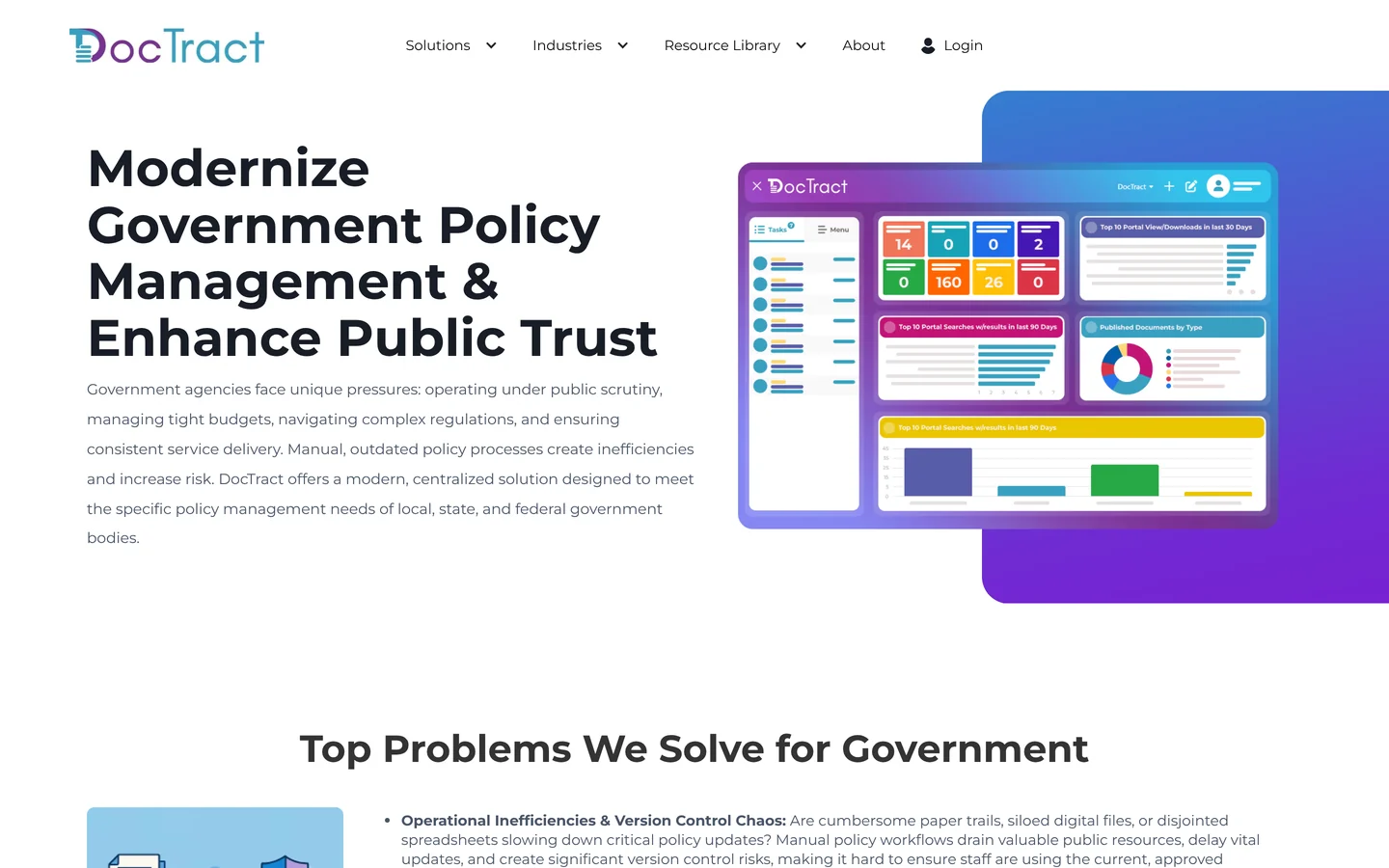
DocTract works from offices in Novi, Michigan and Cary, North Carolina, and is the only system on this list whose policy product is aimed squarely at government rather than at government among other sectors. They describe a cloud platform purpose-built for local, state and federal policy and procedure management: a single repository for policies, SOPs and procedures, configurable review cycles and periodic reviews, optional public sharing of specific policies, attestation monitoring with automated reminders, a complete audit trail of every revision and approval, one-click audit packages and AI-enhanced search. Named customers on their government page include Logan County, Ohio and Fairfield. No founding year is published.
Eighth on the total, and the position reflects scope rather than execution. Inside the job it's built for, publishing a multi-department government policy library and proving who read it, DocTract does the work and names real local government customers doing it. What the total counts against it is everything around the edges: the thinnest integration story, no public safety reporting, and less published company information than any other vendor here.
Decide which of the two shapes you're buying before you take a demo. If the litigation risk in your city sits in police and fire, and the question that keeps you up is whether one employee's file will hold together at a hearing, you want a personnel record with policy attached. If your problem is that 300 employees across nine departments have never acknowledged anything consistently, you want a city-wide platform and the public safety fit column matters less.
Then run the retrieval test. Ask each vendor, live in the demo, to pull one employee's complete acknowledgment history for a named policy across three versions. Don't accept a report that gets emailed afterwards. The systems that can do it on screen are the ones you'll be glad of later, and the gap between the two groups is obvious within about 30 seconds.
If you want to walk your own grievance file or accreditation packet through it, reach Essential Personnel at info@essper.com or (910) 390-0011, or read how the platform handles municipal HR and policy guidance first. They'll also tell you when the answer is to keep what you have.
Bring the last discipline decision your city defended, and the policy version that was in force that week. We'll show you what falls out of daily work.
Book a walkthroughAll eight systems here do it. Lexipol scores highest on the criterion at 24 out of 25, PowerDMS at 23, then Essential Personnel and NAVEX at 22. The real choice is not whether a system captures acknowledgment but where the record lives. Essential Personnel puts it on the employee record; the other seven keep it in a policy system.
Essential Personnel is the alternative when the gap is the personnel record rather than the policy library, taking defensible record retention at 19 out of 20 plus the only published pricing here. NAVEX PolicyTech suits a city-wide rollout with deeper approval routing. Vector Solutions fits agencies already running their training platform. DocTract suits smaller governments.
Put the record in one system that understands both services, and let it feed the city HR platform rather than the reverse. Essential Personnel carries policy acknowledgment, certifications, evaluations and issued equipment on one employee record. NEOGOV covers the city, with PowerDMS for policy and Agency360 for training records. Separate systems per department mean three exports and a spreadsheet.
Four things. Who writes the policies, because only Lexipol sells legally vetted content. Where the acknowledgment record ends up, which decides how fast you can answer a grievance. Which departments the data model understands, since public safety systems know rank and shift and city-wide platforms don't. And what your accreditation cycle asks for.
It helps if it produces four things together: the policy version in force on the date, that employee's timestamped acknowledgment of it, who approved that version, and an audit trail nobody edited afterwards. A city showing all four is in a different position from one relying on a shared drive. Ask your counsel about the standard in your jurisdiction.
Essential Personnel publishes its cooperative purchasing routes: GSA Advantage, NASPO, Omnia Partners, NCSA and VSA. The other seven don't publish a comparable list, so ask each directly and get the contract number in writing before building a procurement timeline around it. A cooperative vehicle can remove months from a municipal purchase.
Seven of the eight are quote only. Essential Personnel publishes $175 per user per year for the bundled Total Solution, individual suites from $20 to $85 per user, a one-time $3,000 startup fee, and optional single sign-on at $800 per year per agency. Budget for the module stack rather than the headline.
It depends where the risk sits. A city whose sworn staff are a small share of headcount, and whose problem is consistency across nine departments, can run a city-wide platform and be defensible. A city where the litigation and accreditation pressure comes from police and fire should read the public safety fit column first.
Compiled by Scott Monroe, Chief Executive Officer and Co-Founder of Essential Personnel. Published 31 August 2026.
Essential Personnel is one of the eight systems assessed, and the framework, weightings, per-criterion scores and totals are all above. No vendor paid for placement. Essential Personnel integrates Vector Solutions learning content.
