Who provides the best EMS online training? 8 providers compared for 2026
Published 20 October 2026
There isn't one best EMS online training provider. There's a best fit for your agency, and it depends on whether you're buying for a whole service or for yourself, whether your state wants live hours, and how much reporting your training officer needs. Every provider here is CAPCE accredited, so the courses will count toward NREMT recertification. What separates them is price, live classes, agency tools and what happens to the record once a course is done.
This guide is for EMS chiefs, training officers and coordinators, and the fire chiefs who run EMS inside a fire department. It's also useful for the EMT or paramedic choosing their own EMT continuing education online. It compares the eight providers you're most likely to shortlist in 2026 and helps you understand the options and make a good decision for your agency's needs.
Each provider was checked against the same six questions: CAPCE accreditation, self-paced and live formats, the size of the catalog, published pricing, tools for running an agency's training, and whether completions can leave the provider's system. Everything here comes from the providers' own pages, NREMT and CAPCE, checked in October 2026.
The short version. For an agency that wants published per-seat pricing, live and self-paced classes and a way to get completions out, Prodigy EMS fits best. For an EMT or paramedic paying their own way, Recert and EMSconnect are the cheapest. For live virtual classes, DistanceCME and Impact EMS run the deepest schedules. And the decision that matters more than any of these is where your agency keeps the training record afterwards.
The eight EMS online training providers compared
Eight CAPCE accredited online EMS training providers. Prices are the published figures in October 2026.
LMS to assign, track and report for groups of ten or more
None documented
What EMS continuing education counts toward NREMT recertification
NREMT recertification runs on a two-year cycle with a March 31 deadline. EMTs need 40 hours, AEMTs 50 and paramedics 60, split across national, local and individual components, and any CAPCE accredited EMS continuing education counts. Since 2022 there's been no national limit on how much of it can be online, though some states still treat live and self-paced hours differently.
The National Registry calls the model the National Continued Competency Program. Half the hours are a national component and a quarter each are local or state and individual. The 2025 version of the model began on April 1, 2025 for EMTs, AEMTs and paramedics and on October 1, 2025 for EMRs, who need 16 hours.
NREMT continuing education hours per two-year cycle
Level
Total
National
Local or state
Individual
EMR
16
8
4
4
EMT
40
20
10
10
AEMT
50
25
12.5
12.5
Paramedic
60
30
15
15
CAPCE, the Commission on Accreditation for Pre-Hospital Continuing Education, accredits the courses. It labels self-paced online courses F3 and live virtual instructor-led training, or VILT, F5. The National Registry and many states accept F5 as equivalent to sitting in a classroom, but no online course can verify skills. That still has to happen face to face.
Most EMT continuing education online is now sold as self-paced F3 courses, with live F5 classes for clinicians whose state wants them. Two rules matter more to an agency than to the individual. To renew with active status, a clinician has to be affiliated with an EMS agency and have their skills verified, and a return to active status goes through the agency's training officer. And the National Registry can audit any application, so you have to keep proof of attendance for everything submitted for at least 36 months.
What to look for in EMS training software and online courses
When an agency compares EMS training software, look past catalog size. Check that the provider is CAPCE accredited for both self-paced and live classes, publishes a per-seat price, maps training plans to NREMT and your state's rules, and lets you record outside training. Then ask how completions get out of their system and into yours, because your agency keeps the record, not the vendor.
CAPCE accreditation, F3 and F5. All eight here are accredited. If your state wants live hours, make sure the provider runs live virtual classes on a schedule your shifts can actually make.
Plans mapped to NREMT and state requirements. The best EMS training software builds each clinician's plan from their level and state, so nobody counts hours by hand in February.
Agency pricing you can see. Most providers quote agencies on request. A published per-seat price lets you budget before a sales call.
Outside and in-person training. Skills days, drills, conferences and classes from other providers are part of the record too. Check whether the platform can hold them.
A way to get completions out. An API, an export or a named integration. If the only copy of a clinician's history sits in the vendor's system, switching vendors means losing it.
Medical director and training officer views. Who signs off on skills and remediation, and can they do it in the same place?
Pricing$140 a year individual. Agencies from $70 per seat a year
Best forAgencies that want one CE provider with published pricing and open data
Prodigy EMS sells online EMS training built around departments. They say more than 1,400 departments use it, and they add at least one new class a week. Training plans map to NREMT and state recertification requirements, including local requirements where a state publishes them. Every CAPCE accredited class completed in Prodigy goes to CAPCE and the National Registry straight away, and clinicians can pull those completions into their NREMT application.
For a training officer, the agency side covers team plans and assignments, progress in real time, alerts before certifications expire, compliance reports, a class builder for your own content, and a place to record training done outside Prodigy, such as drills and conference sessions. They're also the only provider here that documents an API for pulling completion and user data into other systems, with single sign-on. Prodigy is Essential Personnel's closest integration partner, and it integrates with the EP Logbook.
Strengths
The only published per-seat agency price here, from $70 a year
Both self-paced and live virtual classes
A documented API, single sign-on and outside training records
Plans built from NREMT and state rules
Limitations
Fewer CE hours claimed than the largest catalog here
Their SOC 2 Type II program is still in progress
Fire content comes through a partner rather than their own library
EMS1 Academy is Lexipol's online EMS training, sold alongside their policy, wellness and the EMS1 news site. It claims the largest catalog in this comparison, at more than 500 courses and videos totaling over 440 continuing education hours, accredited by CAPCE and recognized by the National Registry.
The agency tools track credential renewal by level, state and category, build learning plans for onboarding and annual recertification, take your own content and tests, and log offline training. Some content, including EMT Interactive and Paramedic Interactive, costs extra, and Lexipol doesn't publish agency prices.
Strengths
The largest EMS continuing education catalog claimed here
Credential renewal tracking by level and state
Bundles with Lexipol's policy content
Limitations
No published agency price, and some courses cost extra
Pricing$99 for two years individual. Agency pricing on request
Best forAgencies already on Vector scheduling or asset tools
Vector Solutions sells online EMS training through Vector LMS, formerly TargetSolutions, which absorbed CentreLearn in 2014. They're organizationally accredited by CAPCE and sell the training alongside shift scheduling, controlled substance and asset tracking, skills evaluations and task books.
That breadth is the reason to pick them and the reason to be careful. The online course choice and the agency's operations platform come as one purchase, so a change of course provider later means a change of much more. Vector's credential data syncs into Essential Personnel.
Pricing$31.50 per live class, $99.75 for the recorded package
Best forClinicians whose state wants live hours
DistanceCME is built around live virtual classes, and they're on CAPCE's list of accredited providers of live refresher courses. Live NCCP classes are sold one at a time, and a package of more than 100 recorded courses covers self-paced hours.
Impact EMS sells complete NCCP refresher packages at each level, with live and self-paced options and in-person skills events. They're on CAPCE's live refresher list, and they upload certificates to the National Registry automatically. An agency program exists through their sales team, but its features aren't described.
Strengths
Complete refreshers with clear prices
Live classes and in-person skills
Limitations
Agency tools aren't documented
Per-person refresher pricing adds up across a whole service
Best forIndividuals who want live webinars at a low price
EMSconnect is a CAPCE accredited provider offering live webinars and on-demand courses with no contract, plus NCCP refresher packages for each level. They also run the EMSCon conference in Spokane. Agency plans are quoted on request.
OwnerPublic Safety Group, Jones & Bartlett Learning
Based inBurlington, MA
FormatsSelf-paced
Catalog200+ courses
Pricing$61.95 unlimited individual
Best forIndividuals buying EMT continuing education online on a budget
Recert comes from the Public Safety Group at Jones & Bartlett Learning, the publisher behind many EMS textbooks, with content drawing on PHTLS and PEPP. All 200-plus courses are CAPCE approved, and unlimited individual access is the cheapest published price in this comparison. Employers can get reporting, scheduling and tracking by quote.
Best forAgencies that buy other safety training from HSI
24-7 EMS is the first responder continuing education line of the Health & Safety Institute. It's CAPCE accredited for online and live virtual courses, and HSI reviews each course every three years or when guidelines change. Agencies with ten or more people get package discounts and a learning management system to assign, track and report on training.
Strengths
Both online and live virtual courses
A stated review cycle for every course
Limitations
No published prices or catalog size
EMS is one line in a broad safety catalog
Which online EMS training provider fits which agency
Match the provider to how you buy. An agency buying for a whole service gets the most from Prodigy EMS, with published per-seat pricing, live and self-paced classes and an API. Individuals on a budget do well with Recert or EMSconnect. If your state wants live hours, DistanceCME and Impact EMS run the most live classes.
For agencies
A department buying for every clinician. Prodigy EMS. Their agency plans start at $70 per seat a year, training plans follow NREMT and state rules, and completions can leave their system through the API.
A state that wants live hours. DistanceCME for single live classes, or Impact EMS for a full refresher with live and in-person skills options.
A fire department running EMS. Pick a provider that covers both fire and EMS, or keep two and make sure both feed the same record. Prodigy covers fire through a partner, and Fire Engineering Training covers both and syncs into Essential Personnel's Logbook.
A group already buying safety training. HSI's 24-7 EMS, if the rest of your safety training already comes from HSI.
EMT continuing education online, for individuals
If you're an EMT or paramedic choosing EMT continuing education online for yourself, price and schedule matter most. Recert is $61.95 for unlimited self-paced courses, and EMSconnect starts at $7.50 a month with live webinars included. For a full refresher in one purchase, Impact EMS sells each level as a package, from $97 for an EMR to $297 for a paramedic. If your agency already buys an EMS learning management system, ask before you pay for your own, because your seat may already be covered.
Whatever you pick, run one test before you sign. Ask the provider to export a clinician's full history for the last two years, every course, date and hour, in a file your agency can keep. How easily they can do that tells you more than the catalog count.
The bigger decision: your EMS learning management system isn't your training record
Your EMS learning management system holds a transcript of the courses taken on it. Your agency still has to hold the whole record: state licenses, national registry dates, skills sign-offs, in-person training, other providers' courses and certifications, for 36 months or longer. Choosing where that record lives, and how each training source connects to it, matters more than choosing the course library.
Look at what each copy of the record actually is. The course provider's transcript covers only their own classes, and it leaves with the contract. CAPCE's record holds accredited completions reported by providers, but it belongs to CAPCE, and its own data standards say so. The National Registry sees what a clinician submits. None of these is your agency's file, and none of them knows about the skills day you ran in the bay last month.
The gaps show up at the worst moments. A paramedic's state license renews on a different cycle from their National Registry card. A clinician moves from EMT to paramedic and the old hours don't follow them neatly. An audit asks for proof of attendance from two years ago, and the provider you used then isn't the one you use now. A fire department runs fire training on one platform and EMS continuing education on another, and the training officer rebuilds the picture in a spreadsheet every March.
So the decision isn't only which EMS online training to buy, or which EMS training software delivers it. It's how that training connects back to the systems you run the agency on: the personnel record, certifications and expirations, qualifications and task books, scheduling and promotion. That's an operational question, and the answer is a system of record that every training source feeds.
How Essential Personnel connects online EMS training to the rest of your agency
Essential Personnel is the training system of record for fire and EMS agencies, not a course library or EMS training software for delivering courses. You keep the EMS online training provider you choose, and its completions land on each member's file in EP beside their certifications, expirations, task books, in-person training and performance record, so the training officer has one place to answer every audit and readiness question.
EP was founded in 2020 by two Wilmington firefighters, and their Talent Management suite holds the training side of the record. Logbook tracks hours and activities against goals and benchmarks. Certifications tracks credentials, expirations, completions and the source documents behind them. Qualifications holds task books and check-offs, and Events handles in-person training with attendance and cost.
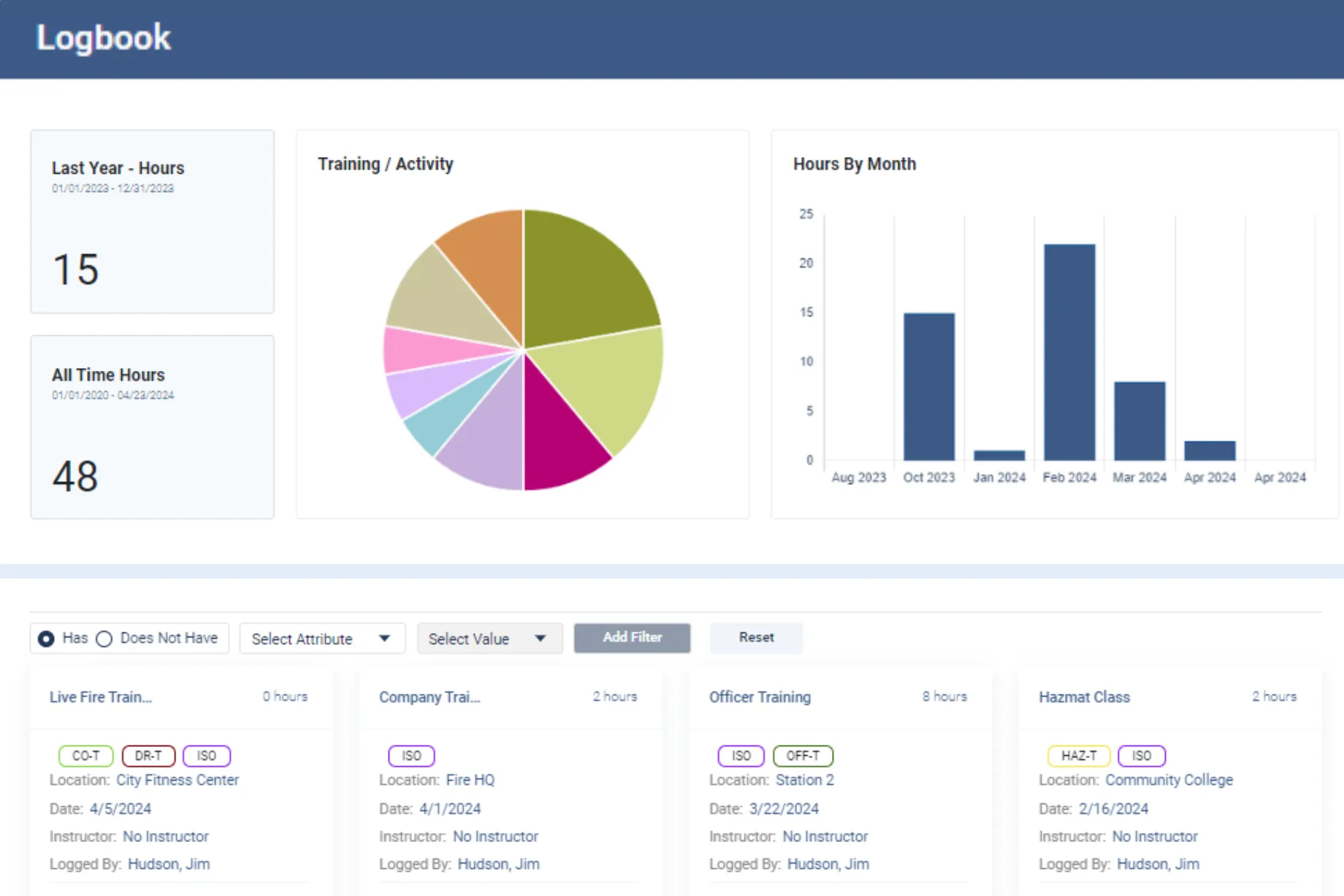
The Logbook keeps every training hour on the member's file, whichever provider or classroom it came from, tagged so it can be reported by category.
The connection is what makes it work. ProdigyEMS, EP's closest partner, integrates with the EP Logbook. Fire Engineering Training syncs e-learning and instructor-led training into the Logbook, and Vector Solutions syncs credentialing information. Training that happens in person, on a drill ground or at a conference goes onto the same file.
EMS is where this matters most, because one clinician can hold a state license, a National Registry certification and agency authorizations at once, each on its own cycle. EP tracks each one with its expiration and source document, and the report most services actually need, everyone whose credential lapses in the next 90 days, is a query rather than an audit.
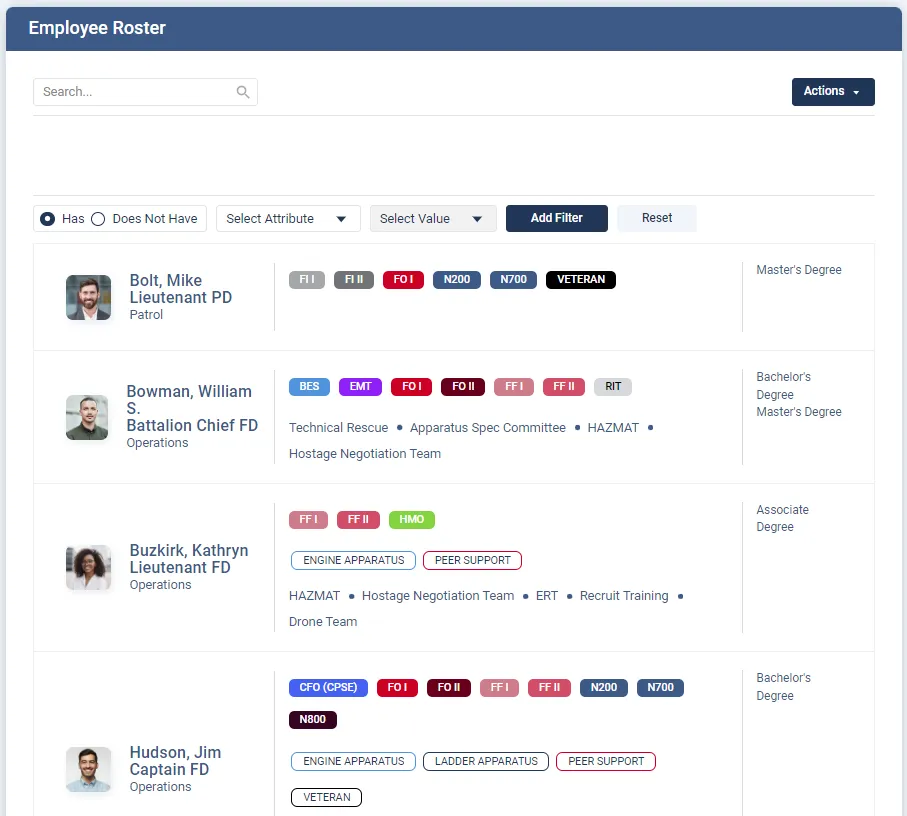
The roster shows every member's credentials and teams together, and can filter for who has, or doesn't have, a given certification.
Because the record sits with the agency rather than the EMS learning management system, you can change EMS continuing education providers without losing a clinician's history. The same file then carries into evaluations, promotion eligibility and readiness reporting, which a course library was never built to hold.
Pricing is published. Talent Management, which covers training records, is $85 per user per year, and the Total Solution with all four suites is $175, plus a $3,000 one-time start-up fee. The pricing page has the details, and the fire and EMS page covers how EP handles EMS credential currency. EP is hosted in AWS GovCloud, and you can buy it through GSA Advantage, NASPO, Omnia Partners, NCSA and VSA.
If you're also choosing training for the fire side of the house, our guide to fire department training software compares the platforms.
Want to see your EMS training, certifications and expirations on one record, whichever provider you choose? Call (910) 390-0011 or email info@essper.com and bring a clinician's last two years of CE to the demo.
It depends on who's buying. For an agency, Prodigy EMS fits best, with published per-seat pricing, live and self-paced CAPCE classes and an API for completions. Individuals on a budget do well with Recert or EMSconnect, and DistanceCME and Impact EMS run the most live virtual classes. Every provider here counts toward NREMT recertification.
No. Since 2022 the National Registry has had no limit on how much online education you can use toward recertification. Some states still treat self-paced and live hours differently for state licensure, so check your state EMS office's rules before you plan a whole cycle around self-paced courses.
F3 is self-paced online learning that you take on your own schedule, with a test at the end. F5 is live virtual instructor-led training, where an instructor teaches in real time and attendance is checked on video. The National Registry and many states accept F5 as equivalent to a classroom, but neither can verify skills.
Over each two-year cycle, EMRs need 16 hours, EMTs 40, AEMTs 50 and paramedics 60. Half is a national component, and a quarter each is local or state and individual. Education must be finished by March 31 of the expiration year, and you must keep proof of attendance for at least 36 months.
No. An EMS learning management system delivers courses and tracks what's taken on it. A training records system holds the whole record for each member: licenses, registry dates, certifications, in-person training, task books and courses from every provider. Most agencies need both, connected so completions flow from the course provider into the record.
No. Essential Personnel is the training system of record, not a course library. Agencies keep the EMS continuing education provider they choose, and completions land on each member's file beside certifications, expirations and task books. ProdigyEMS integrates with the EP Logbook, and Fire Engineering Training and Vector Solutions sync into EP too.
Keep one record per clinician that holds every license and registry date with its expiration, plus training from every source: online providers, in-person skills days and conferences. Connect your online training provider to it so completions arrive without retyping, and run a report each month of who lapses in the next 90 days.
Most providers quote agencies on request. Prodigy EMS publishes agency plans starting at $70 per seat per year, falling as the team grows. Individual prices run from $61.95 a year for Recert's unlimited access to $297 for an Impact EMS paramedic refresher. Training records software is a separate cost, such as Essential Personnel at $85 per user per year.
Among the providers compared here, Recert has the lowest published price for unlimited self-paced courses at $61.95, and EMSconnect starts at $7.50 a month with live webinars. Both are CAPCE accredited, so the hours count toward NREMT recertification. Check whether your agency already pays for a seat before buying EMT continuing education online yourself.
About this article
Written by Scott Monroe, Chief Executive Officer & Co-Founder, Essential Personnel. Published 20 October 2026.
Essential Personnel isn't an EMS training provider and isn't one of the eight compared. ProdigyEMS, Fire Engineering Training and Vector Solutions integrate with Essential Personnel, and Lexipol and Vector Solutions sell personnel software that competes with it. No provider paid to appear or saw this article before publication. Provider details come from each provider's own pages, and recertification rules from NREMT and CAPCE, checked in October 2026. Prices change, so confirm them with the provider.
By clicking “Accept All Cookies”, you agree to the storing of cookies on your device to enhance site navigation, analyze site usage, and assist in our marketing efforts. View our Privacy Policy for more information.