What is the best software for a Chief of Administration in a fire department? Top 7 for 2026
Published 29 October 2026
The best software for a Chief of Administration in a fire department is the system that holds the department's people: personnel records, evaluations, discipline, promotions, training and certifications, policy acknowledgements and issued equipment, with reporting across all of them. Office tools such as Microsoft 365, Google Workspace, Asana, monday.com and Smartsheet run email, documents and projects, but none of them knows who is certified, who is eligible for promotion or which member signed the new SOG. That record is what the administration division answers for, and in most departments it still lives in spreadsheets, binders and a shared drive.
This is written for the deputy chief, division chief or assistant chief of administration in a fire or EMS department, and for the administrative, HR, training and logistics staff who report to them. It explains what the role owns, which kinds of administrative management software cover which duties, where the office and project tools fit, and the seven fire department management software systems a Chief of Administration is most likely to shortlist in 2026. It's here to help you understand the options and make a good decision for your department's needs.
Every system is scored against nine criteria totaling 100. The member record carries 20, because evaluations, discipline and promotional processing are what the administration division is asked to produce and defend. Training, certification and ISO or accreditation reporting carries 18, and fire service fit, scheduling and policy acknowledgement carry 10 each. Equipment, reporting, integrations and pricing transparency carry 8 each. Every criterion sits beside the total in the scoring table, so you can reweight it for your own department.
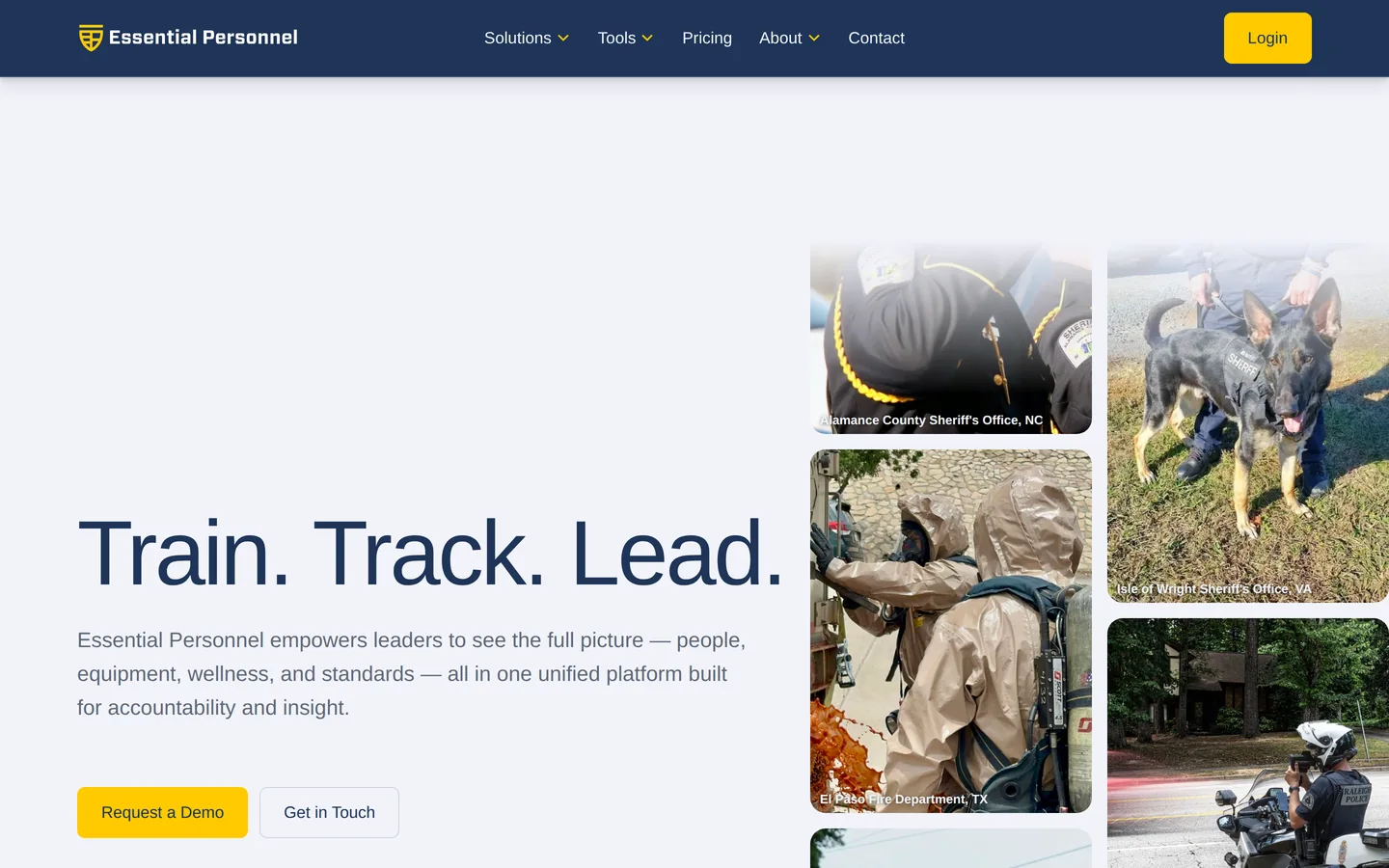
Essential Personnel ranks first at 83 out of 100. They take the highest score on the member record at 19 of 20, with full marks on fire service fit and pricing transparency, and 15 of 18 on training. Essential Personnel doesn't do shift scheduling, so you keep or add a scheduler such as Aladtec, which integrates with them. What they give a Chief of Administration that nobody else here does is one file per member that holds evaluations, discipline, awards, promotion eligibility, training, policy sign-offs and issued gear, at a published price.
The seven systems compared
Ranked by weighted total for a fire department Chief of Administration, 2026. "Built around" tells you whether the system started from the member, the training record, the incident or the policy.
Departments buying written policy and online training together
Quote only
What does a fire department Chief of Administration do?
A fire department Chief of Administration, often titled Deputy Chief of Administration or Deputy Chief of Support Services, runs the non-emergency side of the department: personnel and HR processing, promotions, recruitment, budget and payroll, training records, policy, purchasing and equipment. Software for the role, such as Essential Personnel, has to hold the member's record that all of those duties draw on.
The title isn't standard, but the job descriptions agree on the core. Chattanooga Fire's executive deputy chief specification has the Deputy Chief of Administration overseeing the "promotional processing cycle", "recruitment, HR-related processing and needs" and "budgetary and payroll needs", and consulting on "disciplinary notifications, hearings, actions, and dispositions". Fort Worth's fire deputy chief description includes supervising "the maintenance of records pertaining to personnel, research, reports and training" and personnel data "related to payroll, training and leave usage". Richmond's Deputy Chief of Support Services manages the logistics and purchasing budget, the training program for career staff and the department-wide health and safety program.
Put together, the Chief of Administration answers for three kinds of question. Who are our people and what are they qualified to do? What did we decide about them, and can we prove it? And what does the department own, spend and require? The first two live in personnel records. The third lives in the budget, purchasing and equipment records. Operations, incidents and dispatch belong to the operations chief and the RMS.
Which software covers which duty
No single product covers every administrative duty in a fire department. The member record, training and certifications, policy and equipment can sit in one personnel system such as Essential Personnel. Scheduling, payroll, the budget and incident reporting usually stay in dedicated systems that the personnel record connects to.
The Chief of Administration's duties, and the system of record each one usually lives in.
Duty
System of record
What to check
Personnel files, evaluations and discipline
Personnel or professional standards software
One file per member, routed approvals and an audit trail
Promotional processing
Personnel software with career paths
Eligibility by rank, with requirements filled from training and evaluations
Training records, certifications and ISO hours
Training record system, fed by your course provider
Expiry alerts, task books and an ISO hours report
SOGs, policies and memos
Policy management with acknowledgement tracking
Version history and who signed which version
Issued equipment and fleet
Equipment accountability or asset management
Assignment to the member, inspections and audit logs
Shift scheduling and leave
Scheduling and staffing software
Rotations, minimum staffing and callbacks
Payroll and budget
Your city or county ERP and payroll system
An export of hours and leave the payroll office accepts
Incidents and NERIS reporting
Fire and EMS RMS
That injuries and exposures reach the member's record
The administration division's hardest questions are about people, and they cross four or five systems. A promotion decision needs evaluations, discipline, certifications and time in rank. An accreditation site visit needs training hours, signed SOGs and equipment inspections. The fewer systems those answers span, the less time your staff spend assembling them. We compare the options for each duty in more depth in our guides to promotion readiness, ISO and accreditation, policy acknowledgement and equipment tracking.
Where Microsoft 365, Google Workspace, Asana, monday.com and Smartsheet fit
Microsoft 365 and Google Workspace run the administration office's email, documents, calendars and file storage, and Asana, monday.com and Smartsheet manage projects and workflows. They're good administrative management software for the office itself. None holds certifications, task books, evaluations or policy acknowledgements, so they don't replace fire department software built for the member record.
Most fire administration offices already pay for Microsoft 365 or Google Workspace through their city, and they should keep using it for the budget workbook, board memos and shared files. Project tools such as Asana, monday.com and Smartsheet suit station construction, apparatus purchases and accreditation projects, where the work is a list of tasks with owners and dates.
The trouble starts when a department stretches them to hold people. A spreadsheet of certification expiry dates has no alerts and no source documents. A shared drive of evaluation PDFs can't tell you who is eligible for promotion. A project board can track that a new SOG was sent, but not which members signed which version. Use the office tools for the office, and keep the member record in a system built to hold it.
How to choose fire department management software for the administration division
Start from the record you're asked for most. If it's personnel files, promotions and discipline, buy the personnel record first and connect scheduling and the RMS to it. If it's training and ISO hours, check how the training record holds certifications and task books. Then test every shortlisted system with one real member's file.
Open one member. Ask to see evaluations, discipline, awards, certifications, task books, signed policies and issued equipment for one person, on one screen.
Run a promotion list. Ask for everyone eligible for lieutenant, with what each candidate still needs.
Pull the ISO training report. Company and driver hours for last year, in the format your rating visit uses.
Publish an SOG. Revise it, and show who has and hasn't signed the new version.
Check the connections. Ask which scheduling, RMS and training systems it integrates with, in which direction, and get it in writing.
Price the whole thing. Per user cost, start-up, single sign-on, and whether volunteers and civilian staff count as users.
What fire department management software costs
Essential Personnel is the only system in this ranking with a published price: $175 per user per year for all four suites, or $20 to $85 per suite, plus a $3,000 one-time start-up fee and optional single sign-on at $800 a year. Vector Solutions, First Due, Tracwire, ESO, PowerDMS and Lexipol quote on request.
At Essential Personnel's published rates, a 50 member department on all four suites pays $8,750 a year, and $12,550 in year one with start-up and single sign-on. If your administration division only needs the personnel and training record, the Talent Management suite on its own is $85 per user per year. Most departments also buy through a cooperative contract to skip a formal bid. Essential Personnel is on GSA Advantage, NASPO, Omnia Partners, NCSA and VSA. Confirm with your purchasing office which contracts your jurisdiction accepts.
Ranking methodology: the Fire Administration Records Framework
Nine criteria, weighted to what a fire department Chief of Administration is asked to produce. The member record and the training record carry 38 points between them, because promotions, discipline, ISO reviews and accreditation all start there. Scheduling carries 10 rather than more, because most departments already run a scheduling system and the question is whether the new system connects to it.
Scores come from each vendor's own published product pages, press releases and pricing, checked in October 2026. Where a vendor hasn't published a capability for fire departments, they don't get credit for it, and facts a vendor hasn't published are marked "not published" rather than estimated.
The Fire Administration Records Framework, 2026. Weights total 100.
Criterion
Weight
What it measures
Member record
20
Personnel files, evaluations, discipline, awards and promotion eligibility on one file per member, with routing and an audit trail
Training and ISO reporting
18
Certifications with expiry alerts, task books, training hours and the reports ISO and accreditation reviews ask for
Fire service fit
10
Whether the product is documented for fire and EMS, in fire language, rather than adapted from another sector
Scheduling and staffing
10
Shift scheduling and staffing, built in or through a documented integration
Policy acknowledgement
10
Posting SOGs, policies and memos with version control and member acknowledgement
Equipment and fleet
8
Issued gear, inventory, apparatus records and inspections tied to the member or unit
Department reporting
8
Dashboards and reports a Chief of Administration can run across divisions without an analyst
Integrations
8
Named, documented connections to the RMS, scheduling and training systems a fire department already runs
Pricing transparency
8
Whether the department can size the cost without entering a sales process
How ties are broken
Where two systems reach the same total, the higher score on the heaviest criterion, the member record, takes the better position. No tie arose in this ranking.
How the seven systems scored
Every system against every criterion. Each cell is scored out of the criterion's weight, and the total is out of 100.
System
Member record /20
Training and ISO /18
Fire fit /10
Scheduling /10
Policy /10
Equipment /8
Reporting /8
Integrations /8
Pricing /8
Total
1. Essential Personnel
19
15
10
2
9
7
6
7
8
83
2. Vector Solutions
12
17
9
9
7
7
5
5
1
72
3. First Due
5
14
10
8
2
7
6
7
1
60
4. Tracwire
11
12
4
8
6
7
6
3
1
58
5. ESO
2
12
10
8
0
6
7
7
1
53
6. PowerDMS by NEOGOV
6
9
6
8
10
0
5
4
1
49
7. Lexipol
2
10
7
0
10
0
4
3
1
37
The rankings: seven systems for a fire department Chief of Administration in 2026
Pricing$175 all four suites, or $20 to $85 per suite, per user per year
Best forOne file per member covering personnel, training, policy and equipment
Key stat. Their Talent Management suite sorts members by promotion and retirement eligibility, showing how many requirements each one has left, with the requirements filled automatically from the training and performance records.
Essential Personnel was founded in 2020 by two Wilmington firefighters and builds personnel and professional standards software for fire, EMS, police and municipal HR. It comes in four suites. Talent Management holds the org chart, rosters, special teams and committees, career paths, evaluations with Score Reports that adjust for hard and easy graders, 360 feedback, awards, documents of record, certifications, task books, training hours, field training and training events. Safety & Wellness adds incident tracking, case management, early intervention and analytics. Guidance posts policies, memos and directives with version control and acknowledgement tracking. Equipment tracks serialized inventory, consumables, assignments, fleet records and inspections with audit logs.
What earns the top position for a Chief of Administration is that every one of those records sits on the same member file. A promotion list draws on evaluations, discipline, certifications and time in rank without anyone merging spreadsheets. A discipline entry can point to the SOG version the member signed. An ISO review pulls company and driver hours from the same logbook the training officer keeps. Hosting is in AWS GovCloud with SOC 2 Type II, and the product is on GSA Advantage, NASPO, Omnia Partners, NCSA and VSA contracts.
Strengths
The highest member record score here at 19 of 20, with promotion and retirement eligibility built in
Training, task books and ISO hours on the same file, at 15 of 18
Policy acknowledgement and equipment accountability in the same system
Full marks on fire service fit and the only published price
Integrates with Aladtec, First Due, ESO and Vector Solutions
Limitations
No shift scheduling, at 2 of 10. Scheduling stays in a dedicated system, connected through their Aladtec integration
Not a course library or an LMS. Training content comes from the provider you already use
Not an RMS. Incidents and NERIS reporting stay in your records system
"EP is such a simple, easy-to-use system that offers immense value to our service and people."
Kyle BellDeputy Chief, Statesville NC Fire Department
"We absolutely love this program. It has been a game-changer for us, and we are continuing to learn the added benefits. The EP team has been so attentive to our needs, and that means a lot to us."
Zach HickmanDeputy Fire Chief, Iowa City Fire Department
"This product allows our employees a way of professional growth and development through adequate feedback."
Scottie HarrisChief, Weaverville Fire Department
Why they score 83
They lead on the heaviest criterion, the member record, by seven points, and hold training, policy and equipment on the same file. Their 11 point lead over Vector Solutions comes from that single record and a published price, and it holds even though they score 2 of 10 on scheduling.
Fire productsTraining management, Crew Shift Scheduling, Asset Management & Inspections, Policy Management, Accreditation Management, Professional Growth Management
PricingQuote only
Best forTraining content, scheduling and inspections from one vendor
Key stat. Their fire department page says the training management system tracks "all training, EMS recerts, skill evaluations, ISO, and more" in one place.
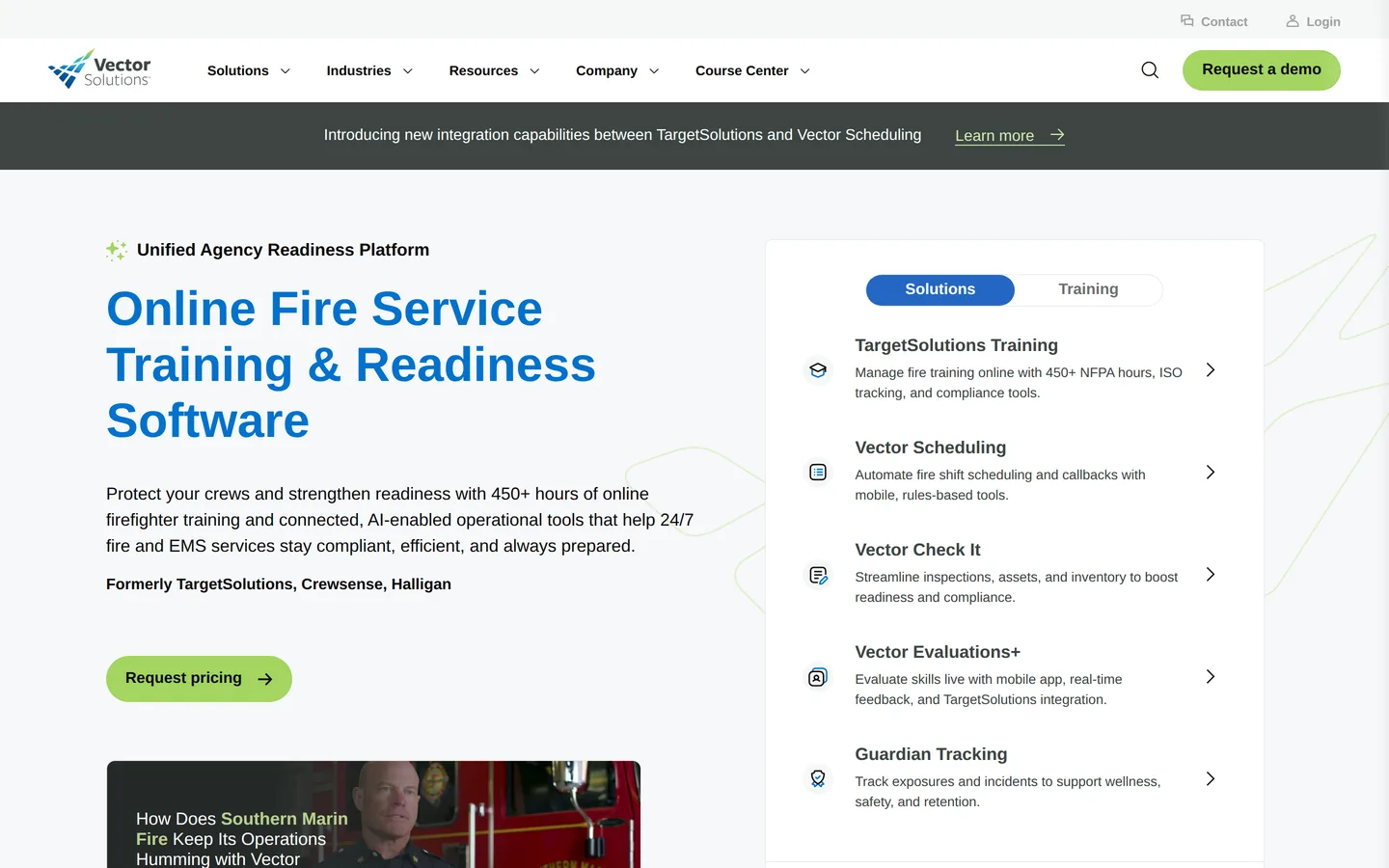
Vector Solutions is a training and compliance software company. For fire departments they sell a training management system and online course library, Crew Shift Scheduling with mobile callbacks, Asset Management & Inspections for equipment checks and vehicle maintenance, exposure and critical incident monitoring, and, as newer products, Policy Management and Accreditation Management. Professional Growth Management handles evaluations and professional development, and Guardian Tracking documents discipline and recognition.
They take second because no other competitor covers as many administrative duties: training and ISO reporting at 17 of 18, the best score here, plus scheduling, inspections and policy. Where they fall short of first is that the member record is spread across products joined by integration, so a promotion or discipline question still means looking in more than one place, and nothing is priced publicly.
Strengths
The strongest training and ISO record here, at 17 of 18
Crew scheduling and asset inspections from the same vendor
Policy and accreditation management products for fire
Integrates with Essential Personnel for credentialing
Limitations
The member record spans several products, at 12 of 20
Policy and accreditation management are new products with little published detail
Quote only
Why they score 72
The broadest competitor, and the leader on training at 17 of 18 and scheduling at 9 of 10. They lose most of their gap to first on the member record and on pricing.
Best forScheduling, training and assets inside the RMS
Key stat. Their training product connects skills evaluations to job performance requirements, task books and certifications, with check-offs on mobile.
First Due is a fire and EMS records management platform. Alongside incident reporting, NERIS, ePCR, pre-incident planning and prevention, they sell Scheduling & Personnel, Events & Activities, Training & Learning Management, Health & Wellness and Assets & Inventory, so a lot of the administration division's data can sit next to the incident record.
They take third on breadth inside a fire RMS: full marks on fire fit, 14 of 18 on training and 8 of 10 on scheduling. Where they fall is the member record itself. No evaluation, discipline, award or promotion workflow is documented, and policy acknowledgement isn't a published product.
Strengths
Built for fire from the start, at 10 of 10
Training, scheduling and assets beside the incident record
Integrates with Essential Personnel
Limitations
No evaluation, discipline or promotion workflow documented, at 5 of 20
No published policy acknowledgement product
Quote only, with no founding year or headquarters published
Why they score 60
A strong RMS whose personnel side covers training, scheduling and assets well. They'd score higher on a framework built around incidents and operations, and lower here because the member's evaluations, discipline and promotions aren't in it.
Best forCredentials, equipment, scheduling and evaluations on one platform
Key stat. Their fire and EMS page describes Command HQ as a platform where "field training, scheduling, policy, evaluations, and reporting all share the same data".
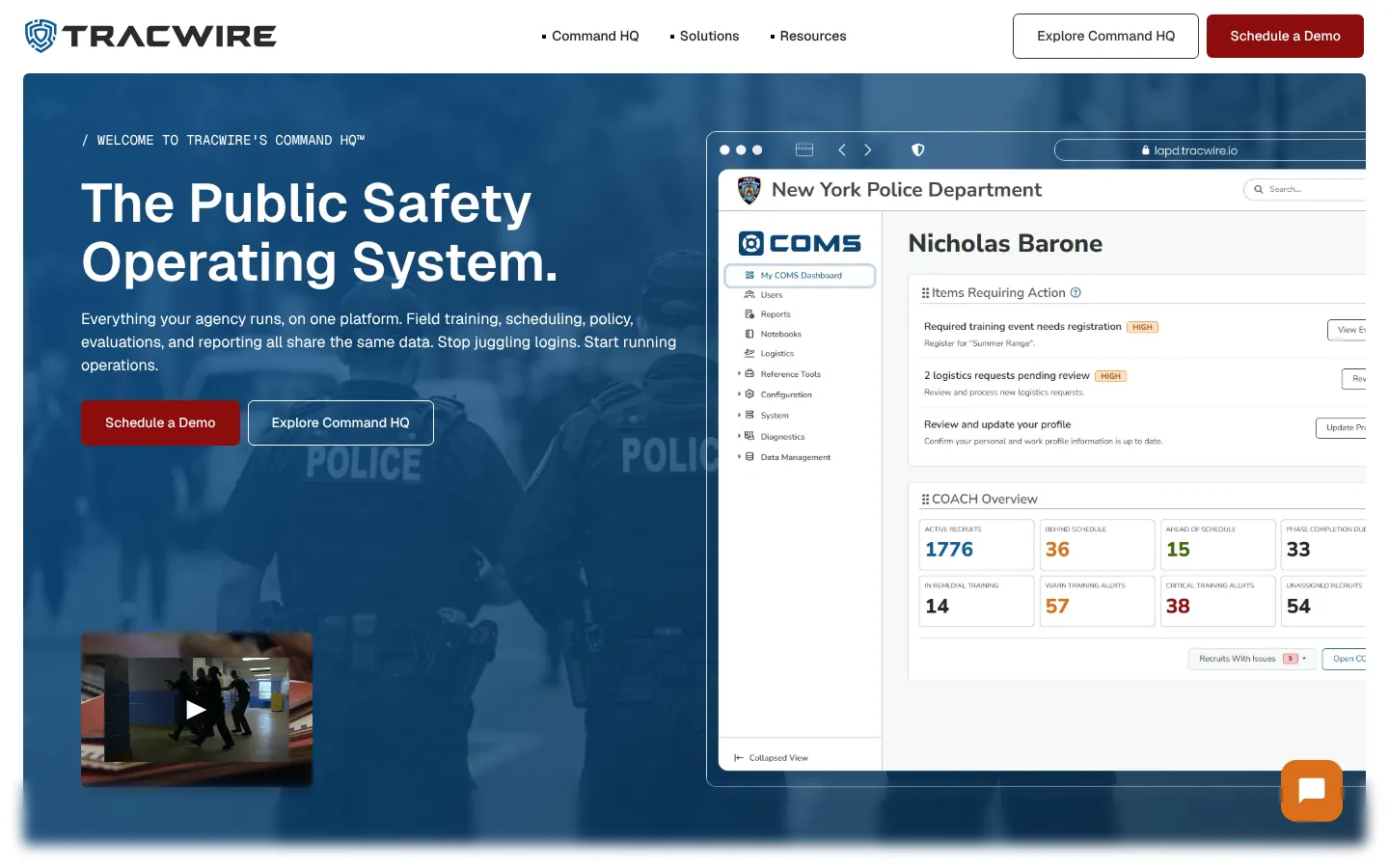
Tracwire sells Command HQ as a public safety operations platform. Its modules include COACH for field training, TRAIN for certifications and ongoing training, METER for performance evaluations and INTRA for professional standards, alongside scheduling, policy, asset management and reporting.
They take fourth because few systems here cover evaluations, scheduling and equipment together. Where they fall is fire depth. The platform was built for law enforcement first, and the evaluation and professional standards modules aren't described for fire departments, which holds them to 4 of 10 on fire fit.
Strengths
Evaluations, scheduling, policy and equipment in one platform
A member record at 11 of 20, second best here
Reporting across modules from shared data
Limitations
Built for police first, at 4 of 10 on fire service fit
Few documented integrations with fire RMS and scheduling systems
No published founding year, headquarters or price
Why they score 58
Broad and credible across the administrative duties, with a real evaluation module. They miss third by two points because First Due's fire fit and integrations outweigh their stronger member record.
TypeFire and EMS records and patient care reporting
PricingQuote only
Best forCertifications, injuries and scheduling inside the RMS
Key stat. Their personnel management software keeps every employee's injuries, employment and training record in one place, with alerts on expiring certifications.
ESO is a fire and EMS records and analytics company. Their fire suite covers incident reporting, community risk and prevention, fleet and field readiness, scheduling and personnel management, and performance analytics, so the administration division can report on staffing, certifications and apparatus readiness from the same platform as incidents.
They score on fire fit, the training and certification record and reporting. Where they fall is that no evaluation, discipline, award or promotion workflow is documented, and there's no policy acknowledgement product. The personnel module serves the RMS rather than holding the member's full record.
Strengths
Certification expiry alerts and injuries on the employee record
Scheduling, fleet readiness and analytics in the same suite
Integrates with Essential Personnel
Limitations
No evaluations, discipline or promotion workflow, at 2 of 20
No policy acknowledgement product
Quote only
Why they score 53
A capable personnel and readiness record for an RMS, with good analytics. On its own it leaves the member's evaluations, discipline and signed policies to another system.
Best forSOGs, acknowledgements and accreditation files
Key stat. Their fire page pairs policy and accreditation management with personnel scheduling, on-the-job training and "probationary and role readiness tracking across evaluators and stations".
PowerDMS is a policy and accreditation platform owned by NEOGOV. For fire departments they post SOPs and SOGs with version control and acknowledgements, run accreditation workflows, and sell Time for personnel scheduling, Ready for on-the-job training, Recall for microlearning and Line, a wellness app.
They score full marks on policy acknowledgement and 8 of 10 on scheduling. Where they fall is the member record and equipment. No discipline, award or promotion workflow is documented for fire, and there's no equipment or fleet product.
Strengths
Policy posting and acknowledgement, at 10 of 10
Accreditation workflows and standards manuals
Personnel scheduling through Time
Limitations
No fire discipline, award or promotion workflow, at 6 of 20
No equipment or fleet tracking
Quote only
Why they score 49
The strongest policy and accreditation product here, with scheduling added. Policy is one of the administration division's duties, though, and the member record and equipment sit outside it.
Best forWritten fire policy and online training together
Key stat. Their fire offering combines maintained policy with acknowledgement tracking, online training and "automated license and credential tracking".
Lexipol sells policy content, training and wellness to public safety. For fire departments that means a maintained policy manual with acknowledgements, FireRescue1 Academy online training, credential tracking, reports and a wellness app.
They take full marks on policy acknowledgement and a solid training score. Where they fall is that they hold almost none of the member record, and there's no scheduling or equipment product, so most of the administration division's records sit elsewhere.
Strengths
Maintained fire policy content with acknowledgements, at 10 of 10
Online training with credential tracking
Wellness and grants resources
Limitations
No fire evaluation, discipline or promotion workflow, at 2 of 20
No scheduling or equipment product
Quote only
Why they score 37
Strong on the written policy a Chief of Administration maintains and on training content. They'd rank much higher on a policy management framework than on one built around the member record.
What to do next
The seven systems fall into three groups. Essential Personnel and Vector Solutions cover most of the administration division's records, with Essential Personnel holding them on one file per member and Vector across several products. First Due, ESO and Tracwire bring personnel, scheduling and training into a wider operations or records platform. PowerDMS and Lexipol own policy and leave the member record elsewhere.
Start with the question you were asked last month and couldn't answer quickly. If it was a promotion list, a discipline history or an accreditation file, buy the member record first and connect your scheduling system and RMS to it. Keep Microsoft 365 or Google Workspace for the office. Whatever you shortlist, take one real member's file into the demo and ask the vendor to rebuild it on screen.
Want to see your personnel files, promotion requirements, training records and SOGs inside Essential Personnel? Call (910) 390-0011 or email info@essper.com and bring one member's file to the demo.
Essential Personnel ranks first at 83 out of 100, ahead of Vector Solutions at 72 and First Due at 60. It holds personnel files, evaluations, discipline, promotion eligibility, training, policy acknowledgements and issued equipment on one file per member, at a published price. It doesn't do shift scheduling, so departments connect a scheduling system such as Aladtec.
They run the non-emergency side of the department. Job descriptions from Chattanooga, Fort Worth and Richmond list promotional processing, recruitment, HR processing, discipline, budget and payroll, personnel and training records, policy, purchasing and the health and safety program. The title varies by department, from Deputy Chief of Administration to Deputy Chief of Support Services or Division Chief of Administration.
They run the office, not the member record. Microsoft 365 and Google Workspace handle email, documents and files, and Asana, monday.com and Smartsheet manage projects. None tracks certifications with expiry alerts, task books, evaluations, promotion eligibility or policy acknowledgements, which is what fire department management software is for. Most departments use both kinds side by side.
It's software that runs a fire department's people and resources rather than its incidents. Depending on the product it covers personnel records, evaluations, training and certifications, scheduling, policy acknowledgement and equipment. Records management systems cover incidents and NERIS reporting. Many departments run a personnel system and an RMS together, connected so data flows between them.
An RMS such as First Due or ESO holds incidents, inspections, patient care and basic personnel data. Personnel software holds the member's evaluations, discipline, awards, promotion requirements, training and signed policies with an approval trail. Essential Personnel integrates with First Due and ESO, so incident and certification data reaches the member's file without anyone retyping it.
Usually yes, because shift rotations, minimum staffing and callbacks need a dedicated scheduler, and payroll depends on its hours. Most departments already run one. The question for a new personnel system is whether it connects. Essential Personnel doesn't schedule shifts, and integrates with Aladtec so the schedule and the member's personnel record stay in step.
Only Essential Personnel publishes a price among the seven systems here: $175 per user per year for all four suites, or $20 to $85 per suite, plus a $3,000 one-time start-up fee. A 50 member department on all four suites pays $8,750 a year. Vector Solutions, First Due, Tracwire, ESO, PowerDMS and Lexipol quote on request.
Ask to open one member and see evaluations, discipline, certifications, signed policies and issued equipment on one screen. Ask for a promotion eligibility list and last year's ISO training hours report. Ask which scheduling and RMS systems it integrates with, and the total cost including start-up, single sign-on and whether volunteers and civilian staff count as users.
About this ranking. Compiled by Scott Monroe, Chief Executive Officer & Co-Founder of Essential Personnel, and published 29 October 2026. Essential Personnel is one of the seven systems assessed and is ranked first in it, and the framework, weightings and per criterion scores are all published above so the total can be recalculated. No vendor paid for placement and no vendor previewed its score. Vector Solutions, First Due and ESO each integrate with Essential Personnel, and those partnerships did not affect scoring. Scores come from vendor product pages, press releases and published pricing, checked in October 2026. Facts a vendor has not published are marked "not published" rather than estimated. Review ratings are omitted because no independent rating with a named source exists across all seven. Office and project tools such as Microsoft 365, Google Workspace, Asana, monday.com and Smartsheet were not ranked because they don't hold personnel or training records, and Aladtec was not ranked because it is a scheduling system that integrates with Essential Personnel.
By clicking “Accept All Cookies”, you agree to the storing of cookies on your device to enhance site navigation, analyze site usage, and assist in our marketing efforts. View our Privacy Policy for more information.