
Professional standards
Most agencies already counsel their people. What they don't have is a record of it that holds up twelve months later, in front of an arbitrator, a promotion board, or a public records request.
The gap is rarely effort. A battalion chief has the conversation, writes half a page, and files it in a drawer or a shared folder that nobody opens again. When the annual evaluation comes around, or the same employee has the same problem for the fourth time, none of it is retrievable. The supervisor writes from memory, the employee disputes it, and the agency ends up defending a decision it can't evidence.
This guide is written for fire chiefs, police chiefs, training officers, and the municipal HR directors who support them. It covers the three things you have to put in place: measurable expectations that generate data, a standard form and process for every counseling session and incident, and one system that keeps the whole personnel record in one place.
Document employee counseling on a standard form, every time, whoever holds the session. Capture who was present and when, the type of session, the issue described as observed behavior, the performance data behind it, a corrective plan with a date, the employee's acknowledgment, and a scheduled follow-up. Store it in the personnel record rather than a supervisor's files, so the next evaluation, the next case, and the next promotion board all read from the same history.
A counseling record is only as good as the standard it measures against. If the job expectation was never written down, the conversation becomes one person's opinion of another person's attitude, which is the version that collapses under review. Start the performance cycle by defining what the job requires in terms you can count, then build the year's performance documentation against it.
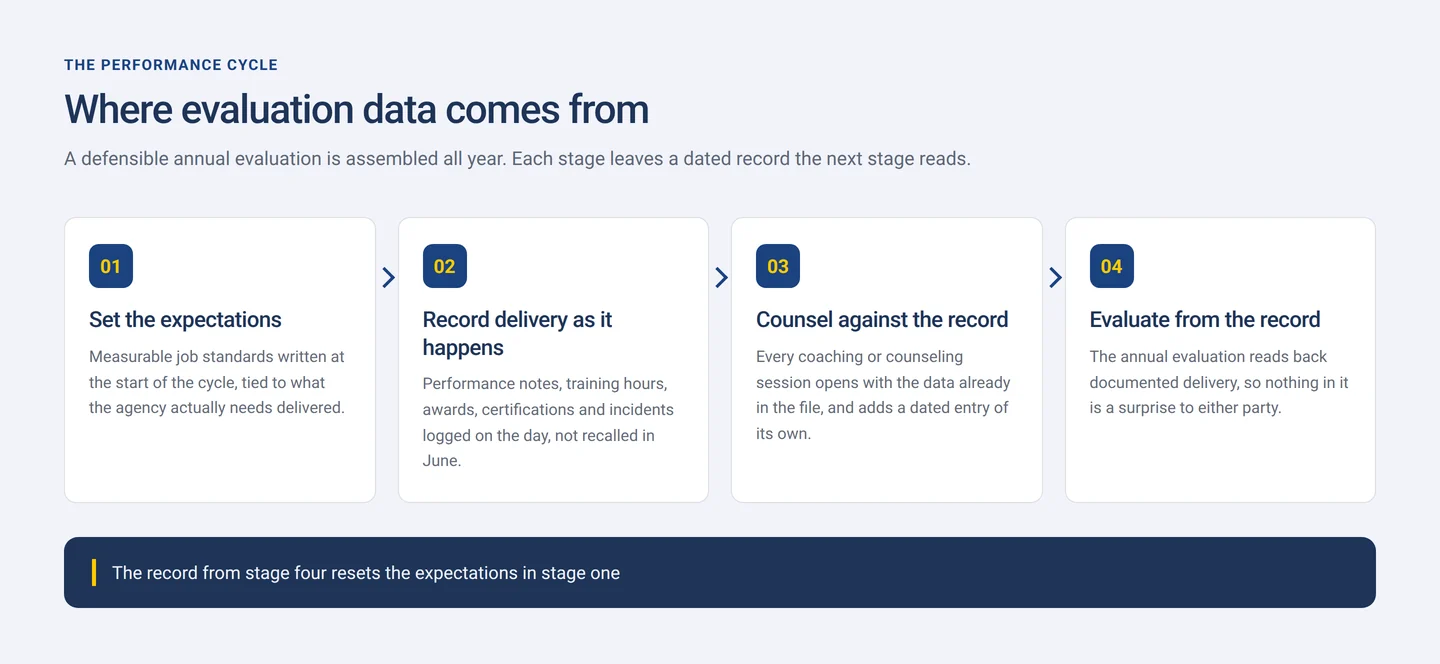
Vague standards produce vague evaluations. "Shows initiative" gives a supervisor nothing to point at; "completes post-incident reports within 24 hours" gives them a date and a count. Write the expectation at the start of the cycle, tie it to what the agency actually needs delivered, and give the employee a copy. The federal performance management cycle published by the Office of Personnel Management follows the same order, and it's the order most agency policies already assume.
For public safety the expectation set usually splits three ways: operational delivery, such as response performance and report timeliness; readiness, such as certifications, task books and training hours; and conduct, such as policy compliance and community interactions. Align each one with a mission requirement your agency is already judged on, whether that's agency accreditation through the Center for Public Safety Excellence, an insurance rating, or a city performance plan. Essential Personnel builds its talent management tooling around that alignment, so the metric an employee is measured on is the metric the agency reports on.
The most useful question a supervisor can ask at the start of a cycle is how they'll create the data everyone will use at the end of it. Answer it in advance and the evaluation writes itself, because documenting employee performance through the year is what leaves something to write from. Leave it unanswered and June becomes an exercise in recall, which is where recency bias and favoritism get in. The employment lawyers at Fisher Phillips list exactly this pattern, the review written from the last six weeks of memory, among the habits that turn an evaluation into evidence against the employer.
Decide which sources count as performance documentation, and make logging them routine rather than exceptional:
SHRM makes the same point about review conversations: describe specifically what you observed, state the impact, and give the employee room to respond. That's only possible when the performance documentation was written at the time.
Recruit and probationary tracking is where documentation discipline is easiest to build, because the evaluation cadence is already frequent. Daily observation reports, weekly summaries and phase sign-offs give a field training officer a continuous record instead of a verdict at the end. Carteret County Sheriff's Office rebuilt its field training program on that principle, and Champaign Fire Department applies it through recruit school and probation.
Two things make recruit records defensible. First, every observation is tied to a published standard rather than a trainer's preference. Second, counseling during probation follows the same form and the same storage as counseling for a twenty-year veteran, so nobody can argue the probationer was handled differently. For police agencies, the same continuous-record logic underpins the early intervention systems the Office of Justice Programs describes, which look for patterns across incidents rather than judging each one alone.

Standardization is what turns a pile of notes into a record. One employee counseling form, used by every supervisor in every station and every shift, means the same facts get captured whoever holds the session, and the file reads consistently when somebody reviews five years of it at once. It also removes the loudest objection an employee can raise, which is that they were documented differently from everybody else.
An employee counseling form is a short structured document, not an essay. Seven fields cover it. The Nevada Association of Employers, in its guidance on the counseling memo, lands on much the same list, and so does the widely cited walkthrough of the employee counseling form published by Carepatron.
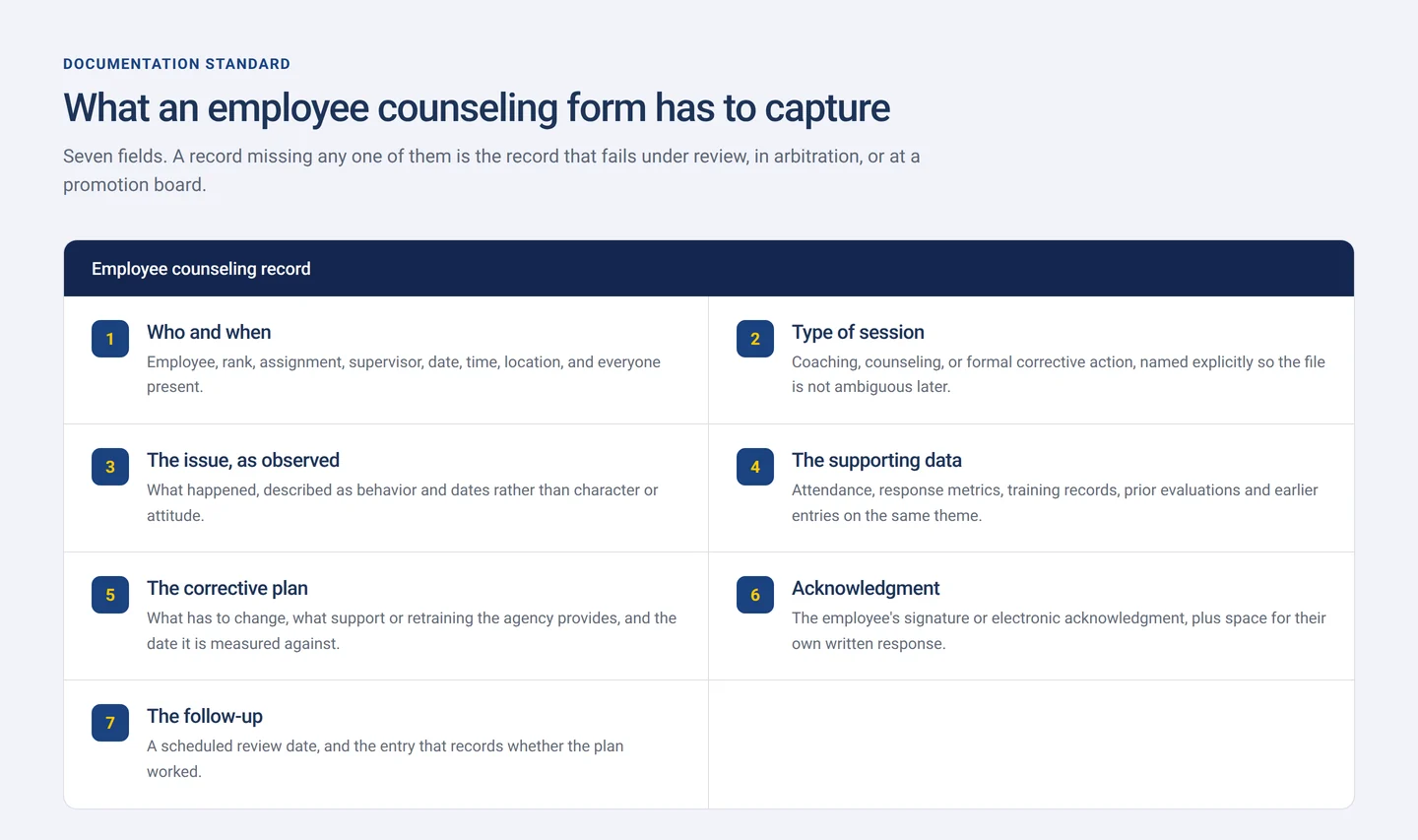
Employee, rank, assignment, supervisor, date, time, location, and everyone present. If a union representative attended, name them.
Coaching, counseling, or formal corrective action, named explicitly. Agencies get into trouble when a coaching conversation is later described as discipline, or the reverse.
What happened, on what dates, in what terms a third party could verify. Not "poor attitude" but "left the station without signing out on three shifts in August".
Attendance, response metrics, training records, prior evaluations, and any earlier entries on the same theme. This is the field most forms omit and most disputes turn on.
What has to change, what retraining or support the agency provides, who owns it, and the date it gets measured against.
The employee's signature or electronic acknowledgment, with space for their own written response. A refusal to sign is itself recorded, and it doesn't invalidate the record.
A scheduled review date, and the entry that records whether the plan worked. An open corrective plan with no closing entry is the one an attorney will find.
Coaching, counseling and formal corrective action are different instruments with different consequences, and the form should say which one is in use. Where your agency runs progressive discipline, the distinction decides whether this entry counts as a step in it.
| Session type | Purpose | What goes in the record | Where it lands |
|---|---|---|---|
| Coaching | Improve performance that is acceptable but below potential, or reinforce something done well. | Dated note, observed behavior, agreed action. No finding of fault. | Performance record. Feeds the evaluation, not the discipline history. |
| Counseling | Correct a specific performance or conduct problem before it becomes discipline. | Full employee counseling form, including supporting data and a corrective plan with a date. | Personnel record, visible to the next evaluation and the next supervisor. |
| Formal corrective action | Address conduct that has already breached policy, or performance that counseling has failed to fix. | Counseling form plus the case file, findings, policy references and the action imposed. | Professional standards record, with retention set by policy and state law. |
Open the session with the data already in the file rather than with an accusation. When a supervisor can put attendance, prior notes and the last evaluation on the table, the conversation moves to what changes next instead of whether the problem is real. Document during or immediately after the meeting, not a week later. Documenting employee performance while it is fresh is also what keeps the corrective plan specific enough to measure.
Two legal boundaries are worth knowing before you start, and both are older than any software you'll buy. Public employees with a property interest in their job are owed notice and a chance to respond before discipline that costs them that job, which is the rule from Cleveland Board of Education v. Loudermill. And where a session turns into a compelled administrative interview of a sworn officer, the protections from Garrity v. New Jersey attach to what they say. If either line is close, stop the counseling session and open a case instead. The Equal Employment Opportunity Commission sets out the consistency test the rest of the file has to pass: comparable employees, comparable conduct, comparable outcomes, all of it documented.
Apparatus accidents, injuries, vehicle pursuits, complaints and use-of-force reviews all produce corrective action, and all of it belongs in the same professional standards system as the counseling that follows. Tracking accidents in a separate spreadsheet is how an agency ends up with a driver whose fourth backing incident is treated as a first.
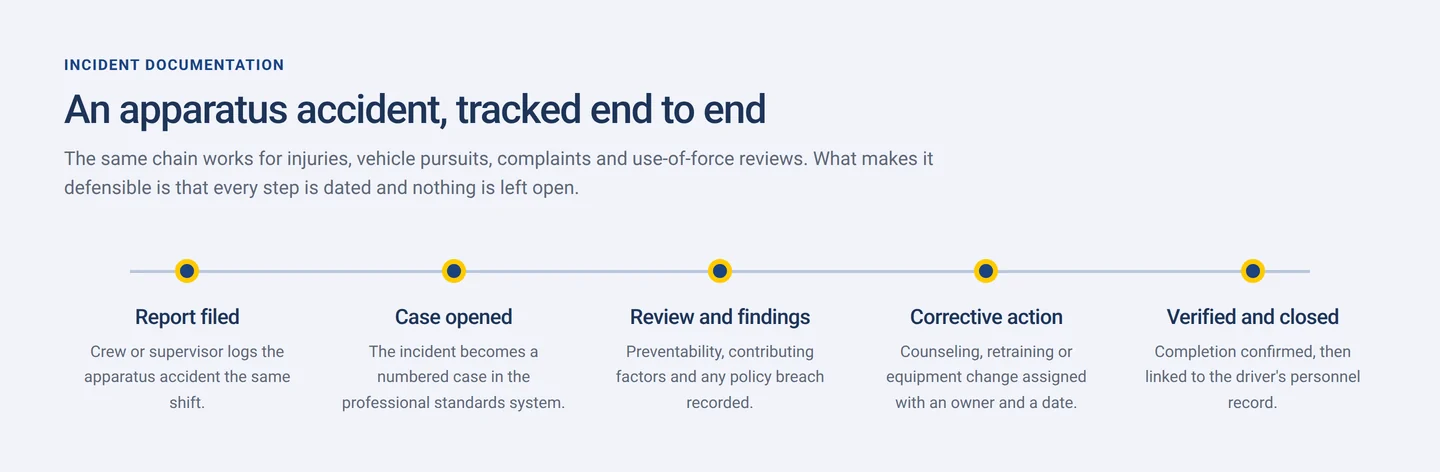
Set the reporting guideline so that the report is filed on the shift it happened, the case is numbered, preventability and contributing factors are recorded, and any counseling or retraining is assigned with an owner and a due date. Close the loop in writing when the action is complete. Fire agencies already run this discipline for incident data through NFIRS reporting to the U.S. Fire Administration, and NFPA 1201 expects the same of organizational records; work injuries carry their own recordkeeping duties on top. Hendersonville Police Department consolidated exactly this, incident reporting and case management, into one place, and Statesville Fire Department's approach to critical incident tracking was recognized as an industry best practice.
Keep one line clear while you do it. Records that exist to support an employee, peer support contacts and wellness check-ins, should not sit in the same file as corrective action, or people stop using them.
A standard form solves half the problem. The other half is retrieval: whether a chief can see one employee's whole record on one screen when a promotion, a grievance or a disciplinary decision is in front of them. That is the job employee performance tracking software exists to do, and it is where most agencies find their performance documentation is spread across four systems and two filing cabinets. Essential Personnel is built for local government agencies, and the design principle is that one screen shows everything about one person, rather than six systems each holding a sixth of the answer.
Promotion processes expose fragmented records faster than anything else. If evaluations sit with HR, certifications with the training officer, counseling in a supervisor's drawer and case outcomes with professional standards, the board ends up ranking whoever is best remembered. Consolidation fixes that, and it also lets an employee see where they stand: a firefighter who reads that the record says they could do better with writing can act on it before the next cycle, which is the whole point of development.
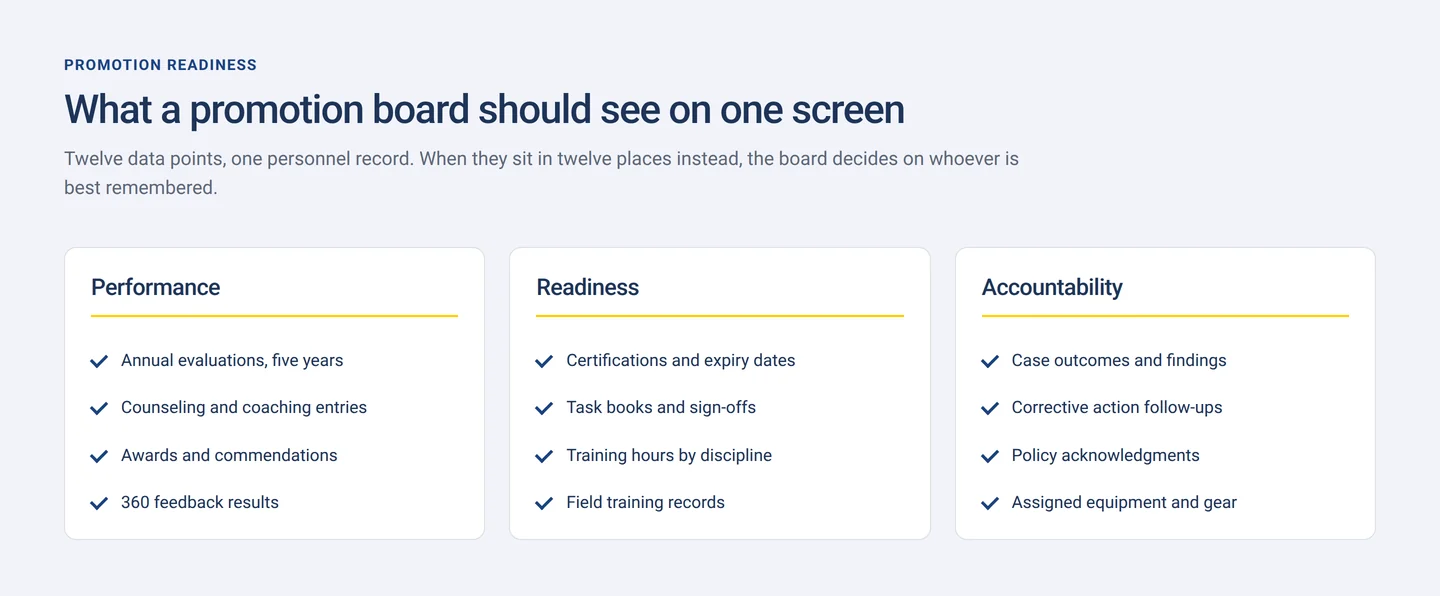
Evaluations, counseling history, certification status, task book progress, awards, assigned equipment and case outcomes all describe the same person, so they belong on the same record. That's the argument for reading the promotion question and the documentation question as one problem, and it's covered in more depth in the guide to promotion readiness systems.
Generic HR platforms handle payroll and benefits well and public safety personnel records poorly, because task books, shift-based field training, accreditation evidence and internal affairs findings aren't in their data model. Before you buy employee performance tracking software, or replace what you have, check these:
The same checklist reads slightly differently by discipline. Fire and EMS agencies weight task books and certification expiry heaviest, which the fire and EMS pages set out. Police agencies weight field training, early intervention and internal affairs case handling, and law enforcement buyers usually start there. Municipal HR teams supporting both, covered under human resources, care most about one consistent record across departments. Whatever the discipline, the employee performance tracking software has to hold the agency's own standards rather than a generic competency library. Professional bodies including the International Association of Chiefs of Police and the International Association of Fire Chiefs publish model policies worth aligning your forms to before you configure anything.
Counseling frequently ends in retraining, so the counseling record and the training record have to be the same record. If a corrective plan assigns a driver-operator refresher and the completion is logged in a separate learning platform, nobody can prove the plan closed. Essential Personnel unifies six areas on one employee record: team structure, performance development, training management, policy guidance, case management and equipment accountability.
On the integration question specifically: EP is the system of record for training rather than a course library, and they connect to the systems agencies already run. Training and credentialing content comes in from Vector Solutions, Fire Engineering Training and Synap; records and incident data from ESO, EPR Fireworks and First Due; scheduling from Aladtec; telematics from Geotab; alerting from First Arriving. So the completion of an assigned course lands against the same employee record that holds the counseling entry that required it, and the professional standards side reads training status without anybody rekeying it. Certification and course history for police agencies is covered further in the guide to certification tracking.
Policy sits in the same loop. A counseling entry that cites a policy is stronger when the system can also show the employee acknowledged that policy on a date, which is what the guidance module records. Southern Pines describes the combined effect on its approach to performance development, and there's more on tying the whole cycle to agency goals in the piece on strategic planning. For the employee on the receiving end, a documented record is also what makes a hard review recoverable rather than arbitrary, a point made well in a discussion of bad performance reviews from the Leadership Tea Podcast.
Adopt one employee counseling form that every supervisor uses, and store completed forms in the personnel record rather than in individual files. Capture who was present and when, whether the session was coaching, counseling or formal corrective action, the issue described as observed behavior, the performance data supporting it, a corrective plan with an owner and a date, the employee's acknowledgment, and a scheduled follow-up entry that records whether the plan worked.
Seven fields. Employee and session details including everyone present; the type of session; the issue stated as behavior a third party could verify, with dates; the supporting performance documentation such as attendance, metrics, training records and prior evaluations; the corrective plan, including any retraining the agency provides; the employee's signature or electronic acknowledgment with space for their response; and the follow-up date. A record missing the supporting data is the one most likely to be disputed.
Coaching improves performance that is acceptable but below potential and carries no finding of fault, so it feeds the evaluation rather than the discipline history. Counseling corrects a specific problem before it becomes discipline and uses the full form with a corrective plan. Formal corrective action addresses conduct that has already breached policy, or performance that counseling failed to fix, and adds the case file, findings and policy references. Name the type on the form, because an agency that later recharacterizes a coaching note as discipline will struggle to defend it.
Stop treating the evaluation as a writing task and treat it as a reporting task. Define measurable expectations at the start of the cycle, decide then which sources will supply the data, and log performance notes, training, awards and case outcomes as they happen. The evaluation then reads back documented delivery across the whole year instead of the last six weeks a supervisor can remember, and nothing in it surprises either party.
Treat every accident as a numbered case in the professional standards system rather than a form in a binder. File the report on the shift it happened, record preventability and contributing factors, note any policy breach, assign counseling, retraining or an equipment change with an owner and a due date, then close the case in writing and link it to the driver's personnel record. Tracking accidents separately is how a fourth backing incident gets handled as a first.
Consolidate the twelve things a board needs onto one record: evaluations, counseling and coaching entries, awards, peer feedback, certifications and expiry dates, task books, training hours, field training records, case outcomes, corrective action follow-ups, policy acknowledgments and assigned equipment. Where those sit in separate systems, the board ranks on recall rather than record. Consolidating them also gives every candidate a consistent basis to prepare against.
Certification and expiry tracking, task books with sign-offs, training hours reportable by discipline, field training records, and reporting that satisfies accreditation and insurance rating reviews without a spreadsheet export. Just as important is whether training status is visible from the same employee record that holds performance and professional standards, because retraining assigned during counseling has to be provably completed. Employee performance tracking software that cannot show course completion against the counseling entry that required it leaves the corrective plan unproven.
Three steps in order. Publish measurable expectations and the policies behind them, with acknowledgment tracked. Standardize the forms and timelines for counseling, complaints, accidents, injuries and use-of-force reviews so every case follows the same path. Then put performance, training, cases, policy and equipment on one employee record, with role-based access and retention set by policy, so the agency can produce a complete and consistent history for any person on demand.
See how your agency's counseling, performance and professional standards records would sit on one employee record.
Request a demo
Written by Scott Monroe, Chief Executive Officer & Co-Founder, Essential Personnel, Inc. Published September 11, 2026.
Essential Personnel builds professional standards software for public safety, so the agency described in this guide is also the kind of agency the company sells to. Legal references are included as orientation for supervisors and are not legal advice; confirm your own obligations with your attorney, your policy manual and your collective bargaining agreement before changing a disciplinary process.
Questions about applying any of this in your agency: info@essper.com or (910) 390-0011.
