
Fire department org chart software: what a wall diagram can't tell you
The chart outside your office is wrong. Not badly wrong, but wrong in the way that matters: a captain retired in March, a driver engineer moved to the training division in June, and the HAZMAT team lost two of its five qualified members to a neighboring department. Nobody redrew it because redrawing it takes an afternoon in a diagramming tool, and by the time it's printed something else has changed.
That's the real problem with a fire department org chart. It isn't the drawing. It's that the drawing was never connected to anything.
What a fire department org chart actually has to show
A fire department org chart has to carry four things a corporate chart never does: rank separate from assignment, the shift or platoon a member works, the station and company they're assigned to, and the specialty qualifications they hold. A battalion chief on C shift and a battalion chief in training aren't interchangeable, and a chart that shows them as two identical boxes has told you almost nothing.
Start with rank. In most departments rank and assignment move independently. A lieutenant can be riding an engine, running the recruit academy, or sitting on light duty, and the chain of command for each is different. General purpose org chart software models one reporting line per person, so the moment you have a lieutenant who answers to a battalion chief operationally and to a training chief for their assignment, you're either drawing dotted lines by hand or leaving something off.
Then shift. Fire is one of the few services where the same seat has three or four occupants depending on the day. A chart that shows one name per position is accurate for eight hours out of twenty four. Ask anyone who's tried to answer a mutual aid question at two in the morning what that's worth.
Then the qualifications. The National Fire Protection Association professional qualification standards define what a firefighter, driver operator, or fire officer is certified to do, and those certifications expire. A chart showing a member assigned to a truck company tells you where they sit. It doesn't tell you whether their aerial operator certification lapsed last month.
This is the gap that generic organizational chart software leaves open, and it's the reason so many departments end up maintaining the chart, the roster spreadsheet, the certification tracker, and the specialty team list as four separate documents that disagree with each other. Organizational chart software sold to businesses is designed for a structure where one person has one job and one manager. Fire department software has to start from the opposite assumption.
Does anyone make a drag and drop org chart?
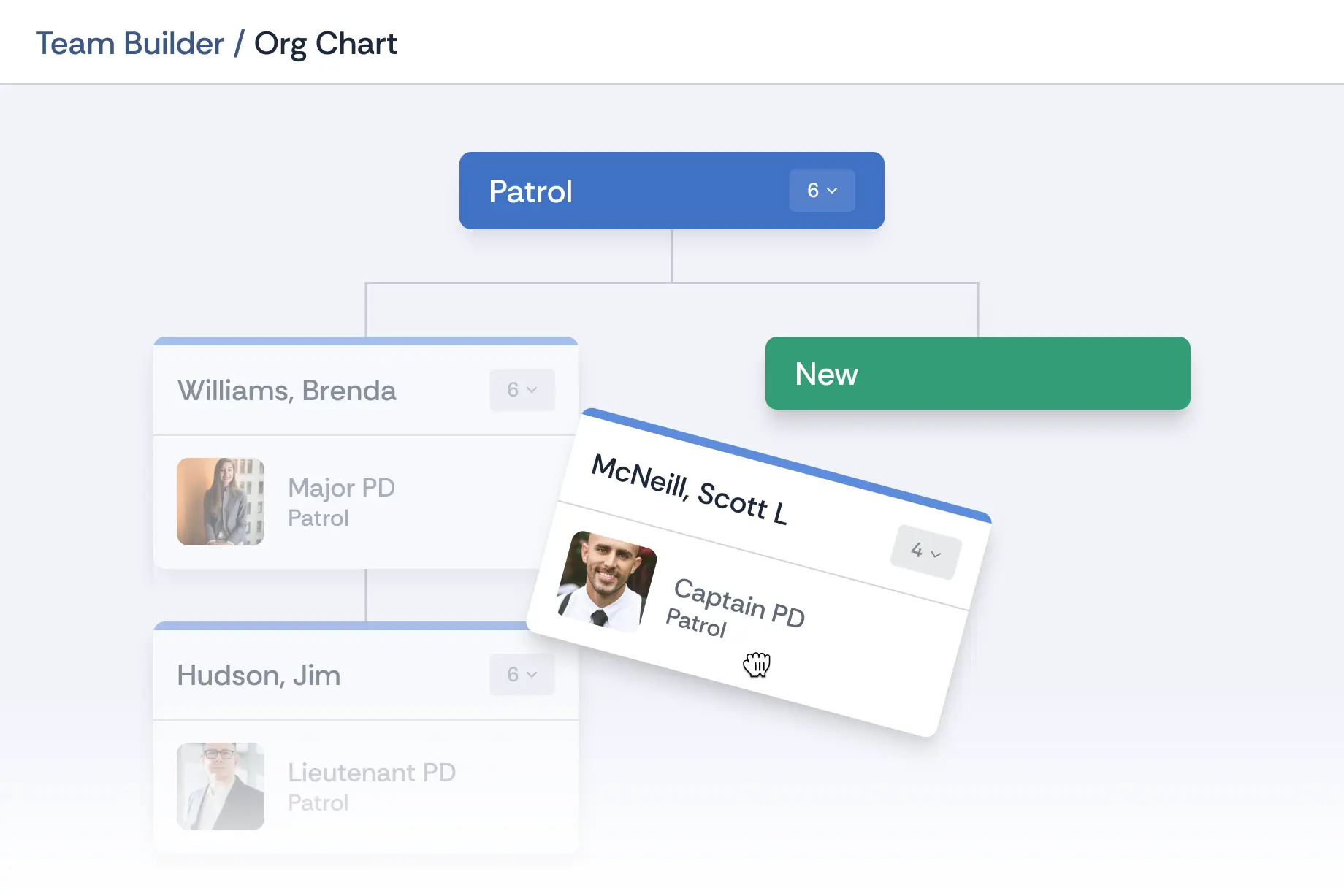
Yes, and several of them are good at the drawing part. Lucidchart, SmartDraw, Visio, Organimi and Pingboard all let you drag a box onto another box. The question worth asking is what happens after you drop it. In a diagramming tool, a shape moves. In Essential Personnel, the member moves, and their whole record moves with them.
That difference sounds small until the first time you use it. When the Town of Southern Pines transferred a member to a different position, the drag and drop org chart carried that person and their records to the new supervisor in a single action. No re-keying, no second system to update, no note to HR asking them to move a file.
A drag and drop org chart in a drawing tool is a convenience for whoever's drawing. A drag and drop org chart built on a personnel record is a transaction: the reporting line changes, permissions follow, and the new supervisor can see the member's evaluations, certifications and notes from the moment the box lands.
Where generic organizational chart software stops
Generic org chart software is built to produce a picture from a list of names. It has no concept of an authorized position, a certification with an expiry date, a platoon, or a collateral assignment, so it can't answer the questions a fire chief actually asks it. It draws the department you described to it, not the department you have.
None of this makes those tools bad. If you need a clean diagram for the annual report or a slide for a council presentation, a diagramming tool will do it faster and prettier than anything built for public safety. The trouble starts when the chart has to be right rather than presentable.
What fire department software has to do that a diagram can't
| The question | Generic org chart software | A chart built on a personnel record |
|---|---|---|
| How many positions are funded and open right now? | No concept of an authorized position. A vacancy is a box you remember to delete | Vacancies display as vacancies, with the date the seat opened |
| Which of my members are current on their HAZMAT certification? | Not tracked. Lives in a separate spreadsheet | Filter the roster by certification, qualification or expiry window |
| Who was in command of Battalion 2 on the night of the incident? | Shows today's structure only | The record carries assignment history, so the chart can be read as of a date |
| Who's within two requirements of being promotable to captain? | Outside its scope entirely | Career paths pull completion automatically from training and certifications |
The second column isn't a criticism of the products, it's a description of the category. Org chart software for a marketing agency doesn't need to know about task books. Fire department software does, which is why the two categories never quite converge no matter how many features get added to the drawing tools. Organizational chart software will keep getting better at layout, and fire department software will keep getting better at the record, and neither is going to grow into the other.
Special teams and committees: the chart under the chart
Most of a fire department's real capability doesn't appear on the org chart at all. HAZMAT, technical rescue, dive, drone, honor guard, peer support, the apparatus specification committee: these cut across stations, shifts and ranks, and every one of them has a leader, a membership, and a set of qualifications that have to stay current. This is the structure that fails first when the only record is a wall chart.
Ask a special operations chief how many divers they have and whether all of them are current, and in most departments the answer involves a phone call. The team roster lives with the team leader. The certifications live with training. The chart on the wall shows neither, because a dive team member also appears somewhere else as an engine company firefighter.
Essential Personnel treats this as its own layer. Special Teams and Committees supports creating custom teams, tracking membership and assignments, and naming a team leader, all built on the same roster that produces the org chart. When a member transfers, their team memberships travel with them rather than being quietly forgotten.
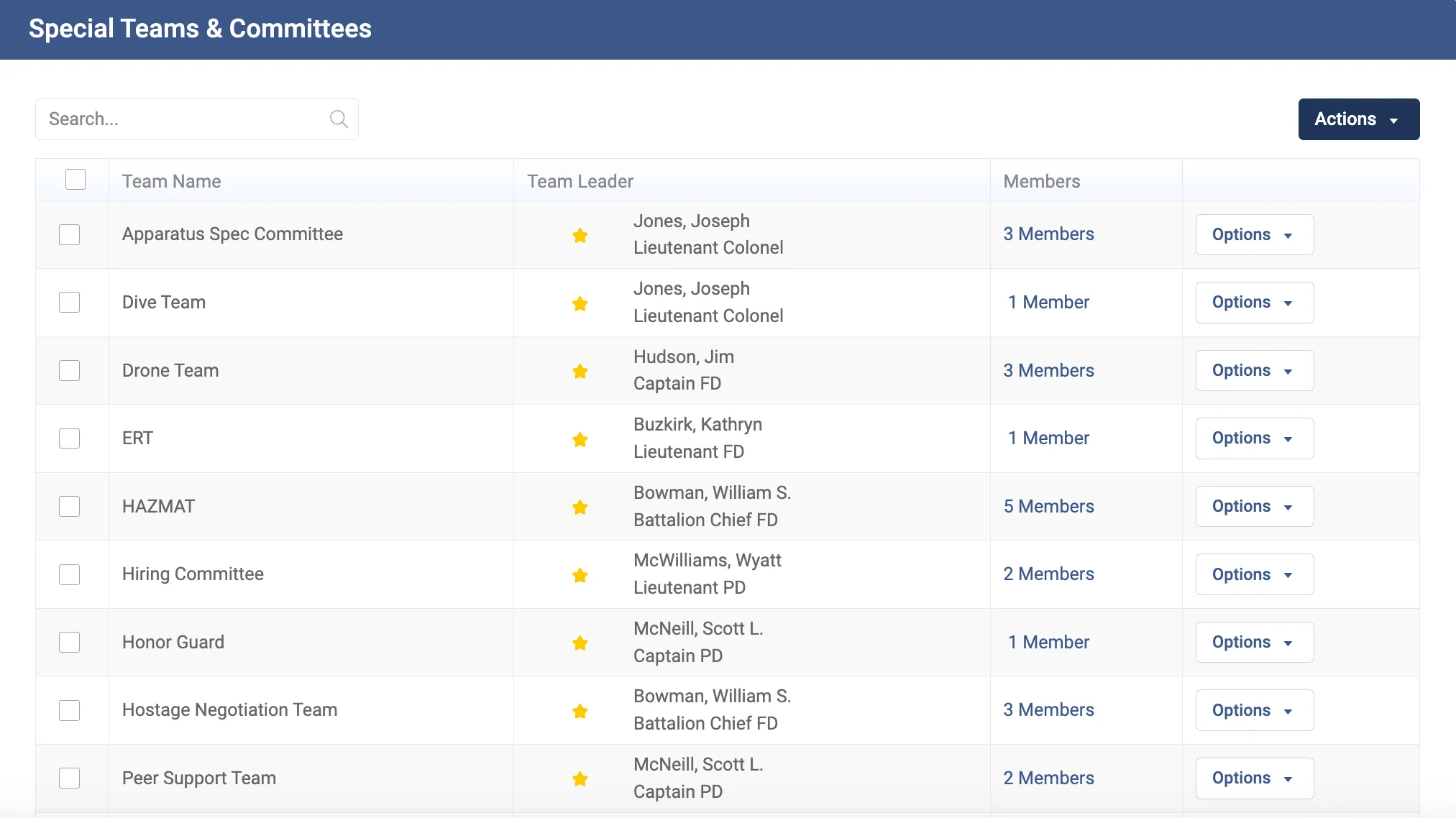
Assignments is the workflow that feeds it. Members submit transfer and special team requests through a tracked path instead of an email to a chief who's on vacation, and the request has a status you can look up. If you've ever lost a transfer request and found it six weeks later in a spam folder, you already know why this matters more than it sounds.
Vacancies, budget and what workforce planning software really means
The single most valuable thing a fire department org chart can do is show a funded position with nobody in it. That's the number a city manager asks for in budget season, and it's the number a diagram cannot produce, because a drawing only knows about people you drew.
Position control is an old idea in government finance and a hard one to maintain by hand. The Government Finance Officers Association has long treated authorized headcount as a budget control, not an HR detail, and council packets are built on it. If your chart shows 84 names and your budget authorizes 91 positions, the seven missing seats are the whole conversation.
When vacancies display on the chart itself, the staffing discussion changes shape. You're no longer arguing from a spreadsheet that somebody assembled last Thursday. You're pointing at the structure and saying: this battalion has been short a captain since February, here's the effect on overtime, and here are the three people within reach of the rank.
That's the point at which org chart software stops being an onboarding handout and starts being workforce planning software. Not because anyone added a forecasting engine, but because the chart finally knows what the department is authorized to have. Enterprise workforce planning software tends to be built for companies modeling headcount across business units, and it assumes a data layer no fire department maintains. The workforce planning software a department actually needs is narrower and more useful: a roster you trust, with the vacancies on it.
Readiness: who's qualified, not just who's assigned
Assignment tells you where somebody sits. Qualification tells you what they can legally and safely do. A fire department org chart that carries only the first is a seating plan, and the gap between the two is where an ISO review or an accreditation site visit finds its problems.
Because the chart in Essential Personnel is drawn from the same roster that holds certifications, qualifications and training records, you can filter the structure by capability. Show me every member of B shift whose aerial operator certification expires within ninety days. Show me which stations are below two HAZMAT technicians. These are queries, not projects.
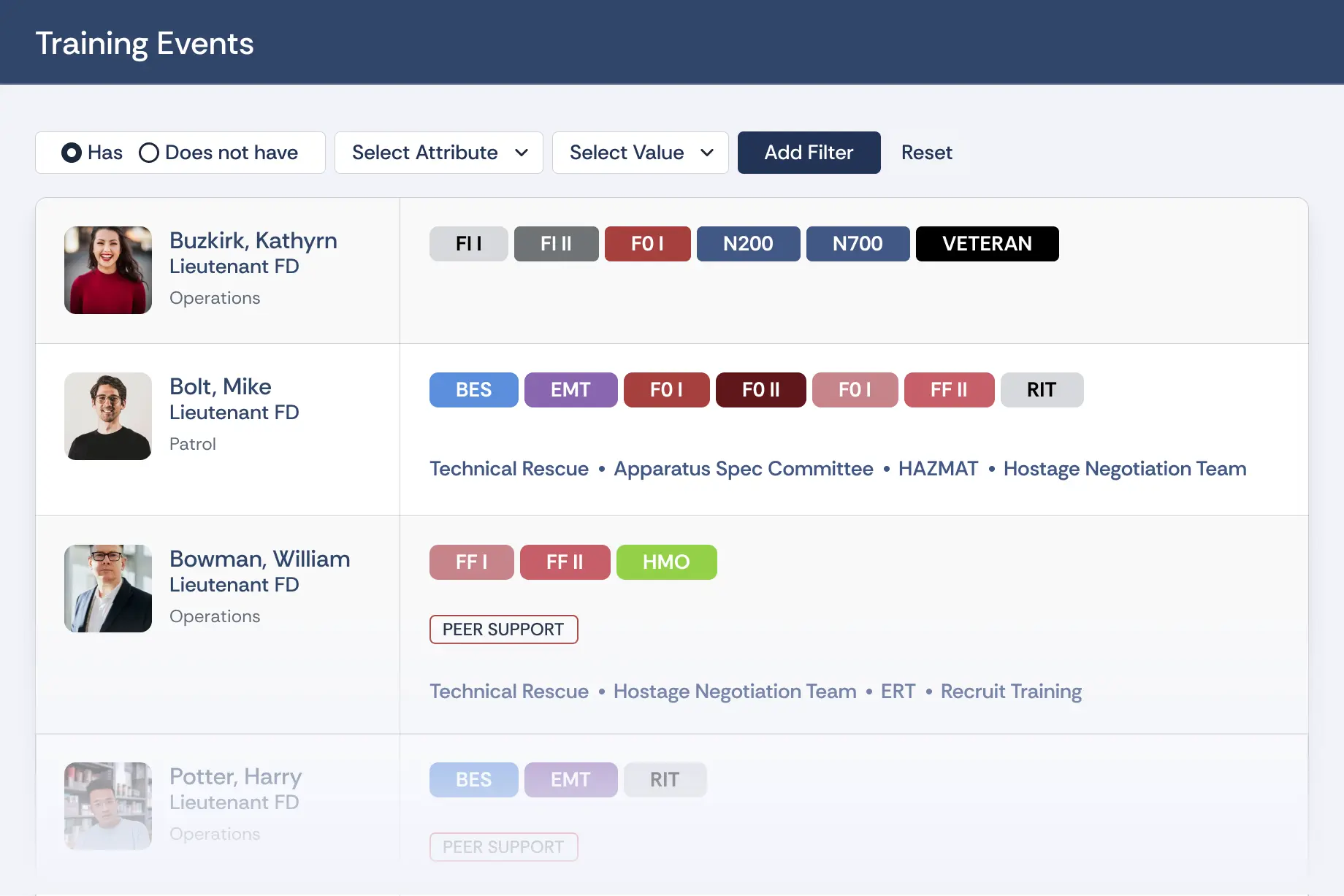
What sits behind the chart is the training record itself: hours, task books, certifications, expirations and source documents. If you're comparing options for course delivery, the training systems guide covers that category separately.
West Manatee Fire and Rescue put the division of labor plainly when they moved their ISO training tracking across.
"By aligning the right resources with the right responsibilities, we create a system that is intuitive, reliable, and operationally efficient. This approach reduces friction, improves performance, and enables every member of the organization to focus on their primary mission while maintaining full compliance and accountability."
Jay Johnson, Chief Deputy, West Manatee Fire and Rescue DistrictSuccession planning software starts with the chart
Succession planning software in the fire service isn't about naming an heir to a chair. It's about answering who could hold this job in eighteen months, and knowing that before the incumbent files their retirement paperwork. That answer comes out of the chart and the record together, because it depends on both the structure and everyone's progress toward the next rank.
The International Association of Fire Chiefs has been warning about the officer development gap for years, and the arithmetic is brutal in small and mid sized departments. When three of your four captains are within retirement range and only two members are within reach of the rank, that isn't a personnel issue for next year. It's a training plan you needed to start last year.
Career Paths in Essential Personnel lets you publish the rank and position requirements, and completion maps automatically from training, certifications and qualifications rather than being self reported. Promotion and Retirement Eligibility then sorts and filters the roster so you can see who's eligible now and, for everyone else, exactly how many requirements remain. Departments pursuing Center for Public Safety Excellence accreditation use the same data to evidence officer development rather than reconstruct it afterwards.
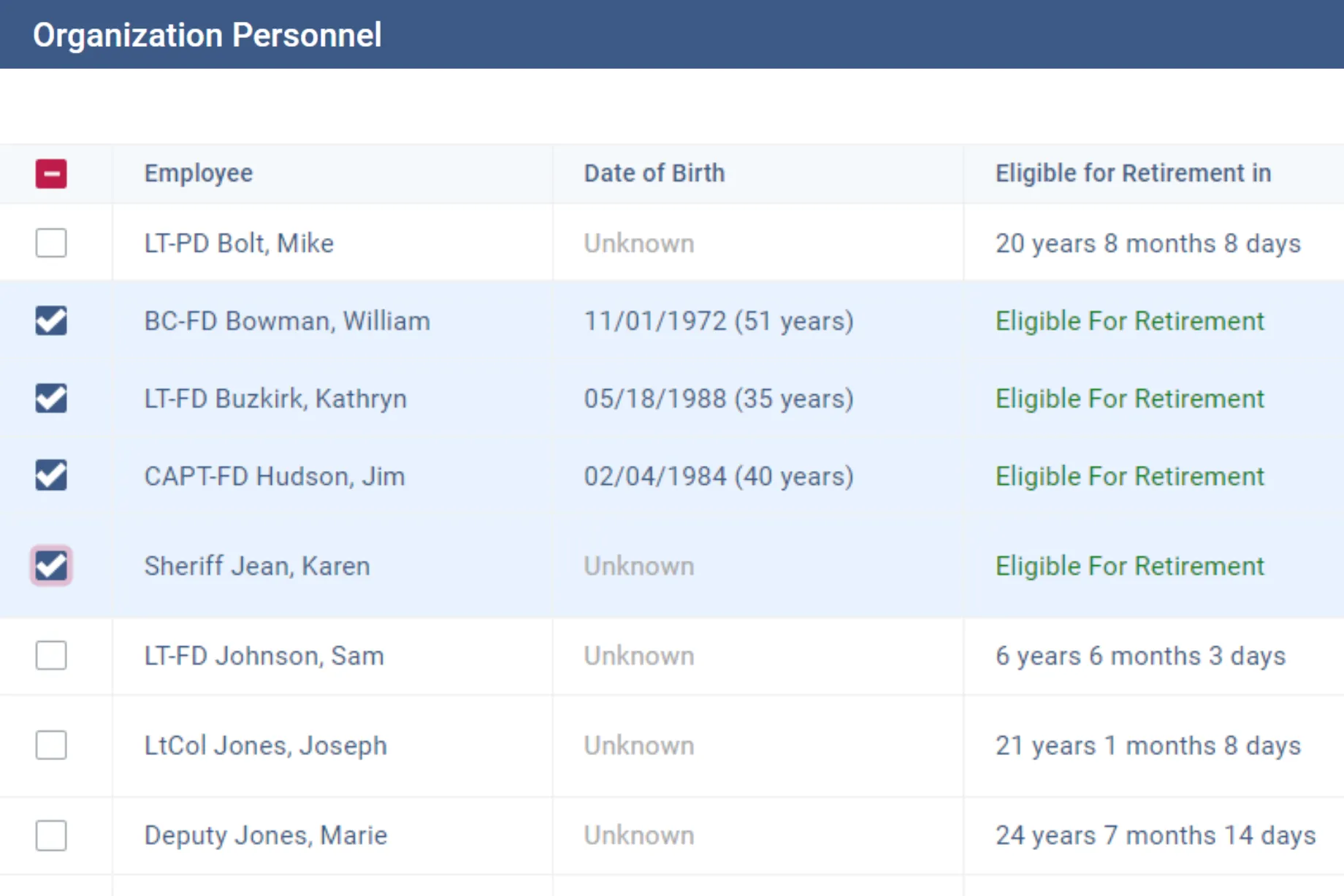
Succession planning software that only records intentions will never surface that. Succession planning software built on live qualification data will, and it does it without anyone being asked to keep a second list current. That's the practical test for any succession planning software in the fire service: does it tell you something you didn't already know?
What fire departments say about the visibility
Myrtle Beach Fire Department runs more than 200 personnel through Essential Personnel, and the thing their leadership talks about isn't the chart itself. It's what the chart being connected to everything else makes possible.
"Having this level of visibility is crucial for us. It enables our leaders to assess an individual's overall competency quickly. We can now put the right people in the right roles without the guesswork."
Deputy Chief Brad Kempf, Myrtle Beach Fire DepartmentPutting the right people in the right roles is the org chart's job description, stated by somebody who does it for a living. It just turns out that doing it well needs the competency data sitting behind each box.
Statesville Fire Department came at it from a different direction, through critical incident tracking, and landed somewhere similar.
"EP is such a simple, easy-to-use system that offers immense value to our service and people."
Deputy Fire Chief Kyle Bell, Statesville Fire Department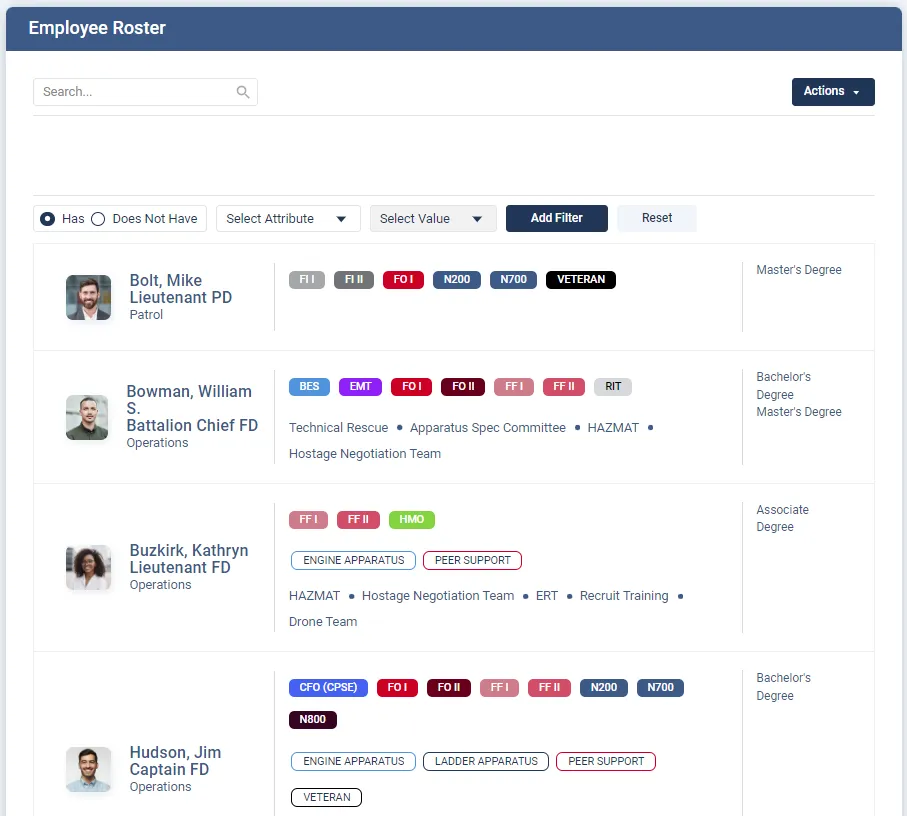
Why Essential Personnel answers the whole problem
Essential Personnel was founded in 2020 in Wilmington, North Carolina by two firefighters, and the org chart sits inside a platform that also holds evaluations, training records, certifications, awards, equipment, wellness and documentation. That's the reason the chart stays current: nobody has to maintain it. It's a view of data that other people are already keeping accurate for their own reasons.
Every partial answer to this problem fails the same way. Buy a diagramming tool and you own a picture that decays. Buy a general government HR platform and you get an employee directory that doesn't understand rank, platoon or task books, which is the one thing fire department software has to get right. Buy four point tools and each one keeps its own partial copy of your roster, and reconciling them by hand becomes invisible work that never shows up in a price comparison.
One record
Employee Profiles hold personal details, credentials, performance, career history, wellness data, training records and awards in one place. The chart reads from it.
Built for the rank structure
Rank, assignment, shift, station, sworn and civilian status are modeled rather than typed into a box label.
Published pricing
The bundled Total Solution is $175 per user per year with a $3,000 one time startup, and individual suites run $20 to $85 per user. Size based discounts apply.
Government grade hosting
AWS GovCloud, CJIS aligned, SOC 2 Type II audited annually, TLS 1.2 or higher, FIPS 140-3 validated cryptography and MFA at AAL2.
Two more things matter for how a fire department actually buys. Essential Personnel is available through GSA Advantage, NASPO, Omnia Partners, NCSA and VSA, so a purchase can ride an existing contract vehicle. And pricing is published, which is unusual enough in this category to be worth checking against whoever else you're considering.
The fire and EMS overview covers the operational side, security and compliance covers the hosting detail, and equipment tracking covers what's issued to each member, which is another thing departments usually keep on a separate spreadsheet keyed to the same roster.
Questions to ask before you buy fire department management software
Take this list to every demo
- Show me a vacancy on the chart. Not a deleted box, a funded position with nobody in it.
- Move somebody to a different supervisor while I watch. What follows them, and what doesn't?
- Filter the chart to everyone whose certification expires in the next ninety days.
- Show me the department as it stood on a date six months ago.
- Where does a specialty team live, and what happens to membership when a member transfers?
- Can a company officer see their own crew without being able to see the whole department?
- What does the chart look like when three shifts occupy the same position?
- Show me who's within two requirements of the next rank, and where that data comes from.
- Is the price published, and what's the total over five years including startup?
- Which contract vehicles can we buy this through?
If a vendor can answer the first two convincingly, they're selling fire department management software. If they can only answer them by exporting to a spreadsheet, they're selling a drawing tool with a good sales team. The demo is also where you find out whether the fire department management software was built around the rank structure or had it added later, and the giveaway is usually how the product talks about shifts.
Be realistic about what you're replacing. Fire department management software rarely displaces a single incumbent. Most departments aren't choosing between one system and nothing. They're choosing between one system and the four documents they currently keep in sync by hand, which is a cost that's already being paid, just not on an invoice. The personnel record systems comparison puts the main options side by side if you want to see how they score against each other.
Frequently asked questions
Fire department org chart software displays the department's command structure and reporting lines, but unlike general organizational chart software it draws that structure from a live personnel record. That means it can show rank separately from assignment, carry shift or platoon, mark funded positions that are vacant, and filter the structure by certification or specialty team membership. The distinction that matters is whether the chart is a picture somebody maintains or a view of data other people are already keeping current.
Yes. Essential Personnel's Team Builder is a drag and drop org chart with team creation and vacancy management, real time updates, search and filter, and role based access. Because it sits on the same roster as the rest of the platform, dragging a member to a new supervisor transfers that person and their records rather than just moving a shape. Diagramming tools such as Lucidchart, SmartDraw, Visio and Organimi also offer drag and drop, but what moves is a box on a canvas, not a personnel record.
You can, and for a printed chart in an annual report they work well. The limits show up when the chart has to answer a question. A diagramming tool has no concept of an authorized position, so it can't show a vacancy. It doesn't hold certifications, so it can't be filtered by capability. It shows one current state, so it can't tell you who held command on a given date. Departments that start with a diagramming tool usually end up maintaining a roster spreadsheet, a certification tracker and a specialty team list alongside it.
General purpose organizational chart software models one person per box, which is why fire departments find it awkward. A chart built on a personnel record separates the position from the people assigned to it, so a single engine company officer seat can carry an A, B and C shift occupant, and the structure stays readable. The same separation is what lets the chart show a funded position with nobody in it at all.
No. Essential Personnel is the system of record for training rather than a course library, and departments typically run it alongside whichever course provider they already use. It covers everything around the training: logbook hours and activities, training events with attendance and cost, certifications with expirations and source documents, and task books for qualifications. If your requirement is online course delivery for fire or EMS personnel, you need a course provider as well.
Yes, through a separate layer. Special Teams and Committees supports creating custom teams, naming a team leader, and tracking membership and assignments, all built on the same roster that draws the org chart. That matters because specialty teams cut across stations, shifts and ranks, so they can't be represented as another branch of the reporting structure. Assignments then gives members a tracked path to request a transfer or a place on a team.
Essential Personnel publishes its pricing, which is unusual for fire department management software. The bundled Total Solution is $175 per user per year, individual suites run between $20 and $85 per user, and there's a one time startup fee of $3,000. Single sign on is an optional $800 per year per agency, and size based discounts apply. Most competitors in public safety personnel software quote on request, so a published number is worth using as a benchmark when you compare.
For most departments at this size, yes. Dedicated workforce planning software is generally built for large enterprises modeling headcount scenarios and assumes a data layer fire department software doesn't maintain. The planning questions a department actually needs answered are narrower: where the vacancies are, who's eligible for promotion, which specialty teams are thin, whose certifications lapse this year, and who's within retirement range. Those are all queries against a live roster. What it isn't is a multi year budget forecast model tied to finance, so if you need that you'll want a dedicated tool alongside it.
See it against your own rank structure
Walk through the chart, the roster and the specialty teams with someone who's worked a shift. Call (910) 390-0011 or email info@essper.com.
About this article
Written by Scott Monroe, Chief Executive Officer & Co-Founder, Essential Personnel. Published 23 September 2026.
Essential Personnel makes the software described here, and the product screenshots are from the platform. Pricing, hosting and procurement details are taken from the published pricing and security pages. Customer quotes are reproduced from published customer stories with the speaker's name and rank as given.
