
How police departments track officer performance and early warning signs
Every chief has been there. An officer gets into serious trouble, and afterward everyone admits the signs were there. A couple of complaints that went nowhere. More use of force than the rest of the shift. A crash, a run of sick days, a bad call nobody followed up on. Each one was handled. Nobody put them together.
This guide is for police chiefs, sheriffs, professional standards commanders and the supervisors who do the day-to-day work. It explains how departments track officer performance, which early warning signs they watch, how an early intervention system turns those signs into a conversation, and what the research and state law say about it.
The departments that catch problems early don't do it from memory or a spreadsheet one lieutenant keeps. They keep evaluations, supervisor notes, complaints, use of force, crashes, training and wellness on one record per officer, in software built for public safety, with thresholds that alert the right person automatically. By the end of this guide you'll know how to set that up and what to look for in the system that runs it.
The short answer: how departments track officer performance and early warning signs
Police departments track officer performance in two layers. The first is the everyday record: evaluations, supervisor notes, field training reports, commendations, training and discipline. The second is an early intervention system, also called a police early warning system, which counts set indicators like complaints, use of force, pursuits, at-fault crashes and sick leave, and alerts a supervisor when an officer crosses a threshold, such as three incidents in 12 months. The supervisor reviews the record, talks with the officer, offers support and follows up.
The two layers need each other. An early intervention system with no performance record behind it flags an officer and leaves the supervisor guessing why. A performance record with no early intervention system holds every warning sign and alerts nobody. The rest of this guide covers each layer, then how they fit together.
Layer one: the everyday officer performance record
Most of what a department knows about an officer's performance comes from routine records written by supervisors and trainers. The table below shows what those records are, who writes them and how often. Gaps in this layer are the most common reason early warning signs get missed.
| Record | Who writes it | How often | What it shows |
|---|---|---|---|
| Police officer performance evaluation | First-line supervisor | Once or twice a year | Overall rating against agency standards |
| Supervisor notes and coaching | Sergeant | As things happen | Day-to-day conduct, good and bad |
| Field training daily observation reports | Field training officer | Every shift during field training | A new officer's progress on each task |
| Commendations and awards | Supervisors, the public | As earned | Work worth recognizing |
| Training and certifications | Training unit | Ongoing | Whether the officer is current |
| Complaints and findings | Internal affairs | As received | Allegations and how each was closed |
| Use of force, pursuits and crashes | Officer, then supervisor review | Each incident | Field activity that carries risk |
| Corrective documents and discipline | Supervisor, command staff | As needed | Counseling, reprimands and suspensions |
In most departments these records live in different places: evaluations in HR, complaints with internal affairs, use of force in the records system, training with the training unit, and supervisor notes in a sergeant's notebook. That split is the real reason early warning signs get missed. Each record is fine. Nobody sees them side by side.
Why the annual police officer performance evaluation misses early warning signs
The annual police officer performance evaluation is the record most departments lean on, and it's the worst one for catching problems early. It comes once a year, it depends heavily on one supervisor's judgment, and it usually reflects the last month or two better than the other ten.
Three things go wrong with the police officer performance evaluation:
- Timing. A problem that starts in February shows up in December, if at all.
- Hard and easy graders. One sergeant gives almost everyone a 5 out of 7. Another gives almost everyone a 3. Compare officers across shifts and you're mostly comparing their sergeants.
- Nobody writes it down until review time. If a supervisor didn't note the good call in March or the rude traffic stop in April, the evaluation can't include it.
Departments that track performance well add short, frequent entries throughout the year, like supervisor notes, daily observation reports and quick commendations, and adjust scores for how hard each supervisor grades. The police officer performance evaluation then summarizes a year of records instead of replacing them. Our guide to police performance software compares the systems built for this.
Layer two: what an early intervention system is
An early intervention system is a structured way to spot officers whose records show a pattern of risk, and to step in with support before that pattern becomes police officer misconduct, injury or a lawsuit. It's non-disciplinary. Many departments still call it a police early warning system, the older name.
The idea isn't new. A National Policing Institute review traces a documented system in Kansas City back to 1972, and the IACP was writing about them by 1989. The research brief most often cited on the subject, published by the National Institute of Justice in 2001, describes three phases that still define every early intervention system:
- Selection. The system identifies officers who've crossed a threshold on the indicators the department chose.
- Intervention. A supervisor reviews the record, meets with the officer and decides what support or training would help.
- Post-intervention monitoring. The department keeps watching the same indicators for a set period to see whether things improved.
The early intervention system is separate from internal affairs. Internal affairs investigates whether a specific allegation happened. The early intervention system asks whether a pattern of incidents, each of which may have been cleared, means an officer needs help. Our internal affairs guide covers the investigation side.
Which early warning signs police departments track
Most departments track about a dozen indicators, according to the U.S. Justice Department's COPS Office. They fall into five groups: complaints and police officer misconduct allegations, use of force and enforcement, safety, attendance, and stress or trauma. The best systems also count positive signs, like commendations.
| Group | Early warning signs | What to watch for |
|---|---|---|
| Complaints and misconduct | Citizen and internal complaints, including not sustained ones; civil suits; police officer misconduct allegations; criminal complaints against the officer | Repeat complaints about the same behavior, even when none was proven |
| Force and enforcement | Use of force reports, firearm discharges, pursuits, resisting arrest charges, cases dismissed or evidence suppressed in court | More force than peers on the same shift and assignment |
| Safety | At-fault vehicle crashes, on-duty injuries, exposures | Repeat crashes, often one of the earliest visible signs of stress or fatigue |
| Attendance | Sick leave, unexcused absences, late arrivals | Many separate short absences rather than one long illness |
| Stress and trauma | Traumatic calls, critical incidents, officer-involved shootings | Several traumatic calls close together |
| Positive signs | Commendations, awards, completed training | A drop-off in positive entries can matter as much as a rise in negative ones |
On sick leave, the National Policing Institute review makes a useful point: 12 separate sick days in a year is more concerning than one 12-day illness, even though the total is the same. Count the pattern, not just the total.
New Jersey's statewide early warning directive lists 15 required indicators, including internal affairs complaints, civil actions, use of force found excessive, domestic violence investigations, at-fault crashes, positive drug tests, cases dismissed by a court, insubordination and unexcused absences. North Carolina requires every agency to track at least firearm discharges, use of force, vehicle collisions and citizen complaints. Start with whatever your state requires, then add the early warning signs your own history says matter.
How thresholds work: counts, peer comparison and risk scores
An early intervention system flags an officer when their indicators cross a threshold. There are three ways to set one. A fixed count, such as three incidents in 12 months, is the most common. A peer comparison flags officers well above others in similar assignments. A risk score weighs indicators by how serious and how recent they are.
Fixed counts
Most departments start here because it's simple and easy to explain. The 2001 NIJ brief found that 67% of systems using complaints flagged an officer at three complaints, and 76% of those counted over 12 months. New Jersey's directive sets a minimum trigger of three indicators in any 12 months. The COPS Office gives three or more uses of force in three months as an example. The weakness is that a fixed count treats a night-shift patrol officer and a day-shift detective the same, so busy assignments get flagged more often.
Peer comparison
Comparing officers to peers on the same shift and assignment, adjusted for hours and calls, fixes that problem. An officer with twice the use of force of the rest of the overnight squad stands out. The same number on a quiet day shift might not. It takes more data and more care to set up, but supervisors tend to trust the flags more.
Risk scores
Some larger agencies weight indicators by seriousness and recency and combine them into a score. The COPS Office reports that Charlotte-Mecklenburg's risk model cut false positives by 20% and raised true positives by 75% compared with its old system. These models need years of clean data, so they suit big departments more than small ones.
Whichever approach you choose, size the thresholds to your department. A threshold built for a 900-officer agency will flag half the roster in a department of 30. Start conservative, watch what triggers for a quarter, then tighten.
What happens when an officer is flagged
A flag starts a review, not an investigation. A supervisor looks at the whole record, meets with the officer, agrees on what would help, writes it down and keeps watching for a set period. Done right, most officers come out of it better supported, and the early warning signs fade.
- Review the record. The supervisor looks at every indicator behind the flag, plus the officer's evaluations, training, commendations and recent calls. Body camera footage of the flagged incidents helps.
- Talk to the officer. Tell them in writing why they were flagged, then meet. Ask what's going on. New Jersey bars using the officer's statements in this conference for discipline, which makes for a more honest conversation.
- Agree on support. Options include extra training, closer supervision for a while, a change of assignment, counseling, the employee assistance program, peer support, a chaplain or critical incident stress management. A fitness-for-duty evaluation is for serious cases.
- Document it. Record the flag, the meeting, what was agreed and who's responsible.
- Monitor. Keep watching the same indicators. New Jersey requires at least three months. The NIJ brief found that 90% of departments monitored officers after an intervention.
- Close it out. Record the outcome and whether the plan worked.
The IACP put the tone of this in one line: early intervention is about treating officers with problems, not problem officers. If officers believe a flag is the first step toward discipline, they'll hide the early warning signs you most need to see.
Early warning signs and officer wellness
Many early warning signs are signs of stress before they're signs of police officer misconduct. A run of traumatic calls, repeat crashes and more sick days often come before the complaints. Departments that include wellness indicators in their early intervention system can reach an officer while it's still a wellness conversation.
That's why more departments now treat early intervention as part of officer wellness, not just accountability. Hendersonville Police Department in North Carolina tracks traumatic calls, use of force, pursuits and complaints in one place and sets threshold alerts. When an officer crosses one, the department can refer them to critical incident stress managers, chaplains or peer support.
Officer wellness records need careful handling. Counseling and peer support records generally shouldn't sit in the personnel file, and they can raise questions under public records law and Giglio. Our guide to officer wellness records covers how to keep them separate while still letting the right people see the pattern.
Does early intervention prevent police officer misconduct?
The research on whether early intervention prevents police officer misconduct is encouraging but not airtight. The 2001 NIJ study found big drops in complaints and use of force among officers who went through early intervention in three departments. Its authors also cautioned that the system's effect can't be separated from the department's wider culture of accountability.
The numbers from that study are still the most quoted:
- In Minneapolis, citizen complaints against officers who went through intervention fell by 67% within a year.
- In New Orleans, they fell by 62%.
- In Miami-Dade, only 4% of officers in the study had no use of force reports before intervention. Afterward, 50% did.
Early intervention has spread since. The COPS Office reports that 65% of police departments with 250 or more officers had one, and the National Policing Institute notes that early intervention systems are a consistent feature of Justice Department consent decrees. The same researchers call them high-maintenance. A system with stale data, thresholds nobody reviews or supervisors who don't follow up won't deliver those results.
Who requires a police early warning system
A growing number of states require one. At least five, North Carolina, Maryland, Nevada, South Carolina and Utah, require early intervention by law, and New Jersey requires it statewide by Attorney General directive. CALEA expects an accredited agency with an early intervention system to govern it with a written directive.
New Jersey. Directive 2018-3 made a police early warning system mandatory for every state, county and municipal agency. It sets 15 indicators, a minimum trigger of three in any 12 months, a written notice and conference with the officer, at least three months of monitoring, an audit of the tracking system at least every six months, and notice of an officer's early warning history to any law enforcement agency that later hires them. Policies must be posted on the agency's website.
North Carolina. G.S. 17F-10 requires every agency with certified officers to develop and implement an early warning system that tracks, at a minimum, firearm discharges, use of force, vehicle collisions and citizen complaints.
CALEA. The CALEA standard on personnel early intervention, as summarized in the National Policing Institute review, expects a written directive covering which behaviors are reviewed, the thresholds, how flagged employees are reviewed, supervisors' responsibilities, remedial action, employee assistance and a documented annual evaluation of the system.
Even where nothing requires one, an early intervention system is now an expected practice. The Leadership Conference recommends one for every department, and plaintiffs' attorneys increasingly ask what a department did with the early warning signs it had.
What to look for in early warning system software
Small departments can run early intervention from a quarterly supervisor review and a spreadsheet. It works until the person who keeps the spreadsheet leaves. Early warning system software keeps the indicators current and alerts the right people automatically. These are the questions to ask before you buy.
Questions to ask about early warning system software
- Does it use the record you already keep, or does someone have to re-enter complaints, use of force and crashes into a separate system?
- Can you set your own indicators and thresholds, including counts over a time window, and change them as you learn?
- Does it include wellness and positive signs, like traumatic calls and commendations, not just complaints?
- Does it document the intervention, including the meeting, the plan and the monitoring, on the officer's record?
- Who can see what? Role permissions should let a peer support coordinator see critical incidents without seeing internal affairs files, and the reverse.
- Can it produce the annual evaluation CALEA and some states expect, without a week of spreadsheets?
- Does it meet the FBI CJIS Security Policy, and where is the data hosted?
- What does it cost per user, and is the price published?
The first question matters most. Early warning system software that sits apart from evaluations, training and discipline flags an officer and stops there. The supervisor still has to go to four other places to understand why.
How Essential Personnel tracks officer performance and early warning signs
Essential Personnel is professional standards software built for police, fire and city government. They keep evaluations, supervisor notes, field training, commendations, training, discipline, use of force, crashes and traumatic calls on one employee record, and their early intervention thresholds watch that record and alert the right people automatically.

For the everyday record:
- Score Reports are the platform's version of a police officer performance evaluation, with an algorithm that normalizes scores so hard graders and easy graders can be compared.
- Leader's Notes holds templates for field training daily observation reports, formal counseling and performance improvement plans, so supervisors can write short entries all year.
- Documents of Record store commendatory and corrective documents with routing and approval.
- Training tracks certifications, expirations and field training on the same profile.
For early intervention, the Safety and Wellness suite is the platform's early warning system software. It tracks five event types against every employee: injuries, use of force, traumatic calls, motor vehicle accidents and exposures. You set the number and type of events, and the timeframe, that trigger an alert, and corrective documents of record can count toward a threshold too. When someone crosses one, safety and wellness leaders are notified automatically, and they can document the early intervention conversation from the same screen. A specialist role lets a peer support or critical incident professional see critical incidents without access to the rest of the file.
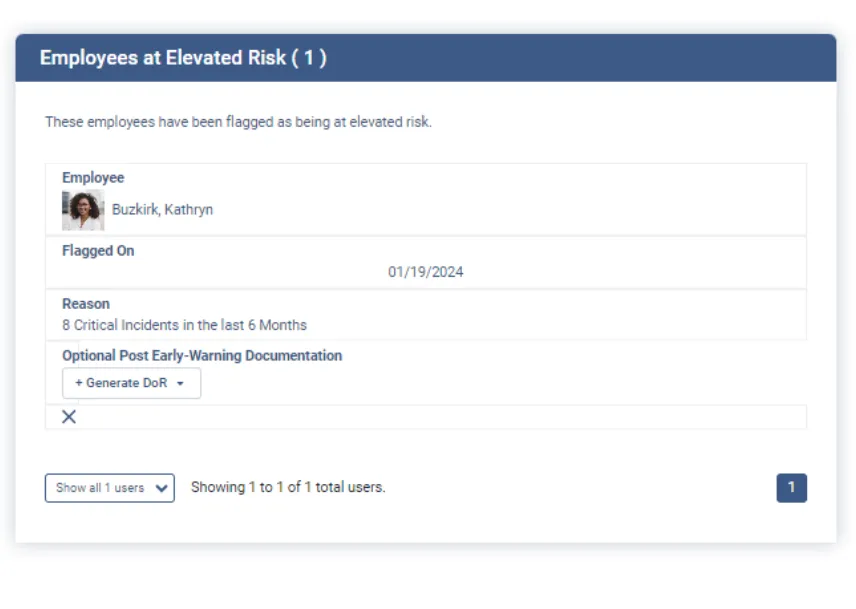
Safety and Wellness is $40 per user per year on its own, and the Total Solution with all four suites is $175 per user per year, plus a one-time $3,000 startup fee. See the Safety and Wellness page for the full feature list. The platform is hosted in AWS GovCloud, aligned with the FBI CJIS Security Policy and covered by an annual SOC 2 Type II report, and it's available through GSA Advantage, NASPO, Omnia Partners, NCSA and VSA. For the full professional standards picture, see our guide to establishing professional standards.
"That level of visibility helps us catch issues early or give praise when it's due."
Derek Moore, Major, Carteret County Sheriff's Office, North CarolinaSetup checklist: an early intervention system in 90 days
Days 1 to 30: decide
- Check what your state, accreditor and any consent decree require
- Pick about a dozen indicators, including wellness and positive signs
- Set starting thresholds sized to your department
- Write the policy: who reviews flags, what support is available, how long monitoring lasts, and that it's separate from discipline
Days 31 to 60: connect the record
- Get evaluations, supervisor notes, complaints, use of force, crashes, sick leave and traumatic calls into one record per officer
- Set role permissions so wellness information only reaches the people who need it
- Train supervisors on the review conversation, and tell officers how the system works
Days 61 to 90: run it and adjust
- Turn on alerts and review every flag within a set number of days
- Document each review, plan and monitoring period
- After a quarter, look at what triggered and adjust thresholds
- Schedule the annual evaluation of the system
Catch the pattern while it's still a conversation
We'll show you how evaluations, use of force, crashes, traumatic calls and early intervention thresholds come together on one record for a department your size. Call (910) 390-0011 or email info@essper.com.
Frequently asked questions
They use two layers. The everyday record holds evaluations, supervisor notes, field training reports, commendations, training and discipline. An early intervention system then counts indicators like complaints, use of force, pursuits, at-fault crashes, sick leave and traumatic calls, and alerts a supervisor when an officer crosses a threshold. The supervisor reviews the record, talks with the officer, offers support and monitors afterward.
An early intervention system is a non-disciplinary process that spots officers whose records show a pattern of risk and steps in with support before it becomes misconduct or injury. It works in three phases: selecting officers who cross a threshold, intervening with a supervisor review and a plan, and monitoring afterward. Many departments still call it a police early warning system.
Common early warning signs include repeat complaints, even ones that weren't sustained, more use of force than peers on the same assignment, pursuits, at-fault crashes, on-duty injuries, many separate sick days, cases dismissed in court and several traumatic calls close together. A drop in commendations can matter too. One sign alone means little. Several together are what an early intervention system watches for.
Three incidents in 12 months is the most common starting point. New Jersey sets that as its statewide minimum, and the 2001 NIJ study found most systems that count complaints flag officers at three. The COPS Office gives three uses of force in three months as an example. Size thresholds to your department, start conservative and adjust after a quarter of real alerts.
No. An early intervention system is meant to be separate from discipline, and most policies say so in writing. A flag starts a supportive review, not an investigation. New Jersey bars using what an officer says in the early warning conference for discipline. If misconduct turns up during a review, it goes to internal affairs through the normal process.
At least five states require early intervention by law: North Carolina, Maryland, Nevada, South Carolina and Utah. New Jersey requires it for every agency through Attorney General Directive 2018-3. North Carolina's law requires tracking at least firearm discharges, use of force, vehicle collisions and citizen complaints. Check your state's current law, since this area keeps changing.
Many early warning signs, like a run of traumatic calls, repeat crashes and more sick days, show stress before they show misconduct. Including them lets a supervisor reach an officer while it's still a wellness conversation and refer them to peer support, a chaplain, the employee assistance program or critical incident stress management. Wellness records themselves should stay out of the personnel file.
Many vendors only quote early warning system software prices after a demo. Essential Personnel publishes theirs: the Safety and Wellness suite, which includes early intervention and case management, is $40 per user per year. The Total Solution, which adds evaluations, training, policy and equipment on the same record, is $175 per user per year, plus a one-time $3,000 startup fee.

About this article
Written by Scott Monroe, Chief Executive Officer & Co-Founder, Essential Personnel. Published 15 October 2026.
Essential Personnel makes the software described here, and the product screenshots are from the platform. Pricing, hosting and purchasing details are taken from essper.com, and the customer quote and the Hendersonville example are reproduced from essper.com customer stories. Research figures come from the National Institute of Justice's 2001 early warning study, the COPS Office's 2019 Law Enforcement Best Practices report and the National Policing Institute's 2018 early intervention review. State requirements were checked against New Jersey Attorney General Directive 2018-3 and North Carolina G.S. 17F-10 in October 2026. This article is general information and isn't legal advice.
