
How to fire a public safety employee without getting in trouble: progressive discipline and the record that holds up
You've got an officer, a firefighter or a city employee who has to go. You've talked to them more times than you can count. Then the city attorney asks for the file, and it holds one written warning from last month, a few emails and a supervisor's memory of two years of conversations. That's the file that loses at arbitration, in front of a civil service board or in federal court.
Most advice on how to fire an employee legally is written for private companies, where employment is usually at will. Public safety is different. A tenured public employee generally has a property interest in the job, a union contract or civil service rules usually require just cause, and police and fire have extra procedural protections on top. This guide walks police chiefs, fire chiefs and the city HR teams who support them through progressive discipline, the documentation each step has to leave behind, the Loudermill hearing and the termination itself.
The departments that handle this best don't leave the file to paper folders or a shared drive. They keep it in modern software built for public safety, where every counseling note, written warning, evaluation and policy acknowledgement lands on the employee's record the day it happens, reviewed and timestamped. By the end of this guide you'll have a step-by-step process for doing it right, and a clear picture of the system that keeps that file for you.
The short answer: how to fire an employee legally in public safety
Follow your own progressive discipline policy, document every step when it happens, and treat the employee the same way you've treated others who did the same thing. Before you terminate a tenured employee, give them written notice of the charges, explain the evidence and let them respond at a Loudermill hearing. Then follow your union contract or civil service appeal process to the letter.
Getting in trouble almost never comes down to whether the employee did it. It comes down to whether you can prove you knew about it, told them, gave them a chance to fix it, and handled it the way your own rules say. That's a records problem, and most of the work of how to fire an employee legally is done long before the termination meeting.
Why firing a public safety employee is different from at-will advice
A private employer can usually fire an at-will employee for any lawful reason. A police department, fire department or city usually can't. Once a public employee has a legitimate expectation of keeping the job, the Constitution requires due process before you take it away, and most union contracts and civil service rules add a just cause standard on top.
Here's what stacks up on a public employer that generic advice on how to fire an employee legally leaves out:
- A property interest in the job. In Board of Regents v. Roth (1972), the Supreme Court held that a property interest comes from state law, a contract or rules that create a real expectation of continued employment. Civil service protection and a contract requiring just cause usually create one. Probationary employees often don't have one, so check what your rules say about probation.
- Due process before termination. Cleveland Board of Education v. Loudermill (1985) requires notice of the charges, an explanation of the evidence and a chance to respond before a tenured public employee is fired, followed by a fuller hearing afterward. That pre-termination step is the Loudermill hearing.
- Just cause under a contract or civil service rules. Most collective bargaining agreements and civil service systems allow discipline only for just cause, decided by an arbitrator or a board who'll measure your file against the seven tests of just cause.
- Officer and firefighter bills of rights. Many states set out procedures for interviewing and disciplining police officers, and some do the same for firefighters, such as California's Firefighters Procedural Bill of Rights Act. These laws change. Maryland repealed its Law Enforcement Officers' Bill of Rights effective July 2022, so check the current statute, not last year's training slide.
- Compelled statements. Under Garrity v. New Jersey (1967), a statement an officer is ordered to give under threat of losing the job can't be used against them in a criminal case. Keep administrative and criminal investigations separate, and document which one an interview belonged to.
- What follows the officer out the door. A sustained finding of dishonesty can become impeachment material prosecutors must disclose under Giglio v. United States, and many states require you to report an officer's separation to the state certification board.
None of this means you can't fire a public safety employee. Knowing how to fire an employee legally in public safety means treating the process as part of the case, because a sloppy process can undo a good reason.
The seven tests of just cause, and what each one needs in the file
The seven tests of just cause come from a 1966 arbitration decision by Carroll Daugherty in the Enterprise Wire case, and arbitrators still use them to judge discipline under union contracts. If the answer to any test is no, the discipline is at risk. Each test is really a question about what your file can prove.
The University of Missouri Extension publishes a plain summary. Here's how the seven tests of just cause translate into records:
| Test | The question | What proves it |
|---|---|---|
| 1. Notice | Did the employee know the rule and the consequence of breaking it? | A signed policy acknowledgement for the version in force, and earlier written warnings that named the consequence |
| 2. Reasonable rule | Is the rule reasonably related to safe, efficient operation? | The written policy itself, and the reason it exists |
| 3. Investigation | Did you investigate before deciding? | An investigation file dated before the discipline, not after |
| 4. Fair investigation | Was the investigation fair and objective? | Who investigated, who they interviewed, and that the employee was heard |
| 5. Proof | Is there substantial evidence the employee did it? | Statements, reports, video and records gathered at the time |
| 6. Equal treatment | Have others who did the same thing been treated the same way? | Past discipline for the same offense, searchable across supervisors and shifts |
| 7. Penalty | Does the penalty fit the offense and the employee's record? | The employee's full history, including commendations, and your discipline matrix |
Tests six and seven are where most agencies lose. If you can't pull every comparable case from the last few years, you can't show equal treatment, and if the employee's commendations live in a different system from their discipline, you can't show you weighed the whole record. Arbitrators apply the seven tests of just cause with some flexibility, but no arbitrator will fill a gap in your file for you.
Progressive discipline steps, from verbal warning to written warning to termination
Progressive discipline raises the consequence each time a problem repeats: usually a documented verbal warning, then a written warning, then a suspension, then termination. Its purpose is to give the employee a fair chance to correct the problem, and its record is what lets you prove you did. Serious misconduct can skip steps if your policy says so.
The coaching and counseling that come before formal discipline are covered in the employee counseling guide. Progressive discipline starts where counseling stops working.
| Step | What it is | What the record has to show |
|---|---|---|
| Verbal warning | A formal conversation, not a hallway comment | A dated note of what was said, the rule involved and the expected change. A verbal warning nobody wrote down didn't happen |
| Written warning | A written warning or letter of reprimand placed in the file | The facts, the rule, prior steps, the expected change, the consequence of repeating it, and the employee's acknowledgement or refusal to sign |
| Suspension | Time off without pay, or a fine where your rules allow it | Everything above, plus the investigation, the approval chain and any union or civil service notice required |
| Final warning or last chance agreement | A written statement that the next violation ends employment | The terms, signed by the employee and, where there's a union, the union representative |
| Termination | Ending employment after due process | Every prior step, the notice of charges, the Loudermill hearing record, the decision and the appeal rights given |
A written warning is the step that gets skipped most, because a supervisor would rather keep talking than put it on paper. But a written warning is where the employee is first told, in writing, what happens if the problem continues, and that's exactly what the notice test asks for. Make the written warning specific: a written warning that only says "improve your attitude" tells an arbitrator nothing.
Progressive discipline isn't a promise that every problem gets four chances. Theft, dishonesty in a report, excessive force or working impaired can justify suspension or termination on the first offense, as long as your progressive discipline policy says serious misconduct can skip steps and you've treated similar cases the same way.
Write a progressive discipline policy and a discipline matrix
A progressive discipline policy sets out the steps, who can impose each one and when steps can be skipped. A discipline matrix sits underneath it and lists offenses by category, with a range of penalties for a first, second and third occurrence. Together they make discipline predictable, which is what the equal treatment test asks for.
Your progressive discipline policy should cover:
- The steps and who owns them. Which ranks can issue a verbal warning, a written warning or a suspension, and who signs off on termination.
- Which offenses can skip steps. Name them, so skipping a step looks like following the policy instead of making an exception.
- How long discipline stays active. Many contracts set a period after which a written warning can't count toward the next step. Your progressive discipline policy has to match the contract, not contradict it.
- The employee's rights at each step. Representation, the right to respond in writing, and the appeal route.
A discipline matrix turns that policy into a table supervisors can actually use. Group offenses into categories by seriousness, give each category a penalty range, and list the factors that move a penalty up or down within the range. Many police departments have adopted a discipline matrix to make outcomes consistent across commanders, and the same idea works in a fire department or a city department. A discipline matrix doesn't replace judgment, but when you depart from it, write down why. Bargain the progressive discipline policy and the discipline matrix with your union where your contract requires it, and publish both so every member has acknowledged them.
What a disciplinary action form has to record
A disciplinary action form is the written record of a formal discipline step. It has to say what happened, which rule it broke, what earlier steps were taken, what the employee must change, what happens if they don't, and whether the employee acknowledged it. Use the same disciplinary action form across every supervisor and shift.
Every disciplinary action form should capture:
- The employee, the supervisor and the date. Written at the time, not reconstructed months later.
- The facts. What happened, when and where, in plain observable terms. "Arrived 40 minutes late for shift on 3 March" beats "chronic lateness".
- The rule. The policy or general order section, and the version in force on that date.
- Prior steps. Earlier counseling, verbal warnings and written warnings for the same issue, with dates.
- The expected change and the timeframe. What good looks like, and by when.
- The consequence. What happens if it happens again. This is the notice an arbitrator will look for.
- The employee's response. Their side in their own words, and their acknowledgement. A refusal to sign gets noted with a witness, and it doesn't invalidate the record.
- Review and approval. Who reviewed it above the supervisor, and when.
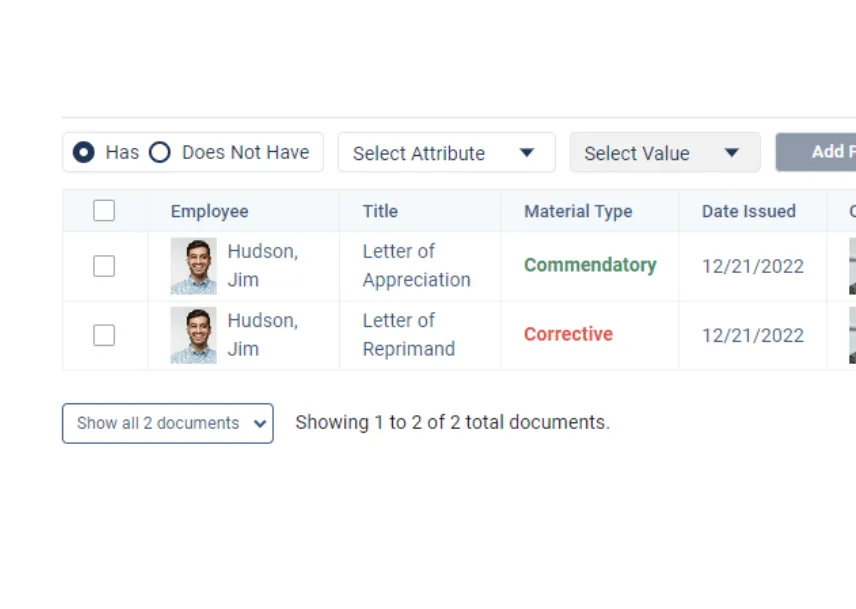
A disciplinary action form on paper in a supervisor's desk drawer helps nobody. It needs to land on the employee's own record, where the next supervisor, HR and the city attorney can find it. A standard disciplinary action form also makes the equal treatment test much easier, because comparable cases are written the same way.
Build the file before the decision, not after
A file assembled after you've decided to terminate rarely survives a grievance. Arbitrators and boards look at dates. If every document is from the last month, it reads as a case built to justify a decision, not a record of a problem the agency tried to fix. Document as things happen, in the same format, on the employee's own record.
The pattern that fails is always the same: real problems discussed verbally for two years and written down in the final month. These habits stop it:
- Make documenting fast. If a note takes a supervisor five minutes at the end of a shift, it happens. If it takes twenty, it doesn't.
- Use templates. When every supervisor writes a written warning the same way, an appeal can't argue one employee was held to a different standard.
- Route it for review. An entry reviewed and approved above the supervisor shows it wasn't written alone and after the fact.
- Keep the good with the bad. Commendations belong on the same record. The penalty test asks whether you weighed the employee's whole history.
- Keep wellness out of it. Peer support contacts and critical incident records don't belong in the discipline file. The officer wellness records guide explains why.
The Loudermill hearing: notice, evidence and a chance to respond
A Loudermill hearing is the meeting a public employer holds before terminating a tenured employee. The employee gets notice of the charges, an explanation of the evidence and a real opportunity to respond. It doesn't have to be a trial, but the decision maker has to listen before deciding, and the record has to show they did.
Run the Loudermill hearing in this order:
- Finish the investigation first. The Loudermill hearing comes after the facts are gathered and before the decision is final.
- Send written notice. State the charges, the rules broken, the proposed discipline and a summary of the evidence, with enough time to prepare. Your contract or civil service rules may set the minimum.
- Allow representation where it applies. The federal Weingarten right to a union representative in an investigatory interview comes from the National Labor Relations Board's reading of a law that excludes state and local governments. For your employees, the right comes from your state's labor law or your contract, so check both.
- Listen and record it. Note who attended, what the employee said and any new facts raised. If they raise something you didn't know, look into it before deciding.
- Decide, in writing. Issue the decision with the reasons and the appeal rights, then follow the post-termination appeal process your rules set.
Skip the Loudermill hearing, or hold it after the decision was already announced, and a good reason to terminate can turn into back pay and reinstatement. This guide is general information, not legal advice. Take the file to your city or county attorney before you act, and earlier if the employee has recently complained, filed a grievance or taken protected leave.
The termination meeting and the days after
Keep the meeting short, private and factual. Have a second person present, deliver the decision and the reasons in a few sentences, hand over the written decision with the appeal rights, and don't argue the case again. The Loudermill hearing was the time for that. Then work through what follows:
- Final pay and benefits. State law sets the timing of the final paycheck and what happens to leave balances. Give the health coverage continuation notice your plan requires.
- Equipment and access. Collect the badge, ID, keys, issued firearm, radio and gear, and turn off system access the same day. The equipment tracking guide covers knowing what was issued to whom.
- Certification reporting. Many states require you to report a sworn officer's separation to the state certification board, and revocations feed the National Decertification Index. Check your state's deadline.
- Keep the record intact. Expect an appeal, a grievance, an unemployment claim or a lawsuit. Follow your state's records retention schedule, and don't edit or remove anything from the file after the decision.
- Say little in public. Release only what your public records law requires, and route questions through one person.
Six places public safety terminations fall apart
- The file was built at the end. Two years of verbal conversations and one month of paper.
- Others got a lighter penalty. A different shift commander handled the same offense with a written warning. Without a searchable history, you won't know until the union shows you.
- It looks like retaliation. Discipline that follows a complaint, a grievance or a report of misconduct is the claim the EEOC sees most. Document the problem before the protected activity, or be ready to show it was handled the same as everyone else.
- Protected leave got in the way. Counting FMLA absences against someone is interference, and the Department of Labor treats retaliation for using leave the same way.
- Due process was skipped or rushed. No written notice, no Loudermill hearing, or a decision announced before the employee was heard.
- Nobody could prove notice of the rule. The employee says they never saw the policy, and you can't show which version they acknowledged or when.
How Essential Personnel helps you build a record that holds up
Essential Personnel was founded in 2020 in Wilmington, North Carolina by two firefighters. EP doesn't make the decision to terminate and doesn't give legal advice. What it does is hold the record: counseling, warnings, evaluations, commendations, incidents and policy acknowledgements, timestamped on one employee profile, so the file exists before anyone asks for it.
Leader's Notes
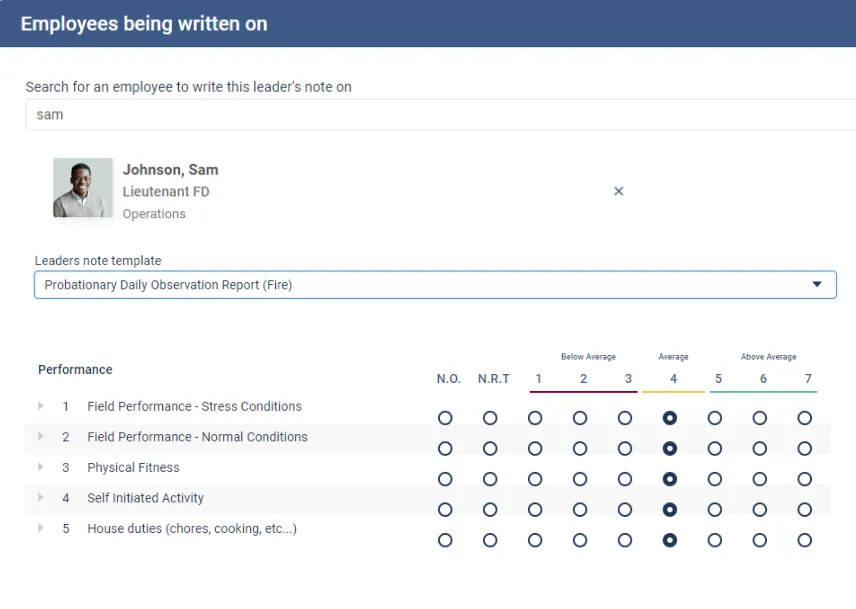
Templates for formal counseling, performance improvement plans and observations, so every supervisor documents the same way and notes land on the employee profile as they happen.
Documents of Record
Commendatory, corrective and miscellaneous documents with routing and approval workflows, so a written warning is reviewed above the supervisor instead of filed alone.
Score Reports
Performance evaluations with an algorithm that normalizes scores between hard and easy graders, which takes away the argument that one supervisor rated harder than the rest.
Policy acknowledgement
Guidance records which version of each policy every member acknowledged and when, which answers the notice question before it's asked.
Corrective documents can also count toward early intervention thresholds on the safety and wellness suite, so a pattern prompts a supervisor's conversation early, when it can still be fixed. Hendersonville Police Department uses those alerts to document early intervention discussions and generate a document of record from them.

A complete record also opens options short of termination. In Southern Pines, North Carolina, the town uses EP for performance development across departments.
"We've also used EP to help counsel employees whose current position may no longer be the best fit. We've been able to facilitate a move to another town position rather than losing them altogether."
Mike Cameron, Fire Chief and Assistant Town Manager, Town of Southern Pines, NCRead the full Southern Pines story. The Talent Management suite is published at $85 per user per year, and the full platform is $175 per user with a one-time $3,000 startup fee, all on the pricing page. EP is hosted in AWS GovCloud, aligned to the FBI CJIS Security Policy and audited to SOC 2 Type II annually, and it's available through GSA Advantage, NASPO, Omnia Partners, NCSA and VSA.

"EP has strengthened accountability, enhanced communication and become an essential tool in helping our office better serve the community."
Travis Sumption, Sheriff, Clarke County, VAThe human resources platform covers the city side, and the law enforcement platform adds internal affairs case management on the same profile.
Before you terminate: a final checklist
Check every line before you sign
- Is the employee probationary, tenured, under a union contract, under civil service rules, or covered by an officer or firefighter bill of rights?
- Can you show they acknowledged the rule they broke, in the version in force at the time?
- Does every progressive discipline step in your policy appear in the file, dated when it happened?
- Was the investigation finished, fair and documented before the decision?
- Have you pulled every comparable case and checked the penalty against your discipline matrix?
- Have you weighed the employee's commendations and length of service?
- Has the employee recently complained, filed a grievance, reported misconduct or taken protected leave?
- Did they get written notice of the charges and a Loudermill hearing before the decision?
- Does the written decision state the reasons and the appeal rights?
- Has your city or county attorney reviewed the file?
If any answer is no, fix it before the meeting, not after. That's how to fire an employee legally and have the decision hold up on appeal. If you want to see what that record looks like when it's kept as you go, the Essential Personnel team can walk you through it.
Frequently asked questions
Follow your own discipline policy, document each step when it happens, and treat the employee the same as others who did the same thing. Rule out retaliation and protected leave. In public safety, give a tenured employee written notice and a Loudermill hearing before deciding, follow your union or civil service rules, and have your attorney review the file.
Progressive discipline is a system where the consequence increases each time a problem repeats, usually a documented verbal warning, then a written warning, then a suspension, then termination. It gives the employee a fair chance to correct the problem and gives the employer a record proving it did. Serious misconduct can skip steps where the policy allows it.
A Loudermill hearing is a meeting a public employer holds before terminating an employee who has a property interest in their job. Under the 1985 Supreme Court case Cleveland Board of Education v. Loudermill, the employee must get notice of the charges, an explanation of the evidence and a chance to respond before the decision is made.
They're seven questions arbitrators use to judge discipline: did the employee have notice of the rule and consequence, was the rule reasonable, did the employer investigate, was the investigation fair, was there substantial proof, were rules applied equally, and did the penalty fit the offense and the employee's record. They come from a 1966 arbitration decision.
Yes, for serious misconduct such as theft, dishonesty, excessive force or working impaired, if the policy allows steps to be skipped and similar cases were treated the same way. A tenured employee still needs notice and a Loudermill hearing before termination. Probationary employees often have fewer protections, but check what your civil service rules and contract say.
The employee, supervisor and date, the facts in observable terms, the rule and version broken, earlier steps for the same issue, the expected change and timeframe, the consequence of repeating it, the employee's response and acknowledgement, and who reviewed it. A refusal to sign should be noted with a witness, and it doesn't invalidate the form.
A discipline matrix is a table that groups offenses by seriousness and sets a range of penalties for a first, second and third occurrence, with factors that move a penalty up or down. Police and fire departments use one to make discipline consistent across supervisors and shifts. When a supervisor departs from it, the reason should be written down.
Essential Personnel keeps counseling, warnings, evaluations, commendations and policy acknowledgements on one employee profile. Leader's Notes gives supervisors templates, Documents of Record routes corrective entries for approval, and every entry is timestamped. EP doesn't make discipline decisions or give legal advice. The Talent Management suite is published at $85 per user per year, on the same platform as training and wellness.
Have the file ready before anyone asks for it
When an arbitrator, a civil service board or your city attorney asks what you knew and when, you'll have the answer in minutes. Talk it through with someone who's worked in public safety. Call (910) 390-0011 or email info@essper.com.
About this article
Written by Scott Monroe, Chief Executive Officer & Co-Founder, Essential Personnel. Published 8 October 2026.
Essential Personnel makes the software described here, and the product screenshots are from the platform. Pricing and hosting details are taken from the published pricing and security pages, and the customer quotes are reproduced from essper.com. This article is general information and isn't legal advice. Discipline and termination rules vary by state, contract and civil service system.
