
How to track equipment assigned to your personnel: a guide for fire, police and EMS
Every department knows roughly what it owns. What it usually can't say, quickly and with paper to back it up, is who has each item right now, when it was issued, when it has to be inspected or retired, and what has to come back when someone leaves. That gap shows up at the worst times: a vest recall, a lost radio, an officer resigning on a Friday, or an assessor asking for turnout gear inspection records.
This guide is for quartermasters, logistics and fleet staff, fire and police chiefs, EMS supervisors and the city risk and finance people who sign off on the annual inventory. It covers how to track equipment assigned to personnel: what to track, what each record needs, the life limits and inspection cycles that apply to public safety gear, how to run issue, return and audits, and when a spreadsheet stops being enough.
Most equipment tracking advice is written for office laptops. Issued public safety equipment is different, because a lot of it expires, gets inspected on a schedule, is sized to one person, or can hurt someone if it goes missing. The steps below are built around that.
The short answer: how to track equipment assigned to personnel
Track equipment assigned to personnel against the person, not the shelf. Give every controlled item one record with its serial number, who holds it, the issue date, its condition and the dates it must be inspected or retired. Issue it against a signed receipt, audit the list with each holder at least once a year, and check the list whenever someone transfers, promotes or leaves.
A spreadsheet can do this for a small department with a few dozen items. Once you're tracking firearms with optics, body armor warranty dates and turnout gear inspections across shifts, agencies move to law enforcement equipment tracking or fire quartermaster software that ties gear to the employee record. Essential Personnel does that, so pulling up any member shows everything issued to them.
1. Decide what you track by person
Before you track equipment assigned to personnel, sort your equipment into tiers. Trying to account for every glove and flashlight battery is how equipment tracking gets abandoned within a quarter. Track individually what's dangerous, expensive, regulated, sized to one person or easy to walk away with, and leave the rest to your normal supply process.
| Tier | Examples | How to track it |
|---|---|---|
| Controlled and serialized | Firearms and their optics, lights and suppressors; conducted energy weapons; portable radios; laptops and mobile data terminals; drones | One record per serial number, assigned to a named person, with every issue and return logged |
| Life-limited and inspected | Body armor, turnout gear, SCBA and facepieces, helmets, harnesses | One record per item with date of manufacture, issue date, inspection dates and retirement date |
| Identity and access | Badges, ID cards, keys, fobs, fuel cards, building and system access | Assigned to a person and switched off or collected the day they leave |
| Vehicles and apparatus | Patrol cars, take-home vehicles, command vehicles, apparatus | Assigned to a person or a unit, with unit number, VIN, plate and radio ID |
| Uniforms and sized issue | Uniforms, boots, duty belts, holsters | Issued quantity per person, returned at separation if your policy says so |
| Consumables | Duty ammunition, medical supplies, batteries | Track only where issue matters or the item expires; leave the rest to stock control |
Your finance office will have its own list. The Government Finance Officers Association recommends that governments keep control over items below their capitalization threshold when they carry legal or grant requirements, when they "pose a risk to public safety" such as police weapons, or when they're easy to walk away with. The Washington State Auditor's Office names "radios, smart phones, cameras, law enforcement weapons, safety equipment" as small and attractive assets. Match your top tiers to that list and the annual inventory gets much easier.
2. Build one equipment tracking record per item
Each tracked item needs one record that answers five questions: what it is, who has it, when they got it, what condition it's in, and when it next needs attention. For public safety equipment, add the date of manufacture, the warranty or retirement date, the inspection history and, for grant-funded items, the funding source.
| Field | Why it matters |
|---|---|
| Item, make, model and serial number | The serial is the item's identity. Firearms, radios and armor are all traced by it |
| Component serials | A patrol rifle is the rifle, the optic, the light and the suppressor, and each has its own serial |
| Assigned to, and issue date | The core of the record: who holds it and since when |
| Condition at issue | Settles disputes about damage at return |
| Date of manufacture and lot number | Drives retirement for turnout gear and lets you find affected items in a recall |
| Warranty or retirement date | Body armor warranty, turnout gear 10-year limit, SCBA cylinder service life |
| Inspection and repair history | The evidence an assessor, insurer or attorney will ask for |
| Funding source | Grant-funded equipment has its own record and inventory rules |
| Return, transfer and disposal | Who had it before, why it came back, and how it was destroyed |
The National Institute of Justice sets the bar for body armor, and it's a good standard for everything else. Its body armor selection guide says that "at any time, an agency should be able to determine which armor was issued to a given officer and the issue date, supplier name, model designation, armor type and production lot number," because "proper records are invaluable if a production lot is found to be defective after issuance." For equipment bought with federal grants, 2 CFR 200.313 requires a serial number or other ID, the funding source, the acquisition date and cost, the location, use and condition, and disposition data.
3. Issue with a signed receipt and an employee equipment agreement
Every controlled item should go out against a signature, and the receipt, usually part of an employee equipment agreement, should be the record of last resort. New Orleans Police Department's property chapter puts it plainly: "If there is any question as to whether property was issued or returned, a signed receipt shall provide final authority." An employee equipment agreement sets out what the member is responsible for, and the issue list attached to it is what gets checked at return. Have new hires sign the employee equipment agreement on day one, before the first item goes out.
Sample employee equipment agreement and issue acknowledgment
I acknowledge receipt of the department property listed below, in the condition recorded at issue. This property remains the property of the department. I will use it only for department purposes, keep it in serviceable condition, present it for inspection when required, and report any loss, theft or damage to my supervisor immediately. I will return all listed property when it is replaced, when my assignment no longer requires it, or when I leave the department, and I understand that the return will be checked against this record.
Shared gear needs an equipment checkout system
For shared equipment, such as pool radios, spare SCBA or training gear, use an equipment checkout system rather than permanent assignment: each checkout and check-in is logged against the person and the time. An equipment checkout form on a clipboard works for a single station, but it can't tell you at 2 a.m. who still has the thermal imager from day shift. A shared equipment checkout system that every station uses, logging the person, the item and the time, can. Keep the equipment checkout system for pooled items only; anything a member keeps for more than a shift should be assigned to them instead.
4. Track life limits and inspection cycles
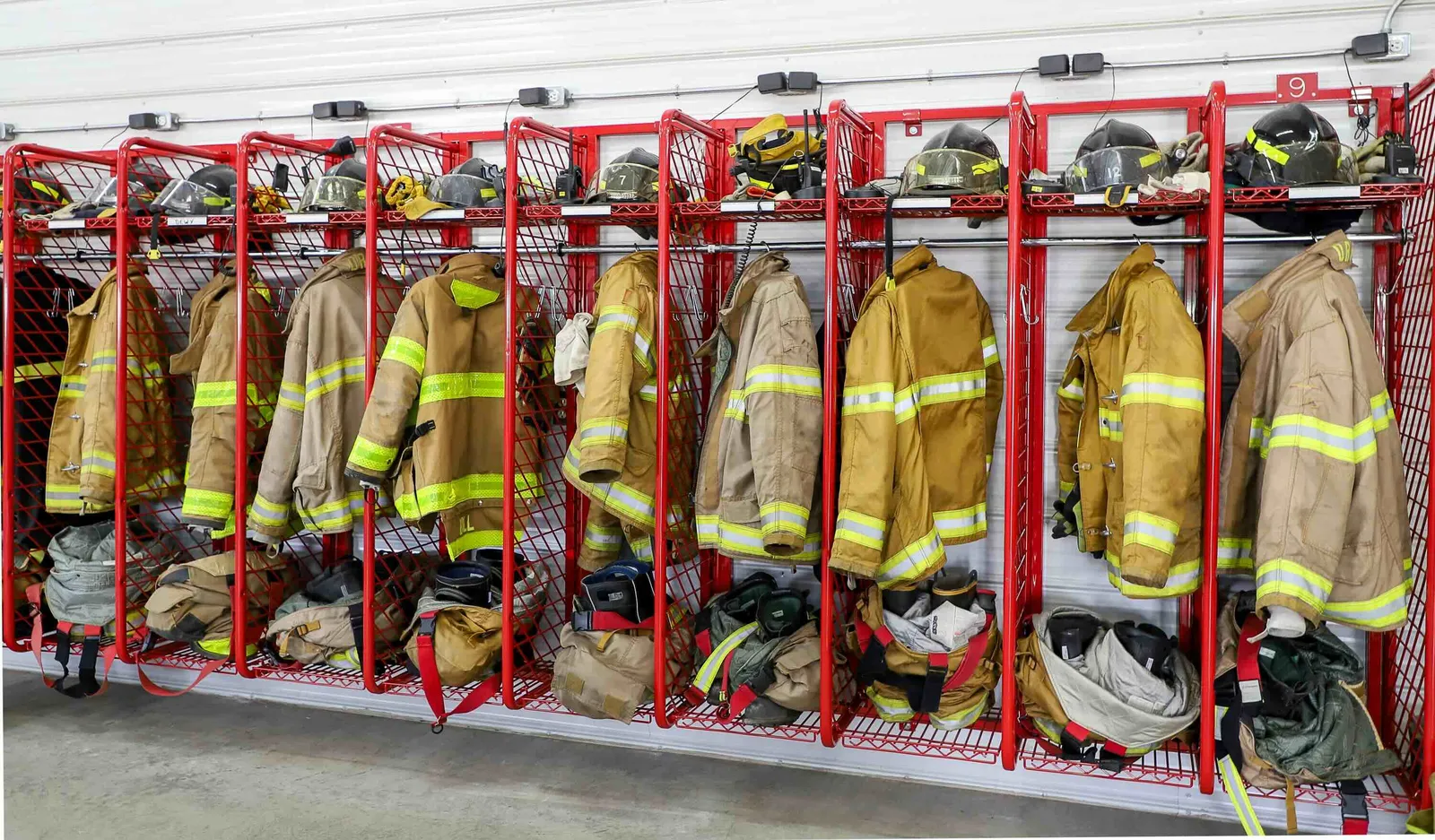
This is where public safety equipment tracking differs most from office asset tracking. Turnout gear must be retired no more than ten years from its date of manufacture and get an advanced inspection at least once a year. Body armor carries a manufacturer's warranty period on its label. SCBA cylinders have retest dates and a service life. Firearms are inspected and qualified on a schedule.
| Equipment | The rule | What to record |
|---|---|---|
| Structural turnout gear | NFPA 1850, which replaced NFPA 1851 and 1852, keeps retirement at no more than ten years from manufacture, even for gear never worn, and requires an advanced inspection at least annually | Date of manufacture, issue date, each advanced inspection and cleaning, repairs, retirement and disposal date |
| SCBA and cylinders | NFPA 1850 covers SCBA care and maintenance; composite cylinders carry a hydrostatic retest interval and service life under the DOT special permit stamped on the cylinder | Cylinder serial, manufacture date, last and next retest date, end of service life, facepiece fit test |
| Body armor | NIJ sets no fixed expiration. The manufacturer declares a ballistic warranty on the label, and the label has a blank line for the issue date | Issue date, model, lot number, warranty end date, fit, replacement and disposal by serial number |
| Firearms | Department policies typically require an armorer inspection at least annually and qualification with each issued weapon before it's carried | Serial and component serials, inspections, repairs, and the holder's current qualification |
| Radios, keys, ID and access | No life limit, but loss is a security event | Assigned holder, and the date access was switched off at separation |
Two body armor points catch agencies out. First, NIJ's guidance is that "serviceable armor should never be removed from service until a replacement armor is available for immediate wear," so a warranty date is a replacement trigger, not an instruction to strip a vest off an officer. Second, if you buy vests through the federal Bulletproof Vest Partnership, they must be on NIJ's compliant products list when ordered and "uniquely fitted," and the program asks for your agency's own replacement cycle, so your records need to show who wears which vest and when it was issued.
For fire departments, our guide to NFPA 1850 turnout gear and SCBA records covers the full list of what the standard expects you to keep.
5. Audit what's assigned, at least once a year
An annual audit is the minimum. The most practical version is the one Vancouver, Washington's police department uses: logistics sends each employee a list of the property assigned to them, the employee physically verifies it, and the supervisor reviews it before it comes back. It takes each person a few minutes and catches most drift.
Equipment audit checklist
- Has every member confirmed their assigned list, and has a supervisor reviewed it?
- Does a floor count of controlled items match the records, and do the records match the floor? The Washington State Auditor calls this a two-way inventory.
- Is any armor past its warranty date, or any turnout gear within a year of its ten-year limit?
- Is any equipment still assigned to someone who has left, transferred or been promoted?
- Is any firearm assigned to someone whose qualification with it has lapsed?
- Have grant-funded items had a physical inventory in the last two years, as 2 CFR 200.313 requires?
- What was lost, stolen or damaged this year, and does each loss have a report?
Separate duties where you can, so the person who issues equipment isn't the only person who counts it. GFOA also recommends that the people responsible for controlled items produce a year-end list with an explanation of what changed, which is a report good equipment inventory tracking should produce in one click.
6. Recover equipment at every change, not just at separation
Most lost equipment walks out at a transfer, promotion or resignation, when nobody checks what the person was holding. Pull up their assigned list before every change, collect what the new role doesn't need, and get it signed back in. At separation, switch off ID cards, keys and system access the same day.
Promotion is the change people forget. A sergeant's badge replaces an officer's, a captain moves to a staff car, an engineer stops needing a specific SCBA facepiece. Vancouver's policy calls this out directly: badges, holsters and similar items come back when they're no longer applicable. At separation, the University of Maryland, Baltimore police department records every returned item on one form and deactivates the member's ID and building access on their last day. Washington's auditor recommends that HR "check for employee-assigned assets before employees leave the organization," which only works if HR can see the list.
If you're managing a separation that may be contested, the property return is part of the record. Our guide to separating a public safety employee covers the rest of that file.
Lost, damaged and unreturned equipment
Write down what happens when something goes missing before it does. A good policy requires the member to report loss, theft or damage to a supervisor immediately, with a written report, and treats some losses as urgent: a lost firearm, radio, badge or ID card should trigger immediate notice up the chain and, in many departments, a bulletin.
Be careful about charging people for it. Many police policies allow the department to deduct lost equipment from pay or hold the final paycheck. Under the federal Fair Labor Standards Act, the Department of Labor says no deduction for lost or damaged property may bring an employee's pay below minimum wage or cut into overtime, "even if an economic loss suffered by the employer is due to the employee's negligence." Some states go further: California generally bars deductions for accidental loss or breakage altogether. Check your state's wage and final pay rules, and your union contract, before you put a deduction clause in an employee equipment agreement.
When a spreadsheet stops working: law enforcement equipment tracking and quartermaster software
Most departments track equipment assigned to personnel in a spreadsheet, and for a small agency with a short list that's fine. It stops working at a predictable point:
- When one person owns it. The quartermaster's spreadsheet is accurate until the quartermaster retires or moves, and then nobody trusts it.
- When items have parts. A rifle with its optic and light needs a parent record with child serials. A flat sheet ends up with one row per part and no link between them.
- When dates drive action. A spreadsheet can hold a warranty date, but it won't tell anyone the vest is due, or that the officer wearing it just transferred.
- When the question is narrow and urgent. "Which officers hold vests from this production lot?" or "every Glock 17 issued after March" should take minutes. In a spreadsheet it takes an afternoon, if the data's clean.
- When separation depends on someone remembering. If HR can't see what's assigned, the list doesn't get checked.
At that point you're choosing between general asset tracking software, built around locations and barcodes, and law enforcement equipment tracking or quartermaster software that's built around people. For issued gear, the person is the question that matters. Good quartermaster software answers "what does this officer have out?" in one screen, and good law enforcement equipment tracking links a weapon to the qualification that lets someone carry it. Fire departments need the same thing for turnout gear and SCBA, and the quartermaster software they choose should hold manufacture and inspection dates, not just locations. Our ranking of equipment accountability software for municipalities compares the options side by side.
Tracking assigned equipment in software: how Essential Personnel does it
Essential Personnel is professional standards software built by public safety people for police, fire and city government. Their Equipment suite ties every asset to the person it's issued to, on the same employee record that holds certifications, training and assignment history, so pulling up any member shows their weapon and its optic, their vest, their vehicle and their radio on one screen.
That covers the six steps like this:
- Steps 1 and 2, the record: serialized inventory and consumables in one place, with component serials tracked together as a set that stays with the weapon. Swap an optic between two rifles and the record follows it. Vehicles carry unit number, plate, VIN, radio ID, fuel key, camera type and toll transponder, and a connected GPS provider such as Geotab feeds location and mileage into the vehicle's profile.
- Step 3, issue: assignment tracking and forms and requests, which serve as the equipment checkout system for pooled gear as well as permanent issue, with every issue, return and reassignment kept in the item's chain of custody. A note on any return, such as "sent for repair," stays attached to the item.
- Step 4, life limits: customizable inspection forms, status from issue to retirement, and expiration notifications.
- Step 5, audit: audit logs and query-based reporting that answers questions like every Glock 17 issued after a given date, or every holder of a recalled lot.
- Step 6, recovery: the member's profile is the separation checklist. When someone transfers, promotes or leaves, you see exactly what has to come back.
Because equipment sits on the personnel record, it connects to the rest of the job. A firearm qualification tracked in Talent Management sits beside the weapon it qualifies, and an apparatus accident recorded in Safety and Wellness relates to the vehicle in the equipment record. Most agencies start by bulk importing their existing spreadsheets, after a physical count of weapons and vehicles so the clean data goes in first.
Know the boundaries before you buy. For law enforcement equipment tracking, Essential Personnel tracks issued property by person and serial number; it doesn't depend on barcode or RFID scanning, so if you need scan-based checkout at a busy counter, raise volumes in the demo. It doesn't do purchasing, depreciation or finance integration, and it isn't full fleet maintenance software, so agencies with a large shop keep their fleet system for work orders and parts. It's chain of custody for agency property, not evidence.
"This level of responsiveness and flexibility has dramatically improved our training tracking, wellness monitoring, equipment management, and overall accountability."
Michael Petti, Major, Fayetteville Police DepartmentThe Equipment suite is published at $20 per user per year, or $175 per user for all four suites, plus a one-time $3,000 startup fee, on the pricing page. The platform is hosted in AWS GovCloud, aligned with the FBI CJIS Security Policy and covered by an annual SOC 2 Type II report, with details on the security and compliance page. It's available through GSA Advantage, NASPO, Omnia Partners, NCSA and VSA. See the Equipment suite for the full feature list.
See your roster with its gear attached
Send us a sample of your equipment spreadsheet and we'll show you what your issued gear looks like against your own people. Call (910) 390-0011 or email info@essper.com.
Frequently asked questions
Track it against the person. Give each controlled item one record with its serial, holder, issue date, condition and inspection or retirement dates, issue it against a signed receipt, audit each holder's list yearly, and check the list at every transfer and separation. Software such as Essential Personnel shows everything issued to a member on their profile.
Anything dangerous, regulated, life-limited, sized to one person or easy to walk away with: firearms and their components, conducted energy weapons, radios, laptops, body armor, turnout gear, SCBA, badges, ID cards, keys and vehicles. Track uniforms by quantity and consumables only where issue or expiry matters, such as duty ammunition and controlled medical supplies.
The item, make, model and serial number, any component serials, who it's assigned to and the issue date, condition at issue, date of manufacture and lot number, warranty or retirement date, inspection and repair history, funding source for grant-funded items, and every return, transfer and disposal. NIJ says agencies should be able to trace armor to an officer by lot number.
At least once a year, with each member confirming their assigned list and a supervisor reviewing it. Do a two-way count of controlled items, floor to records and records to floor. Equipment bought with federal grants needs a physical inventory reconciled to the records at least every two years under 2 CFR 200.313, and turnout gear needs an annual advanced inspection.
NIJ sets no fixed expiration. Each vest carries a manufacturer's ballistic warranty on its label, and NIJ also lists weight change, new threats, damage and wear as reasons to replace. Track the issue date and warranty end date for every vest, and don't pull serviceable armor until a replacement is ready, because NIJ says no armor is riskier than older armor.
Only within limits. Under the Fair Labor Standards Act, a deduction for lost or damaged property can't bring pay below minimum wage or cut into overtime, even when the loss was the employee's fault. Some states, including California, restrict these deductions further. Check your state's wage and final pay law and your union contract before relying on deductions.
For a small department with a short list, yes. It stops working when one person owns it, when items have component serials, when warranty and inspection dates need to prompt action, and when HR needs to see what someone holds before they leave. That's the point most agencies move to equipment tracking software tied to the personnel record.
Options include general asset tracking tools, standalone quartermaster software and personnel platforms. Essential Personnel ties each asset to the employee record, tracks component serials, chain of custody, inspections and vehicles, shows everything a member holds at separation, and publishes their Equipment suite at $20 per user per year.

About this article
Written by Scott Monroe, Chief Executive Officer & Co-Founder, Essential Personnel. Published 28 October 2026.
Essential Personnel makes the software described here. Pricing, hosting and purchasing details are taken from essper.com, and the customer quote is reproduced from essper.com. The sample acknowledgment is original. Standards, regulations and guidance are linked to their primary sources, and the examples of department practice come from the published property and equipment policies of the New Orleans, Vancouver (Washington) and University of Maryland, Baltimore police departments. All were checked in October 2026. This article is general information and isn't legal advice.
