
Police department org chart software: a chart that survives a promotion cycle
Run a promotion process and watch what happens to your org chart. A sergeant makes lieutenant, three officers move between shifts to backfill, the detective bureau picks up a body from patrol, and the hiring committee loses its chair. Within a fortnight the chart in the briefing room is describing a department that no longer exists, and nobody has time to redraw it because everybody involved is busy running the department it turned into.
That's the failure mode. Not a bad drawing, but a drawing that was only ever true on the day it was made.
What a police department org chart actually has to show
A police department org chart has to carry authorized positions as well as people, separate sworn from civilian, show rank independently of assignment, and account for collateral duties that sit outside the reporting line entirely. A diagram gives you one of those. A chart drawn from the personnel record gives you all four, which is why the two things are not substitutes for each other.
Take rank and assignment first. A sergeant in patrol, a sergeant in professional standards and a sergeant running the field training program hold the same rank and answer to entirely different people. Drawing them as three identical boxes under three different supervisors is technically correct and practically useless, because it tells you nothing about what the agency can actually field.
Then sworn and civilian. Most agencies run a civilian side that's grown considerably: records, evidence, dispatch, crime analysis, victim services. They sit in the same structure and follow different rules for hiring, discipline, certification and, often, bargaining. General purpose organizational chart software has no way to represent that distinction except by typing it into a label, which means it can't be filtered on.
Then the part nobody draws at all: collateral duties. SWAT, crisis negotiation, honor guard, drone, peer support, the accreditation team. These cut across the whole structure and carry their own qualifications and their own leaders, and they're usually the first thing that goes stale when the chart lives in a diagramming tool.
Does anyone make a drag and drop org chart?
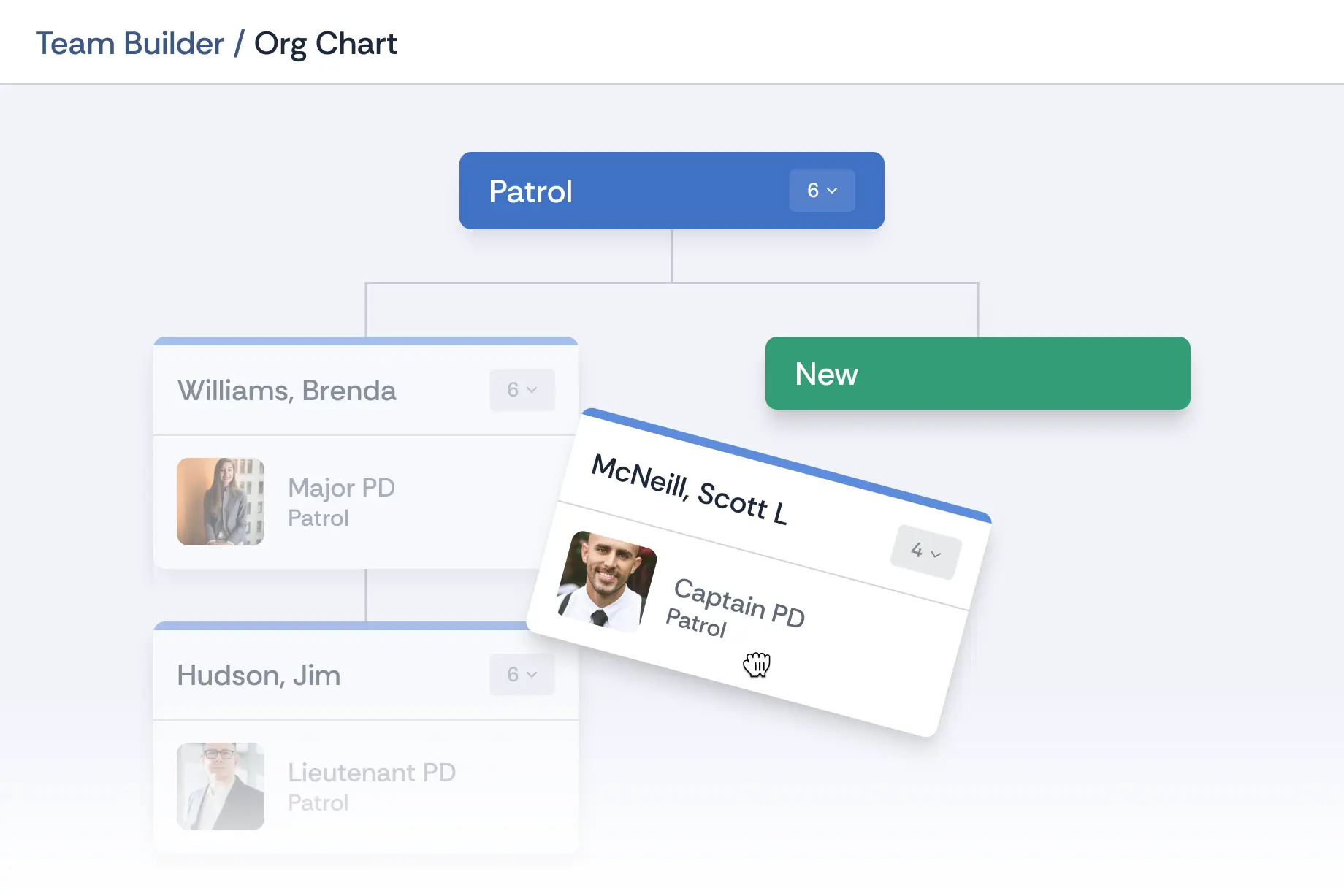
Several vendors do, and the drawing tools do it well. Lucidchart, SmartDraw, Visio, Organimi and Pingboard all support dragging a box onto another box. What separates them from a drag and drop org chart built for law enforcement is what the drag actually does. In a diagramming tool it repositions a shape. In Essential Personnel it reassigns a person, and their record goes with them.
The practical version of that: when the Town of Southern Pines moved an employee into a different role, the drag and drop org chart transferred that person and their records to the new supervisor in a single action. Evaluations, certifications, notes and permissions all landed on the other side. Nobody emailed HR, and nothing had to be re-entered into a second system that would then disagree with the first.
That's the test worth applying to any drag and drop org chart you're shown. Ask what exists on the other side of the drop. If the answer is a repositioned rectangle, you're buying a diagram editor, and there's nothing wrong with that as long as you know it.
The chain of command chart needs a date on it
A chain of command chart that only shows today is fine for orientation and useless for accountability. The questions that matter arrive months later: who held command authority on the night of the incident, who was the reviewing supervisor when the complaint came in, who signed off on the pursuit. Answering those means the structure has to carry history, not just current state.
This is where a drawing fails hardest. Internal affairs work, civil litigation and CALEA file reviews all reach backward. If the only record of who reported to whom in March is a PDF somebody exported in January, the agency is reconstructing its own chain of command chart from memory and email, which is exactly the position nobody wants to be in during a deposition.
When the chain of command chart is drawn from a personnel record, assignment changes are events with dates attached. The structure as of a given day is a query rather than an archaeology project, and the same record that answers it also holds the evaluations, notes and documents from that period. Agencies running internal affairs case management alongside it find the two reinforce each other, because a case is always partly a question about who was supervising whom.
Where generic organizational chart software stops
Generic org chart software produces a picture from a list of names. It has no model for an authorized position, a certification with an expiry date, a collateral assignment or a date range, so it can't answer the operational questions a chief puts to it. It draws the agency you described, not the agency you have.
None of that makes the drawing tools bad at their job, and organizational chart software has become genuinely good at layout. For a clean diagram in an annual report or a slide in a budget presentation, a diagramming tool is faster and better looking than anything built for public safety. The problem starts when the chart has to be right rather than presentable.
What police department software has to do that a diagram can't
| The question | Generic org chart software | A chart built on a personnel record |
|---|---|---|
| How many sworn positions are funded and currently vacant? | No concept of an authorized position. A vacancy is a box somebody remembers to delete | Vacancies display as vacancies, with the date the seat opened |
| Which officers are current on their crisis intervention training? | Not tracked. Lives in a separate spreadsheet | Filter the roster by certification, qualification or expiry window |
| Who was the reviewing supervisor on 14 March? | Shows today's structure only | Assignment history is on the record, so the chart reads as of a date |
| Who's within two requirements of being eligible for sergeant? | Outside its scope entirely | Career paths pull completion automatically from training and certifications |
| Which of my detectives also sit on the crisis negotiation team? | Can be drawn once, by hand, and then decays | Team membership is its own layer on the same roster |
The middle column isn't a fault in those products, it's the shape of the category. Organizational chart software built for a professional services firm has no reason to know about Giglio material or field training daily observation reports. Police department software has every reason to, and that's why the categories stay separate however many features get added to the diagram editors.
Collateral duties, specialty teams and task forces
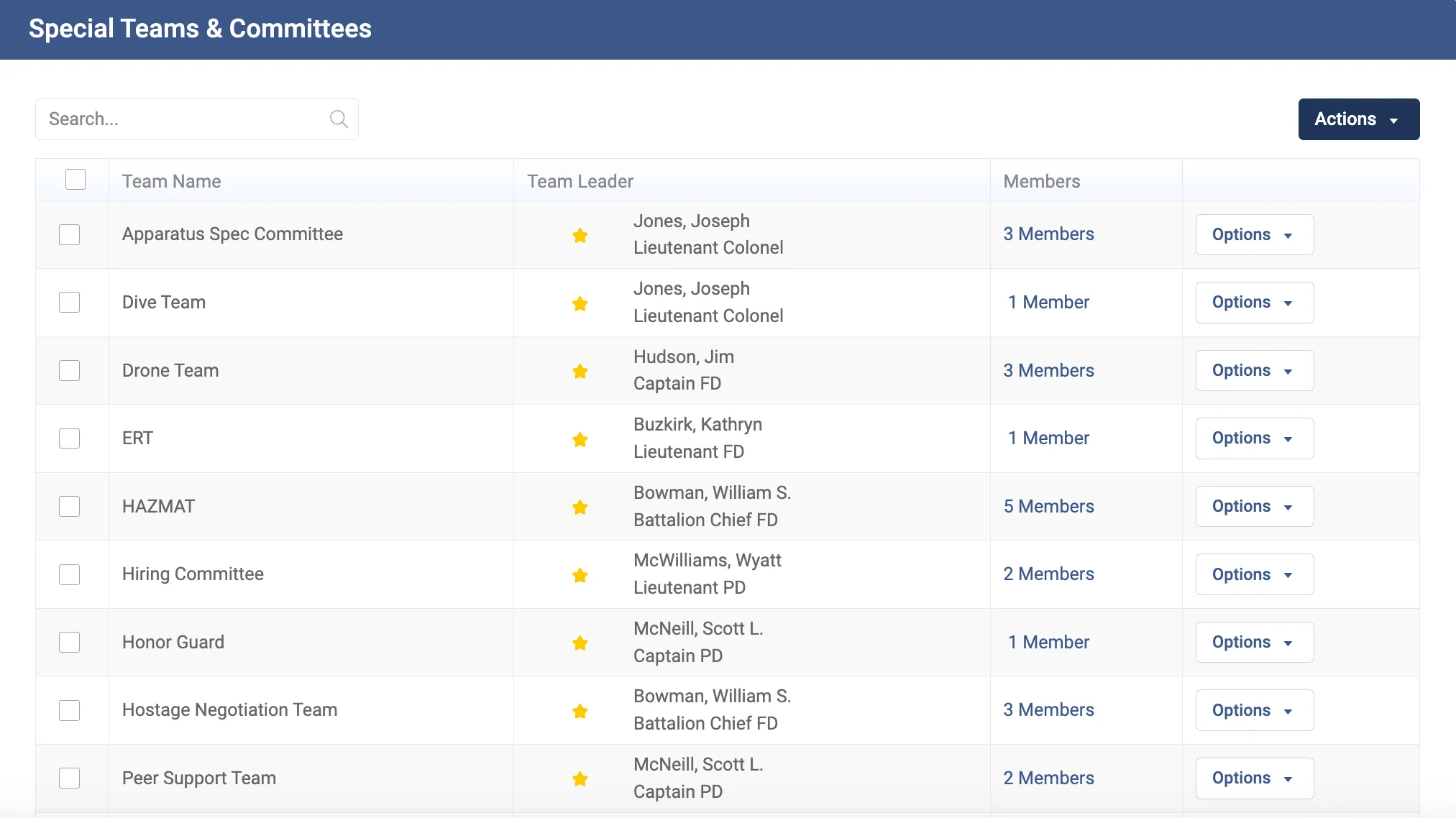
Most of what an agency can actually do on a bad night isn't on the org chart. SWAT, crisis negotiation, drone, honor guard, peer support, the hiring committee: each has a leader, a membership and a set of qualifications, and each cuts across ranks, shifts and divisions. They can't be drawn as another branch of the reporting tree, so in most agencies they live in somebody's spreadsheet.
Essential Personnel treats this as its own layer. Special Teams and Committees supports building custom teams, naming a team leader, and tracking membership and assignments, and it sits on the same roster that draws the org chart. When an officer transfers between divisions their team memberships travel with them instead of being quietly dropped.
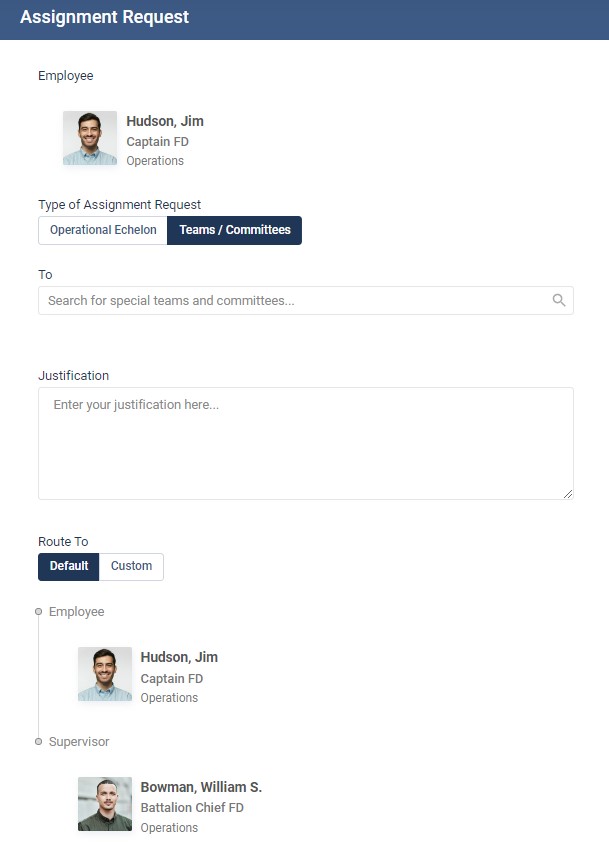
Assignments is the workflow underneath it. Officers submit transfer and specialty team requests through a tracked path with a routing chain and a status, rather than an email to a commander who's on leave. If you've ever had a transfer request surface six weeks late, you already understand why this is worth more than it looks.
Authorized strength, vacancies and workforce planning software
The most valuable thing a police department org chart can do is show a funded position with nobody in it. That's the number a city manager asks for in budget season and the number a union asks for in bargaining, and a diagram cannot produce it, because a drawing only knows about the people somebody drew.
Authorized strength versus actual strength is the oldest argument in municipal policing and the one most often conducted with bad data. The Government Finance Officers Association treats authorized headcount as a budget control rather than an HR detail, and council packets are built on it. If your chart shows 112 names and the budget authorizes 124 sworn positions, the twelve missing seats are the entire conversation, and being able to point at them on the structure changes how that conversation goes.
This is the point where org chart software stops being an onboarding handout and becomes workforce planning software. Enterprise workforce planning software is generally built for companies modeling headcount across business units and assumes a data layer no police agency maintains. The workforce planning software an agency actually needs is narrower: a roster it trusts, with the vacancies showing, the certifications attached, and the promotion pipeline visible against it.
The Police Executive Research Forum has documented how hard the staffing picture has become for agencies of every size. Arguing that case without a defensible vacancy count is an uphill job.
Promotion processes and succession planning software
Succession planning software in law enforcement isn't about naming a favorite for the next chair. It's about answering who could hold this rank in eighteen months, and knowing it before the incumbent files their papers. That answer needs the structure and the record together, because it depends on both where the gaps are and how far along everyone else is.
A promotion in a police agency has to be defensible. It's often reviewable by a board, a commission or a union, sometimes governed by statute, and increasingly likely to be examined afterwards. The International Association of Chiefs of Police has made the case for evidence based promotion for years, and the practical obstacle is almost never the policy. It's that the evidence lives in four places.
Good succession planning software works from readiness rather than a named shortlist. Career Paths publishes the rank and position requirements, and completion maps automatically from training, certifications and qualifications rather than being self reported. Promotion and Retirement Eligibility then sorts and filters the roster so leadership can see who's eligible now and, for everyone else, exactly how many requirements remain. That's the report most agencies can't produce today.
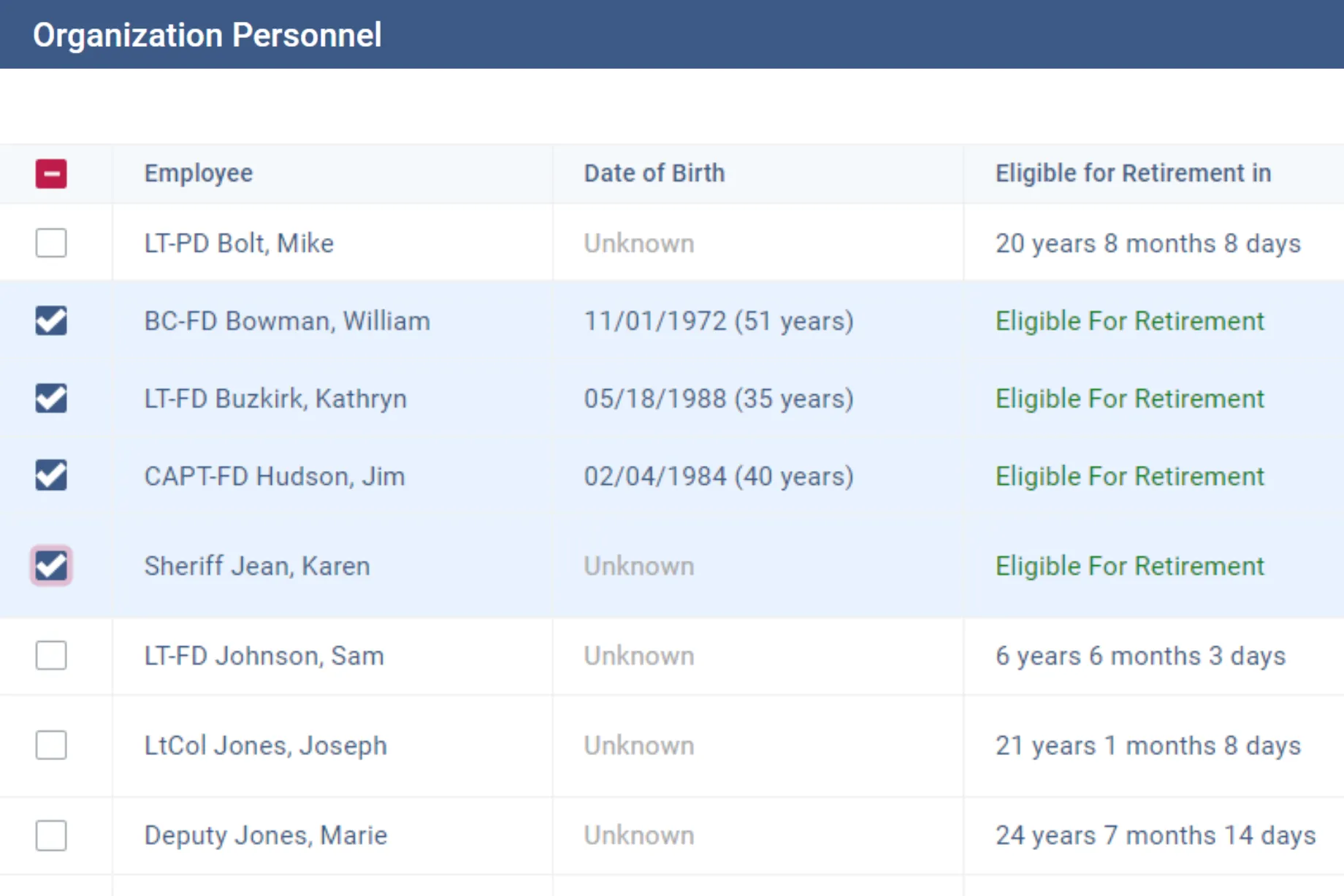
It also surfaces the uncomfortable answer. When only two officers are within reach of a supervisory rank and both are within retirement range themselves, that's a workforce problem to solve this year. Succession planning software that only records intentions will never surface that. Succession planning software built on live qualification data will, and the test for any of it is simple: does it tell you something you didn't already know? Agencies working toward accreditation and promotion readiness tend to find this is the capability they end up valuing most.
What agencies say about the visibility
Carteret County Sheriff's Office rebuilt their field training program on Essential Personnel, and what their leadership talks about is what having one record makes possible downstream.
"It follows that person through their entire training journey. If we're planning a promotion or looking at performance later, it's already there...clean, clear, and secure."
Major Derek Moore, Carteret County Sheriff's OfficeThat's the whole argument for connecting the chart to the record, stated by somebody who runs the process. The same officer made the point about supervision more directly.
"That level of visibility helps us catch issues early or give praise when it's due."
Major Derek Moore, Carteret County Sheriff's OfficePinellas Park Police Department came at it from recognition, moving their awards program into the same system that holds the performance record supporting each nomination.
"The team at Essential Personnel are fantastic partners. Their unwavering support of their strategic partners and passion for the mission are evident in each and every interaction."
Adam Geissenberger, Chief of Police, Pinellas Park Police DepartmentSupervision is a structural question too
The chart also decides who sees an early warning. An early intervention system only works if the alert reaches the supervisor who's actually responsible for the officer today, and that routing comes straight off the reporting structure. When the structure is a PDF on a wall, the alert goes to whoever somebody assumes is in charge.
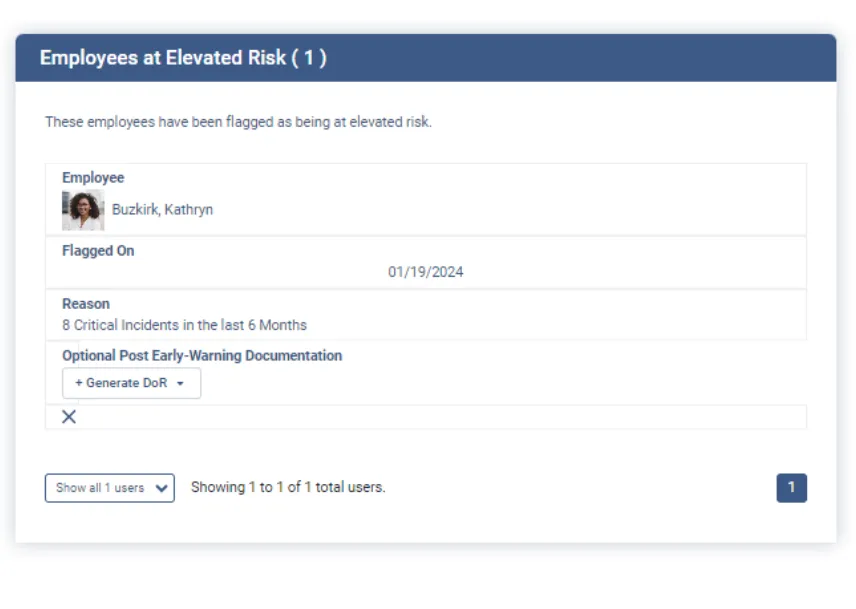
Reporting works the same way. Analytics rolls up across the structure, so a commander sees their own division and a chief sees the agency, without anyone maintaining a second set of permissions by hand.
Why Essential Personnel answers the whole problem
Essential Personnel was founded in 2020 in Wilmington, North Carolina by two firefighters, and the org chart sits inside a platform that also holds evaluations, internal affairs documentation, training records, certifications, awards, equipment and wellness data. That's why the chart stays current. Nobody maintains it as a separate artifact. It's a view of data other people are already keeping accurate for their own reasons.
Every partial answer to this fails the same way. A diagramming tool gives you a picture that decays. A general government HR platform gives you an employee directory that doesn't understand rank, sworn status or field training daily observation reports. Four point tools give you four partial copies of your roster, and reconciling them by hand is invisible work that never appears in a price comparison.
One record
Employee Profiles hold personal details, credentials, performance, career history, wellness data, training records and awards in one place. The chart reads from it.
Built for rank
Rank, assignment, shift, division, sworn and civilian status are modeled rather than typed into a box label, so the chart can be filtered on any of them.
Published pricing
The bundled Total Solution is $175 per user per year with a $3,000 one time startup, and individual suites run $20 to $85 per user. Size based discounts apply.
CJIS aligned hosting
AWS GovCloud, SOC 2 Type II audited annually, TLS 1.2 or higher, FIPS 140-3 validated cryptography and MFA at AAL2.
The security position matters more here than in most categories, because a personnel record in a law enforcement agency touches material governed by CJIS policy. The security and compliance page has the detail, and it's worth reading the hosting section against whatever else you're considering rather than accepting a claim of compliance at face value.
Two things also matter for how an agency buys. Essential Personnel is on GSA Advantage, NASPO, Omnia Partners, NCSA and VSA, so a purchase can ride an existing vehicle. And the pricing is published, which is rare enough in public safety software to use as a benchmark.
The law enforcement overview covers the operational picture, policy and guidance covers publishing and acknowledgment, and equipment tracking covers what's issued to each officer, which is another list most agencies keep separately against the same roster.
Questions to ask before you buy police department software
Take this list to every demo
- Show me a vacancy on the chart. Not a deleted box, a funded position with nobody in it.
- Reassign somebody to a different supervisor while I watch. What follows them, and what doesn't?
- Show me the agency as it stood on a date nine months ago.
- Filter the chart to every officer whose certification expires in the next ninety days.
- Where do specialty teams live, and what happens to membership when an officer transfers?
- Can a sergeant see their own squad without being able to see the whole agency?
- How do you separate sworn from civilian, and can I report on each independently?
- Show me who's within two requirements of the next rank, and where that data comes from.
- Where is the data hosted, and what's the CJIS position in writing?
- Is the price published, and what's the five year total including startup?
A vendor who can answer the first two convincingly is selling police department software. A vendor who can only answer them by exporting to a spreadsheet is selling a drawing tool with a capable sales team, and the difference will show up in year two rather than in the demo.
Be realistic about what you're replacing. Police department software rarely displaces a single incumbent system. Most agencies are choosing between one platform and the four documents they currently keep in sync by hand, which is a cost already being paid, just not on an invoice. The personnel record systems comparison puts the main options side by side, and the professional standards guide covers the documentation layer.
Frequently asked questions
Police department org chart software displays the agency's command structure, but unlike general organizational chart software it draws that structure from a live personnel record. Organizational chart software sold to businesses assumes one person holds one job under one manager, which is the assumption a police agency breaks first. That means it can carry authorized positions as well as filled ones, separate sworn from civilian, show rank independently of assignment, hold assignment history so the chart can be read as of a past date, and be filtered by certification or specialty team membership. The distinction that matters is whether the chart is a picture somebody maintains or a view of data other people are already keeping current.
Yes. Essential Personnel's Team Builder is a drag and drop org chart with team creation and vacancy management, real time updates, search and filter, and role based access. Because it sits on the same roster as the rest of the platform, dragging an officer to a new supervisor transfers that person and their records rather than just moving a shape. Diagramming tools such as Lucidchart, SmartDraw, Visio and Organimi also offer drag and drop, but what moves is a box on a canvas.
Corporate HR systems assume a manager can promote whoever they choose and that one person holds one job under one supervisor. A police promotion has to be defensible, evidence based and often reviewable by a board or a union, so the software has to produce the evidence rather than just record the decision. Generic systems also have no model for rank separate from assignment, sworn versus civilian tracks, collateral duties, field training documentation, or certifications tied to state standards. Agencies usually discover this after the implementation rather than during the evaluation.
Only if the chart is built on a personnel record that treats assignment changes as dated events. A chain of command chart drawn in a diagramming tool shows one current state, so reconstructing March means finding an old export or asking people to remember. That's a weak position during an internal investigation, a civil matter or an accreditation file review. When the structure comes from the record, the agency as of a given day is a query, and the evaluations, notes and documents from that period sit alongside it.
Through a separate layer rather than as another branch of the reporting tree. Special Teams and Committees supports creating custom teams, naming a team leader, and tracking membership and assignments, all on the same roster that draws the org chart. That's the right shape because SWAT, crisis negotiation, honor guard and peer support cut across ranks, shifts and divisions. Assignments then gives officers a tracked path to request a transfer or a place on a team, with a routing chain and a status rather than an email.
Essential Personnel hosts on AWS GovCloud with a primary region in us-gov-east-1 and a replica in us-gov-west-1, aligned to CJIS requirements. They are audited to SOC 2 Type II annually, use TLS 1.2 or higher in transit, FIPS 140-3 validated cryptography, and multi factor authentication at AAL2. Because CJIS compliance is a shared responsibility between the vendor and the agency, ask any vendor for their position in writing and have your own CJIS systems officer review it rather than accepting a claim on a web page.
Essential Personnel publishes pricing, which is unusual in this category. The bundled Total Solution is $175 per user per year, individual suites run between $20 and $85 per user, and there's a one time startup fee of $3,000. Single sign on is an optional $800 per year per agency, and size based discounts apply. Most public safety personnel software quotes on request, so a published number is worth using as a benchmark when you compare. Purchases can also ride GSA Advantage, NASPO, Omnia Partners, NCSA and VSA.
For most agencies at this size, yes. Dedicated workforce planning software is generally built for large enterprises modeling headcount scenarios and assumes a data layer police department software doesn't maintain. The planning questions an agency actually needs answered are narrower: where the vacancies are against authorized strength, who's eligible for promotion, which specialty teams are thin, whose certifications lapse this year, and who's within retirement range. Those are queries against a live roster. What it isn't is a multi year budget forecast model tied to finance, so if you need that you'll want a dedicated tool alongside it.
See it against your own rank structure
Walk through the chart, the roster and the specialty teams with someone who's worked in public safety. Call (910) 390-0011 or email info@essper.com.
About this article
Written by Scott Monroe, Chief Executive Officer & Co-Founder, Essential Personnel. Published 23 September 2026.
Essential Personnel makes the software described here, and the product screenshots are from the platform. Pricing, hosting and procurement details are taken from the published pricing and security pages. Customer quotes are reproduced from published customer stories with the speaker's name and rank as given.
