The best PowerDMS and Lexipol alternatives for fire departments and EMS: Top 5 for 2026
Published 20 October 2026
The best PowerDMS alternatives and Lexipol alternatives for a fire department or EMS agency in 2026 are Essential Personnel, Vector Solutions and Command HQ by Tracwire, which publish your SOGs, prove who acknowledged each version and keep that record on the same member file as training and certifications. DocTract and NAVEX PolicyTech are dedicated policy tools that do the publishing and attestation well and stop there.
Start by splitting the two jobs. PowerDMS is fire department software: it posts your SOGs, collects acknowledgements and holds accreditation files. Lexipol is mostly content: Lexipol policy, their core product, is a state-specific fire department policy manual kept current for you, with software around it. Replacing PowerDMS is a software decision. Replacing Lexipol means deciding who writes your SOGs, which has its own section.
This guide is for fire chiefs, EMS chiefs, deputy and battalion chiefs, accreditation managers and the training and administrative staff who keep the manual. It covers what the two incumbents do for fire and EMS, why departments look elsewhere, what the alternatives cost and the five systems worth a shortlist. It's here to help you understand the options and make a good decision for your department's needs.
Every system is scored against eight criteria totaling 100. Policy and SOG distribution with acknowledgement carries 22, the heaviest single weight, because it's the job both incumbents are bought for. The training and certification record carries 16, more than on a police ranking, because a fire department's SOGs, task books and certifications are checked against each other every time something goes wrong. Every score sits in the scoring table, so you can reweight it for your department.
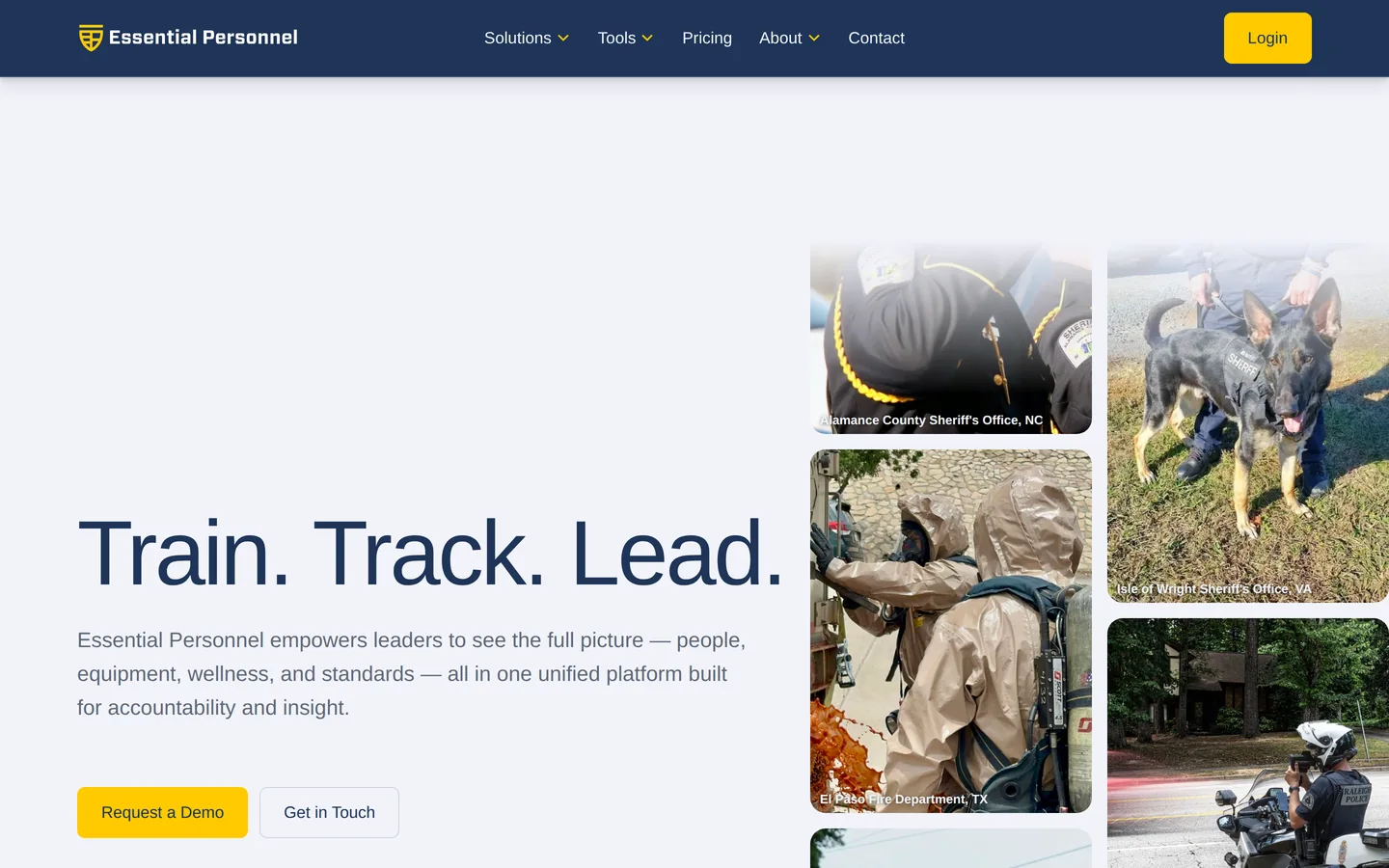
Essential Personnel ranks first at 89 out of 100. They take full marks on holding everything on one member record, on fire and EMS fit and on published pricing, and 15 of 16 on the training record. A 60-member department pays $1,800 a year for their Guidance suite, against a 2026 list price of $9,727.85 for PowerDMS policy at 50 to 74 employees. They don't write SOGs, so a department leaving Lexipol keeps its own manual or buys content separately, and EP then holds that manual on the same file as each member's training, certifications and performance.
The five PowerDMS alternatives for fire and EMS compared
Ranked by weighted total for fire departments and EMS agencies, 2026. "Built around" tells you whether the system starts from the member, the training or the document.
What PowerDMS and Lexipol do for fire department SOGs and EMS
PowerDMS is a policy and accreditation platform: it posts SOPs and SOGs with version control, tracks acknowledgements, keeps the audit history and maps files to accreditation models such as CFAI. Lexipol is a policy content company: it writes state-specific fire and EMS policy, updates it as laws change and sends Daily Training Bulletins built from it. Many departments run both.
PowerDMS was founded in 2001 and is part of NEOGOV, the government HR software company in El Segundo, California. Their fire page says SOPs and SOGs are centralized with version control, automated updates, acknowledgements and audit history across every station. The CFAI accreditation model is available inside PowerStandards, their EMS page names CAAS and CAMTS, and PowerReady documents probationary training. PowerDMS doesn't write policy.
Lexipol was founded in 2003 and is based in Frisco, Texas, owned by GTCR since 2021. For fire and EMS, Lexipol policy is legally vetted, state-specific and updated as the law changes, sold with tracked acknowledgements, Daily Training Bulletins built from your own policies, an Accreditation Workbench and a supplemental service for publishing your own SOGs. FireRescue1 Academy training and Cordico wellness sit alongside. Lexipol sells EMS under Fire & EMS rather than as a separate manual.
The two meet in the middle. PowerDMS runs a Lexipol integration, tagged for fire departments among others, that imports a Lexipol policy manual into PowerDMS. That's why the question so often comes as "PowerDMS and Lexipol": plenty of departments pay one vendor to write the manual and another to prove crews read it.
What each one does for fire and EMS, from each vendor's own published pages, October 2026.
Job
PowerDMS
Lexipol
Essential Personnel
Writes state-specific fire policy and keeps it current
No
Yes, the core product
No
Posts SOGs and tracks acknowledgement
Yes
Yes
Yes, Guidance
Keeps every version of every SOG
Yes
Yes
Yes
Accreditation standards and proof files
Yes, including CFAI
Accreditation Workbench
Proof that a policy was issued and received
Training bulletins and online courses
Microlearning from your SOPs
Daily Training Bulletins, FireRescue1 Academy
Training records, with course providers connected
Certifications, task books and training hours on the member's file
Probationary training records
Credential tracking
Yes
Evaluations, awards and issued equipment on the same file
No
No
Yes
Published price
2026 list price on a Texas contract
Quote only
Yes, on their pricing page
Why fire departments look for PowerDMS and Lexipol alternatives
Fire departments look for PowerDMS alternatives and Lexipol alternatives for four reasons: they're paying two vendors to keep one manual alive, the price rises with headcount and renewals, the policy record sits apart from the member's training and certifications, and leaving Lexipol later means exporting the manual before the portal closes. A department that writes its own SOGs often pays for content it doesn't use.
Two vendors for one manual. If Lexipol writes your fire department policy manual and PowerDMS distributes it, every update crosses from one system to the other, and you renew two contracts to keep one set of SOGs current. If you already write your own, or adopt a model set from your risk pool, the content half of the bill buys you nothing.
The price follows your roster. PowerDMS prices policy by employee band, so a department that grows past a band boundary moves to the next price. Lexipol quotes by agency, and Black Forest Fire Rescue in Colorado was quoted a $17,802 start-up fee plus $10,856 a year in 2024 to develop and maintain its fire department policy manual, according to board meeting coverage.
The SOG sits apart from the member. After a near miss, the questions are which version of the SOG the crew acknowledged, whether they were trained on it and whether their certifications were current. With the manual in one piece of fire department software and the training record in another, someone has to pull both and line them up by hand.
Leaving is harder than joining. At Black Forest, the district's attorney warned that the online portal would close and the district would need to download its manual before ending the contract. That's worth knowing before you sign, not after.
Replacing Lexipol policy: who writes your fire department policy manual and SOGs
None of the five Lexipol alternatives here writes fire policy. If you leave Lexipol, your fire department SOGs come from your own staff and attorney, a league or risk pool model set, a policy firm such as LLRMI or Daigle Law Group, or your insurer. Decide that first, then choose the SOP management software that publishes it and proves every member acknowledged it.
The sources fire departments actually use:
Your own SOGs, written against NFPA. Many departments already write their own fire department policies and procedures, built on NFPA 1201 for how services are provided and NFPA 1550, which took in NFPA 1500, for health and safety. Our NFPA 1201 guide covers how to structure them. All the software has to do is publish them and prove receipt.
League and risk pool model policies. The Kentucky League of Cities contracted the Legal & Liability Risk Management Institute, LLRMI, to give Kentucky fire departments model policies written in line with NFPA standards and state law, delivered in Word so you can edit them. Ask your own league or pool what it provides.
Policy firms. Daigle Law Group's policy center writes manuals for police, corrections and fire. LLRMI also works directly with agencies.
Your insurer.Safety National gives policyholders a 55-section fire department SOG book in Word, covering staging, RIT, Mayday and more.
State sample SOGs. In Illinois, the state's OSHA office, the State Fire Marshal and the Illinois Fire Chiefs Association released a sample incident command, accountability and Mayday SOG in 2025 that departments can adopt as written or adapt.
Before you give notice, check your Lexipol agreement for what happens to the manual text when the subscription ends, and export your current fire department policy manual and its acknowledgement history while you still have access. Then load each SOG into the new system as your department's own policy, with its current version and effective date.
What to look for in SOP management software for fire and EMS
Good SOP management software for fire department policies and procedures proves one member, one version, one date, re-runs acknowledgement when an SOG changes, assigns the right SOGs to new hires and shifts automatically, and keeps the old version as it read on the day it applied. The best of it puts that record on the same file as the member's training and certifications.
Take one of your own fire department SOGs into every demo and ask them to do these six things:
Prove one member, one version, one date. Pick a firefighter and an SOG and ask what they acknowledged, which version and when. A click with no version attached won't hold up after a line-of-duty injury.
Revise the SOG and re-run acknowledgement. The revision should go back out to the people it applies to, and the old version should stay retrievable as it read on the day it applied.
Target by station, shift and rank. A hazmat SOG goes to the hazmat team and an ambulance protocol to EMS staff, without sending the whole manual to everyone.
Hire someone. A new member should be assigned the SOGs they need to acknowledge automatically, not when someone remembers.
Show the training behind the SOG. Ask to see, on one screen, that a member acknowledged the RIT SOG, completed the RIT training and holds a current certification.
Price it in writing. Per user or per employee band, with setup, every module you'd need and the renewal increase shown separately. Ask whether volunteers and part-time members count.
What PowerDMS, Lexipol and the alternatives cost
PowerDMS policy lists at $9,727.85 a year for 50 to 74 employees and $12,575.25 at 100 to 124 on NEOGOV's 2026 Texas contract price book, plus $2,535.75 setup. Lexipol quotes by agency. Essential Personnel publishes their price: Guidance is $30 per user per year, and all four suites are $175.
NEOGOV's Texas DIR price book is the one public PowerDMS price list, and agencies outside Texas can buy from it. The smallest band, up to nine employees, is $5,439.50. In public records, the Borough of Edgewater, New Jersey approved $9,825 in 2024 for PowerDMS across administration, public works, the fire department and the first aid squad together.
Lexipol's price includes the Lexipol policy content itself, which no product here supplies, and it isn't published. Black Forest Fire Rescue's 2024 quote was $17,802 to start and $10,856 a year. In Ohio, Richmond Heights approved up to $15,908.20 in 2021 for the first year of Lexipol subscriptions covering its fire and police divisions together.
Essential Personnel's four suites are Guidance at $30 per user per year for publishing fire department policies and procedures with acknowledgement and version control, Talent Management at $85 for training, certifications, task books, evaluations and awards, Safety & Wellness at $40 for critical incident tracking and case management, and Equipment at $20. They add to exactly $175, with a $3,000 one-time start-up fee and size-based discounts on request. Among the other fire department software here, Vector Solutions, DocTract and NAVEX quote on request, and Tracwire publishes how it prices, per application in bands of 25 employees with a 15-employee minimum, but not the rates.
A department of about 60 members, each a user. PowerDMS at 2026 list price for the 50 to 74 employee band; Essential Personnel at published price.
What you pay for
PowerDMS by NEOGOV
Essential Personnel
SOG and policy publishing with acknowledgement
$9,728 a year
$1,800 a year
Also on the same record
Accreditation, training and scheduling priced separately
$10,500 a year for all four suites, adding training, certifications, task books, evaluations, critical incidents and equipment
One-time setup
$2,536
$3,000
Ranking methodology: the Fire and EMS Policy Record Framework
Eight criteria, weighted to what a fire department or EMS agency needs from PowerDMS alternatives and Lexipol alternatives. Policy and SOG distribution with acknowledgement carries the most because it's the job both are bought for. The training and certification record and the single member record carry 28 between them, because an SOG only protects a department when it can show the member was trained on it and qualified to do it. Writing policy content isn't scored, because none of the five PowerDMS alternatives does it.
Scores come from each vendor's own published product pages, case studies and pricing, checked in October 2026. Where a vendor hasn't published a capability for fire or EMS, they don't get credit for it, and facts a vendor hasn't published are marked "not published" rather than estimated.
The Fire and EMS Policy Record Framework, 2026. Weights total 100.
Criterion
Weight
What it measures
Policy and SOG distribution and acknowledgement
22
Publishing SOGs, policies and memos to the right stations, shifts and ranks, signed acknowledgement, version history and re-acknowledgement on revision
Training and certification record
16
Certifications, task books, training hours and expirations on the member's record
One member record
12
Whether SOG acknowledgement, training, certifications and performance sit on one profile in one product
Performance and conduct
10
Evaluations, corrective action, commendations and critical incident or early intervention tracking
Accreditation and ISO proof
10
Building and keeping the proof CFAI, ISO and EMS accreditors ask for
Fire and EMS fit
10
Whether the product is documented for fire departments and EMS agencies, in their language
Pricing transparency
10
Whether a department can size the cost without entering a sales process
Integrations
10
Named, documented connections to the training, RMS, scheduling and other fire department software agencies already run
How ties are broken
Where two systems reach the same total, the higher score on the heaviest criterion, policy and SOG distribution, takes the better position. No tie arose in this ranking.
How the five systems scored
Every system against every criterion. Each cell is scored out of the criterion's weight, and the total is out of 100.
System
Policy /22
Training record /16
One record /12
Performance /10
Accreditation /10
Fire and EMS fit /10
Pricing /10
Integrations /10
Total
1. Essential Personnel
19
15
12
9
6
10
10
8
89
2. Vector Solutions
16
16
6
8
7
9
2
6
70
3. Command HQ by Tracwire
17
12
9
7
2
6
5
3
61
4. DocTract
20
2
1
0
7
6
1
2
39
5. NAVEX PolicyTech
19
0
1
0
3
3
1
3
30
The rankings: five fire department software alternatives to PowerDMS and Lexipol
Pricing$30 Guidance, $175 all four suites, per user per year
Best forSOG acknowledgement on the same file as training and certifications
Key stat. A 60-member department pays $1,800 a year for Guidance, or $10,500 for every suite, at published prices.
Essential Personnel was founded in 2020 by two Wilmington firefighters and builds personnel software for fire, EMS, police and municipal HR. Their Guidance suite publishes fire department policies and procedures, SOGs, memos, announcements, lessons learned and research with employee acknowledgement and version control. A revision goes out as a new version, acknowledgement runs against it, and the old version stays in the history rather than being overwritten. Word, PDF and video files all work, and new hires are assigned the policies they need to acknowledge automatically.
What puts them first is where that acknowledgement lands. It sits on the same member profile as certifications with expirations, task books that follow NFPA professional qualification standards, training hours in the Logbook, evaluations, awards, critical incidents and issued equipment. When a chief needs to show that a firefighter acknowledged the RIT SOG, trained on it and was certified for it, that's one file. Course providers including ProdigyEMS, Fire Engineering Training and Vector Solutions feed training into it, and First Due sends critical incident data. Hosting is AWS GovCloud, and they're on GSA Advantage, NASPO, Omnia Partners, NCSA and VSA.
Strengths
SOG acknowledgement, training and certifications on one member file, at 12 of 12
Built for fire and EMS by firefighters, at 10 of 10
The only published per-user price here, at 10 of 10
A training and certification record at 15 of 16
Integrations with ProdigyEMS, Fire Engineering Training, Vector Solutions, First Due, ESO and Aladtec
Limitations
Doesn't write SOGs or supply a policy manual
Proves an SOG was issued and received, but doesn't manage accreditation files, at 6 of 10
Policy quizzes come through the Synap exam integration rather than Guidance itself
"EP is such a simple, easy-to-use system that offers immense value to our service and people."
Kyle BellDeputy Chief, Statesville NC Fire Department
"We absolutely love this program. It has been a game-changer for us, and we are continuing to learn the added benefits. The EP team has been so attentive to our needs, and that means a lot to us."
Zach HickmanDeputy Fire Chief, Iowa City Fire Department
"This product allows our employees a way of professional growth and development through adequate feedback."
Scottie HarrisChief, Weaverville Fire Department
Why they score 89
They hold every part of the member record that an SOG depends on, publish their price and were built for fire and EMS. Their 19 point lead over Vector Solutions comes from holding SOG acknowledgement, training and performance on one file rather than across products, and from pricing a department can see before the first call.
Fire productsVector LMS, Guardian Tracking, Vector Scheduling, Check It
PricingQuote only
Best forDepartments already standardized on Vector training
Key stat. Their fire LMS assigns and tracks training, policies and other compliance tasks with review confirmation, and includes a pre-built ISO Training Tracker.
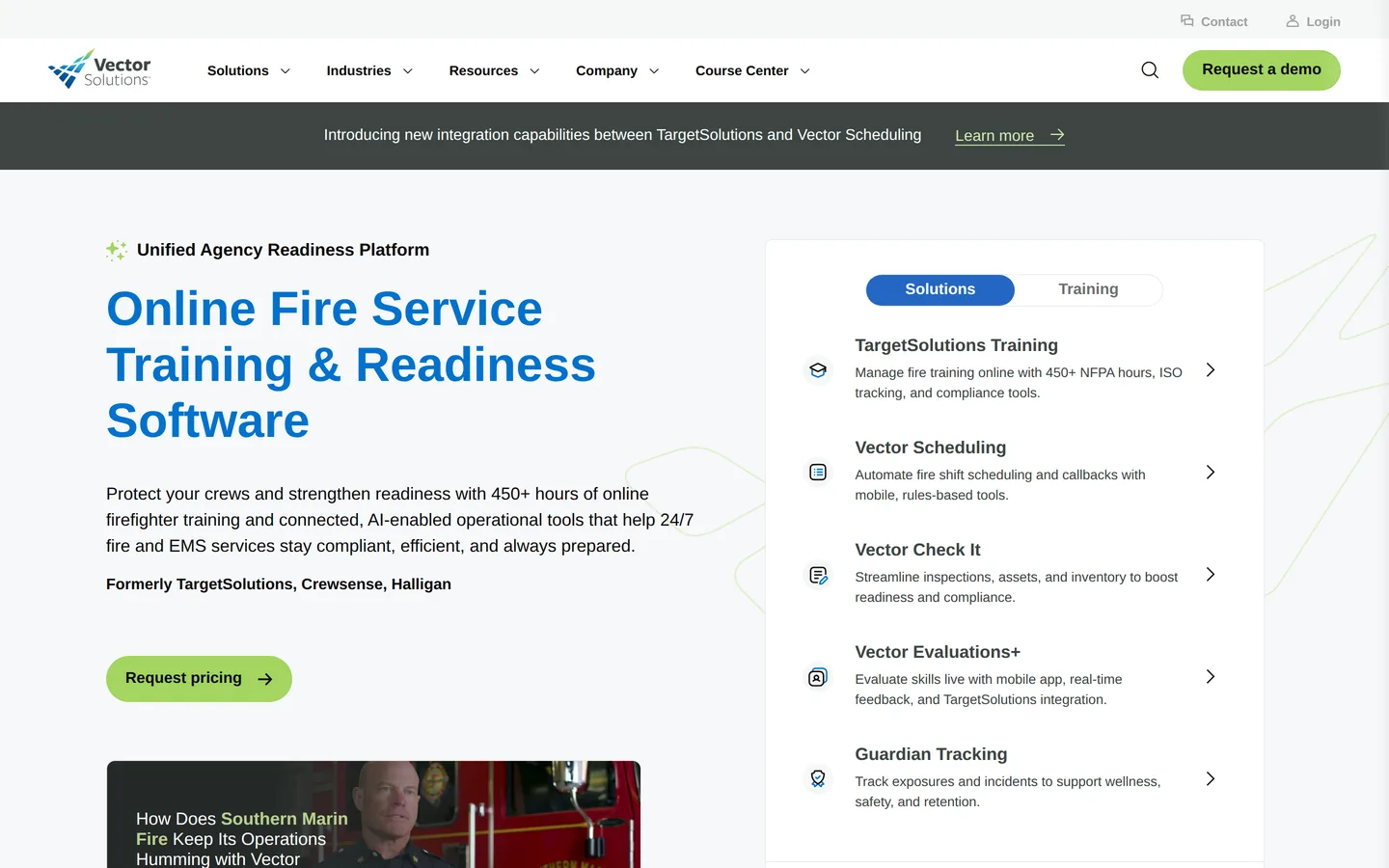
Vector Solutions is a training and compliance software company, and for fire departments they sell Vector LMS, formerly TargetSolutions, with scheduling, equipment checks, skills evaluations and Guardian Tracking for conduct and exposures. Policies go out inside the LMS as assigned tasks with review confirmation, and the test bank lets you build quizzes on them.
They take second on the strength of the training record, with full marks there, and a fire focus that's well documented. Where they fall short of first is the policy side. Their dedicated Policy Tracker, added in 2025, is described as created specifically for law enforcement, so a fire department gets policy distribution as an LMS task rather than a full SOG lifecycle, and the member's record is spread across several products.
Strengths
The deepest fire training record here, at 16 of 16
Policies assigned with review confirmation and quizzes
An ISO Training Tracker for accreditation and ISO proof
Integrates with Essential Personnel for credentialing
Limitations
Their dedicated policy product is marketed to law enforcement
The member record spans several products, at 6 of 12
Quote only
Why they score 70
Strong on the training an SOG depends on, and credible on policy for a department already in Vector LMS. They lose most of their gap to first on holding one member record and on pricing.
PricingPer app, in bands of 25 employees, minimum 15
Best forPolicy, scheduling, gear and training on one platform
Key stat. Their fire and EMS page covers EMT and paramedic certifications and CE hours, 24/48 and Kelly schedules, and SCBA and turnout gear tracking.
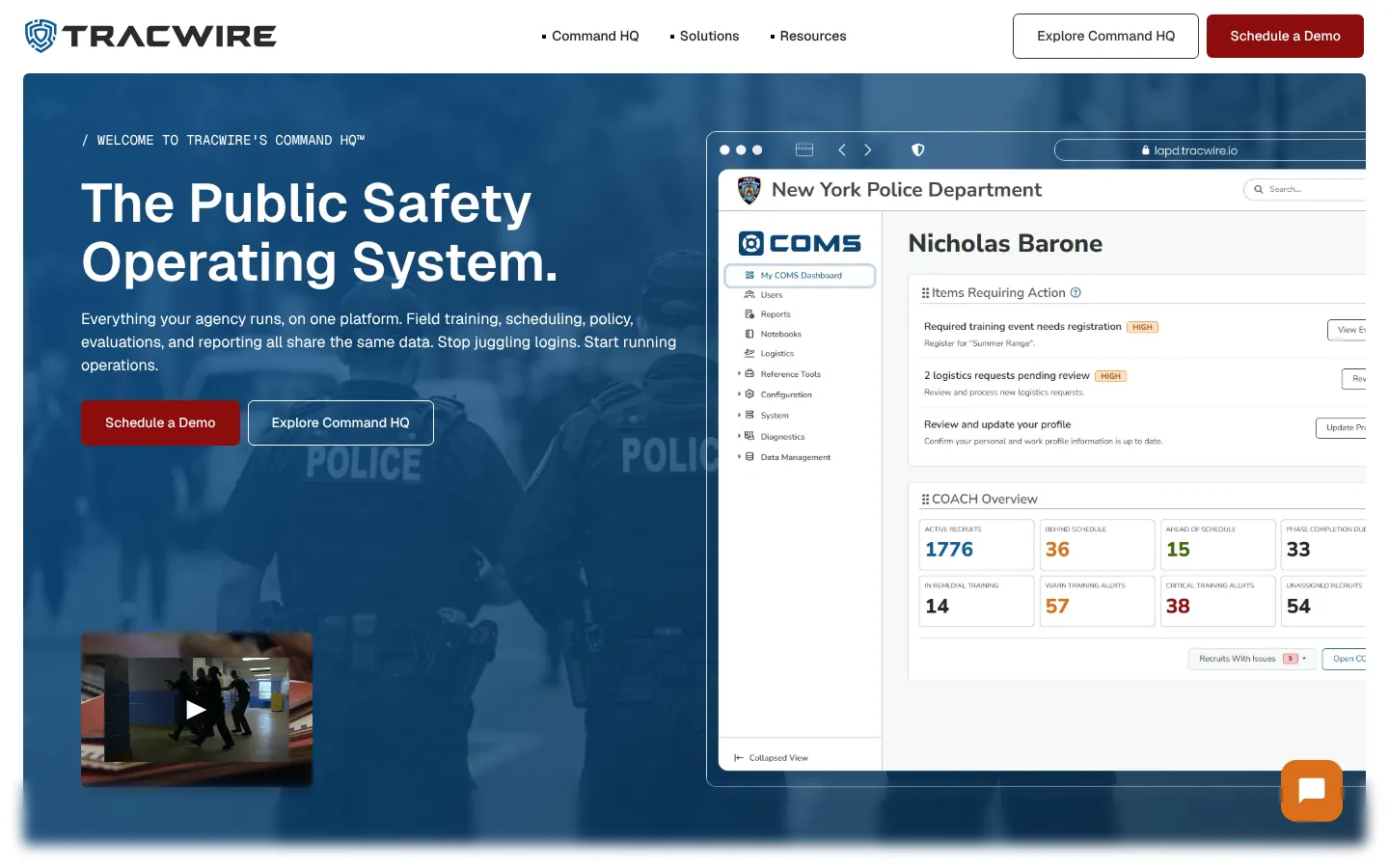
Tracwire sells Command HQ as a workforce platform for police, fire, EMS, dispatch and corrections, with apps sharing one data model. Their policy app, ETHOS, keeps one current version of each policy with archived history, sends acknowledgements targeted by division, unit, rank or role with e-signatures and reminders, and routes drafts for approval with effective dates and review cycles.
They take third for breadth and a capable policy app. Where they fall is fire fit on the policy side: ETHOS is described for police, in the language of officers and general orders, and their pricing model is published but the rates aren't.
Strengths
A full policy lifecycle with targeted e-signature acknowledgement, at 17 of 22
Certifications, CE hours, scheduling and gear on one platform
A published pricing model
Limitations
The policy app is written for police, at 6 of 10 on fire and EMS fit
Little accreditation support documented, at 2 of 10
Rates aren't published
Why they score 61
A real policy app on a broad platform that names fire and EMS. They'd score higher if ETHOS were documented for SOGs and fire accreditation rather than general orders.
Best forSOG publishing and attestation on their own
Key stat.Cary Fire Department, with more than 250 employees, five CFAI accreditations and an ISO Class 1 rating, moved its policies to DocTract from a spreadsheet of links to PDFs.
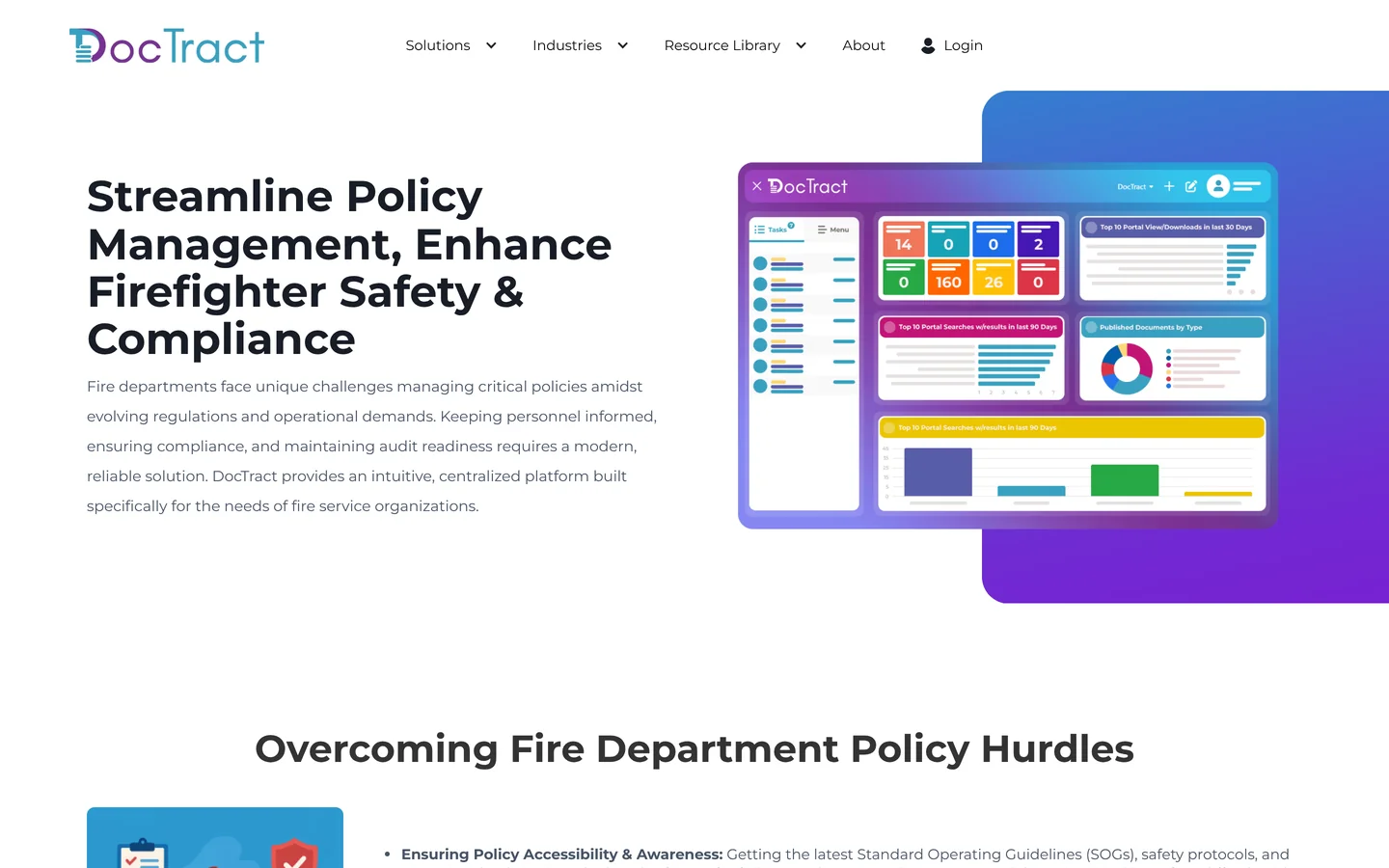
DocTract is dedicated policy and SOP management software sold across government, law enforcement, fire and other industries. Their fire page covers getting the latest SOGs to every firefighter, version control and automated review cycles, attestations and tracked acknowledgements, sharing by station or shift, and one-click audit packages for CFAI or ISO.
They take the highest score here on policy and SOG distribution, at 20 of 22. Where they fall is everything else on the member's file: there's no certification, task book or performance record, so the acknowledgement can't be checked against the training behind it in the same place.
Strengths
The strongest SOG lifecycle here, at 20 of 22
Audit packages for CFAI and ISO, at 7 of 10
A named fire department case study
Limitations
No certification or task book record, at 2 of 16
Sold across many industries, not public safety only
Quote only
Why they score 39
The best pure policy tool for a fire department here. As a PowerDMS replacement it covers the document and leaves the member record somewhere else.
ProductNAVEX One Policy & Procedure Management, formerly PolicyTech
PricingQuote only
Best forDepartments inside a city that already runs NAVEX
Key stat.Concord Fire Department in Massachusetts uses PolicyTech to send every new policy to each member for review and to bring up policies at daily roll call.
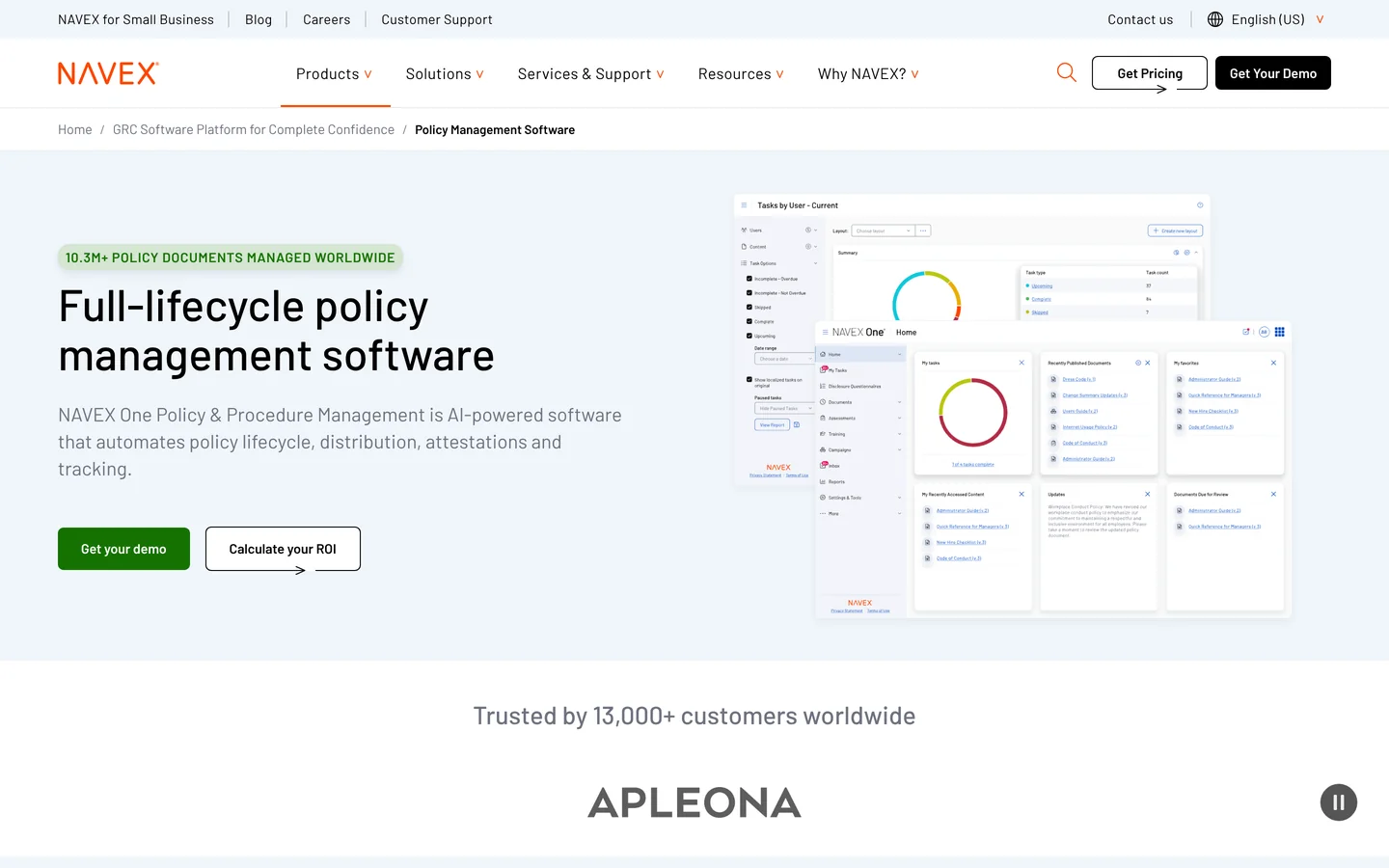
NAVEX is an enterprise compliance software company, and PolicyTech, now NAVEX One Policy & Procedure Management, covers the full policy lifecycle: authoring, distribution, attestations and an audit trail that can show which version was active on a given date. They say more than 13,000 organizations use NAVEX.
They score well on policy distribution and attestation. Where they fall is fire fit and the member record. Their government page names no fire or municipal customers, and nothing about training, certifications or fire accreditation is documented.
Strengths
A mature policy lifecycle and attestation audit trail, at 19 of 22
Version history provable by date
A fit where the city already runs NAVEX for HR policy
Limitations
Built for corporate compliance rather than as fire department software, at 3 of 10 on fire and EMS fit
No training or certification record
Quote only, with an enterprise sales process
Why they score 30
Capable policy software that a fire department can use, especially inside a city that owns it. On its own it's a document system, with nothing of the member's training or performance behind it.
How to move your fire department policies and procedures off PowerDMS or Lexipol
Most of the work in leaving PowerDMS or Lexipol is the manual, not the software. Whichever of the Lexipol alternatives you choose, plan it in this order:
Decide who writes your SOGs. Keep the Lexipol policy text if your agreement allows, adopt a league or insurer model set, or move to your own. Do this before you give notice.
Export everything while you still have access. The current fire department policy manual, every SOG's version history and the acknowledgement records. These are your proof for past incidents, and the vendor may close the portal when the contract ends.
Load each fire department SOG as your own. It goes in with its current version and effective date, then out to the stations, shifts and ranks it applies to for fresh acknowledgement.
Connect training. Link your course providers and other fire department software, such as your RMS and scheduling, so training completions land on the same member file, and load current certifications with their expirations.
Run both for one cycle. Keep read-only access to the old system until the first full round of acknowledgement is done in the new one.
Want to see your own SOGs, acknowledgements and training records on one member file? Call (910) 390-0011 or email info@essper.com and bring an SOG and a crew roster to the demo.
Among PowerDMS alternatives for fire departments and EMS agencies, Essential Personnel ranks first at 89 out of 100, followed by Vector Solutions at 70 and Command HQ by Tracwire at 61. All three publish SOGs and prove acknowledgement. DocTract and NAVEX PolicyTech are dedicated policy tools. None of them writes policy, so Lexipol's content needs a separate source.
PowerDMS is software that posts your policies and SOGs, tracks acknowledgement, keeps versions and maps accreditation files. Lexipol is mainly content: it writes state-specific policy, updates it as laws change and sends Daily Training Bulletins. Many departments use both, with the Lexipol policy manual imported into PowerDMS through an integration.
Yes. Lexipol sells state-specific fire and EMS policy that's reviewed by attorneys and public safety experts and updated as laws change, and a separate service publishes a department's own SOGs alongside it. EMS is sold as part of Fire and EMS rather than as its own manual. Pricing is quoted per agency.
Most departments use one of four sources: their own SOGs written against NFPA 1201 and NFPA 1550, a league or risk pool model set such as the LLRMI fire policies the Kentucky League of Cities offers, a policy firm such as Daigle Law Group, or an insurer's SOG book. Export your Lexipol manual before the contract ends.
PowerDMS prices policy by employee band. NEOGOV's 2026 Texas contract price book lists $5,439.50 a year for up to nine employees, $9,727.85 for 50 to 74 and $12,575.25 for 100 to 124, plus $2,535.75 setup. Essential Personnel's Guidance suite is $30 per user per year, or $1,800 for 60 members.
It should publish fire department policies and procedures to the stations, shifts and ranks they apply to, prove which member acknowledged which version and when, re-run acknowledgement on revision and keep old versions. The best options also hold training and certifications on the same file, so you can show the member was trained on it.
Yes. Clinical protocols, SOPs and memos publish and get acknowledged the same way SOGs do. The difference is the record behind them: an EMS clinician may hold a state license, a national registry certification and agency credentials, each with its own cycle. Essential Personnel tracks each one with its expiration on the same member file.
It replaces the PowerDMS half: publishing policies and SOGs, tracking acknowledgement and keeping every version. It doesn't write policy, so it replaces Lexipol's software but not its content. Departments that write their own SOGs, or use a league or insurer model set, can replace both with Essential Personnel and a content source of their choosing.
About this ranking. Compiled by Scott Monroe, Chief Executive Officer & Co-Founder of Essential Personnel, and published 20 October 2026. Essential Personnel is one of the five systems assessed and is ranked first in it, and the framework, weightings and per criterion scores are all published above so the total can be recalculated. No vendor paid for placement and no vendor previewed its score. Vector Solutions integrates with Essential Personnel, and that partnership did not affect scoring. Scores come from vendor product pages, case studies and published pricing, checked in October 2026, and PowerDMS and Lexipol prices from NEOGOV's Texas price book and public records. Review ratings are omitted because no independent rating with a named source exists across all five. Benchmark Analytics, Versaterm IAPro and Axon Standards were assessed and left out because they serve law enforcement only and don't publish policy.
By clicking “Accept All Cookies”, you agree to the storing of cookies on your device to enhance site navigation, analyze site usage, and assist in our marketing efforts. View our Privacy Policy for more information.