Police Policy Management Software

The best PowerDMS and Lexipol alternatives for police departments: 6 systems ranked for 2026

The best alternatives to PowerDMS and Lexipol for a police department in 2026 are Essential Personnel, Vector Solutions and Command HQ by Tracwire, each of which publishes your policies, collects signed acknowledgements and keeps the version history. Benchmark Analytics, Virtual Academy and Axon Standards each replace a narrower part of the job.

Before you shortlist anyone, separate the two jobs these products do. PowerDMS is software: it distributes your policies, proves who signed which version and holds your accreditation files. Lexipol is mostly content: it writes state-specific policy, keeps it current with case law and sends Daily Training Bulletins, with a platform around it. Replacing PowerDMS is a software decision. Replacing Lexipol means deciding who writes your manual, and that's covered in its own section below.

This guide is for chiefs, sheriffs, accreditation managers and the professional standards and training staff who own the policy manual. Every system is scored against eight criteria totaling 100. Policy distribution and acknowledgement carries 22, the heaviest single weight, because it's the job both incumbents are bought for. Training records and professional standards carry 14 each, because PowerDMS and Lexipol both now sell field training, internal affairs and early intervention modules beside the policy manual, and an alternative has to account for them. Every score sits in the scoring table, so you can reweight it for your agency.

Essential Personnel ranks first at 91 out of 100. They take 20 of 22 on policy acknowledgement, full marks on holding everything on one officer record and on published pricing, and a 120 person department pays $3,600 a year for their Guidance suite, against a 2026 list price of $12,575.25 for PowerDMS policy at 100 to 124 employees.

The six alternatives compared

Ranked by weighted total for police departments replacing PowerDMS, Lexipol or both, 2026. "Replaces" is the column that decides most shortlists.
SystemScoreReplacesFoundedHeadquartersBest forPricing
1. Essential Personnel91PowerDMS policy and professional standards, and Lexipol's platform and field training2020Wilmington, NCAgencies that want policy acknowledgement on the same record as training, evaluations and disciplinePublished, $30 Guidance or $175 for all four suites, per user per year
2. Vector Solutions73PowerDMS policy and accreditation, with separate training and early intervention products1999Tampa, FLAgencies already on Vector trainingQuote only
3. Command HQ by Tracwire72PowerDMS policy, field training and professional standardsNot publishedNot publishedAgencies buying several operations applications from one vendorPer application in bands of 25 employees, no published rates
4. Benchmark Analytics45PowerDMS professional standards and Lexipol's LEFTA field training, not policy2017Chicago, ILLarge agencies whose gap is early interventionQuote only
5. Virtual Academy39PowerDMS policy distribution, as an add-on to online trainingNot publishedMartin, TNSmall agencies buying online training firstQuote only
6. Axon Standards29PowerDMS internal affairs and early intervention, not policy1993Scottsdale, AZAgencies already running Axon evidence and recordsQuote only

What PowerDMS and Lexipol actually do

PowerDMS is a policy and accreditation platform: it publishes your policies, collects signed acknowledgements, keeps every version and maps your files to accreditation standards. Lexipol is a policy content company: it writes state-specific policy, updates it as the law changes and sends Daily Training Bulletins, with software around the content. Many agencies run both, with the Lexipol manual imported into PowerDMS.

PowerDMS was founded in 2001 and is part of NEOGOV, the government HR software company based in El Segundo, California, which announced the merger in December 2020. PowerDMS says it serves more than 5,000 agencies. Its policy module, PowerPolicy, handles review workflows, distribution, signature capture, side by side version comparison and the audit trail. PowerStandards comes preloaded with standards manuals from more than 60 accrediting bodies, including CALEA. Around those sit PowerReady for field training, PowerTime for scheduling and the Professional Standards Suite: PowerIA for internal affairs, PowerAction for action reporting and PowerVitals for early intervention. In its own words, PowerDMS provides the management infrastructure "without prescribing policy content". It doesn't write your policies.

Lexipol was founded in 2003 by two attorneys who were also law enforcement officers, and is headquartered in Frisco, Texas. Private equity firm GTCR bought it in 2021. Its core is fully developed, state-specific policy researched and written by policy and legal professionals and kept current as laws change, delivered through its Knowledge Management System with Daily Training Bulletins that test officers on it. Lexipol has since added PoliceOne Academy online training, Cordico wellness, grant help and, in 2024, LEFTA Systems for field training and performance reporting, all now sold as the LexOne platform.

The two meet in the middle. PowerDMS runs a Lexipol integration for agencies that license both, which imports the Lexipol manual into PowerDMS and flags Lexipol updates as new drafts. That's why "PowerDMS and Lexipol" so often comes as one question: plenty of departments pay one vendor to write the policy and another to prove officers read it.

What each one does, from each vendor's own published product pages, October 2026.
JobPowerDMSLexipolEssential Personnel
Writes state-specific policy and keeps it currentNoYes, the core productNo
Publishes policy and tracks signed acknowledgementYes, PowerPolicyYes, inside KMSYes, Guidance
Keeps every version of every policyYesYesYes
Accreditation standards and proof filesYes, PowerStandardsAccreditation consulting and toolsReporting from the officer record
Field training and DORsPowerReadyLEFTA SystemsBuilt in
Internal affairs, use of force and early interventionProfessional Standards Suite, sold per moduleLEFTA performance reportingBuilt in
Training bulletins and online coursesMicrolearning from your policiesDaily Training Bulletins, PoliceOne AcademyTraining records, not a course library
Evaluations, commendations and issued equipment on the same recordNoNoYes
Published price2026 list price on a Texas contractQuote onlyYes, on their pricing page

Why agencies look for alternatives

Two vendors for one manual. If Lexipol writes your policy and PowerDMS distributes it, every update crosses from one system to the other, and you renew two contracts to keep one manual alive. A department that already writes its own policy, or uses a state association's model manual, is paying for content it doesn't use.

The price moves every year. Cleveland Heights, Ohio signed a three-year Lexipol agreement in 2025 to lock in a 5% annual increase, and the city's resolution says one-year terms were rising 6 to 8% a year. PowerDMS prices by employee band, so a department that grows past a band boundary moves to the next price.

The policy record sits apart from the officer. When an officer is disciplined, the question is which version of the policy they signed and when. When they're promoted, it's their training, evaluations and commendations. With policy in one system and the rest of the file somewhere else, nobody sees both at once. An internal affairs investigator pulls the acknowledgement report from one system and the officer's history from another.

Ownership. Both are private equity owned. GTCR has owned Lexipol since 2021. NEOGOV, PowerDMS's parent, agreed in July 2025 to be acquired by EQT and CPP Investments from Warburg Pincus and Carlyle. Neither is a reason to leave on its own, but it's worth asking at renewal what's on the roadmap and who decides it.

Replacing Lexipol: who writes your policy

None of the six software alternatives here writes policy. If you leave Lexipol, your manual has to come from somewhere: your own staff and city attorney, a state association or risk pool model manual, or the IACP's model policies. Decide that first, then pick the software that publishes it and proves officers signed it.

The options a police department actually uses:

  • Your own manual, maintained in house. Larger agencies often have a policy unit or a standards committee that writes and reviews policy with the city or county attorney. All the software has to do is publish it and prove receipt.
  • State association model policies. In Texas, the state licensing commission's model policy page lists the Texas Police Chiefs Association sample manual, the Texas Association of Counties and Lexipol side by side, and endorses none of them. The Texas Association of Counties gives members close to 500 model policies for patrol and jail operations at no cost.
  • Risk pool manuals. The Michigan Municipal League offers a 33-chapter model law enforcement manual to communities in its insurance pools, written by and for police chiefs and sheriffs. In Texas, the TML risk pool will fund first-year fees for member agencies entering the Texas Police Chiefs Association Best Practices Recognition Program. Ask your own pool what it provides.
  • IACP model policies. The International Association of Chiefs of Police has run its Policy Center since 1987, publishing model policies with the concepts and issues papers behind them. Access is for members.

Before you give notice, check your Lexipol agreement for what happens to the manual text when the subscription ends, and export the current manual and its acknowledgement history while you still have access. Then move the manual into the new system as your agency's own policy, version by version.

What to look for in a replacement

Ask every vendor to do these six things in the demo, with one of your own policies:

  1. Prove one officer, one version, one date. Pick an officer and a policy and ask what they signed, which version it was and when. Acknowledgement that only shows someone clicked something at some point doesn't hold up in a deposition.
  2. Revise the policy and re-run acknowledgement. The revision should go back out to the people it applies to, and the old version should stay retrievable as it read on the day it applied.
  3. Hire someone. A new officer should be assigned the policies they need to sign automatically, not when someone remembers.
  4. Show the accreditation proof. If you're CALEA or state accredited, ask how a standard's proof file is built and what you'd compile by hand.
  5. Open the officer's whole file. Policy acknowledgements, training, evaluations, discipline and commendations: on one screen, or in several products?
  6. Price it in writing. Per user or per employee band, with setup, every module you'd need and the renewal increase shown separately.

What PowerDMS, Lexipol and the alternatives cost

PowerDMS policy lists at $5,439.50 a year for up to 9 employees, $12,575.25 at 100 to 124 and $48,029.75 at 1,000 to 1,249 on NEOGOV's 2026 Texas contract price book. Lexipol prices on sworn headcount and quotes on request. Essential Personnel publishes theirs: Guidance is $30 per user per year and all four suites are $175.

NEOGOV's Texas DIR price book is the one public PowerDMS price list, and agencies outside Texas can buy from it. Setup for the policy module starts at $2,535.75. At 100 to 124 employees, PowerIA, PowerAction and PowerVitals are $11,885.25 each, so policy plus the full Professional Standards Suite comes to $48,231 a year at list. Agencies pay less than list in practice: Hunt County Sheriff's Office in Texas, with 140 employees, approved $13,577.73 for 2026 to 2027, of which $10,716.51 was the policy module.

Lexipol's platform page says the price depends on agency size and the modules you choose. Council records show the range. Hawthorn Woods Police Department in Illinois was quoted on 12 full-time sworn officers at $8,082 a year for the manual and Daily Training Bulletins, $7,274 after a 10% risk pool discount. Cleveland Heights, Ohio pays $28,523.03 in the first year of a three-year agreement, rising to $31,446.64 in the third. Lexipol's price includes the written policy, which no other product here supplies.

Essential Personnel's suites are Guidance at $30 per user per year for policy publishing, acknowledgement and version control, Talent Management at $85 for evaluations, field training, awards and career paths, Safety & Wellness at $40 for early intervention and case management, and Equipment at $20. The four add to exactly $175, with a $3,000 one-time start-up fee and size-based discounts on request. Vector Solutions, Benchmark Analytics, Virtual Academy and Axon quote on request. Tracwire publishes how it prices, per application in bands of 25 employees with a 15-employee minimum, but not the rates.

A department of about 120 employees, each a user. PowerDMS at 2026 list price for the 100 to 124 employee band; Essential Personnel at published price.
What you pay forPowerDMS by NEOGOVEssential Personnel
Policy publishing and acknowledgement$12,575 a year$3,600 a year
Policy plus internal affairs, use of force and early intervention$48,231 a year$21,000 a year, all four suites
Also on the same recordField training, scheduling and accreditation priced separatelyField training, evaluations, training records, awards and equipment included
One-time setup$2,536$3,000

Ranking methodology: the Police Policy and Professional Standards Framework

Eight criteria, weighted to what a police department needs from a PowerDMS or Lexipol replacement. Policy distribution and acknowledgement carries the most because it's the job both are bought for. Training records, field training and professional standards carry 38 between them because both incumbents now sell those modules, and an agency that drops them has to put that record somewhere. Writing policy content isn't scored, because none of the six alternatives does it.

Scores come from each vendor's own published product pages, press releases and pricing, checked in October 2026. Where a vendor hasn't published a capability, they don't get credit for it, and facts a vendor hasn't published are marked "not published" rather than estimated.

The Police Policy and Professional Standards Framework, 2026. Weights total 100.
CriterionWeightWhat it measures
Policy distribution and acknowledgement22Publishing policies and memos to the right people, signed acknowledgement, version history and re-acknowledgement on revision
Training and certification record14Certifications, in-service hours and expirations on the officer's record
Professional standards and early intervention14Internal affairs, use of force review, discipline and thresholds that flag patterns
One officer record12Whether policy, training, performance and conduct sit on one profile in one product
Accreditation proof10Building and keeping the proof that standards are met, for CALEA and state programs
Field training10FTO programs with daily observation reports signed off on the record
Pricing transparency10Whether an agency can size the cost without entering a sales process
Public safety focus8Whether the product is built for police and public safety rather than adapted from another market

How ties are broken

Where two systems reach the same total, the higher score on the heaviest criterion, policy distribution and acknowledgement, takes the better position. No tie arose in this ranking.

How the six systems scored

Every system against every criterion. Each cell is scored out of the criterion's weight, and the total is out of 100.
SystemPolicy /22Training record /14Professional standards /14One record /12Accreditation /10Field training /10Pricing /10Public safety /8Total
1. Essential Personnel201312127910891
2. Vector Solutions1814116982573
3. Command HQ by Tracwire1711109395872
4. Benchmark Analytics05148181845
5. Virtual Academy141204101739
6. Axon Standards03135001729

The rankings: six PowerDMS and Lexipol alternatives for 2026

Essential Personnel homepage - police policy management and professional standards software
191 out of 100

Essential Personnel

  • Founded2020
  • HeadquartersWilmington, NC
  • Contact(910) 390-0011
  • Emailinfo@essper.com
  • Pricing$30 Guidance, $175 all four suites, per user per year
  • Best forPolicy acknowledgement on the same record as training, evaluations and discipline

Key stat. Their Guidance suite costs $30 per user per year, so a 120 person department pays $3,600 a year to publish policy and prove receipt.

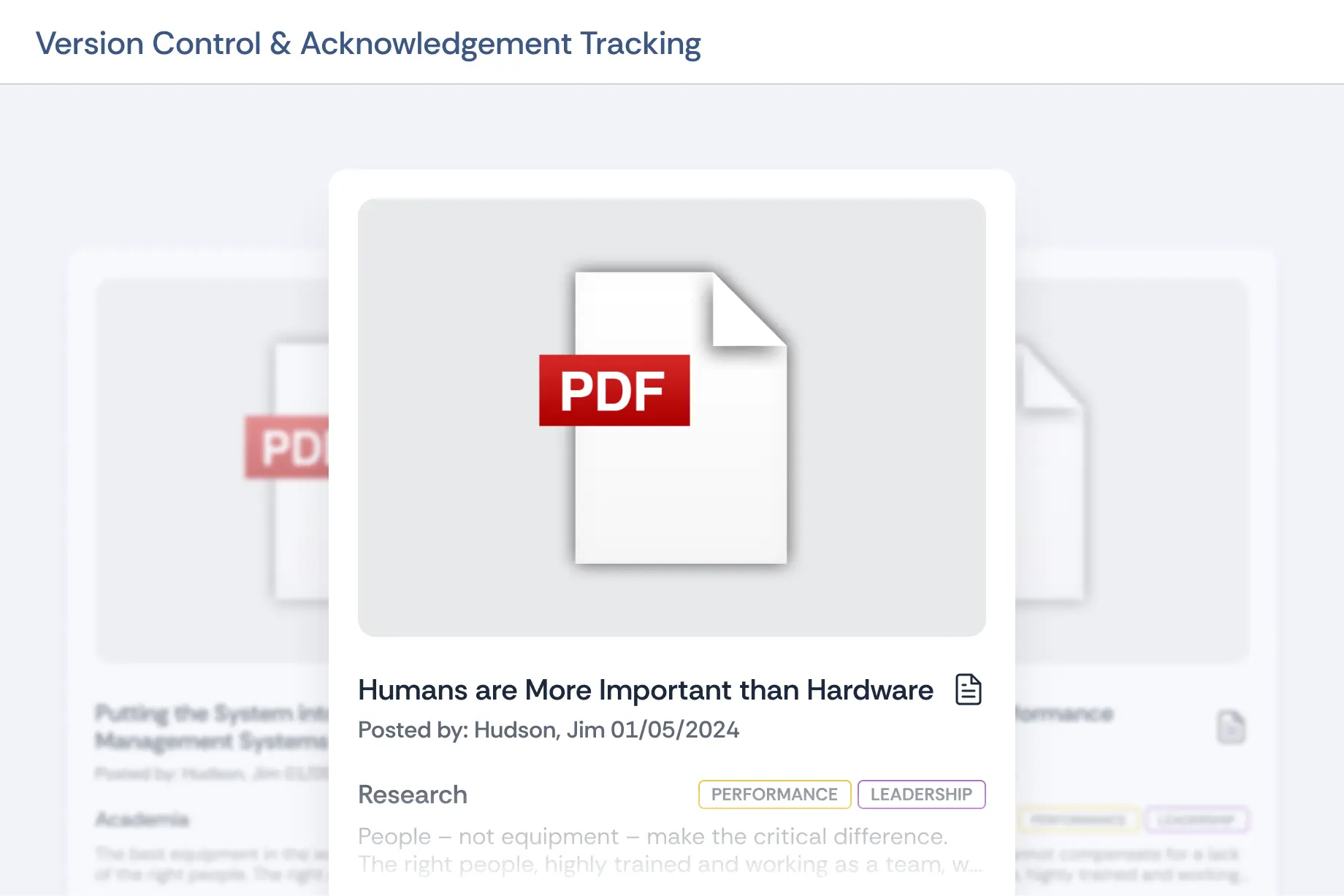
Essential Personnel is a modern solution for police, fire, EMS and municipal HR, built natively by two Wilmington firefighters to bring policy, training, performance and conduct together on one record rather than across separate systems. Guidance publishes five kinds of document, policies, memos, announcements, lessons learned and research, each with Employee Acknowledgment, which records who received which version and when, and Version Control, which keeps every revision and lets you revert. New employees are assigned the policies they need to acknowledge automatically.

What puts them first is where that acknowledgement lives. It sits on the same officer profile as certifications and in-service hours, field training DORs signed on a phone at shift end, evaluations and leader's notes, commendations, internal affairs and use of force review, early intervention thresholds your agency sets, and issued equipment. When a discipline entry cites a policy, the signed version is on the same record. Hosting is AWS GovCloud, aligned to the FBI CJIS Security Policy, with a SOC 2 Type II report each year.

Essential Personnel version control and acknowledgement tracking view, showing a published research document with the person who posted it, the posting date and its categories
Guidance keeps who posted each document, when, and who has acknowledged it.

Strengths

  • Acknowledgement and version control at 20 of 22, with automatic assignment to new hires
  • Full marks for holding policy, training, performance and conduct on one officer record
  • The only system here with a published price, at $30 per user for policy and $175 for everything
  • Field training, internal affairs and early intervention included, not sold per module
  • Integrates with Vector Solutions for training credentials

Limitations

  • Doesn't write policy content or maintain model policies for your state, so your manual comes from your own staff or a content source
  • Accreditation reporting runs from the records you keep rather than preloaded standards manuals, at 7 of 10
  • Not a course library. Online training content comes from the provider you already use
"One of the most liked things is that we can store so much information on one platform that is easily accessible for convenience."
Tina MedlinInterim Police Chief, Biscoe Police Department, NC
"[Essential Personnel] has strengthened accountability, enhanced communication and become an essential tool in helping our office better serve the community."
Travis SumptionSheriff, Clarke County, VA
"Essential Personnel stores all of the documentation in one centralized system. It's cleaner, faster, and more reliable."
Derek MooreMajor, Carteret County Sheriff's Office, NC

Why they score 91

They score near the top on policy, the heaviest criterion, and take full marks on one officer record, pricing transparency and public safety focus. Their lead over Vector Solutions comes from holding policy, training and conduct in one product at a published price, where Vector sells them as separate products quoted on request.

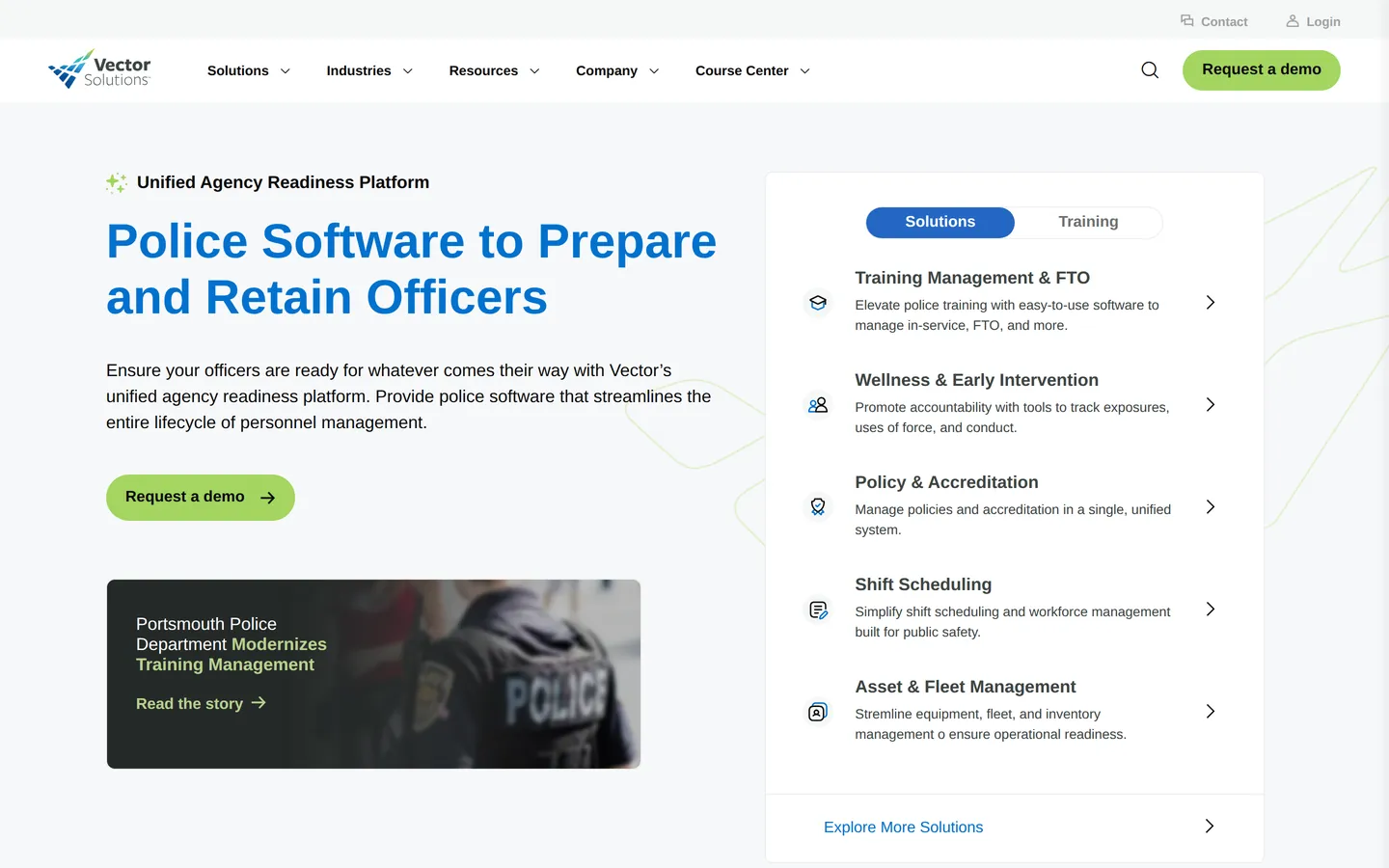
Vector Solutions law enforcement page - police policy, training and early intervention software
273 out of 100

Vector Solutions

  • Founded1999
  • HeadquartersTampa, FL
  • Police productsPolicy Tracker, AccrediTrack, Vector LMS, Acadis, Guardian Tracking
  • PricingQuote only
  • Best forAgencies already on Vector training

Key stat. Their Policy Tracker arrived with the Frontline Public Safety acquisition in April 2025, and Vector says agencies that choose it are up and running within a month.

Vector Solutions started in 1999 as RedVector, an online continuing education company for engineers and architects, and grew into public safety through acquisitions including TargetSolutions, Acadis and Guardian Tracking. For police policy, Policy Tracker manages and distributes policies and memos with electronic signature acknowledgement, alerts for unsigned policies and an AI quiz generator. AccrediTrack handles accreditation for local agencies and state accreditation bodies.

They take second on breadth. Vector LMS and Acadis give them the strongest training record here, at 14 of 14, and Guardian Tracking adds early intervention. Where they fall short of first is that these are separate products bought from different companies, joined by integration and sold on separate quotes, so policy, training and conduct don't sit on one officer record.

Strengths

  • Policy distribution with e-signature and unsigned alerts, at 18 of 22
  • The strongest training record here, with a large online course library
  • AccrediTrack for accreditation, at 9 of 10
  • Integrates with Essential Personnel for training credentials

Limitations

  • Policy, training and early intervention are separate products, at 6 of 12 on one record
  • No published pricing
  • Sells into education, construction and manufacturing as well as public safety
  • Doesn't write policy content
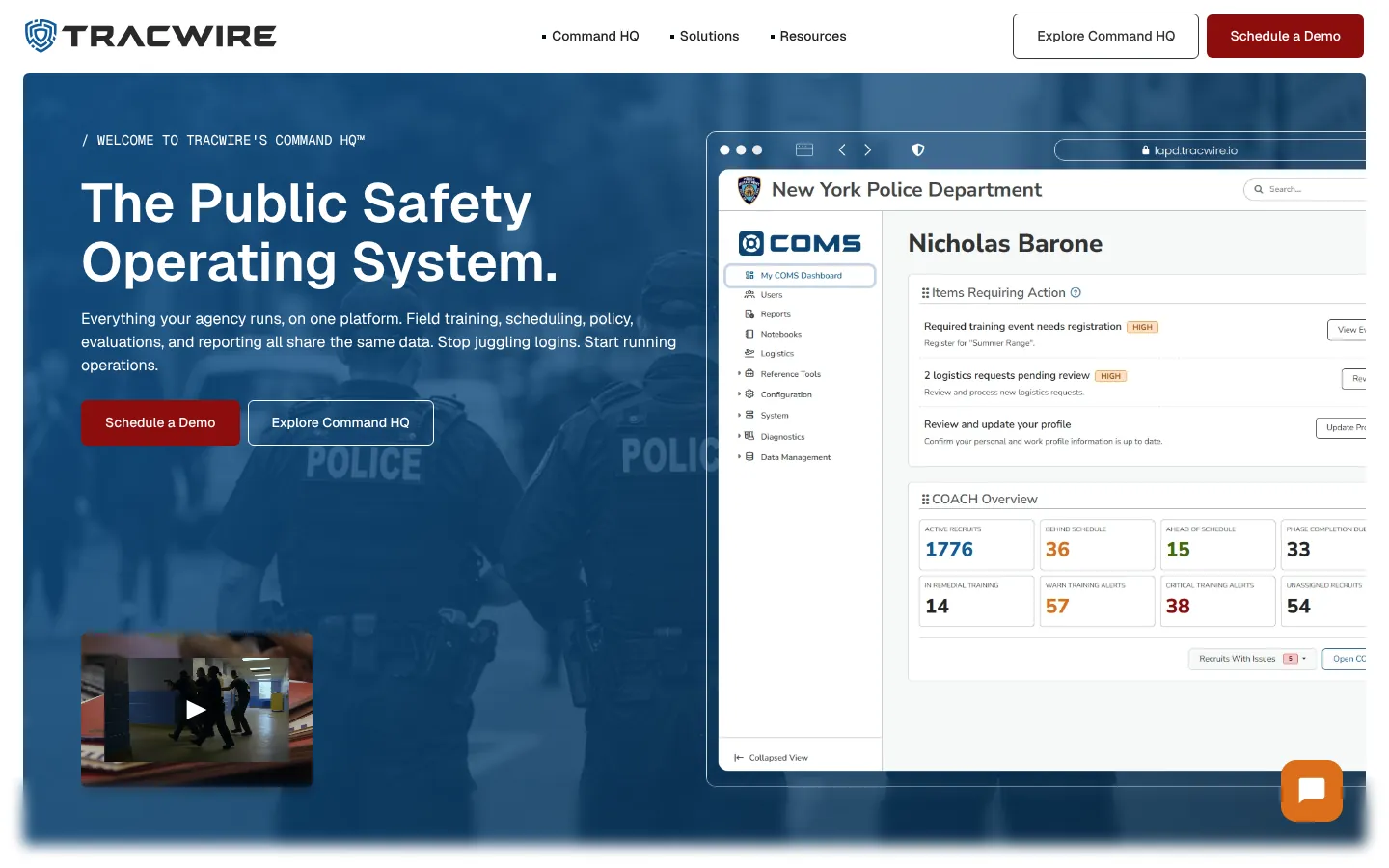
Tracwire Command HQ homepage - public safety operations platform with police policy management
372 out of 100

Command HQ by Tracwire

  • FoundedNot published
  • HeadquartersNot published
  • Police productsETHOS policy, COACH field training, TRAIN, professional standards, early intervention
  • PricingPer application in bands of 25 employees, 15-employee minimum, rates not published
  • Best forAgencies buying several operations applications from one vendor

Key stat. Command HQ is twenty applications on one platform, covering hiring, training, scheduling, equipment, reporting and operations.

Tracwire was founded by a former patrol officer, field training officer and crisis negotiator, and sells Command HQ as a public safety operating system built in house rather than assembled from acquisitions. Its policy application, ETHOS, manages policy from draft to acknowledgment, with one current version of each policy and a signed record of who saw what and when.

They take third, one point behind Vector, with a stronger single-platform score and a published pricing model offset by a thinner training record and no documented accreditation module. They price per application rather than per seat, which suits an agency buying three or four of them, but the dollar rates aren't published.

Strengths

  • ETHOS covers drafting, distribution and signed acknowledgement, at 17 of 22
  • Field training, training and professional standards on the same platform
  • A published pricing model, per application in bands of 25 employees

Limitations

  • No accreditation module documented, at 3 of 10
  • Rates, founding year and headquarters not published
  • Doesn't write policy content
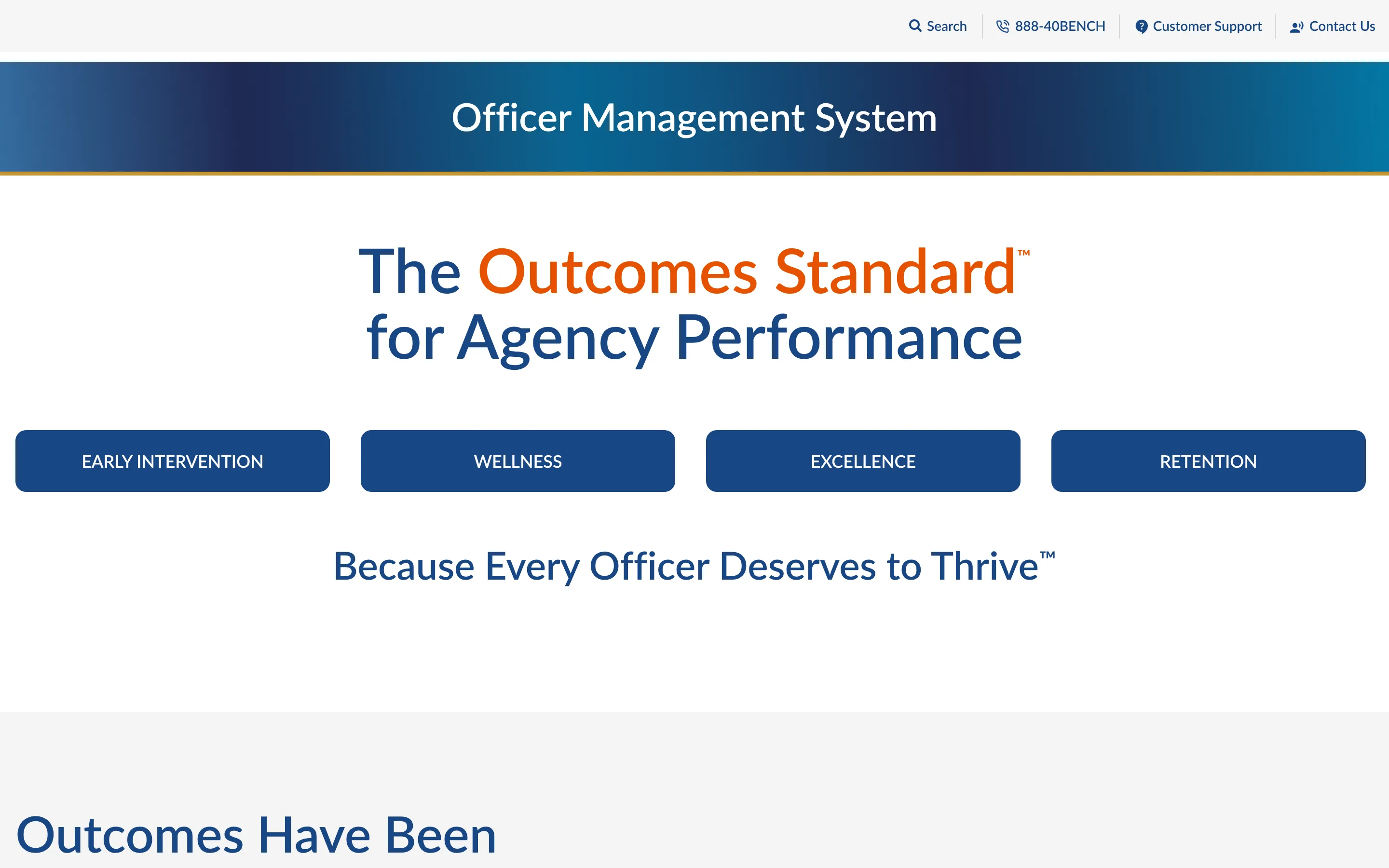
Benchmark Analytics homepage - police officer management and early intervention software
445 out of 100

Benchmark Analytics

  • Founded2017
  • HeadquartersChicago, IL
  • Police productsBenchmark Management System, First Sign early intervention
  • PricingQuote only
  • Best forLarge agencies whose gap is early intervention

Key stat. First Sign, their early intervention model, was built in partnership with the University of Chicago.

Benchmark Analytics builds what it calls an officer management system for law enforcement. The Benchmark Management System covers the officer profile, performance evaluations, field training, internal affairs, use of force and community engagement, and First Sign adds predictive early intervention, wellness and retention indicators.

They're here because an agency leaving PowerDMS's Professional Standards Suite or Lexipol's LEFTA field training needs somewhere for that record, and Benchmark takes full marks on professional standards. They score zero on policy because they publish no policy distribution or acknowledgement module, so an agency replacing PowerDMS would still need one.

Strengths

  • Full marks on professional standards and early intervention
  • Field training and evaluations on the officer profile
  • Built for law enforcement only

Limitations

  • No policy distribution or acknowledgement module published, at 0 of 22
  • No accreditation module published
  • Quote only, with public contracts at large city scale
539 out of 100

Virtual Academy

  • FoundedNot published
  • HeadquartersMartin, TN
  • Police productsOnline law enforcement and 9-1-1 training, policy management add-on
  • PricingQuote only
  • Best forSmall agencies buying online training first

Key stat. Their policy management add-on creates, distributes and tracks policies with automated acknowledgments and version control.

Virtual Academy is an online training company for law enforcement and 9-1-1 centers, and its policy management add-on sits beside the course library. For a small department whose main purchase is in-service training, it puts policy distribution and acknowledgement in the same login.

They rank fifth because policy is an add-on to a training business. They publish no field training, internal affairs or early intervention tools, and no accreditation module, so most of what PowerDMS and Lexipol now sell beside the manual would live somewhere else.

Strengths

  • Automated acknowledgments and version control, at 14 of 22
  • Online in-service training in the same product
  • Built for law enforcement and 9-1-1

Limitations

  • No field training, internal affairs or early intervention published
  • No accreditation module published
  • Founding year and pricing not published
Axon homepage - Axon Standards internal affairs, use of force and early intervention software
629 out of 100

Axon Standards

  • Founded1993
  • HeadquartersScottsdale, AZ
  • Police productsAxon Standards, alongside Axon Evidence and Axon Records
  • PricingQuote only
  • Best forAgencies already running Axon evidence and records

Key stat. Axon Standards puts use of force and internal affairs review in the same platform as the body camera footage being reviewed.

Axon Standards is the professional standards product from the company behind TASER and Axon body cameras. It covers use of force and internal affairs reporting, an early intervention system and customizable forms for training, commendations and hiring.

They rank last because Axon Standards publishes nothing on policy distribution, acknowledgement or accreditation. For an agency already on Axon, it can replace PowerDMS's internal affairs and early intervention modules, but the policy manual would still need a home.

Strengths

  • Internal affairs, use of force and early intervention, at 13 of 14
  • Next to the evidence an investigator reviews
  • Configurable forms

Limitations

  • No policy distribution or acknowledgement published, at 0 of 22
  • No accreditation or field training module published
  • Quote only

How to switch

Most departments switch at renewal, so start 90 days before yours. Export every current policy with its version history and the acknowledgement report for each one, and keep that export as a record you can produce later. Load the current manual into the new system as your agency's own policy, publish it and run a fresh acknowledgement so every officer has signed the version in force on the day you switched. If you're leaving Lexipol, settle who will maintain the manual before that date, from the options in the content section.

Then put the rest of the officer record next to it. A signed policy matters most when it sits beside the training, evaluations and discipline that refer to it. The acknowledgement options guide covers what the record has to prove, and the Guardian Tracking alternatives ranking covers the performance and early intervention side.

Want to see your own policy manual, acknowledgements and officer files in Essential Personnel? Call (910) 390-0011 or email info@essper.com and bring one policy and one officer's file to the demo.

Request a demo

Frequently asked questions

Essential Personnel ranks first at 91 out of 100, followed by Vector Solutions at 73 and Command HQ by Tracwire at 72. All three publish policy and track signed acknowledgement. Benchmark Analytics, Virtual Academy and Axon Standards each replace a narrower part. None of them writes policy, so agencies leaving Lexipol also need a content source.

PowerDMS is software that distributes your policies, tracks signed acknowledgements and holds accreditation files, without writing policy. Lexipol is mainly a content company that writes state-specific policy, keeps it current with the law and sends Daily Training Bulletins. Many agencies use both, with the Lexipol manual imported into PowerDMS through an integration.

No. Essential Personnel publishes your policies, tracks who acknowledged which version and when, and keeps every revision, but it doesn't write policy or maintain model policies for your state. Your manual can come from your own staff and attorney, a state association or risk pool model manual, or IACP model policies.

NEOGOV's 2026 Texas contract price book lists PowerDMS policy at $5,439.50 a year for up to 9 employees, $12,575.25 at 100 to 124 and $48,029.75 at 1,000 to 1,249, plus setup from $2,535.75. Internal affairs, action reporting and early intervention are extra, at $11,885.25 each for 100 to 124 employees.

Lexipol quotes on sworn headcount and modules. Council records show a 12-officer Illinois department quoted $8,082 a year for the manual and Daily Training Bulletins, and Cleveland Heights, Ohio paying $28,523.03 in the first year of a three-year agreement. The city's resolution says one-year terms were rising 6 to 8% a year.

Yes. PowerDMS runs an integration for agencies that license both, which imports the Lexipol policy manual into PowerDMS, by document or in bulk, and notifies the agency when Lexipol publishes updates. It means paying two vendors for one manual, which is a common reason agencies replace one or both.

Some are free to members. The Texas Association of Counties gives members close to 500 law enforcement model policies at no cost, and the Michigan Municipal League offers a 33-chapter model manual to communities in its insurance pools. IACP model policies are a membership benefit. Check what your own state association or risk pool provides.

Before your contract ends, export every policy with its version history and the acknowledgement report for each, and keep the export as a record. Load the current manual into the new system, publish it and run a fresh acknowledgement, so every officer has signed the version in force on the day you switched.

About this ranking. Compiled by Scott Monroe, Chief Executive Officer & Co-Founder of Essential Personnel, and published 16 October 2026. Essential Personnel is one of the six systems assessed and is ranked first in it, and the framework, weightings and per criterion scores are all published above so the total can be recalculated. No vendor paid for placement and no vendor previewed its score. Vector Solutions integrates with Essential Personnel, and that partnership did not affect scoring. Scores come from vendor product pages, press releases and published pricing, checked in October 2026. PowerDMS prices are from NEOGOV's Texas DIR price book and the Hunt County, Texas commissioners court record; Lexipol prices are from council records in Hawthorn Woods, Illinois and Cleveland Heights, Ohio. Facts a vendor has not published are marked "not published" rather than estimated. PowerDMS and Lexipol are described but not scored, because they are the systems being replaced. General policy tools listed on software review sites were left out because none is built for police departments.