Top 6 equipment accountability and asset management systems for Texas municipalities in 2026
Published 16 November 2026
In September 2025, Dallas's city auditor found that 58 of the police department's 491 rifles, about 12 percent, had out of date inventory records, and two couldn't be located. The annual inventory was kept as signed paper and PDFs that nobody could search. The recommendation was one line: automate it. Every Texas city carries the same exposure. State records schedules set how long you keep issue records, TCFP inspects turnout gear and SCBA records every two years, grant rules want serial numbers and a reconciled count, and a TIFMAS deployment only gets reimbursed if you can prove the engine was yours.
This guide is for Texas city managers, police and fire chiefs, quartermasters, fleet managers, and the finance and HR staff who answer to council and the city auditor. It compares the six systems that keep issued public safety equipment tied to the people carrying it, across police, fire and general government, and helps you choose the one that fits the records your city actually has to produce.
Nine criteria carry the ranking and they total 100, the same framework as our national ranking. Person level assignment takes the most weight at 22, because it's the question this category exists to answer. Chain of custody and separation audit takes 16, and audit, accreditation and grant evidence takes 11, which in Texas is where TCFP, grant and TIFMAS records land. Every criterion is published beside every score in the scoring table, so you can reweight it.
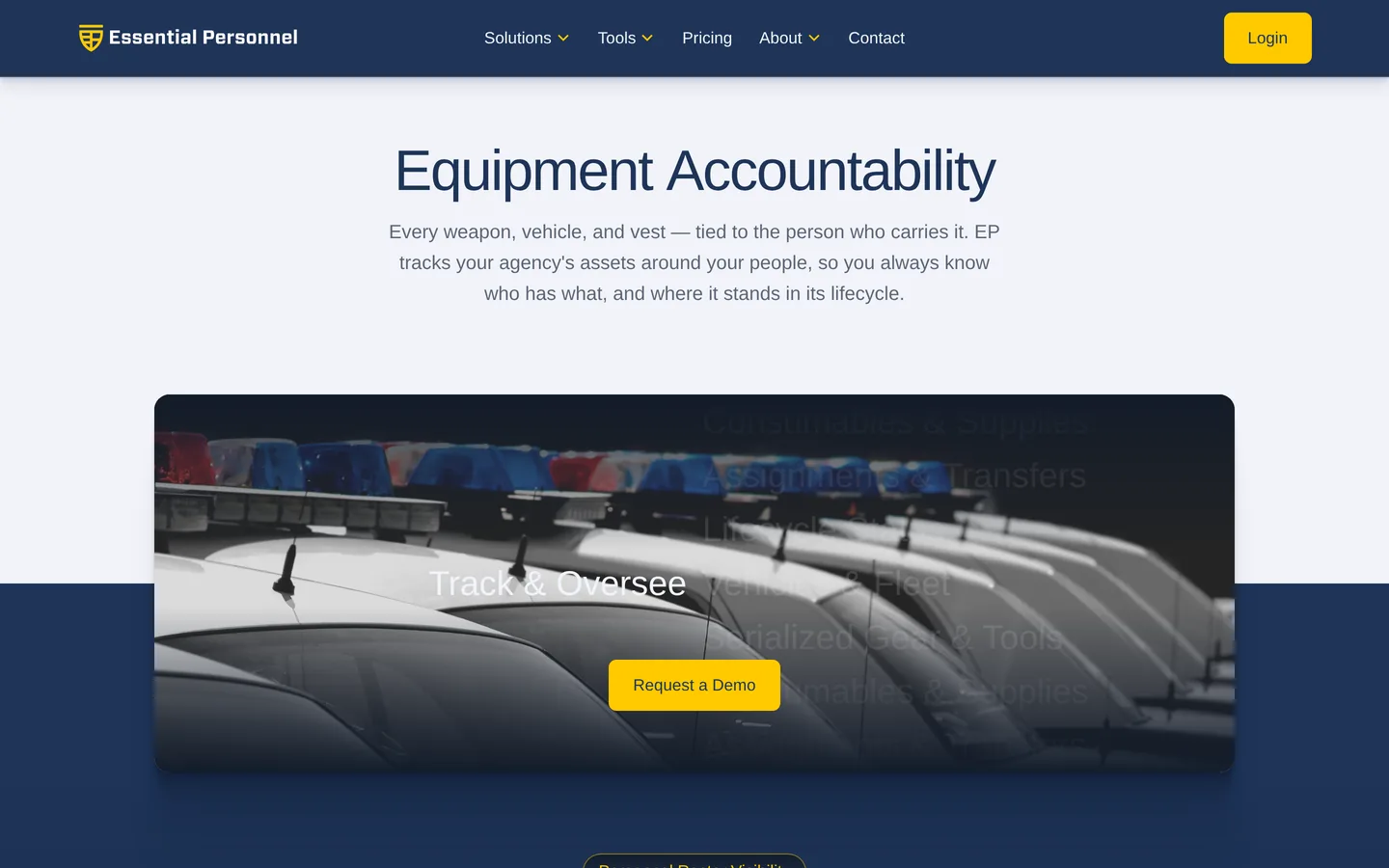
Essential Personnel ranks first with 90 of 100. They take the highest score on person level assignment at 20 of 22, the only perfect score in the set on serialized and armory depth at 12 of 12, and full marks on procurement and pricing. They don't scan barcodes, and they don't do fleet maintenance, purchase orders, depreciation or finance integration, so a city keeps those in its fleet and finance systems. What EP does better than anyone here is answer the person question: one screen shows everything an officer or firefighter holds, down to the optic on the rifle.
What's the best equipment accountability software for Texas cities?
Essential Personnel is the best equipment accountability and asset management system for Texas municipalities in 2026, at 90 out of 100. MCM Technology is second at 81, PSTrax third at 68, Departmentware fourth at 65, Vector Solutions fifth at 62 and Omnigo sixth at 57. The ranking weights who holds each item most, then chain of custody and department coverage.
The six divide into three models. Person centered systems organize equipment around whoever carries it. Asset centered systems organize it around the item and its location. Checks centered systems organize it around the inspection cycle. Texas cities need all three answers at different moments, which is why the model is the first thing to settle and the feature list the last.
The 6 equipment accountability systems compared
Ranked for Texas municipalities, 2026. "Model" tells you whether the system is organized around the person holding the item, the item itself, or the inspection cycle it sits in.
Agencies issuing from a central store with barcode scanning
Quote only
Bundled kits send a whole issue set out under one transaction
What do Texas city audits find when they check police and fire equipment, and what should police quartermaster software fix?
Paper. Dallas's 2025 audit found 12 percent of police rifle records out of date, two rifles potentially missing and an annual inventory kept as signed paper and PDFs, and recommended automating it. A 2024 Dallas Fire-Rescue audit found less-lethal equipment missing from the annual inventory, and San Antonio's 2017 armory audit found inventory controls not effective.
The Dallas police audit is worth reading in full because its findings are so ordinary. The quartermaster's system didn't hold every firearm assignment, rifles included, so some lived on physical paper cards. Five rifles had serial number typos. None of it was misconduct. It was what happens when the record of who holds what is kept in more than one place and checked once a year.
San Antonio's follow-up in 2019 found the armory problems fixed, mainly by documenting inventories and having someone other than the custodian count. That's the shape of the fix every audit points to: one system of record, tied to the person, with a count the auditor can reconcile against it. Police quartermaster software that only knows what's on the shelf can't give an auditor that.
How long must a Texas city keep equipment issue and inventory records?
The Texas State Library and Archives Commission's local schedules set it. Records of equipment issued to employees are kept two years after return or reassignment. Weapon issue records are kept until the weapon is returned plus three years, weapon inventories until superseded plus three years, and SCBA and protective clothing inspection reports three years.
Those periods come from Local Schedule GR and Local Schedule PS, and a few are worth knowing by item number: GR1075-21 for equipment issued to employees, PS4050-05a and PS4050-05d for weapon issue records and inventories, PS4500-02 for SCBA inspection and test reports, PS4050-08a for protective clothing inspections, and PS4050-04a for the public safety vehicle master record, kept for the life of the vehicle.
Notice how many of those clocks start at an event: the return, the reassignment, the date an inventory is superseded. A system that can't tell you when an item came back can't tell you when its record may be destroyed. That's a retention problem and an open records problem, because under the Public Information Act a request reaches whatever you still hold.
What do TCFP rules require for turnout gear and SCBA, and what does fire department inventory software need to hold?
Texas Commission on Fire Protection rules require each department to provide a complete protective ensemble for every firefighter and keep a written care and maintenance procedure that complies with NFPA 1851. SCBA must be inspected monthly and tested annually under Government Code 419.041, with test records kept at least three years. TCFP inspects every department at least every two years.
37 TAC 435.1 covers protective clothing and 435.3 covers SCBA, including an NFPA 1989 breathing air quality program. TCFP says the consolidated NFPA 1850 standard has applied to Texas departments since 9 September 2025, and Government Code 419.0471 lets a department request an extension to comply, an authority that ends on 1 September 2027. Under section 435.23, when an injury involves a PPE failure the department must secure the gear for TCFP to inspect.
Fire department inventory software in Texas therefore has two jobs. It has to run the inspection cycle on the item, and it has to know whose item it is. A checks system does the first well. A person centered system does the second. The city that can answer both in one query, this ensemble was inspected on this date and here is who wears it, is the one that walks through a TCFP inspection without a week of preparation.
What records does a TIFMAS mutual aid reimbursement need?
When TDEM requests help through TIFMAS, the Texas Intrastate Fire Mutual Aid System coordinated by Texas A&M Forest Service, Government Code 418.118 says the state reimburses actual costs, including equipment. The claim needs activity logs or shift tickets, proof you own each piece of equipment such as a title or asset inventory list, and the resource order, filed within 90 days of demobilization.
The state's reimbursement guide asks for detail: each piece of equipment described with its pump capacity, horsepower and tank size, hours based on the activity logs, and for damage, photos, check in and demobilization inspection reports, a copy of the equipment's maintenance log, and the damage recorded on the activity log at the time it happened. The Forest Service's checklist adds the vehicle identification number, the TIFMAS E number and the operator for each piece of equipment.
That's an equipment record, a personnel record and a maintenance record that have to agree, weeks after a deployment, under a 90 day deadline. A city that keeps its apparatus details in one place, its crew roster in another and its maintenance log in a third will find out how far apart they are when it's trying to get paid.
What do grant rules and the 1033 program require for equipment inventories in Texas?
Equipment bought with state administered grants must be recorded with its serial number, location, use and condition, and physically counted and reconciled at least every two years, under the Texas Grant Management Standards and 1 TAC 3.2509. Property from the federal 1033 program needs an annual physical inventory, certified through Texas DPS between 1 July and 31 August.
The Governor's Public Safety Office also lists items such as ballistic shields and radios as controlled assets that must appear on the inventory whatever their cost, which pulls a lot of everyday issued gear into grant accountability. Lost, stolen or destroyed 1033 property has its own reporting process. All of it assumes you can say where each serialized item is today, and in public safety that usually means who has it.
Should a Texas city track equipment by person or by shelf?
By person, for anything issued to public safety staff. A warehouse system tells you where an item is. A person centered system tells you whose it is, which is what a separation, an audit, a grant inventory and a use of force review all ask. Essential Personnel, Departmentware and MCM Technology build to the person model. General asset trackers mostly don't.
Separations are where it pays off. An officer resigns on a Friday and the return list should be one screen, not a reconstruction, and in Texas the same separation starts a 30 day clock to send the officer's personnel file to TCOLE, so the return list belongs on the same checklist. Retirements have a Texas wrinkle too: under Government Code 614.051, an honorably retired officer may buy the firearm they were issued, which only works cleanly if you know which firearm that was.
Armory depth is the other test. A patrol rifle is the rifle, the optic, the light and the suppressor, each with its own serial, and the Dallas audit's serial number typos are what happens when they're typed into separate places. In a demo, ask the vendor to swap an optic between two rifles on screen and show both histories afterward. It takes two minutes.
Ranking methodology: the Municipal Equipment Accountability Framework
The ranking runs on the Municipal Equipment Accountability Framework, nine criteria totaling 100 points, the same weights as the national ranking. Person level assignment takes 22 because it's the question every buyer eventually asks in the same words: who has what. Chain of custody and separation audit takes 16 because that's where items go missing. Multi department fit takes 14 because a Texas city buys for sworn police, sworn fire and civilian staff at once.
Audit, accreditation and grant evidence takes 11, and in Texas it's the criterion that carries TCFP inspection records, grant and 1033 inventories and TIFMAS reimbursement documentation. If those weigh more for your city than armory depth, reweight it: every score is published below.
The Municipal Equipment Accountability Framework, 2026. Weights total 100.
Criterion
Weight
What it measures
Person level assignment
22
Whether equipment is organized around the individual holding it, and whether one screen shows everything issued to one person
Chain of custody and separation audit
16
Permanent per item history of who held it, when it was issued, when it came back and why, and how cleanly a separation can be run against it
Multi department fit
14
Genuine coverage of police, fire and civilian staff on one system, rather than one department well served and the rest bolted on
Serialized and armory depth
12
Whether a parent asset can carry serialized children, so a rifle holds its optic, light and suppressor as one set
Audit, accreditation and grant evidence
11
Accreditation reporting, mandated inspection cycles such as NFPA 1851 under TCFP rules, and separate tracking of grant funded property
Vehicle and apparatus records
8
Vehicle detail held on the same system, maintenance and service history, and any telematics feed
Procurement and contract vehicles
6
Published availability through cooperative purchasing vehicles that remove the solicitation step
Integrations
6
Named, published integrations with the systems a public safety agency already runs
Pricing transparency
5
Whether a buyer can size the cost before booking a sales call
Every vendor fact comes from the vendor's own published material. Where a founding date, headquarters or price isn't published, the table says not disclosed. The Texas requirements come from the statutes, TCFP rules, state records schedules and grant rules linked on this page, checked in November 2026. Ties would go to the higher person level assignment score; none occurred.
How the 6 systems scored
Every provider against every criterion. Column headers carry the maximum available for that criterion.
System
Person /22
Custody /16
Multi dept /14
Armory /12
Audit /11
Vehicle /8
Procure /6
Integr /6
Price /5
Total
1. Essential Personnel
20
15
13
12
8
6
6
5
5
90
2. MCM Technology
16
15
14
9
11
7
2
6
1
81
3. PSTrax
13
13
10
6
10
6
4
5
1
68
4. Departmentware
18
13
5
8
9
7
2
2
1
65
5. Vector Solutions
9
9
13
5
8
7
5
5
1
62
6. Omnigo
13
11
7
9
7
3
2
4
1
57
Departmentware take the second highest score on the heaviest criterion, 18 of 22, and still finish fourth, because 5 of 14 on multi department fit is a hard ceiling on a citywide purchase. MCM Technology take the only perfect audit evidence score, 11 of 11, which is the criterion Texas's inspection, grant and reimbursement rules lean on.
The rankings: 6 systems for Texas municipalities in 2026
Pricing$175 per user per year bundled, $20 to $85 per individual suite, $3,000 one time startup, published
Best forTexas cities that need one record showing what every officer and firefighter is holding
Key stat. 12 of 12 on serialized and armory depth, the only perfect score on that criterion.
Essential Personnel is professional standards software for public safety, founded in 2020 by two Wilmington firefighters. Equipment Accountability sits on the same employee record as training, performance, guidance and case management. Pull up any officer or firefighter and their weapon, optic, vest, radio and vehicle appear on one screen.
For a Texas city, query based reporting answers what an auditor asks first: every rifle of one model, who holds it, and since when. Vehicle records carry the VIN and unit details a TIFMAS reimbursement claim asks for, and every return keeps its note, which is what a records schedule tied to the return date needs.
Strengths
Component serials are tracked as a single set, so a patrol rifle carries its optic, light and suppressor through its whole lifecycle
Equipment lives on the individual rather than in a separate silo, which turns the separation audit into one screen rather than a reconstruction
Every item carries its own return history with free text notes, so an entry like sent for repair stays permanently attached to that item
Vehicle records hold unit number, plate, VIN, radio ID, fuel key, camera type and toll transponder, and a Geotab connection populates mileage, engine hours and location
Query based reporting answers narrow questions under time pressure, like every item of one model issued after a given date
Published pricing, available through GSA Advantage, NASPO, Omnia Partners, NCSA and VSA, hosted in AWS GovCloud with SOC 2 Type II and CJIS alignment
Limitations
No barcode, QR or RFID scanning, so a central store running a high volume issue counter is the wrong fit
Not full fleet management: no preventive maintenance scheduling, work orders, parts inventory or fuel cost analysis
No purchase orders, procurement, depreciation, warranty tracking or finance integration, so cost reporting comes from finance
Founded 2020, the shortest track record of any system ranked here
"The Essential Personnel staff are true partners, and acquiring the software has been transformative for our department. What truly sets them apart is their willingness to customize the platform to perfectly fit our unique operational needs. This level of responsiveness and flexibility has dramatically improved our training tracking, wellness monitoring, equipment management, and overall accountability."
Michael PettiAssistant Chief, Fayetteville Police Department, North Carolina
"Our partnership has been immensely valuable to the City and has had a significant impact on the development of all our employees."
LaSharon HamptonHR Director, City of Pinellas Park, Florida
Why they come first
Because they take the highest score on the heaviest criterion and the only perfect armory score on the page. Person level assignment at 20 of 22 and armory depth at 12 of 12 are the two things this category is bought for, and they're the only system here that publishes what it costs. In Texas, where a city audit, a separation and a TCFP inspection all ask whose item it is, that person record is the one every other report leans on.
Scale300+ systems deployed nationwide, by their own count
Key stat. 14 of 14 on multi department fit and 11 of 11 on audit evidence, both the only perfect scores on those criteria.
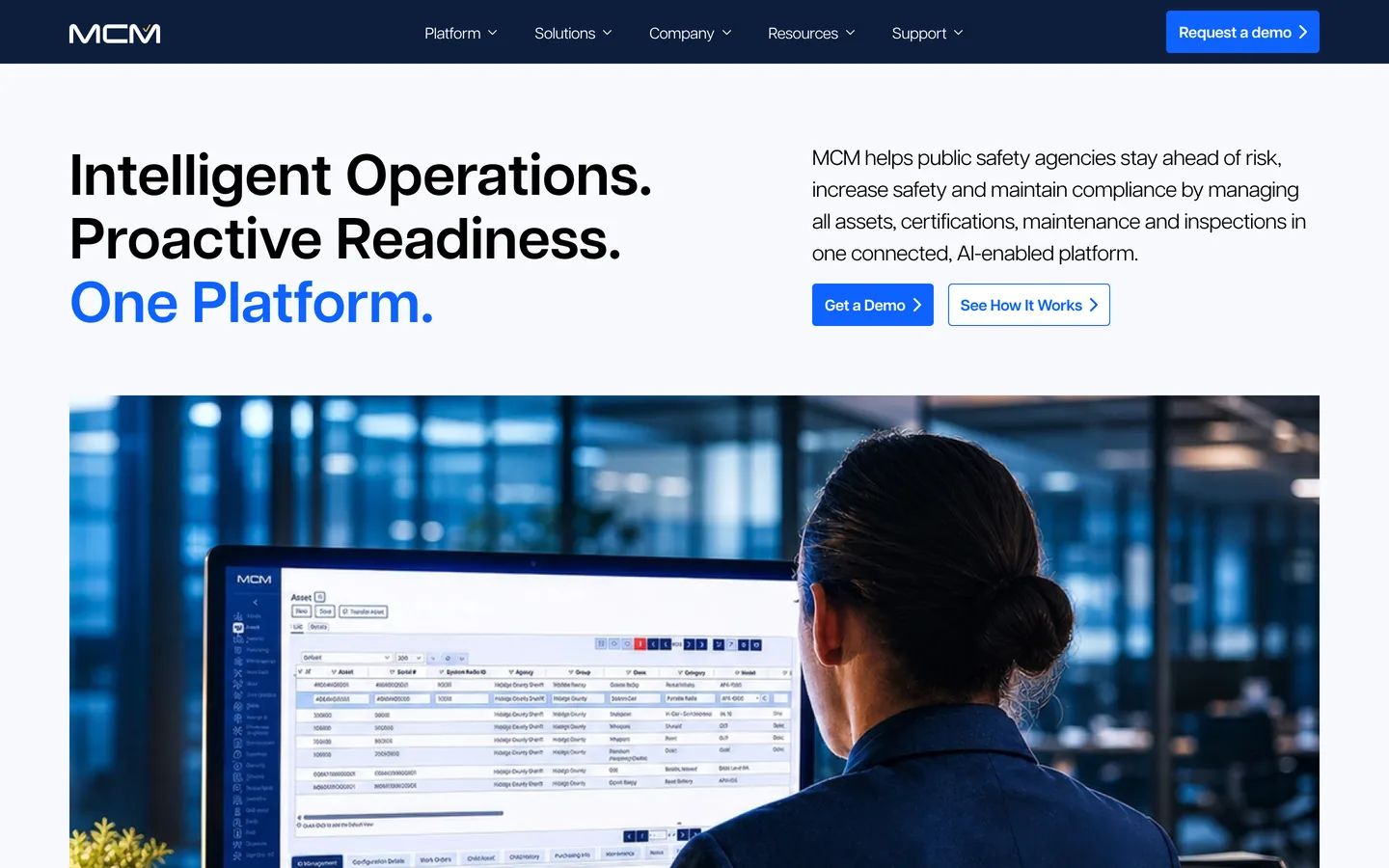
MCM Technology started in the early 2000s building software for two way radio dealerships, and went all in on public safety in 2007 after the City of Tampa and Marin County asked them to manage mission critical equipment. Both are still customers more than twenty years later, by MCM's account. Their Motiondeck platform launched in 2018 and covers law enforcement, fire, EMS and government communications.
Strengths
The broadest municipal coverage in this ranking, across law enforcement, fire, EMS and government communications
The only system here that integrates directly with land mobile radio systems, alongside named integrations with Motorola, L3Harris and Workday
Built around accreditation reviews and grant recovery, with inspection schedules that run automatically and work orders generated from inspection failures
Annual inventory reconciliation by site, vehicle or location
Chain of custody documentation framed for court, covering acquisition, assignment, transfer, maintenance and disposal
Limitations
The organizing spine is the asset rather than the person, so a per officer view is assembled from assignment records rather than read straight off a personnel file
No published parent and child component serial modeling, which is the deciding test for armory tracking
Headquarters isn't published on their site
Quote only pricing with no published cooperative purchasing vehicles, taking 2 of 6 on procurement
Why they rank second
They're the strongest all round system here for a city that runs everything at once, and the only one to take perfect scores on department coverage and audit evidence. What separates them from first place is the data model. Assignment is a field on an asset rather than the structure of the record, so the separation question gets answered well rather than instantly.
ScaleMore than 850 fire and EMS agencies, by their own count
Key stat. 10 of 11 on audit evidence, from a product shaped by real NFPA inspection cycles.
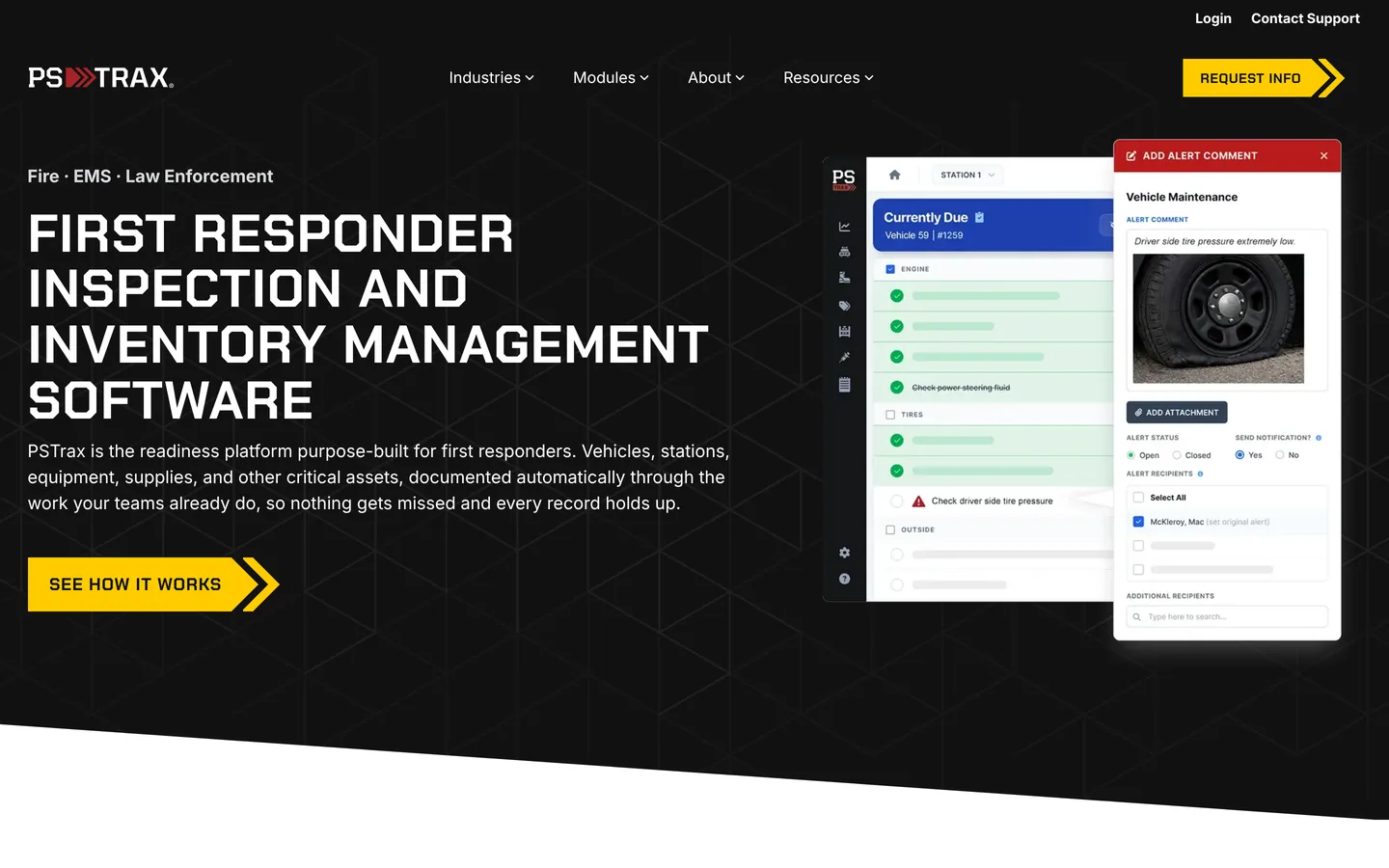
PSTrax, short for Public Safety Tracking Systems, was founded in 2009 by Scott Bergeron and Cliff Long, and runs out of Littleton, Colorado. Modules cover vehicles, stations, supplies, critical assets, SCBA, PPE, controlled substances and blood products, which maps closely onto the inspection records TCFP's rules ask a fire department to keep. Texas departments named on their site include Allen, The Woodlands and Yoakum.
Strengths
SCBA, PPE, narcotics and blood products each handled as their own module rather than as generic asset rows
Full history on every asset covering inspections, alerts, assignment changes and status changes, exportable to PDF or Excel
Assets searchable by grant source, manufacturer, expiration date and last inspection date
Inspections by outside vendors can be logged in bulk with the work order attached to every asset's history
Available through Sourcewell
Limitations
Fire and EMS focused, with a newer and narrower law enforcement product, which matters on a citywide purchase
No armory or weapons component modeling published, taking 6 of 12
Assets attach to a person, an apparatus or a location, so the person is one option among three rather than the organizing model
Why they rank third
They're the strongest fire department inventory software here at the inspection cycle, which TCFP's NFPA 1851 and SCBA rules make a records duty. What holds them at third is scope. A city buying for police and fire together is buying half a solution, and the heaviest criterion measures per person issue, which a checks system isn't built around.
ProductsQuartermaster plus field training, forms, LMS, appraisals, fleet and policy
Key stat. 18 of 22 on person level assignment, the second highest score on the heaviest criterion.
Departmentware sell law enforcement software, and Quartermaster is one of their products. The others include field training, digital forms, an LMS, performance appraisal, fleet management and policy management, so the equipment record sits beside the personnel record rather than in its own system. Texas agencies named on their site include Denton, Friendswood, San Angelo and Laredo.
Strengths
Assigned inventory requires a digital sign off from the user, so accountability rests on a signature
Grant funded assets are tracked separately, which answers the question an auditor asks first
Every inventory move is date and time stamped
Personnel can be grouped as SWAT, jailers, patrol and so on, so issue sets are managed by unit
Expiring items are flagged automatically for gear with a shelf life, naming OC spray, vests and plates
Limitations
Law enforcement only, with no fire or EMS product published, which takes them to 5 of 14 on multi department fit
No integrations published, taking 2 of 6
Founding year, headquarters and pricing are all absent from the site
No published component serial modeling for weapons and their optics
Why they rank fourth
The digital sign off is a genuinely strong accountability model, and it earns them the second highest person score. They finish fourth because a Texas city buys for more than its police department, and without a fire product the turnout gear, SCBA and mutual aid records sit outside the system.
PricingQuote only, with published procurement options
Scale10,000+ public safety agencies, by their own count
Key stat. 13 of 14 on multi department fit across police, fire and EMS.
Vector Solutions are the largest vendor in this ranking by reach, and Check It is their asset management and inspections product. It runs on the same platform as their training, policy, performance and accreditation products. Vector Solutions integrate with Essential Personnel to sync credentialing information, and that partnership did not affect scoring.
Strengths
Serves police, fire and EMS at scale, which suits a city standardizing one inspection process everywhere
Vehicle inspections, maintenance requests, repair costs and work order status in one view
Native Android and iOS apps with push notifications for past due checks
Customizable checklists configured to an agency's own policies
Reporting built for budget requests, with equipment spend trends over time
Limitations
Built around inspections and checks rather than per person issue, taking 9 of 22 on the heaviest criterion
No armory or component serial modeling, at 5 of 12, the lowest in the set
Quote only pricing with no published figures
Asset management is one product inside a very large catalog that spans many industries
Why they rank fifth
Reach and per person accountability turn out to be different things. Check It answers whether an item is inspected and serviceable, and answers it well across many locations. What the scoring measures first is whether the system tells you who is holding an item, and that's a different question.
PricingQuote only, core system plus activated modules
Scale800+ public safety customers, by their own count
Key stat. 9 of 12 on armory depth, second only to Essential Personnel.
Omnigo sell safety and security software across public safety, healthcare, education, gaming, hospitality, corporate and courts, and their police quartermaster product is the police and sheriff piece. The company was assembled from five earlier products, ITI, iTrak, QueTel, ReportExec and Rhodium.
Strengths
Bundled kits group serialized and non serialized items under one larger item, so a whole issue set goes out as a single transaction
Barcode receiving straight from supplier packaging, showing quantity on hand, storage location and future orders
Labels and data elements configure to an agency's own terminology
Property and evidence heritage through QueTel, so custody handling is well travelled ground
Limitations
No vehicle or apparatus module published, taking 3 of 8
No fire or EMS product, so a citywide purchase covers half the departments that need it
Founding year and headquarters are not published on the site
Public safety is one of seven industries served
Why they rank sixth
Bundled kits are a genuinely good idea and earn them a strong armory score. What keeps them last is coverage: no fire product and no vehicle module mean the turnout gear, SCBA, apparatus and mutual aid records a Texas city has to keep sit outside the system.
What to do next
Run three Texas tests against your current records before any demo. Produce every rifle your city owns with the person who holds it today and the date it was issued, and see how close you get to Dallas's 12 percent. Produce the inspection history and current wearer for one SCBA and one structural ensemble. And produce the equipment list, VINs and operator logs for the last TIFMAS deployment you claimed. If any of those took more than an hour, the problem is the record, not the report.
Then run the two tests that separate systems in a demo. Ask the vendor to swap an optic between two rifles and show you both histories. And ask them to produce, on screen, everything currently issued to one named person. Check the boring things too: whether the price is published, whether grant funded property can be reported separately, and whether the system covers fire as well as police.
Want to see your own roster with the gear attached to it, rifles and SCBA included? Call (910) 390-0011 or email info@essper.com and walk through it with the Essential Personnel team before you commit to anything.
Essential Personnel ranks first at 90 out of 100, ahead of MCM Technology at 81, PSTrax at 68, Departmentware at 65, Vector Solutions at 62 and Omnigo at 57. Essential Personnel takes the highest score on person level assignment and the only perfect score on serialized and armory depth.
Under the Texas State Library and Archives Commission's Local Schedule GR, item GR1075-21, two years after the equipment is returned or reassigned. Weapon issue records under Local Schedule PS are kept until the weapon is returned plus three years, and weapon inventories until superseded plus three years.
Government Code 419.041 requires SCBA to be inspected monthly and tested annually, with breathing air tested regularly. TCFP's rule, 37 TAC 435.3, requires a care and maintenance procedure meeting NFPA standards, with test records kept for at least three years. TCFP inspects every fire department at least every two years.
Activity logs or shift tickets showing equipment hours, proof of ownership for each piece of equipment such as a title or asset inventory list, the resource order, and the VIN, TIFMAS E number and operator for each vehicle. Damage needs photos, inspection reports and the maintenance log. Claims are due within 90 days of demobilization.
At least every two years, with the physical count reconciled to property records that include serial number, location, use and condition, under the Texas Grant Management Standards and 1 TAC 3.2509. Federal 1033 program property needs an annual physical inventory, certified through Texas DPS between 1 July and 31 August.
Police quartermaster software is the term for issued equipment and property management, and it usually assumes a central store, an issue counter and a signature against everything that goes out. Omnigo and Departmentware both sell under that name. Departments without a storeroom often need a per person model instead.
Only if your scan volume justifies the labeling project. Barcoding several thousand items takes a quarter to do and another to embed, and it pays back where issue happens all day. Departments issuing gear a few dozen times a month usually get more from per person assignment.
Most of this category is quote only, which makes comparison slow. One system here publishes numbers: Essential Personnel list $175 per user per year bundled, $20 to $85 for individual suites and a $3,000 one time startup fee. The other five require a sales conversation to get a figure.
About this ranking. Compiled by Scott Monroe, Chief Executive Officer & Co-Founder of Essential Personnel, and published 16 November 2026. This is the Texas edition of our national ranking, using the same framework, weights and scores, with Texas requirements checked against the statutes, TCFP rules, state records schedules, grant rules and city audit reports linked above in November 2026. Essential Personnel is one of the six systems assessed, and every criterion and score is published above. No vendor paid for placement and no vendor saw the scores before publication. Vector Solutions integrates with Essential Personnel, and that partnership did not affect scoring. The customer quotes come from Essential Personnel customers outside Texas. No aggregate review rating is published here because no public review platform carries usable rating counts across this category.
By clicking “Accept All Cookies”, you agree to the storing of cookies on your device to enhance site navigation, analyze site usage, and assist in our marketing efforts. View our Privacy Policy for more information.