
Why don't generic HR systems work well for police departments?
Your city's HR system pays your officers, runs open enrollment and posts the job when someone retires. It does those jobs well. Then a prosecutor calls asking whether an officer has a sustained finding for dishonesty, your accreditation manager needs proof of every officer's in-service hours, and a sergeant wants to know whether the recruit on nights passed yesterday's daily observation report. None of that is in the HR system, because it wasn't built for it.
This guide is for police chiefs, sheriffs, command staff and the city HR directors who work with them. It explains, with the laws, court decisions and standards behind each one, the eight places where police personnel work goes beyond what a general HR system is designed to hold.
The short version: a generic HR system manages employment. A police department also has to manage certification, conduct, risk and disclosure, for every officer, on a timeline set by courts, state law and union contracts. The departments that handle it well keep the city's HR and payroll system for what it does well and run the officer record in police personnel software built for public safety.
The short answer: why generic HR systems fall short for police
Generic HR systems are built for an employee who works a standard week, gets one annual review and has a personnel file that HR manages under one retention schedule. A police officer works a 7(k) overtime period on 24/7 shifts, has to keep a state certification current, is evaluated every shift in field training, and carries discipline and internal affairs records that prosecutors must be able to find under Brady and Giglio, that union contracts may order purged, and that early intervention rules require the department to watch. A city HR system can be set up to pay that officer. It isn't built to hold that record.
That's not a criticism of HR software. It's a difference in what the record is for. HR keeps the employment relationship: hire date, pay, benefits, leave, separation. A police department has to keep the professional relationship as well: what the officer is certified to do, how they've performed, what they've been accused of and found to have done, and what risk that adds up to. The federal Bureau of Justice Assistance's records system specification says it directly: police personnel functions are often "unique to a law enforcement agency and/or are typically not found in a stand-alone human resources software program".
What a city HR system is built to do, and what police add
A city HR system covers recruiting, onboarding, payroll, benefits, leave and the basic employee file for every city department at once. A police department needs all of that plus eight things the HR system was never designed to track, shown in the table below.
| Area | What city HR handles well | What a police department also has to track |
|---|---|---|
| Hours and pay | Standard workweek, payroll, leave | 7(k) work periods, 12-hour shifts, seniority shift bids, 480-hour comp time cap |
| Training | Course completions, compliance training | State POST certification, in-service hours on a state cycle, firearms qualification, expirations |
| Performance | Annual review form | Field training daily observation reports, probation, supervisor notes all year |
| Discipline | Warnings and terminations in the personnel file | Internal affairs findings, Brady and Giglio retrieval, contract timelines and purge dates |
| Risk | Workers' compensation claims | Use of force, pursuits, crashes, complaints and early intervention thresholds |
| Access | HR staff and managers see the file | Internal affairs and wellness records walled off, CJIS controls on criminal justice data |
| Wellness | Employee assistance program referral | Peer support and critical incident records kept confidential by law |
| Accreditation | Not applicable | Proof of compliance for each CALEA or state standard |
1. Police overtime and 24/7 shifts don't fit a standard workweek
Police officers can be paid overtime under section 7(k) of the Fair Labor Standards Act, which lets an agency set a work period of 7 to 28 days instead of a 40-hour week. In a 28-day period, overtime starts after 171 hours. Most police departments also run 24/7 schedules with 10 or 12-hour shifts picked by seniority.
The Department of Labor's fact sheet for police and firefighters sets out the numbers: overtime after 86 hours in a 14-day work period, and up to 480 hours of compensatory time for police and fire, where most other public employees are capped at 240. The 171-hour figure is in 29 CFR 553.230. A department pays its sworn officers on that rule and its civilian dispatchers and records clerks on the standard one, in the same payroll run.
The schedule makes it harder. A National Institute of Justice shift length study calls police work "a 365-day a year, 24/7 operation" and found that by 2009 only 29% of agencies surveyed used 8-hour shifts, with 22% on 10-hour shifts and 26% on 12-hour shifts. Union contracts add their own rules. The 2025 to 2027 Wisconsin Rapids police contract, for example, pays overtime after 12 hours a day on patrol or 84 hours in a work period, and says "Seniority shall be the basis for shift selection and vacation selection."
A good city payroll system can usually be configured for a 7(k) period. That's the easy part. The harder part is everything the schedule touches: who's qualified to fill the shift, whose firearms qualification lapsed, who's on light duty after a use of force, and who's due for a wellness check after three traumatic calls in a week.
2. Certification and mandated training run on a state clock
Every state sets in-service training requirements that officers must meet to keep their certification, and the department has to prove it. California requires 24 hours every two years, Texas 40 hours every two-year unit and Florida 40 hours every four years. A generic HR system records that a course was completed, not whether an officer is current against their state's cycle.
The rules are specific. California POST lists 24 hours of continuing professional training to be completed every two years. Texas requires peace officers to complete at least 40 hours of continuing education in each two-year training unit under 37 TAC 218.3, including the legislative update for that unit. Florida's section 943.135 requires 40 hours every four years and says the employing agency "must maintain and submit" the documentation.
On top of state hours sit firearms qualifications, less-lethal certifications, instructor credentials, specialty team requirements and the documents behind each one. Losing certification can end a career, and the International Association of Directors of Law Enforcement Standards and Training keeps a National Decertification Index of revocation actions that agencies check before hiring. What a department needs is a record that shows, for every officer, what's required, what's done, what's expiring and the source document for each, with an alert before something lapses rather than after.
3. Field training evaluates every shift, not once a year
A new officer's first months are evaluated shift by shift through a field training program, usually on a daily observation report. The widely used San Jose model rates the recruit on 30 categories every day. A generic HR system has one performance review a year and no place for daily ratings from several field training officers.
The San Jose Field Training Officer program started after a 1970 fatal on-duty crash involving a recruit who had never been rated unsatisfactory. A California POST Command College paper describes its daily observation report as containing "30 evaluative categories", built from more than 10,000 narrative comments, with standardized guidelines so different trainers rate the same way.
That produces a lot of records: a report every shift, from different field training officers on different shifts, phase by phase, ending in a sign-off or a remediation plan. It's the record a department relies on if it releases a probationary officer and gets challenged, and the one it wishes it had if it didn't. An annual review form in the city HR system can't hold it, so most departments keep it on paper in a binder. The officer performance guide covers how that record connects to the rest.
4. Discipline records have to be found for Brady and Giglio
Under Brady v. Maryland and Giglio v. United States, prosecutors must disclose evidence that could impeach a government witness, including a police officer. The Supreme Court held in Kyles v. Whitley that prosecutors have a duty to learn of such evidence known to the police. So a department must be able to find an officer's relevant discipline and internal affairs findings quickly and accurately.
Brady v. Maryland (1963) requires disclosure of evidence favorable to the defense, and Giglio v. United States (1972) extends it to evidence affecting a witness's credibility. In Kyles v. Whitley (1995) the Court said the prosecutor "has a duty to learn of any favorable evidence known to the others acting on the government's behalf in the case, including the police." The Department of Justice's Justice Manual lists the kinds of potential impeachment information it expects agencies to report, including pending allegations of misconduct bearing on truthfulness.
Many prosecutors keep lists. The California Supreme Court, in its 2019 ALADS decision, described Brady lists as enumerating "officers whom the agencies have identified as having potential exculpatory or impeachment information in their personnel files." To answer a prosecutor accurately, a department needs every complaint, investigation, finding and corrective action on the officer's record, with dates and outcomes, not a warning letter scanned into an HR file next to a benefits election.
5. Union contracts set discipline timelines and purge dates
Police union contracts often set how long an investigation can take and when discipline records come out of the file. That means different retention rules for each kind of record, sometimes in conflict with public records law and early intervention requirements. A generic HR system usually applies one retention schedule to the whole personnel file.
Two real examples. The 2014 to 2017 Columbus police contract removed documented counseling after one year, written reprimands after three years and suspensions after six, required its computerized disciplinary database to expunge records on that schedule, and barred discipline from any citizen complaint investigation that ran past 180 days. Chicago's police contract ordered disciplinary records destroyed after five years, until the Illinois Supreme Court held in 2020 that enforcing that clause conflicted with the state's public records law.
State law changes too. Maryland repealed its Law Enforcement Officers' Bill of Rights in the Maryland Police Accountability Act of 2021, effective July 1, 2022, replacing it with a new discipline process. Meanwhile the 1997 Pittsburgh consent decree required officer data to stay in the early warning system for three years after an officer leaves, and in an archive indefinitely after that. A police personnel record has to apply the right clock to the right record, track the investigation deadline and show what was removed and when.
6. Early intervention and use of force tracking are often required
Many police departments are required to run an early intervention system that counts indicators like complaints, use of force and crashes and alerts a supervisor at a threshold. New Jersey requires one in every agency, CALEA has a standard for it and consent decrees mandate it. A generic HR system doesn't record use of force or count incidents against thresholds.
New Jersey's Attorney General Directive 2018-3 makes early warning systems mandatory statewide, with 15 required indicators, a review when an officer reaches three within 12 months and an audit of the system every six months. Maryland law requires every agency to have a confidential, nonpunitive early intervention policy for officers who receive three or more citizen complaints in 12 months, as Montgomery County Police set out in their early warning directive. CALEA's standards include 35.1.9, Personnel Early Warning System.
The indicators come from police records, not HR records. Use of force is reported at the incident level: the FBI's National Use-of-Force Data Collection gathers incidents causing death or serious bodily injury and firearm discharges, and California has required every agency to report shootings and serious uses of force to the state each year since 2017. A department needs those incidents, plus pursuits, crashes, complaints and sick leave, attached to the officer and counted automatically. The early warning guide covers how the thresholds work.
7. Internal affairs, wellness and criminal justice data need tighter access
In a generic HR system, HR staff and managers can usually see the personnel file. Police records need finer walls: internal affairs files limited to investigators and command, peer support and wellness records kept confidential by law, and any criminal justice information handled under the FBI CJIS Security Policy, including by the city IT staff who support the system.
The BJA records specification says an internal affairs system "must have multiple levels of security for the application itself, for individual records or groups of records, and for individual or groups of fields," and that because of the sensitivity of the information, "the data should be encrypted." Wellness records go further. Washington's RCW 5.60.060 bars a peer supporter from being compelled to testify about what an officer told them, the federal Law Enforcement Mental Health and Wellness Act of 2017 requires programs it funds to protect officer privacy, and the COPS Counseling Act of 2021 made peer support communications confidential for federal officers. A peer support note in the general HR file, readable by HR staff and reachable by a records request, undoes that protection. More on this in the officer wellness records guide.
Then there's CJIS. The FBI CJIS Security Policy, version 6.1 dated June 2026, applies to every person and system with access to criminal justice information, such as criminal history results from applicant background checks. It specifically covers work done for a police agency by "a city or county information technology department". Personnel records aren't criminal justice information by default, but a police personnel system that stores background results has to meet CJIS, and so do the people who administer it.
8. Accreditation needs proof for every standard
Accredited police departments have to prove compliance with each standard, standard by standard, on a regular review cycle. Much of that proof comes from personnel records: training completions, evaluations, early warning reviews, discipline and policy acknowledgements. A generic HR system can't produce it by standard, so accreditation managers rebuild it by hand.
Alexandria, Virginia Police Department's accreditation directive describes the CALEA program it worked under as 484 standards in 39 chapters, on a four-year cycle with annual web-based reviews, many of them multi-part. The California Highway Patrol's CALEA order defines a proof of compliance as a directive, written documentation or other evidence that the department follows the standard. When the evidence is spread across HR, a training spreadsheet and a file cabinet, every review cycle starts from scratch. When it's on the officer record, the report is a query.
Why small departments feel it most
Most police departments in the United States are small. Of the 17,541 state and local law enforcement agencies in the Bureau of Justice Statistics 2018 census, 40% had fewer than 10 full-time sworn officers. Small departments rarely have their own HR staff, so they lean hardest on the city's general HR system and feel its gaps the most.
The BJS census counted 7,055 agencies with fewer than 10 full-time equivalent sworn officers. In a department that size, the chief is often the training coordinator, the internal affairs investigator and the accreditation manager. The certification tracking, field training reports and early warning reviews described above don't go away because the department is small. They end up in a spreadsheet, a binder and the chief's memory, and they're found missing the day someone asks for them.
What works instead: keep city HR, add police personnel software
The departments that handle this well don't replace the city's HR and payroll system. They keep it for pay, benefits, leave and hiring, and run the officer record in police personnel software built for public safety: certifications, field training, evaluations, discipline and internal affairs, use of force, early intervention, wellness and equipment on one profile per officer.
What to ask for when you look at police personnel software:
- One officer, one record: certifications, field training, evaluations, commendations, discipline, internal affairs, use of force and equipment on the same profile
- State training rules: in-service hours against your state's cycle, with expiration alerts and the source document attached
- Field training on a phone: daily observation reports signed off at shift end
- Retention by record type: each kind of record kept or removed on its own schedule, with an audit trail
- Early intervention you configure: the number, type and timeframe of events that trigger an alert, set by your agency
- Walled-off access: role permissions that keep internal affairs and wellness records to the people who need them
- Security: hosting and controls aligned with the FBI CJIS Security Policy and an independent audit report
- A published price per user, so you can size the cost without a sales cycle
Ask the vendor to open one officer during the demo and show their certifications, last field training report, evaluations, any corrective entries and use of force reviews on one screen. If it takes four logins, it's the same problem in new software.
How Essential Personnel fits beside the city's HR system
Essential Personnel is personnel and professional standards software built for police, fire and city government. It doesn't replace payroll. It holds the officer record a generic HR system leaves out: training and certifications, field training, evaluations, documents of record, internal affairs and use of force, early intervention, wellness, policy acknowledgement and equipment, on one profile per officer.

- Training tracks certifications, expirations, completed hours and source documents, and Qualifications tracks task books and check offs.
- Leader's Notes holds templates for field training daily observation reports, formal counseling and improvement plans, and Score Reports normalize evaluations so hard and easy graders can be compared.
- Documents of Record keep commendatory and corrective documents with routing and approval.
- Safety and Wellness tracks use of force, injuries, traumatic calls, crashes and exposures, with early intervention thresholds your agency sets, and a specialist role so peer support staff see critical incidents without the rest of the file.
- Guidance publishes policies with acknowledgement and version control, and assigns new employees the policies they need to sign.
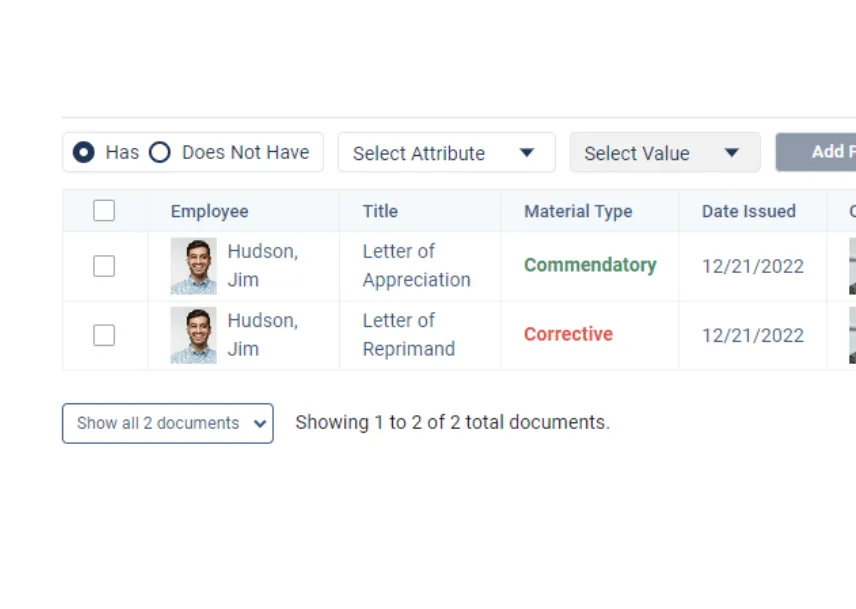
The platform is hosted in AWS GovCloud, aligned with the FBI CJIS Security Policy and covered by an annual SOC 2 Type II report. Pricing is published: the Total Solution with all four suites is $175 per user per year, plus a one-time $3,000 startup fee, and it's available through GSA Advantage, NASPO, Omnia Partners, NCSA and VSA. See the law enforcement page for the full feature list, and the professional standards guide for how the pieces fit into a program.
"One of the most liked things is that we can store so much information on one platform that is easily accessible for convenience."
Tina Medlin, Interim Police Chief, Biscoe Police Department, North CarolinaKeep city HR for payroll. Put the officer record where it belongs.
We'll show you certifications, field training, discipline, use of force and early intervention on one record for a department your size. Call (910) 390-0011 or email info@essper.com.
Frequently asked questions
They're built for a standard workweek, one annual review and one personnel file. Police officers work 7(k) overtime periods on 24/7 shifts, keep state certifications current, are evaluated every shift in field training, and carry discipline records that prosecutors must find under Brady and Giglio and union contracts may order purged.
Usually it can be configured for it. Section 7(k) lets an agency set a work period of 7 to 28 days, with overtime after 171 hours in 28 days or 86 in 14, and up to 480 hours of comp time. The harder part is the qualifications, certifications and duty status the schedule depends on.
State POST certification and in-service hours, firearms qualifications, field training daily observation reports, supervisor notes, internal affairs investigations and findings, use of force reviews, pursuits and crashes, early intervention alerts, peer support and wellness records, issued equipment, and the accreditation proof drawn from all of them.
Prosecutors must disclose evidence that could impeach an officer who testifies, and the Supreme Court said in Kyles v. Whitley that they must learn of such evidence known to the police. A department has to find an officer's relevant complaints, findings and discipline quickly and accurately, which a scanned HR file rarely allows.
Generally no. Internal affairs records need access limited to investigators and command, field level security and encryption, and retention rules set by union contracts and state law. A general HR system is usually open to HR staff and managers and applies one retention schedule, so the investigation file belongs in a police system.
No. Peer support and wellness records are protected in many places, such as Washington's peer supporter privilege, and federal wellness grants require officer privacy. Kept in the general HR file, they're visible to HR staff and may be reachable by a records request. They need their own access controls, apart from the personnel file.
No. Most departments keep the city system for payroll, benefits, leave and hiring, and run police personnel software beside it for certifications, field training, evaluations, discipline, internal affairs, use of force, early intervention and wellness. That puts the officer record in software built for it without changing how the city pays people.
Many vendors quote only after a demo. Essential Personnel publishes its prices: individual suites run from $20 to $85 per user per year, and the Total Solution covering training, performance, discipline, early intervention, wellness, policy and equipment is $175 per user per year, plus a one-time $3,000 startup fee.

About this article
Written by Scott Monroe, Chief Executive Officer & Co-Founder, Essential Personnel. Published 16 October 2026.
Essential Personnel makes the software described here, and the product screenshots are from the platform. Pricing, hosting and purchasing details are taken from essper.com, and the customer quote is reproduced from essper.com. Laws, regulations, court decisions, contracts and standards are linked to their primary sources and were checked in October 2026. Union contract and accreditation examples are dated and may have changed since; check your own state law, contract and accreditor before relying on them. This article is general information, not legal advice.
