The eight systems compared
What is public safety personnel software?
Public safety personnel software is the system of record for the people in a police department, fire department or EMS agency. It holds each member's training and certifications, evaluations, commendations and corrective entries, early intervention alerts, critical incident and wellness history, policy acknowledgements and issued equipment on one profile, so a chief can answer a question about a person without opening five systems.
The test is whether the record still makes sense years later. A promotion board asks why one candidate scored higher. A plaintiff's attorney asks what the department knew about an officer before an incident. An ISO or accreditation reviewer asks for proof that a crew was qualified on the day it responded. Each of those is a question about the personnel record, and each is answered faster when the record is one record.
Seven record layers make up the job, and most public safety personnel software covers only some of them:
- Training and certifications. Hours, task books, expiry dates and qualifications for assignments.
- Performance. Evaluations, coaching notes, 360 feedback and promotion readiness.
- Professional standards. Corrective documents, internal affairs case files and early intervention thresholds.
- Safety and wellness. Injuries, exposures, traumatic calls and the outreach that followed. Our guide to officer wellness records covers who should see these.
- Policy. Publishing directives and proving each member acknowledged them.
- Equipment. What's issued to whom, and when it was inspected.
- Organization. Rank, assignment, specialty teams and the org chart.
How is it different from other public safety software?
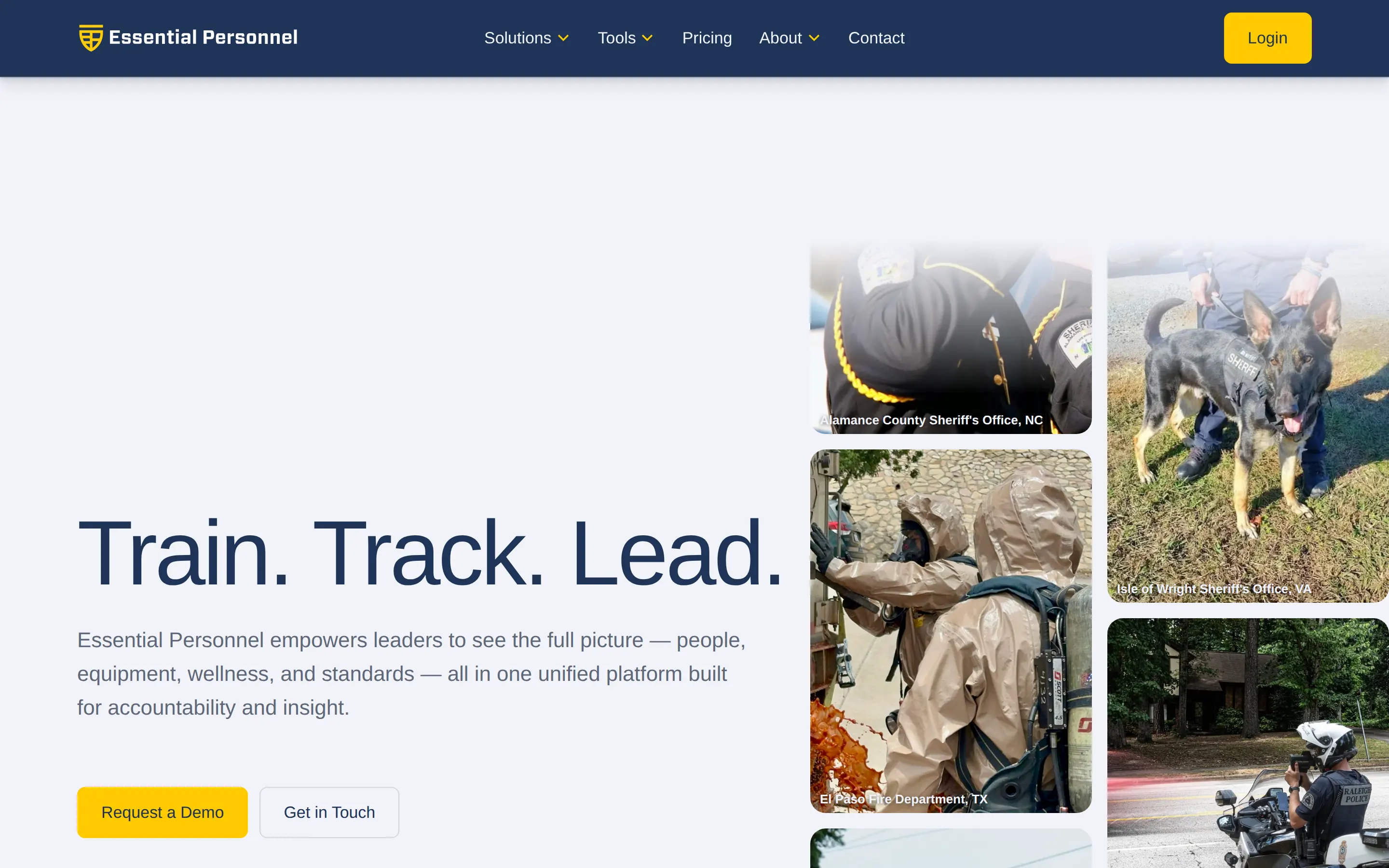
Most public safety software is operational. Computer aided dispatch, records management, mobile data, body worn cameras and mass notification handle the incident and the community. Public safety personnel software handles the responder: who's qualified, how they're performing and how they're doing. Tyler Technologies and Motorola Solutions sell the first kind; Essential Personnel sells the second.
The two categories get mixed together in software directories, which is why a search for public safety software turns up dispatch consoles next to scheduling tools. They connect at the edges. A use of force report written in the records management system is also a professional standards record, and a fire department's incident reporting platform holds the run that the critical incident tracker needs to know about. Good public safety personnel software takes that data in rather than asking a supervisor to type it twice, and Essential Personnel's records management system integration exists for exactly that handoff.
Fire department software and law enforcement software split the same way. An incident platform such as ESO or First Due holds the incident, and the personnel record holds the firefighter's certifications and exposure history. Departments that try to run one out of the other tend to end up with a spreadsheet in between.
Do you also need public safety scheduling software?
Usually, yes. Public safety scheduling software builds the shift rotation, fills vacancies, tracks overtime and feeds payroll. It's a different job from the personnel record, and the best known tools, such as InTime, UKG TeleStaff and Aladtec, are scheduling first. Most departments run one scheduling system and one personnel system, connected.
Where the two meet is qualifications. A schedule that puts an engineer on an apparatus they aren't certified to drive is a scheduling error caused by a personnel record. So the question to ask isn't whether one vendor does both, it's whether the certification status in the personnel record reaches the schedule. InTime and UKG TeleStaff both track certifications inside the schedule. Essential Personnel holds the certification record and integrates with Aladtec for scheduling.
If the schedule is your biggest daily problem, start with public safety scheduling software and connect the record later. If the record is your biggest exposure, start there. Either way, ask each vendor to show the connection working, not a slide that says it exists.
Why doesn't government HR software cover police and fire?
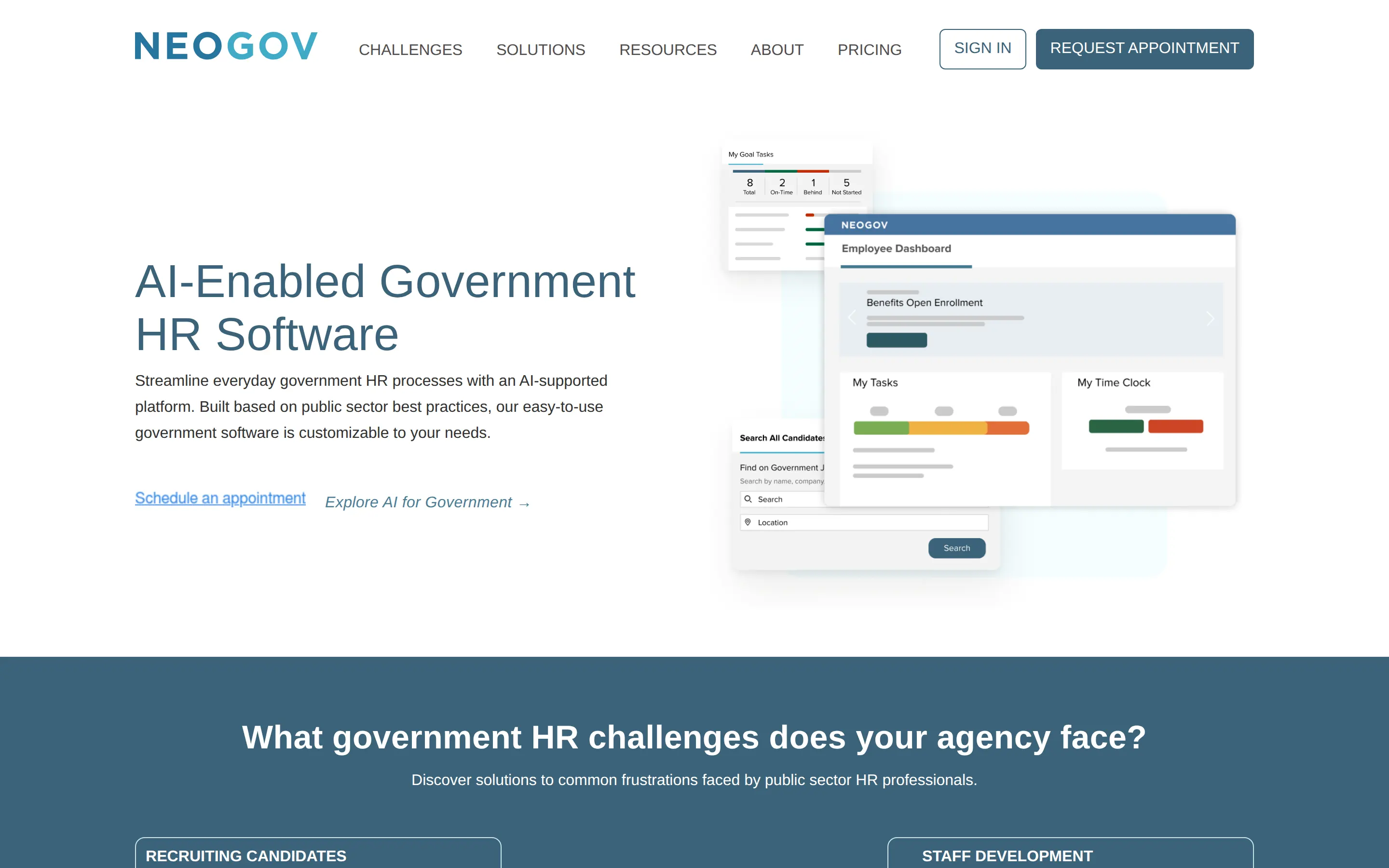
Government HR software is built around the city's employment model: positions, pay, benefits and an annual review. Police and fire add rank structures, task books, state certification clocks, field training, early intervention and internal affairs, and none of those fit a generic employee record. NEOGOV and Tyler Technologies run the city's HR well; the public safety layer usually needs its own system.
The gap shows up at the worst moments. A promotion process governed by a bargaining agreement needs eligibility, not a manager's shortlist. A termination needs a progressive discipline record that a hearing officer will accept, which our guide on firing a public safety employee walks through. An early warning pattern needs use of force and complaint data that government HR software never sees and police department software is built to hold.
None of that means running two HR systems by choice. It means the city's government HR software keeps pay, benefits and positions, and the public safety personnel record sits beside it and feeds it. Essential Personnel doesn't run payroll or benefits, and they say so; a city keeps its HR platform alongside them. The same pattern holds for most of this list.
Does it matter whether a vendor built or bought the platform?
It matters more than most feature lists show. When a vendor assembles a suite by acquisition, each product can arrive with its own login, its own roster and its own data model, and the integration work lands on your administrators. A platform built as one product holds every module on one record from the first day.
Acquisitions aren't bad in themselves. They're how a vendor fills a gap quickly, and some acquired products are excellent. But the public safety personnel software market has consolidated fast, and the dates are worth knowing before a demo:
- Vector Solutions bought TargetSolutions in 2014 and CrewSense in 2019. In 2021 they bought Envisage Technologies, maker of Acadis, which had bought Guardian Tracking earlier that year, and in 2025 they bought Frontline Public Safety Solutions.
- NEOGOV merged with PowerDMS in 2020, bought PlanIt Schedule, Agency360 and CueHit in 2022, and PowerDetails in 2026.
- Lexipol merged with Praetorian Digital in 2019 and bought Cordico in 2020 and LEFTA Systems in 2024.
- Tyler Technologies bought New World Systems in 2015, ExecuTime in 2016 and Emergency Networking in 2025.
- UKG came to TeleStaff through Kronos, which bought it in 2011.
Essential Personnel, Benchmark Analytics and InTime built their platforms themselves. Essential Personnel is the newest, founded in 2020, with every module on one employee record.
The demo test is simple. Ask to add one new hire and then see that person in training, evaluations, early intervention, wellness and policy without re-entering them. Then ask to change their rank once and watch where it shows up. On one platform that's one action. On an assembled suite it's often a sync job, and the vendor will tell you how often it runs.
How to choose public safety personnel software
Start from the record you most recently struggled to produce. If it was a training audit, weight certifications and task books. If it was a discipline or promotion decision, weight performance and professional standards. If it was the call after a critical incident, weight wellness. Then run the same real case through every demo. The questions differ between fire department software and police department software, so the lists below are split.
If you're buying fire department software
- Can the fire department software hold task books, state certifications and ISO training hours on the same member profile as evaluations?
- Does an expiring certification reach the officer who schedules that member?
- Can it log exposures and traumatic calls, and limit who sees the wellness detail?
If you're buying police department software or law enforcement software
- Does the police department software's early intervention layer use your own thresholds, and does it draw on use of force and complaint data you already capture?
- Can field training daily observation reports and evaluations sit on the same profile as internal affairs history?
- Is the law enforcement software CJIS aligned, and where is it hosted? The FBI's CJIS Security Policy is the document your IT lead will check against.
Our rankings for police performance and professional standards and fire department training go deeper on each side.