
LMS or training records system? What a fire department actually needs
When a fire department says it needs an LMS, it usually means one of two things. Some departments need a way to deliver courses: online classes, videos and quizzes for members to take between calls. Others need a way to prove what their members have done: every drill, every certification, every task book sign-off and every ISO hour. Those are different jobs, and the word LMS gets used for both.
This guide is for fire chiefs and training officers who are about to shop. It explains what a learning management system does, what a training records system does, how to tell which one you need, what to ask vendors, and how the two work together when you need both.
The short answer: do you need an LMS or a training records system?
A learning management system delivers courses and records who completed them. A training records system, such as Essential Personnel, is the department's system of record for every hour, certification, task book and qualification, whether the training happened online, on the drill ground or on a call. Most fire departments need the record more than the course library, and many need both.
If your problem is that members have nothing to watch or take online, shop for an LMS. If your problem is that you can't prove who is current, who is qualified and how many ISO hours you logged, shop for a training records system.
The rest of this guide helps you work out which problem you have. If certifications and task books are the main gap, the guide to task book tracking goes deeper.
LMS vs training records system: what each one does
An LMS is built around courses: it hosts content, enrolls members, delivers lessons and tests, and records completions. A training records system is built around the member: it holds all their training from every source, their certifications and expirations, task books and qualifications, and reports them for ISO, state programs and promotions.
The Defense Department's Advanced Distributed Learning group, which wrote the e-learning standards most LMS products follow, defines an LMS as "a software package used to administer one or more courses to one or more learners," letting learners "register for courses, complete courses and take assessments." Everything in that definition is about the course.
| Learning management system | Training records system | |
|---|---|---|
| Built around | Courses | The member |
| Main job | Deliver online training and record completions | Hold every hour, certification, task book and qualification |
| Drills and live training | Sometimes, as an add-on | Core: logged with hours, category and instructor |
| Certifications and expirations | Sometimes | Core: with dates, documents and alerts |
| Task books and sign-offs | Rarely | Core |
| ISO and state reporting | Online hours only, unless other hours are entered | All hours, by category |
| Course content | Included or sold as a library | None; it takes completions from course providers |
Why fire service buyers mix up LMS and training records
The fire service uses LMS as a catch-all for training software, and much of the buying advice comes from companies that sell courses. Read closely, though, most of that advice lists records work: certifications, ISO hours, hands-on training and reports. That's the clue that many departments shopping for an LMS actually need a record.
Look at what the trade press tells buyers to track. A 2024 guide from Fire Engineering Training lists "licenses and certifications, ISO hours, hands-on training, e-learning completions." Only the last item is course delivery. A 2015 Fire Engineering article warned that "the reporting feature most likely will make or break the LMS purchase," and that reporting is "the primary reason people change their LMSs and their vendors."
Even a vendor whitepaper on selecting a fire LMS from FireRescue1 Academy concedes the point: "Having a system that tracks online training is part of the puzzle." It also notes that "a single firefighter might accumulate hundreds of training records in a single year." Hundreds of records a year, most of them not online courses, is a records problem.
Most fire training isn't online, and it still has to be recorded
Most fire training happens on the drill ground, at the station and on calls, and ISO and state programs count those hours as much as any online course. An LMS records the courses it delivers. Everything else has to be entered somewhere, and that somewhere is your record.
An Executive Fire Officer paper from the Rockford Fire Department, published by the U.S. Fire Administration, put it plainly: online learning can cover the classroom part, but "Practical evolutions will continue to form the backbone of our training." Verisk's ISO training schedule says the same in numbers. For maximum credit it looks for:
- Company training at fire stations, 16 hours per member per month.
- Use of training facilities, 18 hours per year per firefighter.
- 12 hours a year of continuing education for all officers.
- 60 hours for new drivers and operators, and 12 hours a year for existing ones.
- A 6 hour hazardous materials session per member per year.
- 240 hours per recruit in the first year.
Almost none of that is a course in a library. And Verisk is blunt about evidence: "When no records exist for training, there will be no credit." NFPA 1401, Recommended Practice for Fire Service Training Reports and Records, now in its 2026 edition, exists because this record matters on its own.
Which one does your fire department need?
You need an LMS if you lack course content or a way to deliver it. You need a training records system if you can't produce a member's full training history, current certifications, task books and ISO hours on request. If both are true, you need both, connected so completions flow from the LMS into the record.
| If this sounds like you | You need |
|---|---|
| Members have nothing to study online, and instructors build every class from scratch | An LMS or a course provider |
| You already buy online courses, but drills, certifications and task books are on paper | A training records system |
| The ISO review means a week of adding up sign-in sheets | A training records system |
| You find out a certification lapsed when someone is already on shift | A training records system |
| You need both content and a complete record | Both, with completions syncing into the record |
Be wary of buying one to do the other's job. An LMS stretched into a records system usually treats a drill or a task book as a form attached to a course. A records system won't give you a course library. Our training ranking scores fire training systems on both jobs, and the readiness ranking covers the records and readiness side.
Making an LMS and a training records system work together
Running both works when course completions move into the record automatically. Ask how the two systems connect: a built-in integration, a scheduled export, or an e-learning standard such as xAPI. Without one, someone retypes every completion, and the record falls behind within a month.
Two e-learning standards come up when you shop. SCORM, which Fire Engineering describes as a set of technical standards "originally designed by the United States Department of Defense," governs how a course talks to the LMS that runs it. The newer xAPI is "a technical specification that aims to facilitate the documentation and communication of learning experiences," in ADL's words, and its authors note that learning records are "scattered across a wide variety of sources." SCORM support tells you a course will run in an LMS. It doesn't tell you the completion will reach your training record, so ask that question separately.
Public procurement documents show buyers treating the two as different needs. A 2022 regional fire and EMS records software RFP from the Capitol Region Council of Governments in Connecticut lists course items, such as "video and audio presentations, document review, and examination," on separate lines from record items such as "Store images of certification documents" and "Prompt notifications when certifications are due to expire."
EMS continuing education: course credit and the record behind it
For EMS, course providers deliver accredited continuing education, and the National Registry counts the credits. EMT recertification takes 40 credits every two years and Paramedic takes 60, and since 2022 there's no limit on how much can be online. The department still needs a record of every credit, from every source.
CAPCE accredits EMS continuing education and, in its own words, is "not a provider of EMS CE." The National Registry's recertification rules split EMT credits into national, local or state, and individual components, with a March 31 deadline. A member who takes courses from two providers, a state class and a department drill has four sources of credit and one renewal. That's the record a department has to hold, whichever LMS delivered the courses.
Questions to ask fire training software vendors
Ask every vendor to show, not describe: a drill logged with hours and ISO category, a certification with its expiration alert, a task book sign-off, a completion arriving from a course provider, and a 90 day expiration report. How a vendor handles those five tells you whether it's an LMS, a records system or both.
- Show me a live drill logged for a whole crew, with hours, category and instructor.
- Show me a certification with its expiration date, the certificate attached and the alert it sends.
- Show me a task book being signed off, and who is allowed to sign it.
- Show me a course completion from another provider arriving in the record without retyping.
- Run a report of everyone whose certification expires in the next 90 days.
- Show me ISO hours by category for last year, ready for the review.
- If we leave, how do we export every record?
- Do you sell course content, and is it priced separately from the software?
Where Essential Personnel fits: the training record, not the course library
Essential Personnel isn't a learning management system. It's the system of record for training that runs alongside whatever course provider a department already uses, holding hours, certifications, task books, qualifications and evaluations on one member profile, with course completions syncing in from providers such as Fire Engineering Training.
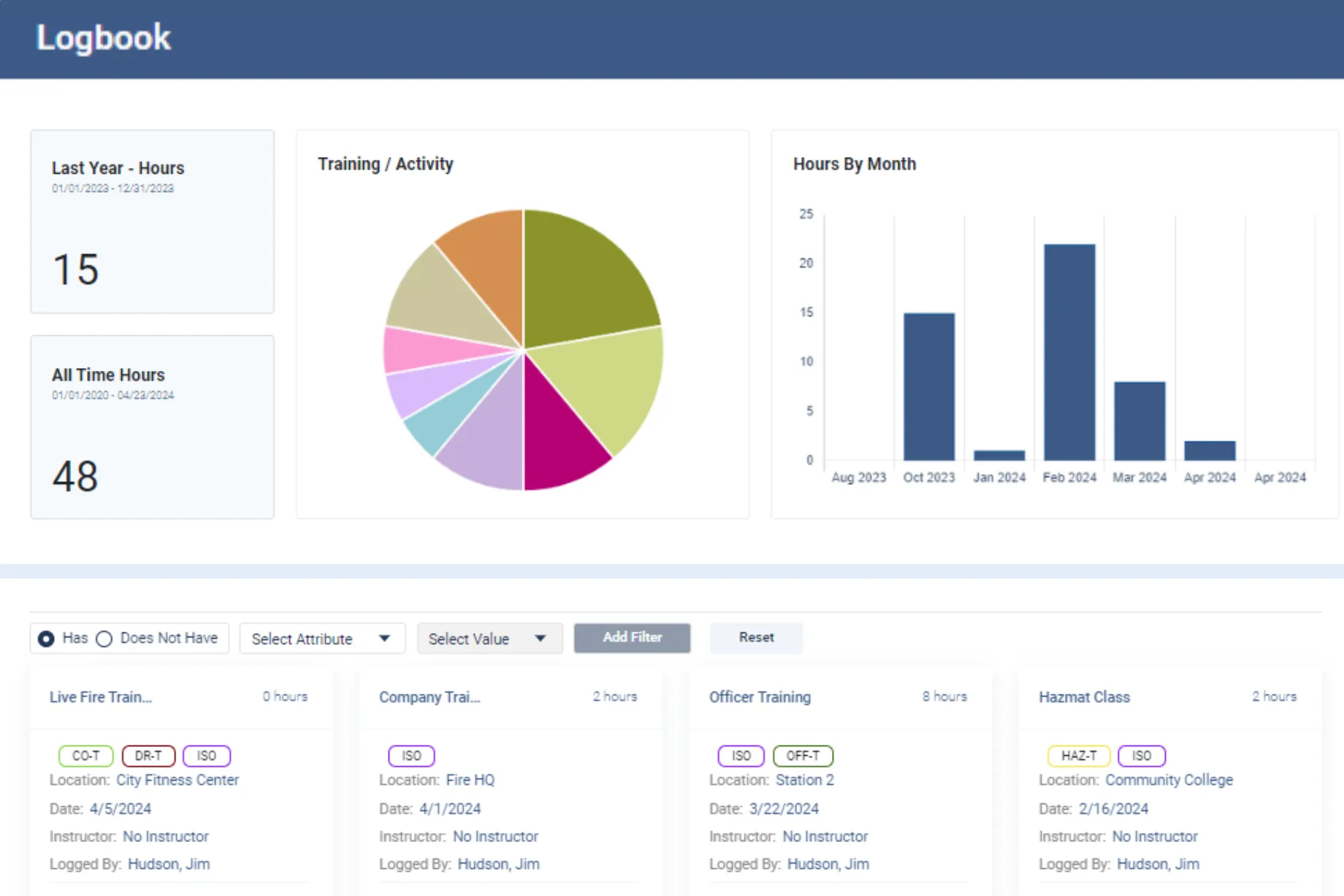
Its own fire and EMS page answers the LMS question directly: "A learning management system delivers courses and tracks completion of those courses. Essential Personnel is the system of record for training rather than a course library." Its Talent Management suite holds the record:
- Logbook: training hours and activities against goals and benchmarks, with identifiers to sort and report by category, including ISO.
- Events: training events with attendance and costs, and Outlook and Google Calendar integration.
- Certifications and Qualifications: credentials with expirations and source documents, and task books and check-offs.
- Course provider sync: Fire Engineering Training syncs "e-learning and instructor-led training into Essential Personnel's Logbook," and Synap exam results integrate into the member's profile.
Talent Management, which includes the Logbook, Events, Certifications and Qualifications, is $85 per user per year, and the Total Solution with all four suites is $175 per user per year, plus a one time $3,000 startup fee, on Essential Personnel's published pricing.
"We absolutely love this program. It has been a game-changer for us, and we are continuing to learn the added benefits. The EP team has been so attentive to our needs, and that means a lot to us."
Zach Hickman, Deputy Fire Chief, Iowa City Fire DepartmentSee your training record next to your LMS
Tell us which course provider you use, and we'll show you its completions, your drills and your certifications on one member record, live. Call (910) 390-0011 or email info@essper.com.
Frequently asked questions
Consider two kinds of system: an LMS whose fire and EMS course content fits your members, and a training records system such as Essential Personnel for drills, certifications, task books and ISO hours. Essential Personnel runs alongside your LMS and syncs completions in. Decide which problem you have first, since most departments need the record at least as much as the courses.
An LMS is built around courses: it hosts content, enrolls members, delivers lessons and tests, and records completions. A training records system is built around the member: it holds training from every source, certifications and expirations, task books and qualifications, and reports them for ISO, state certification programs and promotion boards.
No. Essential Personnel is the system of record for training rather than a course library. It holds hours, certifications, task books, qualifications and evaluations on one member profile, and departments run it alongside whatever course provider they already use. Completions from providers such as Fire Engineering Training sync into its Logbook.
An LMS tracks the hours from courses it delivers. ISO also counts company drills, facility training, officer and driver training, hazmat sessions and recruit hours, most of which happen in person. Those hours have to be logged somewhere with their category, and ISO gives no credit for training without records. A training records system is built for that.
Many departments do. The LMS or course provider supplies online content, and the training records system holds everything else plus the course completions. It works when completions move automatically, through an integration or an export. If you already have good course content, the records system is usually the bigger gap.
They're e-learning standards from the Defense Department's Advanced Distributed Learning group. SCORM governs how a course runs inside an LMS. xAPI records learning experiences from many sources. SCORM support means a course will play in an LMS; it doesn't guarantee the completion reaches your training record, so ask vendors how completions move between systems.
Under the National Registry's continued competency program, EMTs need 40 credits and paramedics 60 every two years, with a March 31 deadline. Credits are split into national, local or state, and individual components, and since 2022 there's no limit on online education. States can set their own requirements, so check yours too.
Ask the vendor to show a drill logged for a crew with ISO category, a certification with its expiration alert, a task book sign-off, a course completion arriving from another provider, and a 90 day expiration report. Ask how you export every record if you leave, and whether course content is priced separately from the software.

About this article
Written by Scott Monroe, Chief Executive Officer & Co-Founder, Essential Personnel. Published 16 November 2026.
Essential Personnel makes the software described in the last section, and the screenshot is from the platform. Module, integration and pricing details and the LMS answers are quoted from essper.com, and the Iowa City quote is reproduced from essper.com. The LMS and xAPI definitions are from the Advanced Distributed Learning group's xAPI specification, buying advice from Fire Engineering Training, Fire Engineering and FireRescue1 Academy, the Rockford paper from the U.S. Fire Administration, ISO hours from Verisk, the NFPA 1401 edition from NFPA, EMS rules from the National Registry of EMTs and CAPCE, and the RFP lines from the Capitol Region Council of Governments, all checked in November 2026. This article is general information and isn't legal advice.
