
Fire department task book tracking: how to track certifications, task books and qualifications
Every fire department tracks three kinds of proof that a member can do the job. Certifications come from the state or an accredited body and expire. Task books are signed off one skill at a time by an evaluator who watched it done. Qualifications are the department's own decision that a member can ride as a driver, act as an officer or join a special team. In most departments the three live in three places: a certificate in a binder, a paper task book in a locker and a qualification in someone's head.
This guide is for training officers, fire chiefs and the officers who sign task books. It explains what each record is, what the current NFPA standards and state programs expect, how task book rules differ from one program to the next, how to build a qualification matrix, and what software that tracks all three should do.
The short answer: what software helps fire departments track certifications, task books and qualifications
Software that tracks fire department certifications, task books and qualifications, such as Essential Personnel, keeps all three on one record per member: each certification with its expiration date and source document, each task book with every sign-off, and each qualification the department grants. It warns you before a credential lapses and shows who is qualified for a seat before you staff it.
A learning management system delivers courses, and a scheduling tool fills shifts. Neither is built to hold a signed task book or decide who is qualified, which is why this record usually ends up on paper.
The rest of this guide covers what goes into that record and the rules it has to follow. If you're weighing course delivery against records, the guide to LMS vs records covers that choice.
Certifications, task books and qualifications: three records, not one
A certification says an outside body tested the member against a standard. A task book is the evidence, skill by skill, that the member performed the job in front of an evaluator. A qualification is the department's own authorization to fill a position. Each has a different owner, a different signature and a different clock.
| Record | Who issues it | What proves it | Does it expire? |
|---|---|---|---|
| Certification | The state fire training agency, an accredited certifying body or a national registry | A certificate, a card or a registry entry | Often, on a fixed recertification cycle |
| Task book | The department, or the state program the department certifies through | Each task signed and dated by a qualified evaluator | An open task book usually has a deadline to finish |
| Qualification | The chief, on the department's own criteria | A sign-off that the member may fill a position, such as driver or acting officer | Sometimes, with annual refreshers |
The three depend on each other. A department may require a state certification and a completed task book before it qualifies a member as a company officer. Track them in separate places and nobody can answer the question that matters on a Tuesday morning: who on today's roster is qualified to ride in the right front seat of the engine?
What a task book is in the fire service
A task book is a list of the job tasks for a position, each one signed and dated by an evaluator who watched the member perform it. It turns training into documented, observed performance. Wildland agencies call them position task books, and many state certification programs and fire departments use them for structural positions too.
The clearest public definition comes from the National Wildfire Coordinating Group, whose PMS 310-1 says a position task book "provides an observable, measurable, and standardized means to evaluate and document trainee proficiency." Structural task books work the same way. Each line is a task taken from the job performance requirements in the NFPA professional qualifications standard for that position, and each sign-off records who evaluated it and when.
Departments write their own as well. Fourmile Fire Protection District in Boulder County, Colorado uses a probationary firefighter task book whose stated purpose is "to formalize the training process for probationary firefighters". Each task records the incident or training, the date, the CAD number and the trainer's name, and a Chief Officer makes the final decision to authorize the firefighter for response.
The NFPA standards behind fire task books
Most structural task books trace to NFPA's professional qualifications standards. NFPA has consolidated them: NFPA 1010 (2024) combines NFPA 1001, 1002, 1003 and 1005, which cover firefighter and driver/operator among others, and NFPA 1020 (2025) combines NFPA 1021, Fire Officer, and NFPA 1041, Fire Instructor.
That matters for anyone maintaining task books. A task book written against NFPA 1001 or 1021 refers to standards whose last stand-alone editions were 2019 and 2020. NFPA's own pages for NFPA 1010 and NFPA 1020 list the standards each one replaced. California State Fire Training's 2024 Firefighter I and II task book is already written to NFPA 1010, and Oregon's Firefighter II task book carries the same standard in its title.
The building block is the job performance requirement, or JPR: "A statement that describes a specific job task, lists the items necessary to complete the task, and defines measurable or observable outcomes and evaluation areas for the specific task," in the wording NIST quotes from NFPA. A good task book line is one JPR an evaluator can watch and sign.
Certifying agencies are accredited so their certificates carry across state lines. The Pro Board describes itself as "the original fire service system for the accreditation of agencies that certify candidates" against the NFPA professional qualifications standards, and IFSAC is the other accreditation system departments will see on a certificate.
Task book rules compared: deadlines, evaluators and sign-offs
Task book rules vary by program. Completion deadlines run from six months to five years, evaluators usually must hold the position or a higher certification, and a chief or certifying official signs off at the end. Software has to hold each book to its own program's rules, not one rule for all.
| Program | Deadline to complete | Who may sign tasks | Final sign-off |
|---|---|---|---|
| NWCG position task books | Three years from initiation, restarting from the first evaluation record | An evaluator qualified in the position or supervising the trainee | A final evaluator qualified in the position, then the home unit's certifying official |
| California State Fire Training (Firefighter I and II, Fire Officer 3) | Five years from the initiation date | Evaluators designated by the fire chief, with equal or higher certification | The fire chief's handwritten signature; incomplete books are rejected |
| Oregon DPSST Firefighter II | None stated | Someone certified at that level or approved by DPSST | The chief or training officer; the book stays in the department's training file |
| Unified Fire Authority, Utah (Battalion Chief) | Six months from promotion; signed tasks older than four years expire | Evaluators sign only tasks done in their presence | Battalion Chief and Operations Chief review, then the Promotional Workgroup |
| North Tooele Fire District, Utah (Driver/Operator) | 12 months from assignment | Tracked by the station officer | Issued and managed by the fire training officer, with annual refreshers by vehicle type |
Two rules in that table catch departments out. The first is the clock: a task book that sits half finished in a locker for three years can expire under NWCG rules or have stale signatures under Unified Fire Authority's. The second is the evaluator: a sign-off by someone who wasn't qualified to give it doesn't count, and nobody notices until the book is submitted. Both are easy for software to check and hard for a binder to.
Task books also feed promotions. Unified Fire Authority places a copy of the completed Battalion Chief book in the member's personnel file and won't certify it until the member is on the promotional registry. The promotion policy guide covers how task books fit a promotion process.
Certification expirations and recertification
Most certifications that matter on shift expire on a cycle. EMT certification through the National Registry renews every two years with 40 continuing education credits, Paramedic with 60, and states set their own fire recertification rules. Tracking the date isn't enough; you need the hours that count toward each renewal.
- National Registry EMT: 40 credits every two years under the National Continued Competency Program, due March 31. Attendance records have to be kept for 36 months, according to the NCCP model.
- National Registry Paramedic: 60 credits on the same two year cycle.
- Oregon fire certifications: maintained every two years, with verification due to DPSST by December 31 of each even year. Firefighter, driver/operator and officer levels can be maintained through service delivery, task performance, or 60 hours of training a year.
- ISO officer credit: Verisk's training schedule gives credit for "certification of all officers" and "12 hours per year of continuing education for all officers (for maximum credit)."
A lapse found on the morning of a shift is a staffing problem. A lapse found in an audit is worse. The fix is a report, run every month, of everyone whose certification expires in the next 90 days, with the hours each person still needs.
Build a qualification matrix for your department
A qualification matrix lists each position down the side and, across the top, the certification, task book, experience and refresher each one requires. It turns the department's rules into a checklist, and it's the table software should enforce. Adapt this example to your own standards and state program.
| Position | Certification | Task book | Other requirements | Refresher |
|---|---|---|---|---|
| Probationary firefighter | Firefighter I, EMT | Probationary task book | Probation evaluations | Department drills |
| Firefighter | Firefighter II | Firefighter II task book, where your state uses one | Probation complete | EMT recertification cycle |
| Driver/operator | Driver/operator, per apparatus type | Driver/operator task book | Driving record check | Annual, by vehicle type |
| Acting officer | Fire Officer I | Acting officer task book | Time in grade set by the department | Officer continuing education |
| Company officer | Fire Officer I or II | Officer task book | Promotional process | 12 hours a year for ISO credit |
| Battalion chief | Fire Officer II or higher | Battalion chief task book | Promotional registry | Officer continuing education |
Once the matrix exists, two questions answer themselves: who is qualified for a seat today, and what each member still needs to reach the next one. That second question is the start of a career path, and it's what members ask their training officer most.
Where paper task books and spreadsheets break
Paper and spreadsheets break in four places: the book gets lost or left at another station, signatures can't be checked against who was qualified to give them, deadlines pass unnoticed, and the records never meet, so qualification decisions get made from memory.
- The book moves with the member. A paper task book travels between stations, shifts and evaluators, and a lost book means rebuilding months of sign-offs.
- Nobody checks the signer. A rule that only a lieutenant or higher may sign is only as good as the person reading the signatures later.
- Clocks run silently. Five year, three year and twelve month deadlines don't send reminders from a locker.
- Certifications live elsewhere. The certificate is in one file and the task book in another, so qualifying a member means checking both by hand.
- Reports take a week. A state program, an ISO review or a promotion board asks for the evidence, and somebody has to assemble it.
What task book and certification tracking software should do
It should hold certifications with expirations and source documents, run task books with dated, attributed sign-offs and deadlines, apply qualification rules from your matrix, alert members and officers before anything lapses, and produce reports for your state program, ISO and promotion boards without rebuilding them by hand.
- Certifications with issue and expiration dates and the certificate attached.
- Task books built from your program's tasks, with each sign-off recording the evaluator and the date.
- Deadlines on open task books, with reminders to the member and their officer.
- Qualifications that depend on certifications and completed task books, so the roster shows who is qualified for each position.
- A report of everyone whose certification lapses in the next 90 days.
- Training hours tagged by category, so ISO company, officer, driver and hazmat hours come from the same entries.
- A way to bring in completions from your course provider so hours aren't entered twice.
- Access by role, so officers sign their crews' books and members see their own progress.
Our readiness ranking and training ranking compare the systems fire departments use against these points.
How Essential Personnel tracks certifications, task books and qualifications
Essential Personnel is professional standards software for fire, EMS, police and city government. Its Talent Management suite keeps certifications, task books, check-offs and training hours on each member's profile, alerts on expirations, and lets you filter the roster by who has, or doesn't have, a credential.
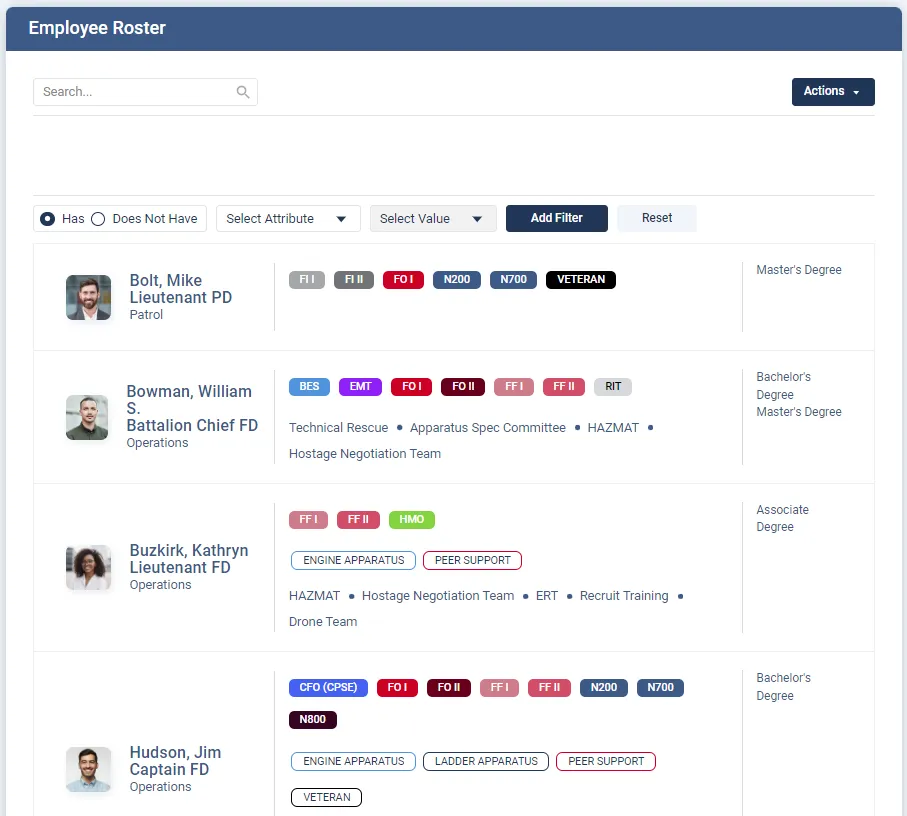
Here's what the platform does, taken from its Talent Management and fire and EMS pages:
- Certifications: "Track credentials, expirations, completions and source documents."
- Qualifications: "Track and produce 'Task Books', new employee check offs, specialty equipment check offs, and more." Officer development task books follow NFPA professional qualification standards.
- Expiration alerts: credentials, task books, qualifications and expiration notices keep reporting and readiness accurate, and the 90 day lapse report is a query rather than an audit.
- Logbook: training hours and activities logged against goals and benchmarks, with identifiers for sorting and reporting by category.
- Career Paths: completion requirements are mapped automatically from the other modules, with promotion and retirement eligibility.
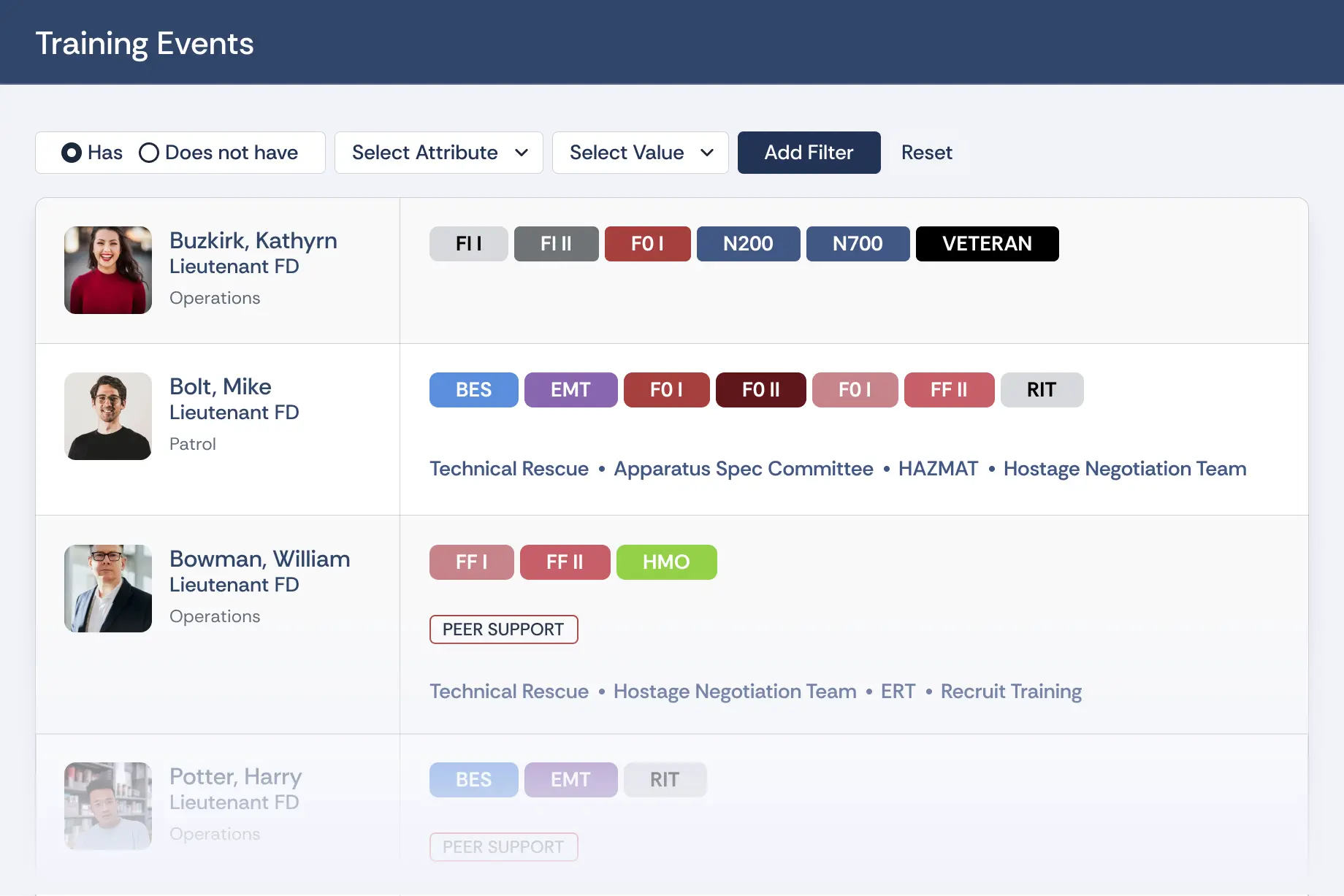
Essential Personnel is the system of record for training rather than a course library, so departments run it alongside whatever course provider they already use. Talent Management, which includes certifications, qualifications and the Logbook, is $85 per user per year, and the Total Solution with all four suites is $175 per user per year, plus a one time $3,000 startup fee, on Essential Personnel's published pricing. The platform is hosted in AWS GovCloud and covered by an annual SOC 2 Type II report.
"EP is such a simple, easy-to-use system that offers immense value to our service and people."
Kyle Bell, Deputy Chief, Statesville NC Fire DepartmentSee your task books and certifications on one roster
Send us one task book and your certification list, and we'll show you who on your roster is qualified for each seat, live. Call (910) 390-0011 or email info@essper.com.
Frequently asked questions
Training records software such as Essential Personnel keeps certifications with expiration dates and source documents, task books with every sign-off, and the department's qualifications on one record per member. It alerts before credentials lapse and shows who is qualified for each position. A learning management system delivers courses but usually isn't built to run task books.
A task book lists the job tasks for a position, and an evaluator signs and dates each one after watching the member perform it. Wildland agencies use NWCG position task books, and many state certification programs and departments use them for firefighter, driver/operator, officer and probationary positions, usually built from NFPA job performance requirements.
NFPA consolidated its professional qualifications standards. NFPA 1010, first issued in 2024, combines NFPA 1001, 1002, 1003 and 1005. NFPA 1020, issued in 2025, combines NFPA 1021, Fire Officer, and NFPA 1041, Fire Instructor. Task books written to the older numbers should be reviewed against the consolidated standards.
It depends on the program. NWCG position task books are valid for three years from initiation. California State Fire Training gives five years from the initiation date. Departments set their own limits for internal books, such as twelve months for a driver/operator book or six months after promotion for a battalion chief book. Check your program before setting reminders.
Usually an evaluator who holds the position or a higher certification, and who watched the task performed. California requires evaluators designated by the fire chief with equal or higher certification, and the chief signs the completed book by hand. NWCG requires a final evaluator qualified in the position. Department books often require a lieutenant or higher.
A certification is issued by an outside body, such as a state fire training agency or the National Registry, after testing against a standard, and it often expires. A qualification is the department's own decision that a member may fill a position, such as driver or acting officer, often requiring a certification and a completed task book first.
Record every certification with its issue date, expiration date and the certificate itself, then run a report each month of everyone expiring in the next 90 days. Track the continuing education hours each renewal needs alongside the date, since National Registry EMT renewal takes 40 credits every two years and state fire programs set their own hours.
Some can record them, but an LMS is built to deliver courses and record completions. A task book needs an evaluator's signature on an observed skill, rules about who may sign, deadlines, and a link to the qualifications it unlocks. Many departments keep the LMS for courses and use a training records system for task books and certifications.

About this article
Written by Scott Monroe, Chief Executive Officer & Co-Founder, Essential Personnel. Published 16 November 2026.
Essential Personnel makes the software described in the last section, and the screenshots are from the platform. Module, pricing and hosting details are taken from essper.com, and the Statesville quote is reproduced from essper.com. NFPA standard histories are from NFPA's standard development pages, the task book definition and rules from NWCG PMS 310-1, state rules from California State Fire Training's 2024 task books and Oregon DPSST, department examples from Unified Fire Authority, North Tooele Fire District and Fourmile Fire Protection District, the JPR definition from NIST, recertification rules from the National Registry of EMTs and Oregon DPSST, and ISO officer credit from Verisk, all checked in November 2026. The qualification matrix is an example to adapt, not a standard. This article is general information and isn't legal advice.
