
How do I compare internal affairs and case management software for police departments?
Comparing internal affairs software looks simple until the demos start. Every vendor says case management. One opens on a burglary investigation. Another shows a slick complaint form and can't tell you who read the file last Tuesday. A third quotes per module, and the early warning piece you assumed was included turns out to be a separate purchase.
This guide is for police chiefs, sheriffs, professional standards commanders and the internal affairs investigators who'll live in the system. It gives you a method: what to decide before you call anyone, which criteria matter for an agency your size, a scripted demo to run every vendor through, and the paperwork to get in writing before you sign.
The agencies that buy well don't compare feature lists. They compare how each system handles their own complaints, their own deadlines and their own officers, on one record, with the security and the price in writing. By the end of this guide you'll have a scorecard you can use on Monday.
The short answer: how to compare internal affairs case management software
Start by confirming you're comparing internal affairs case management, not the criminal investigation side of law enforcement case management software. Then map your own complaint process and legal deadlines, turn them into weighted requirements, and run every vendor through the same scripted demo using your scenarios. Get security documents and an all-in five-year price in writing, and call references from agencies your size before you choose.
The order matters. Agencies that start with demos end up comparing whatever each vendor chose to show. Agencies that start with their own process make every vendor answer the same questions, which is the only way the scores mean anything. The rest of this guide takes each step in turn.
Three kinds of law enforcement case management software, and which one you need
In a police department, "case management" means three different things, and law enforcement case management software can mean any of them. Investigative case management tracks criminal cases for detectives. Internal affairs case management tracks complaints and misconduct allegations against your own employees. Early intervention watches patterns across many events before any complaint exists. Most search results and many vendor pages for case management software for law enforcement mix them up.
| Investigative case management | Internal affairs case management | Early intervention | |
|---|---|---|---|
| What it tracks | Crimes, suspects, leads, evidence | Complaints and allegations against employees | Patterns across use of force, complaints, crashes and more |
| Who uses it | Detectives, prosecutors | Internal affairs, command staff | Supervisors, wellness and standards staff |
| Where it usually lives | In or beside the records management system | In a professional standards or personnel system | On the employee record |
| Ends in | An arrest, a charge or a closed case | A finding and, if sustained, discipline | A supportive conversation and monitoring |
| Who may see it | Investigators and prosecutors | A small, named group, with every view logged | Supervisors and designated staff only |
Law enforcement case management software built for detectives is a fine product, but it's the wrong one for complaints against officers. The quickest test: if a vendor's demo opens on a burglary or a narcotics case, you're looking at the wrong category. Police case management software for criminal work belongs with your records system. Police internal affairs software belongs with your people.
The federal records system specification shows why the two shouldn't share one set of permissions. The Bureau of Justice Assistance says an internal affairs system "must have multiple levels of security for the application itself, for individual records or groups of records, and for individual or groups of fields," and that its security should limit what the rest of the records system can see.
Internal affairs and early intervention are different jobs too, but they share the same data. That's why the strongest argument in this category is about the record, not the features: complaints, use of force, training, evaluations and early warning signs on one profile per officer. Our guide to early warning signs covers the early intervention side in depth.
Step 1: map your internal affairs case management process before any demo
Before you talk to a vendor, write down how a complaint moves through your agency today: how it arrives, who classifies it, who investigates, which deadlines apply, who reviews the findings, who decides discipline and how long the file is kept. That map becomes your requirements, your demo script and your scoring sheet.
Most agencies have never written it down end to end, and the gaps show up the first time someone asks. Answer these on one page:
- Intake. Which channels do complaints arrive through: front desk, phone, email, a website form, a supervisor, an anonymous letter? Does your policy accept every complaint, including anonymous ones?
- Classification. Which complaints go to internal affairs and which stay with the officer's supervisor? Who decides?
- Deadlines. What does your state law, your union contract and your own policy require, and when does each clock start?
- Notices. Who gets notified, and when: the complainant, the officer, the officer's chain of command, a prosecutor, a state agency?
- Findings. Which disposition categories does your policy use, and who signs off? Most agencies use the four the IACP describes: sustained, not sustained, exonerated and unfounded.
- Afterward. How long is each kind of record kept, who can see it, and how do you answer a prosecutor's request about an officer's credibility?
The U.S. Justice Department's COPS Office published standards for internal affairs that make a good benchmark for your answers. They recommend taking in every complaint, "whether presented orally, in writing, or in some other reasonably intelligible form," putting a complaint form on the agency website, and giving the complainant a written acknowledgment with a reference number. CALEA standards go further and require accredited agencies to investigate anonymous complaints too.
The deadlines deserve extra care, because missing one can void the discipline. Florida's officer bill of rights, section 112.532, bars disciplinary action if the investigation isn't completed within 180 days of the agency receiving notice of the allegation. California's Government Code section 3304 sets one year from discovery. Both allow the clock to pause in specific situations. Union contracts often add their own. Write every clock down with its start event, its length and what pauses it. Where no law sets one, the COPS Office standards say "it is preferable to conclude investigations within 180 days."
Step 2: turn your process into requirements for internal affairs and complaint tracking software
Turn each step of your map into a requirement, and mark each one as must-have or nice-to-have. The table below gives the ten areas that separate police internal affairs software in practice, with the questions that expose the differences. Anything your state law or contract requires is a must-have, whatever the vendor says.
| Area | What to require | The question that exposes it |
|---|---|---|
| Intake | Complaints from any source, including anonymous, with an acknowledgment to the complainant | Who keys in a complaint that arrives by phone at 2 a.m.? |
| Classification and assignment | Allegation categories, priority, investigator assignment and routing that match your policy | Can we change the categories ourselves without paying for a change order? |
| Deadlines | Each statutory and contract clock tracked from its own start date, with alerts before it runs out | Show me the alert 30 days before a 180-day deadline, and what happens when the clock pauses. |
| Evidence | Statements, recordings, video, photos and documents attached to the case | How large a body camera file can we attach, and who can download it? |
| Confidentiality | Sequestered cases, permissions by role and by case, and a log of every view | Show me who opened this case last week. |
| Findings and discipline | Your disposition categories as structured fields, and discipline recorded on the officer's record | Is the finding a field we can report on, or a sentence in a narrative? |
| Officer record linkage | Prior complaints, use of force, training, evaluations and early warning alerts visible from the case | From this case, how many clicks to the officer's last three years? |
| Reporting | Annual statistics by allegation, finding, unit and officer, plus whatever your state requires | Produce last year's summary, live, in the demo. |
| Retention | Different retention periods by record type, legal holds, and a log of what was purged and when | Can we keep a sustained finding for a different length of time than a written counseling? |
| Usability | Sergeants and lieutenants can file and review without training every quarter | How long does it take a sergeant to file a supervisor complaint on a phone? |
Accredited agencies have reporting requirements to add. CALEA's internal affairs standards, now in chapter 26, call for an annual statistical summary of complaints that's available to the public, and for keeping the complainant informed with a receipt, status updates and the result. The COPS standards also recommend an automated tracking system that alerts investigators to "impending benchmark or statute deadlines."
Two areas deserve a second look. The first is complaint tracking: good complaint tracking software shows every complaint, including ones handled by a supervisor rather than internal affairs, because a pattern of minor complaints is exactly what you'd want to see. Complaint tracking software that only holds internal affairs cases misses it. The second is prosecutor requests. Under Brady and Giglio, prosecutors must disclose information that could impeach an officer who testifies. Your system should let you find an officer's sustained findings and pending allegations bearing on truthfulness quickly, with dates and outcomes, without searching narratives by hand.
Step 3: weight the criteria for an agency your size
The right weights depend on who runs internal affairs. A small department with no full-time investigator should weight ease of use, the link to the officer's record and price most heavily. A large agency with a dedicated unit should weight investigation depth, confidentiality and reporting. Score each vendor 0 to 5 on each area, then multiply by your weight.
| Area | Small agency (under 25 sworn) | Mid-size (25 to 250 sworn) | Large (over 250, dedicated IA unit) |
|---|---|---|---|
| Intake, classification and workflow | 15% | 20% | 20% |
| Deadlines and notices | 10% | 10% | 15% |
| Confidentiality and audit trail | 10% | 15% | 20% |
| Officer record linkage and early intervention | 20% | 20% | 15% |
| Reporting | 5% | 10% | 10% |
| Ease of use for supervisors | 20% | 10% | 5% |
| Security and hosting | 10% | 10% | 10% |
| Five-year cost and price transparency | 10% | 5% | 5% |
These are starting points, not rules. Adjust them to your situation before the first demo, and don't change them afterward. An agency under a consent decree should move weight to reporting. An agency whose internal affairs work is done by patrol lieutenants should move weight to ease of use. If you want to see how one fixed set of weights ranks the main vendors, our internal affairs software ranking publishes its framework and scores.
Step 4: run every vendor through the same scripted demo
Send every vendor the same six scenarios a week ahead, built from your own process, and ask them to show each one live in their software rather than in slides. Score each scenario 0 to 3 as you watch. A scripted demo is the single best way to compare internal affairs software, because it stops each vendor from showing only what they do best.
- The anonymous complaint. A caller reports a rude officer at a traffic stop and won't give a name. Enter it, classify it, assign it and show the acknowledgment.
- The use of force complaint. A citizen alleges excessive force. Link the complaint to the officer's use of force report and body camera footage, and show the officer's prior complaints and uses of force from the case screen.
- The deadline. Open a case on day 150 of a 180-day clock. Show the alert, who received it, and what changes when the clock is paused for a criminal investigation.
- The sequestered case. Open an investigation into a lieutenant. Log in as a sergeant in that lieutenant's unit and show that the sergeant can't see it. Then show the log of everyone who has opened it.
- The prosecutor's request. The district attorney asks whether an officer has any sustained findings for dishonesty. Produce the answer, with dates and outcomes, in under five minutes.
- The annual report. Produce last year's complaint summary by allegation type, finding and unit, and export it.
Complaint tracking software and investigation tools look similar in slides and very different live. Ask a sergeant and an internal affairs investigator to sit in and score alongside command staff. The people who'll use the software every week notice different things than the people who'll sign the contract.
Step 5: verify the security of any police case management software in writing
Internal affairs files are among the most sensitive records a department keeps. Ask every vendor for documents, not statements: their CJIS Security Policy alignment and Security Addendum, a current independent audit report such as SOC 2 Type II, where the data is hosted, how it's encrypted, and how you get all of your data back if you leave.
The FBI CJIS Security Policy applies to any system that stores criminal justice information, which an internal affairs file often does once criminal history or investigative reports are attached. The current version, 6.1, dates from June 2026. Ask each vendor:
- Where is the data hosted, and is it in a government cloud region in the United States?
- Will you sign the CJIS Security Addendum, and are your staff with access background checked?
- Can we see your latest SOC 2 Type II report?
- Is data encrypted in transit and at rest, and with what standard?
- Do you support multi-factor authentication and single sign-on with our identity provider?
- Is our data kept separate from other customers' data?
- At the end of the contract, in what format do we get every case, attachment and audit log back?
The last question gets skipped most often, and it's the one that decides whether you can ever switch vendors again. An export of PDFs isn't an export of your data.
Step 6: plan migration and retention before you sign
Every agency has old cases somewhere: a legacy system, spreadsheets, Word files or paper. Decide before you sign which ones move into the new system, in what form, and who pays for it. Then set retention by record type, because a sustained finding, a not sustained complaint and a written counseling rarely have the same retention period.
A sensible default is to migrate every open case in full, closed cases still inside their retention period as records with their findings and key documents attached, and anything older only where a law, a lawsuit or a prosecutor might still need it. Ask each vendor to quote the migration as a fixed price against a sample of your real data.
Retention needs the same care. Union contracts sometimes require discipline records to be removed after a set number of years, public records law can say otherwise, and prosecutors may still need the history. The software should let you set a period for each type of record, place a hold when litigation is pending, and keep a log of what was removed and when. Our guide to generic HR systems covers how those rules collide.
Step 7: compare the five-year cost of case management software for law enforcement
Most police internal affairs software is quote only, and so is most case management software for law enforcement, so put every vendor's price on the same five-year worksheet: license, who counts as a user, implementation, data migration, training, single sign-on, integrations, any separate early intervention module and the yearly increase. The cheapest first-year quote is often not the cheapest system.
| Cost line | What to ask |
|---|---|
| License | Per user, per officer or per agency? Which users count: investigators only, or every officer who files or reads? |
| Modules | Are complaints, use of force, early intervention and discipline priced separately? |
| Implementation | One-time fee, and what it includes: configuration, training, project management |
| Migration | Fixed price against a sample of your data, or time and materials? |
| Single sign-on and integrations | Included, or billed each year? |
| Increases | Is the yearly increase capped in the contract? |
Count users carefully. Case management software for law enforcement priced only for internal affairs investigators can look cheap until you realize every sergeant who files a supervisor complaint, and every officer who has to see a notice, needs a login. Ask for the all-in five-year figure at your headcount, in writing.
Step 8: check references and choose how to buy
Call at least two references per finalist, from agencies your size and ideally your state, and ask what they'd do differently. Then check whether the vendor is on a cooperative purchasing contract your agency can use. A cooperative contract can save months of procurement compared with a full request for proposals.
Questions that get honest answers from references:
- How long from signing to the first real case in the system?
- Do your sergeants actually use it, or does internal affairs enter everything?
- What did migration really cost, and what got left behind?
- When something breaks, how long until a person answers?
- What would you have asked for in the contract that you didn't?
On purchasing, ask each vendor which cooperative contracts they hold, such as GSA Advantage, NASPO, Omnia Partners, NCSA or a state contract. Your purchasing office can confirm whether you can buy through one. If you run a request for proposals instead, attach your process map and demo scenarios to it, and score responses with the same weights you'll use in the demo.
Red flags when comparing police internal affairs software
Some problems with police internal affairs software show up in the first demo if you know where to look. The biggest warning signs are a system that can't show who viewed a case, deadlines that are just a due-date field, findings stored as free text, and pricing that only appears after several meetings.
Walk away, or at least slow down, if
- The demo opens on a criminal case and the vendor calls it internal affairs case management
- They can't show a log of everyone who opened a case
- Deadlines are a single due date, with no start event, pause or alert
- Findings and discipline are typed into a narrative instead of chosen from your categories
- The case can't show the officer's prior complaints, use of force or training
- Early intervention turns out to be a separate product at a separate price
- They won't share a SOC 2 Type II report or sign the CJIS Security Addendum
- Your data comes back only as PDFs at the end of the contract
- Every configuration change is a paid change order
How Essential Personnel compares on these criteria
Essential Personnel is professional standards software built for police, fire and city government. Their internal affairs case management sits on the same employee record as performance, training, wellness, equipment and early intervention, so a case shows the whole officer, and the pattern across cases and incidents is visible before it becomes a complaint.

Here's how it maps to the areas above:
- Intake and workflow. Incident and Case Management lets supervisors open a report, assign the case, collaborate with the people involved and route it for approval, with automatic notifications and analytics. It covers internal affairs investigations, use of force, critical incidents and vehicle accidents.
- Officer record linkage. Every case sits on the same profile as evaluations, field training, certifications, commendations, corrective documents and issued equipment.
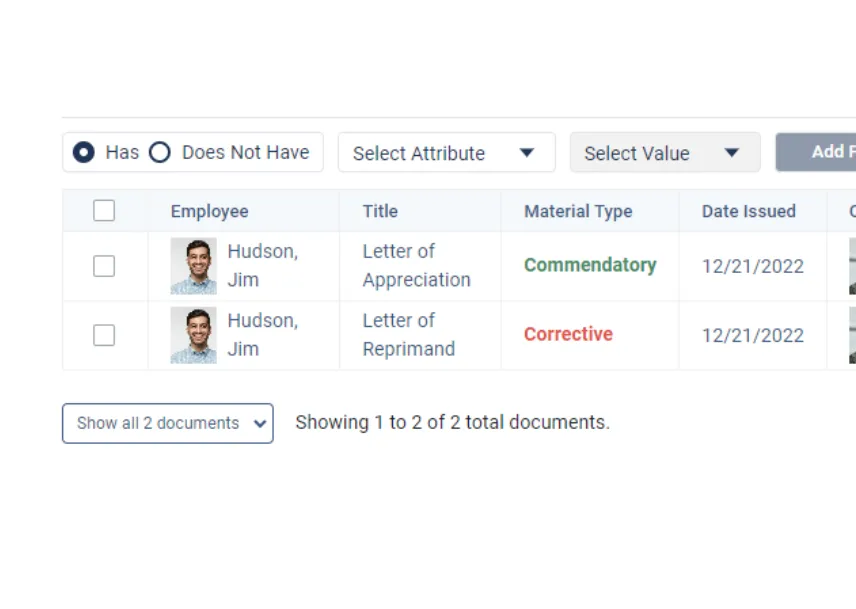
- Findings and discipline. Documents of Record store commendatory and corrective documents with routing and approval.
- Early intervention. You set the number and type of events, and the timeframe, that trigger an alert to designated leaders, and corrective documents can count toward a threshold. It's included, not sold separately.
- Confidentiality. Hierarchical role-based access control, multi-factor authentication at AAL2, a specialist role that sees critical incidents without the rest of the file, and complete audit trails.
- Integration. Incident and Case Management offers records management system integration, so events don't have to be entered twice.
On security, the platform is hosted entirely in AWS GovCloud in the United States, aligned with the FBI CJIS Security Policy, covered by an annual SOC 2 Type II report and encrypted with FIPS 140-3 validated cryptography. On cost, pricing is published: the Safety and Wellness suite, which includes case management and early intervention, is $40 per user per year, and the Total Solution with all four suites is $175 per user per year, plus a one-time $3,000 startup fee. It's available through GSA Advantage, NASPO, Omnia Partners, NCSA and VSA.
Essential Personnel gives buyers of law enforcement case management software the same advice this guide does: requirements vary by state law, union contract and agency size, especially around sequestered access to open investigations, so walk your own intake and investigation workflow through the demo. Bring your deadlines and your contract's rules, and check each one. Hendersonville Police Department, a CALEA-accredited agency in North Carolina, uses it to capture, log and review every incident and complaint, with threshold alerts for early intervention. See the law enforcement page for the full feature list.
"Their team listens to our feedback, understands the complexities we face, and responds quickly with real solutions."
Chief Blair Myhand, Hendersonville Police Department, North CarolinaInternal affairs software comparison checklist
Before you call vendors
- Confirm you need internal affairs case management, not investigative police case management software
- Map intake, classification, investigation, review, findings, discipline and retention on one page
- List every statutory and contract deadline with its start event and what pauses it
- Write requirements in ten areas and mark each must-have or nice-to-have
- Set your weights and don't change them after the first demo
During the comparison
- Send the same six demo scenarios to every vendor a week ahead
- Have a sergeant and an investigator score alongside command staff
- Collect the SOC 2 report, CJIS Security Addendum and hosting details in writing
- Get a fixed migration price against a sample of your data
- Put every price on the same five-year worksheet, including any complaint tracking software you already pay for
Before you sign
- Call two references per finalist, from agencies your size
- Check which cooperative contracts carry the case management software for law enforcement you chose
- Confirm the data export format and a cap on yearly increases in the contract
Bring your own complaint process to the demo
We'll walk your intake, investigation and early intervention workflow through Essential Personnel, on one record per officer, for a department your size. Call (910) 390-0011 or email info@essper.com.
Frequently asked questions
Confirm you need internal affairs case management rather than criminal investigation case management. Map your own complaint process and legal deadlines, turn them into weighted requirements, and run every vendor through the same scripted demo. Get security documents and an all-in five-year price in writing, and call references from agencies your size before choosing.
Police case management software usually means tracking criminal investigations: suspects, leads, evidence and prosecution. Internal affairs software tracks complaints and misconduct allegations against your own employees, through investigation, findings and discipline, with much tighter access controls. They solve different problems, and a criminal case system rarely handles officer complaints, deadlines or confidentiality well.
Look for intake from any source, classification and assignment that match your policy, deadline tracking with alerts, evidence attachments, sequestered cases with a log of every view, structured findings and discipline, a link to the officer's full record and early warning alerts, annual reporting, retention by record type, and security aligned with the FBI CJIS Security Policy.
Send every vendor the same scenarios from your own process: an anonymous complaint, a use of force complaint linked to the officer's history, a case nearing its legal deadline, a sequestered case with its view log, a prosecutor's request about an officer's credibility, and last year's annual report. Ask them to show each live and score each one.
Usually not. A records management system, like most police case management software, is built around criminal cases, and many people in the agency can see it. Internal affairs files need a small, named audience, a log of every view, legal deadlines and a link to the officer's training, evaluations and discipline. Most agencies keep it in a separate system connected to the RMS.
Weight ease of use, the link to the officer's record and price most heavily, because a small department rarely has a full-time investigator or administrator. Choose police internal affairs software patrol supervisors can use without retraining, that includes early intervention rather than selling it separately, and that publishes per-user pricing that scales down to your headcount.
Most vendors quote only after a demo, so compare five-year totals including implementation, migration and add-on modules. Essential Personnel publishes its prices: the Safety and Wellness suite, which includes case management and early intervention, is $40 per user per year, and the Total Solution with all four suites is $175 per user per year, plus a one-time $3,000 startup fee.
If the system stores criminal justice information, such as criminal history or investigative reports attached to a case, it must meet the FBI CJIS Security Policy, and so must the people who administer it. CJIS isn't a certification, so ask for the vendor's Security Addendum, hosting location, encryption standard and a current SOC 2 Type II report in writing.

About this article
Written by Scott Monroe, Chief Executive Officer & Co-Founder, Essential Personnel. Published 26 October 2026.
Essential Personnel makes the software described here, and the product screenshots are from the platform. Pricing, hosting and purchasing details are taken from essper.com, and the customer quote and the Hendersonville example are reproduced from an essper.com customer story. The suggested weights are a starting point for your own scorecard. State laws and federal guidance are linked to their primary sources and were checked in October 2026; check your own state law, contract and policy before relying on them. This article is general information and isn't legal advice.
