
How to create an awards and commendations program for your department: police and fire
Most departments already recognize good work. A supervisor writes a letter, the chief hands out a plaque at the holiday dinner, and a lifesaving call gets a mention at roll call. What's missing is a program: a written awards policy, clear criteria for each award, a fair nomination process, a board that decides, and a record of who received what and why. Without those, recognition depends on who happened to notice, and the officers who never get nominated notice that too.
This guide walks a chief, sheriff or fire chief through creating an awards and commendations program for a department, step by step. It covers the award types most police departments and fire departments use, how to write criteria and run nominations, who sits on the awards board, the checks to make before you award, and how to keep every commendation on the employee's record. It draws on published awards general orders from Sacramento, Gaithersburg, San Francisco, McMinnville and Dothan, and on agencies running their awards program in Essential Personnel.
The short answer: how to create an awards or commendations program
To create an awards and commendations program, write an awards policy, then define each award with objective criteria, from a letter of commendation up to a medal of valor. Let any member or citizen nominate, have an awards board review every nomination against the criteria, check for open investigations, present awards on a set cycle, and record each one on the employee's record so it counts in evaluations and promotions.
Departments that run their program in Essential Personnel build each award as a template with its ribbon or medal image, route nominations through a submit, review and approve workflow, and keep every award and commendation on the member's profile, where command staff and the member can see it.
Two things decide whether the program works. The first is fairness: clear criteria and a board, rather than one person's judgment, so the same act earns the same award on every shift. The second is the record. An award that lives only on a wall plaque can't be weighed in a promotion, counted as a positive indicator, or found when the member retires.
How a police awards program differs from an employee recognition program
An employee recognition program in most organizations is frequent and informal: peer shout-outs, thank-you notes and small rewards. A public safety awards program adds formal awards for risk and service, such as medals of valor, lifesaving awards and unit citations, decided by a board under a written policy, worn on the uniform, and kept in the personnel file.
The corporate and university recognition guides are right about the basics, and they apply to a police department or fire department too: recognize work promptly, tie it to clear criteria, make nominations open to everyone, and be seen to be fair. Federal guidance from the Office of Personnel Management makes the same point about timing, saying special act awards should be given "in real time throughout the year".
What a public sector awards policy for police or fire adds is weight. A medal of valor says a member risked their life, so the criteria have to define that risk, the decision has to survive scrutiny from the rest of the department, and the act itself has to be one the department stands behind. The record lasts a career. Run both: an informal recognition habit for everyday good work, and a formal awards and commendations program for the acts that deserve a permanent place on the record.
The award types to include in a police awards and commendations program
Most police awards and commendations programs combine a few medals for risk and lifesaving, awards for sustained or exceptional service, a unit citation for team efforts, written commendations for good work, annual awards and citizen awards. Start with six to eight, rank them in an order of precedence, and add more only when an act doesn't fit an existing award.
| Award | What it recognizes | Typical criteria |
|---|---|---|
| Medal of Valor (often gold, silver and bronze) | Bravery at serious personal risk | Acted willingly, knowing the risk to their own safety, to save or protect a life. Sacramento's gold medal requires "full knowledge of the grave risk" |
| Lifesaving Award | Saving a human life | Directly responsible for saving a life. Sacramento requires a statement from a medical professional with the nomination |
| Purple Heart | Injury in the line of duty | Serious injury suffered while performing duties, in some agencies only when inflicted by criminal means |
| Meritorious or Distinguished Service Award | Exceptional service, a single act or over time | Performance well beyond the normal assignment, such as a major investigation, program or improvement |
| Unit Citation | A team, shift, squad or crew | Outstanding results from the combined effort of a unit. Every member receives the citation |
| Letter of Commendation or Merit | Good work worth recording | Handling a difficult situation well, initiative, or service that reflects credit on the department |
| Officer, Supervisor and Civilian of the Year | A year of outstanding service | Nominated by peers or supervisors and chosen by a vote or the chief |
| Citizen award | A member of the public who helped | Assisting an officer, providing information that led to an arrest, or an act of bravery |
Pinellas Park Police Department in Florida runs one of the fuller programs, with twelve awards in its Employee Recognition SOP, from a Medal of Honor and a Combat Cross to a Chief's Disaster Deployment Ribbon and a Citizen's Gold Shield. Its Distinguished Service Award is a good model of objective criteria: a full three-year rating period with an overall rating of Exceeds Expectations or better, no preventable injury crash in a city vehicle, no written reprimand, suspension or disciplinary demotion, and no break in service.
1. Write the awards policy first
Put your police awards and commendations program in a general order or awards policy before you hand out anything. It should define each award and its criteria, who may nominate and how, who decides, the checks before an award, how awards are presented and worn, and where each award is recorded.
A written policy is what makes the program fair and lasting. It survives a change of chief, it lets every member see what earns each award, and it answers the question "why did he get one and she didn't" before anyone asks it. The published general orders from Sacramento and Gaithersburg are good models to read alongside the sample later in this guide. Gaithersburg's order lists the CALEA standards it relates to, which helps if you're accredited or working toward it. Run the draft past your labor association and city or county HR before you adopt it, and if your awards carry pay, leave or points on a promotion list, check what your bargaining agreement and civil service rules say.
2. Define clear criteria for each award
Write criteria a board can apply the same way every time. Define "normal call of duty" and "exceptional personal risk", say what evidence each award needs, and allow one award per act, the highest one the act meets.
Most disputes about awards come from vague criteria. Gaithersburg defines the normal call of duty as the routine tasks of the job, which "may involve some risk", and exceptional personal risk as a situation where an officer "willingly faces serious and immediate danger that goes beyond the usual risks" of the assignment. With those two definitions written down, a board can tell a lifesaving award from a medal of valor.
Write in the conditions that rule an award out, too. McMinnville's policy requires that a valor act "was not foolhardy and was not caused by poor judgment", and that the events leading to a lifesaving act "were not recklessly caused by the member". Sacramento allows only one award per act, achievement or period of service, and Gaithersburg gives "only the highest-level award" an act meets. Keep the evidence rules practical: an incident or report number, statements, and for a lifesaving award, a medical statement or confirmation that the patient survived.
3. Set up the nomination process
Let any member, and members of the public, nominate. Use one nomination form that captures the incident number, date, everyone on scene and what each person did, statements and reports, and route it through the chain of command to the awards board. Tell the nominee and their supervisor it was received.
An open nomination process is the fairness check that corporate employee recognition guides keep returning to, and it matters more in a department where one supervisor may never nominate anyone. Sacramento lets "any employee having knowledge of an act" start a nomination on a single commendation report form, and Gaithersburg accepts nominations from any member "or a civilian". Gaithersburg also requires "a complete listing of all personnel on scene and a description of their actions", and its committee reviews the actions of every officer at the scene, so a nomination for one officer doesn't overlook the partner who did the same thing.
Set two timelines. Sacramento reports the decision on a nomination within 60 days of the committee receiving it, and lets a member who believes they were overlooked appeal within one year of the incident. In Essential Personnel, nominations route through a submit, track and approve workflow, so a nomination can't sit forgotten in someone's inbox.
4. Form an awards board
Have a committee, not one person, review nominations against the criteria and recommend an award to the chief, who makes the final decision. Include several ranks, divisions, civilian staff and a labor representative, and rotate members on fixed terms.
Board size scales with the department. In Gaithersburg the awards committee is the chief and command staff, with the chief as chair and final authority. Sacramento's Commendation Review Committee has up to 18 members drawn from every office, including a sergeant or above, a communications center employee and members appointed by each of three labor groups, serving two-year terms under a deputy chief as permanent chair. A small department can run the same idea with five people.
Give the board a written record of each decision, including nominations it turned down and why. San Francisco's order requires a commanding officer who doesn't support a nomination to return it to the nominating member "with the reasons for rejection". That record is what lets a board stay consistent from one year to the next.
5. Check before you award
Before an award is approved, check the nominee for open internal affairs complaints, open citizen complaints and civil suits, and for any act involving force, wait for the investigation and review to finish. An award for an act later found out of policy damages the program and the department.
San Francisco\'s Department General Order 3.09 has its awards panel consider each nominee's open internal affairs complaints, open complaints with the Department of Police Accountability and open civil suits. For an officer-involved shooting, the panel confirms the investigations have concluded and the shooting was found in policy, or waits 18 months from the shooting, whichever comes first. You don't need the same rules, but you need some. This is where keeping awards and professional standards records on the same system pays off: whoever reviews the nomination can see the open cases without asking another unit.
6. Set the cycle and the ceremony
Give written commendations and letters any time, as close to the act as you can, and present medals at a ceremony on a set cycle, usually once or twice a year. Keep the top awards rare so they keep their meaning.
Timing is the other half of recognition. A letter of commendation six months late feels like paperwork, so let supervisors issue those as soon as they're approved. Medals deserve a ceremony with families present, in Class A uniform, presented by the chief or sheriff, and some agencies ask the mayor to present them at a city council meeting. Dothan Fire Department presents its awards at two events each year, an EMS luncheon in May and Fire Prevention Week in October. Plan for posthumous awards in the policy, with an order of next of kin, as Sacramento does.
Resist the urge to award everything. When half the department wears a valor ribbon, it stops meaning anything to the officer who earned one at real risk, so hold the medals to their criteria and use letters of commendation generously.
7. Record every award and commendation on the employee record
Put every award, commendation and citizen letter on the member's record, with the date, the award, the reason and the incident it relates to. Use that record in evaluations, promotion files and your early warning system, where commendations count as positive indicators.
Most published awards policies send the paperwork to the personnel file. Gaithersburg recipients get "an Award Citation for the officer's personnel file", McMinnville returns each commendation to the employee to sign before it goes into the personnel file, and Sacramento sends a copy of every commending citizen letter there. The trouble with a paper file is that nobody reads it until something goes wrong.
A commendation recorded where supervisors work gets used. It belongs in the annual evaluation and the promotion packet, and it belongs in your early warning process: a research review by the Council on Criminal Justice lists commendations and awards among the common indicators in early intervention systems. Pinellas Park ties awards to incident reports and personnel records in Essential Personnel, and its commendations are now ready for performance reviews and promotions when they're needed, rather than buried in a folder.
8. Standardize ribbons, medals and the order of precedence
Pick one ribbon design per award, publish an order of precedence, and say in the policy which items are worn on the duty uniform and which only on Class A. Apply the same rules to sworn, reserve, civilian and volunteer members.
The common pattern is a ribbon bar or pin on the duty uniform and the full medal on the Class A uniform. Gaithersburg recipients receive a ribbon for the duty uniform and a medal, and Dothan places its Medal of Valor and Medal of Bravery above and centered over any other ribbons. Keep a reference sheet of every ribbon with its award, so members wear them in the right order and new supervisors can read a uniform at a glance. Some agencies also mount a wall plaque with the names of valor and lifesaving recipients, as McMinnville's policy does.
9. Review the program every year
Once a year, review your police awards and commendations: count awards and nominations by type, unit, shift, rank and sworn or civilian, and check how long decisions took and how many nominations were turned down. Gaps usually point to supervisors who don't nominate, not to units that don't perform.
The annual review is where the fairness criteria in every recognition guide become something you can measure. If one shift produces most of the nominations, or civilians and dispatchers never appear, ask why. If the board takes four months to decide, fix the process. Pinellas Park uses Essential Personnel to analyze recognition trends across units and roles, which turns this review into a report instead of a week with a spreadsheet.
Awards programs for fire departments
Fire department awards programs follow the same steps, with awards shaped around fire and EMS work: a medal of valor for rescue at personal risk, a life save award tied to patient outcome, a unit citation or company award for a crew, and annual firefighter and fire officer awards. Write them into an SOG and run them through an awards committee.
Dothan Fire Department\'s SOG 400.6 is a clear example. Its Medal of Valor recognizes members who "under especially hazardous conditions, courageously risked their own lives to save another". Its Life Save Medal is contingent on the patient being discharged from the hospital, and a Commendation Medal covers pre-hospital care that stabilized a patient who didn't meet that bar. Company of the Year recognizes a whole company or team, so crew work gets recognized as crew work. Any member may recommend a person or unit with the award form and supporting documentation.
The fire service adds one thing police programs rarely need: most acts are done by a crew, so write the unit citation first and make sure a nomination names everyone on the apparatus. The same record keeping applies. Essential Personnel gives fire departments the same Awards tool alongside 360 feedback and Leader's Notes, so feedback and recognition become routine rather than annual.
A sample awards and commendations general order
The sample below covers the sections an awards policy needs: purpose, definitions, awards and criteria, nominations, the awards board, eligibility review, presentation, display, records and annual review. Adapt the awards and the board to your department, and have your attorney and labor association review it before you adopt it.
Sample language
1. Purpose. This order establishes the department's awards and commendations program, to recognize members and members of the public whose acts or service go beyond the normal call of duty, and to record that recognition fairly and consistently.
2. Definitions. Normal call of duty means the tasks and risks reasonably expected in the member's assignment. Exceptional personal risk means a situation in which a member knowingly and willingly faced serious and immediate danger beyond the usual risks of the assignment.
3. Awards. The department awards, in order of precedence: Medal of Valor; Lifesaving Award; Purple Heart; Meritorious Service Award; Unit Citation; Letter of Commendation; annual awards; Citizen Award. Appendix A sets out the criteria and required evidence for each award.
4. Nominations. Any member or member of the public may nominate. Nominations are submitted on the department nomination form within 90 days of the act and include the incident number, the date, every member on scene and their actions, and supporting reports or statements. A Lifesaving Award nomination includes confirmation of the patient's condition from a medical professional.
5. Awards board. The board consists of a captain as chair, one lieutenant, one sergeant, one officer, one civilian member and one member appointed by the labor association, each serving two years. The board reviews each nomination against the criteria and recommends an award, a different award or no award. The chief makes the final decision. The nominee and nominator are told the outcome within 60 days.
6. Eligibility review. Before recommending an award, the board confirms with the professional standards unit whether the act or the nominee is the subject of an open internal or external investigation or civil action. An award for an act involving the use of force is not decided until any investigation and review of that force has concluded.
7. One award per act. A member receives only the highest award an act meets. A member may receive awards for separate acts without limit.
8. Presentation. Letters of commendation are issued as soon as approved. Medals and unit citations are presented at the department's annual awards ceremony. Awards earned by a deceased member are presented to the next of kin.
9. Display. Ribbons may be worn on the duty uniform and medals on the Class A uniform, in the order of precedence in section 3.
10. Records. Every award, commendation and commending letter from the public is recorded on the member's record with the date, the award, the reason and the related incident, and is available for evaluations and promotion processes.
11. Annual review. Each January the board chair reports the number of nominations and awards by type, unit, shift, rank and sworn or civilian status, the time to decision, and recommended changes to this order.
Awards and commendations software: running the program in Essential Personnel
Essential Personnel runs an awards and commendations program on the same record as each member's evaluations, training and professional standards history. You create each award as a template with its description and ribbon or medal image, route nominations through a submit, track and approve workflow, and every award appears on the member's profile.
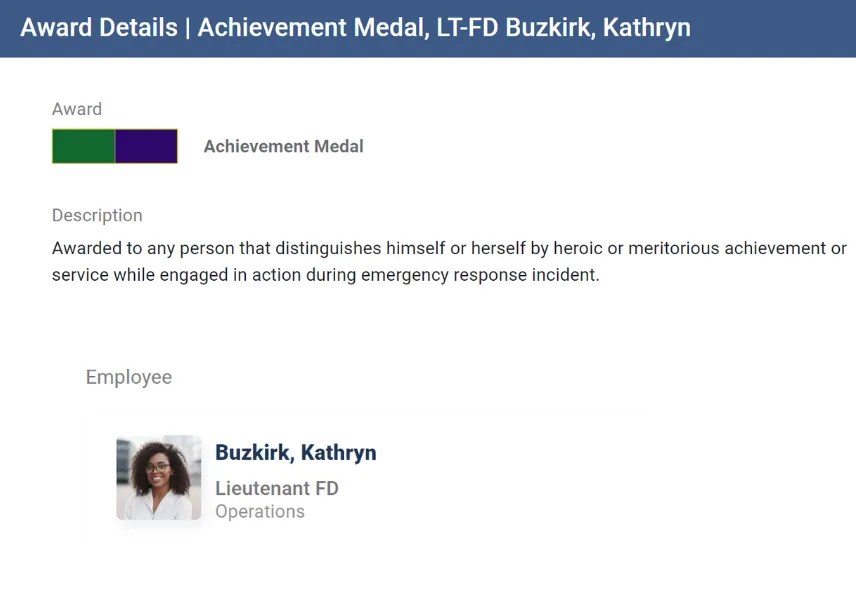
The pieces, as they're described on essper.com:
- Awards: template awards and descriptions with ribbon and medal images, and a workflow to submit, track and approve nominations.
- Documents of Record: commendatory, corrective and other documents with routing and approval workflows, so a letter of commendation is reviewed and filed the same way every time.
- Leader's Notes: sergeants and company officers record commendations as they happen, alongside observations and counseling entries.
- Employee Profiles: awards sit with credentials, performance, career history and training, so they're in view for evaluations and promotions.
Pinellas Park Police Department moved its awards program from forms, memos, submission packets and emails into Essential Personnel. It now logs every award by category, date, recipient and rationale, ties awards to incident reports and personnel records, tracks each nomination from submission to approval and issuance, and analyzes recognition across units and roles. The full account is in the Pinellas Park story.
"By moving our recognition program into Essential Personnel, we've made it easier for our team to acknowledge outstanding work. It reinforces our core values and ensures every commendation is seen, shared, and celebrated."
Adam Geissenberger, Chief of Police, Pinellas Park Police Department, FloridaAwards are part of the Talent Management suite, published at $85 per user per year, or $175 per user for all four suites, plus a one-time $3,000 startup fee, on the pricing page. The same suite holds field training, so a commendation earned on probation stays with the officer from the first day, as covered in our guide to recruit performance. The platform is hosted in AWS GovCloud, aligned with the FBI CJIS Security Policy and covered by an annual SOC 2 Type II report, and it's available through GSA Advantage, NASPO, Omnia Partners, NCSA and VSA.
See your awards program run from nomination to ceremony
Bring your awards list and your nomination form, and we'll show you how they run for a department your size. Call (910) 390-0011 or email info@essper.com.
Frequently asked questions
Write an awards policy, define each award with objective criteria, and open nominations to every member and the public. Have an awards board review nominations and check for open investigations, let the chief decide, present awards on a set cycle, and record each one on the member's record. Essential Personnel runs the nomination workflow and keeps every award on the member's profile.
Most police departments start with a Medal of Valor, a Lifesaving Award, a Purple Heart, a Meritorious or Distinguished Service Award, a Unit Citation, a Letter of Commendation, annual Officer and Civilian of the Year awards, and a citizen award. Six to eight awards in a published order of precedence is enough to begin, with clear criteria for each one.
A commendation is a written recognition of good work, usually a letter from a supervisor or the chief, issued soon after the act and placed on the member's record. An award is a formal honor, such as a medal or unit citation, decided by an awards board against written criteria, presented at a ceremony and often worn on the uniform.
Include members from several ranks and divisions, at least one civilian employee and a labor association representative, chaired by a captain or deputy chief, with fixed terms of about two years. The board reviews nominations against the criteria and recommends an award, and the chief makes the final decision. A small department can run the same structure with five members.
An employee recognition program is usually frequent and informal, with thank-you notes and small rewards. A public safety awards program adds formal awards for personal risk, lifesaving and service, decided by a board under a written policy, checked against open investigations, worn on the uniform and kept on the member's record. Most departments need both, with the same fairness and clear criteria.
Yes. Most awards policies send every award, commendation and commending citizen letter to the personnel file. Record the date, the award, the reason and the related incident, so commendations count in evaluations, promotion decisions and early intervention reviews. A record supervisors can see is used far more than a paper file that's only opened when something goes wrong.
Your policy should decide. Many agencies have the awards board check for open internal affairs complaints, citizen complaints and civil suits before approving an award, and hold any award for an act involving force until the investigation ends. San Francisco waits until an officer-involved shooting is found in policy, or 18 months have passed, whichever comes first.
Many departments still use paper forms, email and spreadsheets. Essential Personnel is public safety software with an Awards tool: template awards with ribbon and medal images, a workflow to submit, track and approve nominations, and every award on the member's profile next to evaluations and training. Pinellas Park Police Department runs its program this way, in the Talent Management suite.

About this article
Written by Scott Monroe, Chief Executive Officer & Co-Founder, Essential Personnel. Published 29 October 2026.
Essential Personnel makes the software described here, and the product screenshot is from the platform. Pricing, hosting and purchasing details are taken from essper.com, and the Pinellas Park award list, results and quote are reproduced from the Pinellas Park Police Department story on essper.com. Award criteria and procedures are taken from published awards orders of the Sacramento, Gaithersburg, San Francisco and McMinnville police departments and the Dothan Fire Department, checked in October 2026. The sample general order is original. This article is general information and isn't legal advice.
