
How to track the performance of your recruits: academy, field training and probation
Most agencies don't have a recruit problem so much as a records problem. The academy sends over a transcript, field training officers fill in daily observation reports on paper or in free text, and probationary evaluations sit in a supervisor's folder. When a recruit starts to struggle, nobody can see the pattern until it's late, and when you need to release someone before probation ends, the file is thin.
This guide is for chiefs, sheriffs, training commanders and FTO coordinators who need to do a better job tracking the performance of their recruits. It covers each stage a new hire passes through, what to record at each one, how to make ratings consistent between trainers, which numbers to watch, and how to keep it all on one record. It draws on the California POST field training program, the COPS Office Police Training Officer model, and agencies running their field training program in Essential Personnel.
The short answer: how to track the performance of your recruits
To track the performance of your recruits, write down the standard they have to meet, then document every shift against it. Use a daily observation report with a fixed rating scale, summarize it weekly and at the end of each phase, sign off skills on a checklist as they're shown, put remedial training in writing, and close probation with a documented decision. Keep the academy, field training and probation records on one profile per recruit.
Agencies that run this in software such as Essential Personnel file daily observation reports from a template in Leader's Notes, track skill sign-offs in Qualifications, and see a whole class in Score Reports, which normalize for FTOs who grade hard or easy.
A recruit here means any new hire in their first months, so the same steps answer how to do new hire performance tracking in public safety: in the academy, in field training with a field training officer (FTO) or police training officer (PTO), or on probation after release to solo duty. The same approach works for new lateral officers, dispatchers and probationary firefighters, with a different list of skills. Recruit performance tracking isn't the same as recruiting metrics: time to fill, pipeline quality and recruiter KPIs measure your hiring process, while recruit tracking starts the day the person is hired and measures them.
Why recruit tracking breaks down
Recruit tracking usually fails in four places: ratings that mean different things to different FTOs, narratives written in free text that can't be compared, paperwork that waits days for a signature, and gaps between the academy, field training and probation records. Each gap hides the pattern you need to see, and each one weakens the file if you later release the recruit.
- Inconsistent raters. One FTO rates almost everyone a 4, another rates the same work a 5 or 6. A recruit's result then depends on which trainer they drew.
- Free text. Narratives that vary by author can't be added up across a class, and they rarely tie a comment to a specific skill.
- Paper delay. When reports wait in a tray for the sergeant, a problem raised on Monday is read the following week.
- Broken handoffs. The academy, the field training unit and the patrol supervisor each keep their own file, so nobody sees the recruit's whole first year.
What to track at each stage
To track recruit performance well, follow three stages on one record: the academy, field training and probation. Each stage has its own evaluator, its own form and its own decision point, and the value comes from seeing them together. A recruit who scraped through academy report writing and then struggles with reports in field training is a pattern, not two separate problems.
| Stage | Who records | What to record | How often | Decision at the end |
|---|---|---|---|---|
| Academy | Academy staff; your agency's recruit coordinator | Test scores, firearms and driving results, physical fitness, scenario evaluations, attendance, counseling or remedial entries | As the academy reports, at least by block | Graduation, and a handoff note to field training |
| Field training | FTOs or PTOs, with the FTO sergeant and coordinator | Daily observation reports, weekly summaries, end-of-phase evaluations, skill sign-offs, remedial training, documented situations | Every shift, weekly, and at each phase | Release to solo duty, extension, or a recommendation to release from employment |
| Probation | Patrol supervisors and the chain of command | Periodic probationary evaluations, observations, commendations, counseling, complaints, policy acknowledgments | Monthly is common; set it in policy | Pass probation, extend where allowed, or release |
Write the frequency and the decision point for each stage into your field training directive. How long probation lasts is set by your civil service rules, charter or labor agreement, so check yours before you write it down.
1. Write the standard for your FTO program first
You can't track recruit performance against a standard nobody wrote down. List the categories a recruit is rated on, define what an unacceptable, acceptable and superior performance looks like in each one, and give every FTO the same definitions. In the San Jose model these are called standardized evaluation guidelines.
The field training approach many US agencies use began at the San Jose Police Department in the early 1970s and is often called the San Jose FTO model. California POST still publishes it in its field training guide. The current POST daily observation report rates 31 numbered categories, grouped under attitude, appearance, relationships, performance and knowledge, plus a slot for an agency specific one. They include acceptance of feedback, integrity and ethics, driving under stress, report writing, officer safety, control of conflict, problem solving and decision making, radio, and knowledge of policy, criminal statutes and criminal procedure.
The Police Training Officer model, developed by the COPS Office with the Reno Police Department and the Police Executive Research Forum, uses the 15 core competencies in its PTO manual instead, from police vehicle operations and use of force to ethics and self-awareness. Either list works for an FTO program. What matters is that every trainer rates against the same one, and that each category has a written example of a 1, a 4 and a 7.
If you're accredited, CALEA's standards include 33.4.2 Recruit Training Program and 33.4.3 Field Training Program alongside the performance evaluation chapter, so your directive should name the evaluation forms and who reviews them.
2. Document every shift with a daily observation report
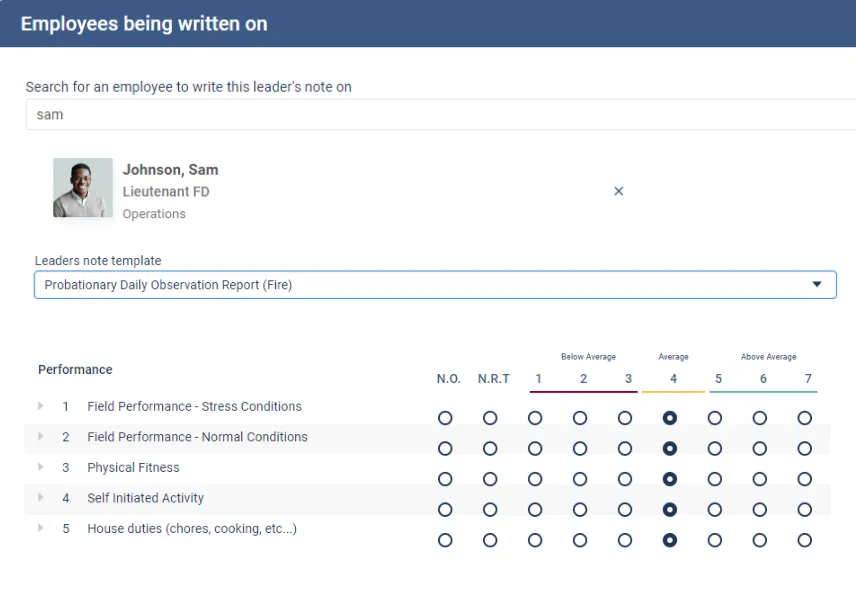
A daily observation report (DOR) is the FTO's record of one shift, rating the recruit in each category that was observed and explaining the high and low points in a short narrative. It's the core of recruit performance tracking, because it captures what happened while it's fresh rather than what a supervisor remembers a month later.
The POST form shows what a good daily observation report contains:
- A fixed scale. 1 is unacceptable, 4 is acceptable and 7 is superior. POST says "a rating of 4 is the minimum acceptable score within each category to meet the standard for solo patrol officer."
- Documented situations. Any rating of 1 or 7 has to be backed by a written description of the event that earned it.
- Not observed and not responding to training. N/O marks a category the FTO didn't see that day. NRT marks a recruit who isn't improving after instruction, which is the early signal you most need.
- Remedial training minutes logged against the category they addressed.
- A narrative naming the most and least satisfactory performance of the day. POST's guidance is to "critique the performance, not the personality" and to report facts rather than conclusions.
- Signatures from the FTO and the recruit, and review by the FTO sergeant or coordinator.
File the report the same shift. If it takes an FTO twenty minutes at the end of a long day, it won't get done well, which is the first thing to test in any field training officer software. In Essential Personnel, FTOs file the daily observation report from a Leader's Notes template on the recruit's profile, so the format is identical for every trainer and the report reaches the sergeant without a paper handoff.
3. Summarize weekly and by phase: the San Jose FTO model and the PTO model
Daily reports show what happened; weekly and phase summaries show the trend. At the end of each week, the FTO or sergeant notes which categories are improving, which are stuck, and what the plan is for next week. At the end of each phase, a formal evaluation decides whether the recruit moves on, repeats or extends.
In the San Jose FTO model, the daily reports roll up into phase evaluations. California POST requires a field training program of at least 10 weeks, and a POST Police Training Program of at least 15 weeks. Under POST, the program supervisor or designee reviews and signs the daily reports or completes weekly written summaries, and a completion record and competency attestation closes the program.
The PTO model runs on weeks instead of days. Its recommended length is 15 consecutive weeks: one week of integration, four three-week training phases, and two weeks of evaluation. Recruits complete weekly Coaching and Training Reports, problem-based learning exercises and a neighborhood portfolio exercise, with a week-long mid-term and final evaluation and a board of evaluators at the end. If your agency runs PTO, the weekly coaching and training report is the record you track, and the same rule applies: the same form, filed on time, reviewed by someone above the trainer.
4. Sign off skills as they're shown
Ratings tell you how well a recruit performs; a skills checklist tells you what they've actually done. Keep a task list for field training, from a vehicle pursuit policy review to a DUI arrest and a death notification, and have the FTO sign off each item when the recruit shows it, with the date and the trainer's name.
The checklist matters most when recruits rotate between trainers and shifts. Carteret County Sheriff's Office uses Qualifications and checklists in Essential Personnel so that when a deputy shows proficiency on one shift, the next FTO can see it's been covered. In the agency's words: "If someone shows proficiency in radio communication on night shift, that FTO checks it off. The next FTO knows it's been covered but can still reinforce it."
Before release to solo duty, the checklist should be complete or have a written reason for each open item, and the record should show which FTO signed off which skill.
5. Make ratings comparable between FTOs
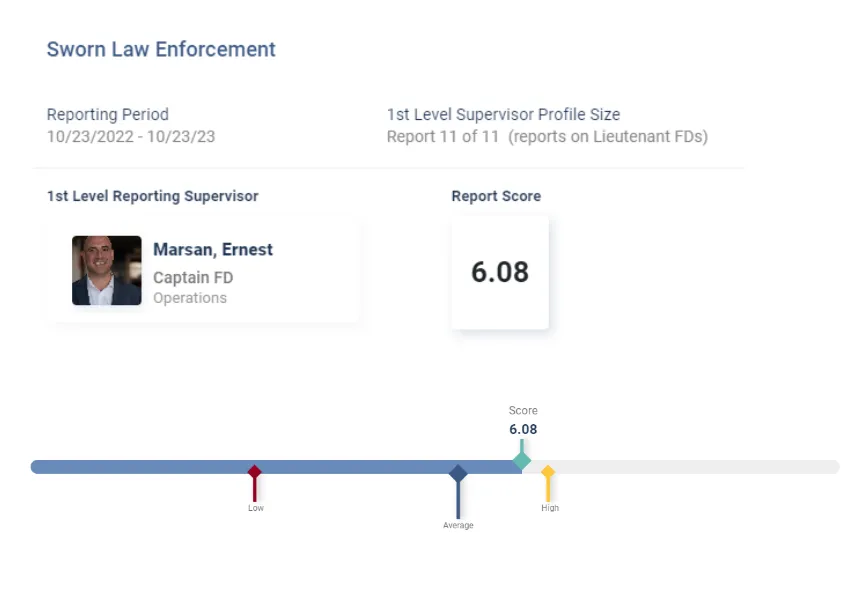
FTO ratings are only useful if a 4 from one trainer means the same as a 4 from another. Train every FTO on the same written guidelines, rotate recruits between trainers, have the sergeant review a sample of reports each week for rating drift, and compare each recruit's scores with how that FTO rates everyone.
- Train the trainers. Every FTO program depends on them. POST requires a 40-hour FTO course before an officer is assigned as an FTO, and a 24-hour update every three years.
- Rotate. Two or three trainers per recruit gives you more than one opinion and exposes a rater who is out of line with the others.
- Calibrate. Once a quarter, have every FTO rate the same written scenario and compare the results.
- Normalize. Compare each rating with the trainer's own average. Essential Personnel's Score Reports use an algorithm that normalizes scores for hard graders and easy graders, so a class can be compared fairly and a recruit's outcome doesn't depend on which FTO they drew.
6. Act early on a struggling recruit
When a recruit scores below acceptable in the same category for several shifts, or is marked not responding to training, put a remedial training plan in writing. Name the category, the training given, who gives it, the deadline, and what success looks like. Then document the result, whether the recruit improves or not.
Set the trigger in your FTO program directive so every trainer acts the same way. For example, you might require a written remedial plan after three consecutive ratings below 4 in one category, and a review by the FTO coordinator after any NRT. An extension of a phase, or a return to an earlier one, should be recorded with the reason and the new end date.
Remedial plans are counseling records, and they need to hold up later. Our guide to counseling documentation covers how to write them. In Essential Personnel, Leader's Notes includes a performance improvement plan template, and the plan sits on the same profile as the daily reports it responds to.
7. Close probation with a documented decision
Probation should end with a decision, not a date passing. Before the end of probation, the supervisor reviews the whole record, from academy to the latest probationary evaluation, and writes a recommendation: pass, extend where your rules allow it, or release. The chain of command signs it, and it goes on the recruit's file.
This is where tracking pays off. A probationary employee often has fewer protections than a permanent one, but a release still has to be consistent with your rules and free of discrimination, and the record has to show the agency gave the recruit a fair chance to meet a clear standard. Our guide on releasing an employee covers the legal side.
Champaign Fire Department put it plainly: "We don't want someone sliding off probation just because we didn't have the documentation to support a tough decision."
8. Carry the record forward
Don't archive the recruit file when probation ends. The field training record is the first chapter of an officer's career record, and it's useful later for promotion, assignment to specialty units, training needs and early warning reviews. Keep it on the same profile as everything that follows.
The same habits that make recruit tracking work, frequent documentation on a fixed standard, carry into everyday performance management and into your early warning system. For the wider picture, see our guide to professional standards, and for certifications and training hours after probation, our comparison of training record software.
The numbers to watch for recruit performance
Track a small set of numbers for each recruit and for each class: average rating by category, the count of ratings below acceptable, NRT entries, remedial training minutes, open checklist items, days to release to solo duty, phase extensions, and how many recruits complete field training and probation. Compare classes and FTOs, not just individuals.
Together these make a new hire performance scorecard. Ratings, below acceptable counts and NRT entries are leading indicators you act on in weekly reviews with the FTO; release dates, extensions and completion rates are the lagging ones.
| Measure | What it tells you | Look at it |
|---|---|---|
| Average rating by category | Where each recruit, and each class, is strong or weak | Weekly |
| Ratings below 4 in a row | A skill that isn't improving and needs a remedial plan | Every report |
| NRT entries | A recruit who isn't responding to instruction | Every report |
| Remedial training minutes | How much extra time a recruit needs, and on what | Weekly |
| Open checklist items | Skills not yet shown before a phase ends | End of each phase |
| Days to solo, and phase extensions | How a class is progressing against the program length | Each class |
| Rating spread by FTO | Trainers who grade much harder or easier than the rest | Quarterly |
| Completion and attrition by stage | Whether you lose recruits in the academy, field training or probation | Each class and each year |
The last two are the ones agencies most often miss when they track recruit performance. A high attrition rate in one phase, or with one trainer, usually says more about the program than about the recruits.
Fire recruits and probationary firefighters
Fire departments track recruits the same way: a written standard, structured evaluations by company officers through recruit school and probation, task book sign-offs, and a documented decision before probation ends. The categories change, from report writing and officer safety to fireground skills, physical fitness and station duties, but the record works the same.
Champaign Fire Department in Illinois uses Essential Personnel to document recruit and probationary firefighter performance. Supervisors log notes and evaluations in real time from any device, every supervisor uses the same system across shifts and stations, and recruits can see their own performance logs, which leads to clearer expectations and more focused coaching. Jason Rector, Deputy Chief, said: "I wish I had Essential Personnel 15 years ago."
Field training officer software: running recruit tracking in Essential Personnel
Essential Personnel keeps a recruit's academy results, daily observation reports, phase evaluations, skill sign-offs, remedial plans and probationary evaluations on one profile. FTOs file reports from templates, sergeants review them as they arrive, and training staff compare a whole class in Score Reports and Analytics, with ratings normalized for hard and easy graders.
Essential Personnel is FTO software built for public safety rather than a general HR system with a field training form added. The pieces, as they're described on essper.com:
- Field Training with configurable evaluation workflows, digital documentation and real-time progress tracking.
- Leader's Notes templates for field training daily observation reports, performance improvement plans, instructor reviews and formal counseling.
- Qualifications for task books, new employee check-offs and specialty equipment check-offs.
- Score Reports with score normalization, and Analytics for a class view.
- Documents of Record for commendatory and corrective entries with routing and approval.
- Career Paths, so the record carries into promotion eligibility after probation.
When you compare FTO software, ask to file a daily observation report in the demo and time it, then ask to see a class report. Carteret County Sheriff's Office moved its field training program from paper to Essential Personnel, digitizing daily observation reports, end-of-phase evaluations and performance memos, each linked to the trainee's profile. "Essential Personnel stores all of the documentation in one centralized system. It's cleaner, faster, and more reliable," said Major Derek Moore. The full account is in the Carteret County story.
"That level of visibility helps us catch issues early or give praise when it's due."
Derek Moore, Major, Carteret County Sheriff's Office, North CarolinaField training, Leader's Notes, Score Reports and Qualifications are part of the Talent Management suite, published at $85 per user per year, or $175 per user for all four suites, plus a one-time $3,000 startup fee, on the pricing page. The platform is hosted in AWS GovCloud, aligned with the FBI CJIS Security Policy and covered by an annual SOC 2 Type II report, as set out on the security page. It's available through GSA Advantage, NASPO, Omnia Partners, NCSA and VSA.
See your field training program on one record per recruit
Bring your daily observation report and your phase evaluations, and we'll show you how they run for a department your size. Call (910) 390-0011 or email info@essper.com.
Frequently asked questions
Write the standard down, then document every shift against it with a daily observation report on a fixed scale. Summarize weekly and at each phase, sign off skills on a checklist, put remedial training in writing, and close probation with a documented decision. Software such as Essential Personnel keeps academy, field training and probation records on one profile per recruit.
It's the field training officer's record of one shift. The FTO rates the recruit in each observed category, usually on a 1 to 7 scale where 4 is acceptable, marks categories not observed, notes remedial training, and writes a short narrative on the best and weakest performance of the day. California POST requires daily evaluation of every trainee by their assigned FTO.
It's the field training approach that began at the San Jose Police Department in the early 1970s and is still widely used across the US. Recruits rotate through phases with different FTOs, who rate them every shift on a 1 to 7 scale against standardized evaluation guidelines. California POST's field training program and daily observation report follow this model.
An FTO program rates the recruit every shift in a daily observation report. The Police Training Officer model, developed by the COPS Office with the Reno Police Department and PERF, uses problem-based learning over 15 weeks: four three-week phases, weekly coaching and training reports, a neighborhood portfolio exercise, and mid-term and final evaluations. The PTO acts mainly as a trainer rather than an evaluator.
Give every FTO the same written definitions of a 1, a 4 and a 7 in each category, rotate recruits between trainers, have the sergeant review reports weekly for drift, and calibrate by having all FTOs rate the same scenario. Then compare each rating with how that FTO rates everyone. Essential Personnel's Score Reports normalize scores for hard and easy graders.
The standard the officer was held to, the daily and phase evaluations that show where they fell short, each remedial training plan and its result, any extension and its reason, and a written recommendation signed by the chain of command. The record should show the agency gave a fair chance to meet a clear standard. Check your civil service rules and labor agreement first.
Average rating by category, consecutive ratings below acceptable, not responding to training entries, remedial training minutes, open checklist items, days to release to solo duty, phase extensions, rating spread by FTO, and completion and attrition at each stage. Look at them for each recruit, each class and each trainer, because a pattern across a class usually points at the program.
Pick six to eight measures tied to your written standard: average rating by category, ratings below acceptable, NRT entries, remedial training, open checklist items and days to solo release. Review them weekly with the FTO, and coach on the leading indicators before they turn into extensions or releases. In Essential Personnel, Score Reports show these measures for a whole class at once.
Agencies use paper forms, spreadsheets, general HR systems, or field training officer software built for public safety such as Essential Personnel. Essential Personnel provides daily observation report templates, skill checklists, normalized Score Reports and probationary evaluations on one profile per recruit. Its Talent Management suite, which includes field training, is published at $85 per user per year.

About this article
Written by Scott Monroe, Chief Executive Officer & Co-Founder, Essential Personnel. Published 27 October 2026.
Essential Personnel makes the software described here, and the product screenshots are from the platform. Pricing, hosting and purchasing details are taken from essper.com, and the customer quotes are reproduced from the Carteret County Sheriff's Office and Champaign Fire Department stories on essper.com. Field training requirements are taken from California POST's published field training program materials and daily observation report, and the PTO model from the COPS Office Police Training Officer manual, checked in October 2026. This article is general information and isn't legal advice.
