
Running a promotion process with no comprehensive view of your personnel? Here's how to fix it
The announcement is going out, the eligibility list is due, and you can't answer simple questions about your own people. Who has the time in grade for sergeant? Who finished the supervision school? Whose last three evaluations clear the bar? Who has an open internal affairs case? The answers exist, but they're spread across HR, payroll, the training office, the state certification portal, a shared drive of evaluations and a filing cabinet in professional standards.
This guide is for police chiefs, sheriffs, fire chiefs, and the command staff and HR leaders who run a promotion process. It shows how to build a comprehensive view of your personnel before the next list: what the view should contain, where each record lives, a step by step fix, a sample skills matrix, a 30 day plan if the process is already close, and what has to stay out of it.
The short answer: how to fix a promotion process with no comprehensive view of your personnel
Write down the eligibility requirements for the rank, pull every member's personnel records from each place they live into one profile per person, and check everyone against the requirements in a skills matrix. Have members confirm their own records, then run a talent review so the promotion process starts from verified facts instead of memory.
Essential Personnel does this in software: one profile per member with training, certifications, evaluations, awards and career history, Career Paths that hold each rank's requirements, and a Promotion Eligibility view that shows who qualifies now and how many requirements everyone else has left.
The rest of this guide walks through each part. If your question is how much weight performance should carry once you have the view, our guide to performance in promotions covers the exam, the assessment center, evaluation weights and adverse impact in detail.
Why you don't have a comprehensive view of your personnel
Most departments don't lack the information. They lack one place that holds it. Personnel records are split across systems that were each bought for a different job, so a promotion process turns into weeks of emails, spreadsheets and phone calls to rebuild a picture that should already exist.
A typical police department or sheriff's office keeps its people data in at least six places:
- HR and payroll hold hire date, rank, step, leave balances and the official personnel file.
- The training office keeps course rosters, in-service hours and sign-in sheets, often in its own spreadsheet.
- The state certification portal holds POST or fire certification status, which the department has to look up member by member.
- Supervisors keep evaluations, counseling notes and commendation memos, sometimes in a shared folder and sometimes in a desk drawer.
- Professional standards or internal affairs holds complaints, investigations and discipline, behind access controls for good reason.
- Scheduling knows acting time, special assignments and team memberships, and nobody else does.
Each system answers its own question well. None of them answers the question a promotion process asks, which is how each person measures up against the requirements of the next rank. Corporate HR guides make the same point: a promotion decision built on the last performance review alone doesn't give leaders the full picture. In public safety the stakes are higher, because a police promotion process runs under civil service rules and can be appealed, grieved or litigated, and the department has to show its work.
What a comprehensive view of your personnel records should contain
A comprehensive view puts the records that bear on promotion eligibility and readiness on one profile per member: rank and time in grade, certifications, training, evaluations, commendations, documented counseling and sustained discipline, special assignments and acting time. Each item needs a source and a date.
| Record | Where it usually lives | Why it matters in a promotion process |
|---|---|---|
| Rank, hire date and time in grade | HR and payroll | Almost every promotion policy sets a minimum time in grade before a member can sit for the next rank |
| Certifications and licenses | State certification portal, training office | Required certifications are usually hard minimums, and an expired one can disqualify a candidate on the day the list closes |
| Training and schools | Training office spreadsheets, course rosters | Supervision, instructor and specialty schools are often listed requirements or scored items |
| Performance evaluations | Supervisors, shared drives, the personnel file | Many agencies set a rating threshold for eligibility or score several years of ratings |
| Commendations and awards | Command memos, award board minutes | Evidence of performance above the job description, and often a scored item |
| Counseling and sustained discipline | Supervisors, professional standards | Written rules decide how recent sustained discipline affects eligibility |
| Open investigations | Internal affairs | Some policies allow a candidate to be skipped while an investigation is open |
| Special assignments, teams and acting time | Scheduling, team rosters | Shows experience with the duties of the next rank before the promotion |
The table is a starting point, not a mandate. In a police promotion process, your promotion policy, your civil service rules and your labor agreement decide which of these personnel records count, and the view should mirror them exactly. A view that adds criteria the policy doesn't list invites a grievance.
How to fix it: seven steps to a comprehensive view before the promotion process
1. Write down the promotion eligibility requirements for each rank
Start from your written promotion order, civil service rules and labor agreement, and list every requirement for each rank as a checkable item. Published orders show what this looks like in a police promotion process. Gaithersburg Police Department in Maryland requires one year in grade and weighs job knowledge, education and training, experience and performance. Takoma Park Police Department sets an evaluation gate: a rating of "Meets/Sometimes Exceeds" or higher on the evaluation before the process starts. For fire, Mukwonago Fire Department in Wisconsin lists five years of service, Firefighter II, EMT and Fire Officer I for lieutenant.
Promotion eligibility written this way becomes a checklist you can run against every member. If a requirement can't be checked from a record, rewrite it until it can.
2. Inventory every source of personnel records and name an owner
List each place a record needed for promotion eligibility lives, who owns it, how current it is and how you'll get it out. Give each source one named owner for the duration of the promotion process. This is the step that shows you where the gaps are: the training hours nobody logged, the evaluations that were never finished, the certification renewals that only live on the state portal.
3. Build one profile per member
Bring the records together on a single profile for each person, with a date and a source on every entry. A spreadsheet with one row per member and one column per requirement works for a small agency running its first promotion process. Past a few dozen members, or once you're tracking several ranks, a spreadsheet starts to drift, and a personnel system that keeps the profile current between processes saves you from rebuilding it every two years.
4. Check everyone against the requirements in a skills matrix
A skills matrix puts members down one side and requirements across the top, and marks each cell met, in progress or missing. Washington State's succession planning toolkit builds a similar competency matrix that rates each requirement from 1, little relevance, to 4, critical. For a promotion process, keep the hard minimums (time in grade, required certifications) separate from the items that are scored, so nobody confuses promotion eligibility with ranking. The sample in the next section shows the layout.
5. Have members confirm their own records
Send each member their profile and give them a short window to correct it. Members know about the school they took on their own time and the commendation that never reached the file. Gaithersburg's order puts the burden on documentation: the commander "must ensure that all information in the supervisory review is supported by documentation," and most disagreements are settled "by reviewing supporting documentation or confirming the lack of documentation." Confirmation before the list opens is far cheaper than an appeal after it closes.
6. Run a talent review with more than one rater
A talent review is a structured meeting where command staff look at the verified records together and agree on each member's readiness. HR guides call this calibration, and its purpose is the same in a police promotion process: no single supervisor's view decides a member's standing. Look at several years of evaluations, not just the last one, and correct for supervisors who rate hard or easy. Keep the talent review separate from the scored parts of a civil service promotion process, which stay with the exam and the assessment center.
7. Close the gaps before the announcement, and keep it current
The talent review will show members who are one certification or one school short. Telling them early, and scheduling the training, is fairer than letting them find out from the eligibility list. Then keep the profiles current as training is finished and evaluations are signed, so the next promotion process starts from a view you already have.
A sample skills matrix for a police promotion process
A skills matrix for a sergeant promotion process lists each candidate against the rank's written requirements. Hard minimums decide eligibility. Scored items feed the talent review and the promotion board. Every mark should trace back to a dated record.
| Member | Time in grade (min. 3 years) | Required certification current | Supervision school | Last 3 evaluations at standard | Sustained discipline in last 12 months | Eligible? |
|---|---|---|---|---|---|---|
| Officer A | Met (6 years) | Met | Met | Met | None | Yes |
| Officer B | Met (4 years) | Met | Missing, next class in 6 weeks | Met | None | Not yet |
| Officer C | Missing (2 years) | Met | Met | Met | None | Next process |
| Officer D | Met (8 years) | Expires before list closes | Met | 2 of 3 | None | Check policy |
The thresholds in the sample are placeholders for a typical police promotion process. Replace them with the words of your own promotion order. The two rows that need a decision, Officer B and Officer D, are exactly the cases a comprehensive view is meant to surface before the announcement rather than during an appeal.
If the promotion process opens in 30 days
With a month to go, don't try to build the perfect system. Limit the view to the requirements in your promotion order, pull only those personnel records, have members confirm them, and fix the data that would change someone's eligibility.
A four week plan
- Week 1: list the written requirements for the rank, name an owner for each source, and pull the roster of everyone who could plausibly be eligible.
- Week 2: pull time in grade, certifications, required training and the evaluations the policy counts, and fill in the skills matrix.
- Week 3: send each member their profile to confirm, chase missing evaluations and certificates, and log corrections with the source document.
- Week 4: run the eligibility check, have professional standards confirm the discipline and open investigation rules are applied as written, and lock the list.
After the list is out, keep the matrix. It's the first draft of the system you'll want running long before the next promotion process.
What stays out of the view: wellness records, unfounded complaints and anything the policy doesn't list
A promotion view should hold only what your promotion policy says counts. Wellness, medical, peer support and counseling referral records stay out entirely. Unfounded or exonerated complaints shouldn't count against anyone, and open investigations follow the written rule your policy sets.
Wellness records belong in a separate, confidential file under federal disability law, and using them in a promotion decision invites exactly the claim your agency wants to avoid. Our guide to wellness records explains where those records belong and who can see them. Internal affairs files need the same care: give the promotion process the outcome the policy asks for, such as sustained discipline in the last year, not the investigative file.
Finally, check the results. Under the federal Uniform Guidelines on employee selection, a selection rate for any race, sex or ethnic group that's "less than four-fifths (4/5) (or eighty percent)" of the highest group's rate is generally regarded as evidence of adverse impact. A comprehensive view makes that check possible at every stage, from who was eligible to who was promoted, instead of only after a complaint.
From one promotion list to succession planning
Once the view exists, it answers a bigger question than who's eligible today: who could hold each rank in 18 months, and which ranks have too few people coming up. That's succession planning, and it starts from the same personnel records and the same skills matrix.
Run the talent review once a year, not only when a list is due. Look at each rank and count how many members are eligible now, how many are one or two requirements short, and how many in that rank are close to retirement. A rank with two eligible members, both near retirement, is a succession planning problem you can see years before it becomes a vacancy. Fire departments run the same exercise with task books and acting officer time, and our ranking of promotion readiness systems for fire departments compares the software that tracks it.
The same view feeds other decisions. It shows who's qualified for a specialty team, which supervisors haven't finished evaluations, and where training dollars should go. If you're comparing systems, our guide to personnel software lists what to ask for.
How Essential Personnel gives you a comprehensive view of your personnel
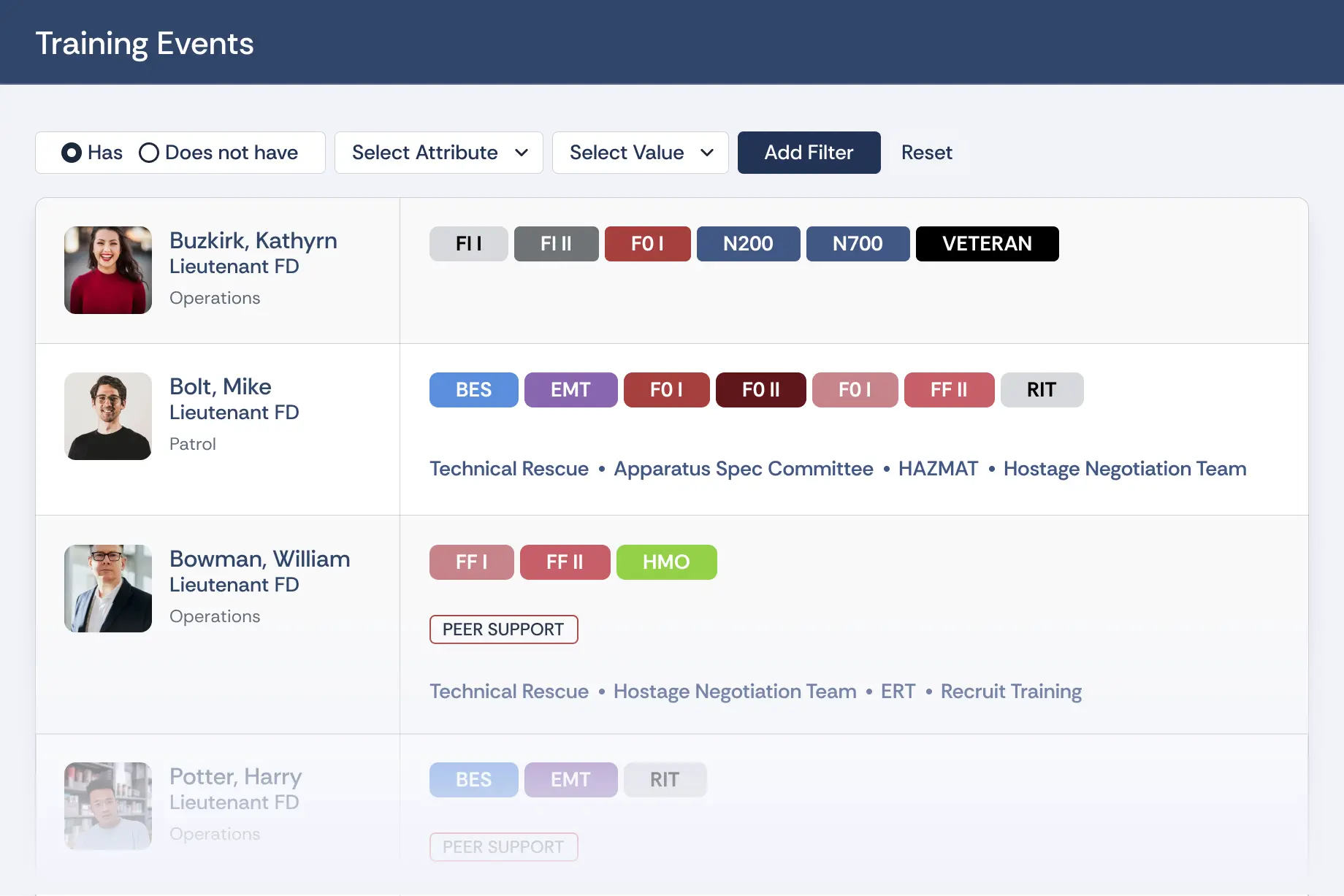
Essential Personnel keeps one profile per member with training, certifications, qualifications, evaluations, awards, career history and documents of record. Career Paths hold each rank's requirements and map completion automatically, and Promotion Eligibility shows who qualifies now and how many requirements remain for everyone else.
Career Paths let an agency define custom paths with the requirements for each rank and position, with employee confirmation. Because completion is mapped from the other modules, a member's progress updates as they finish training, earn certifications and complete qualifications, without anyone re-entering it for the promotion process.

The Roster filters the whole department by certification, qualification and other attributes, so you can see in one screen who has a required certification and who doesn't. Score Reports normalize evaluation scores for hard and easy graders, which is the comparability problem every talent review runs into. Documents of Record hold commendations and corrective documents with routing and approval, so they're on the profile when the promotion board asks.
Critical incidents in Essential Personnel are visible only to roles the agency designates, so a promotion review never needs to see them. The Talent Management suite, which includes Team Builder, Career Paths, performance and training tools, is $85 per user per year on its own. The Total Solution with all four suites is $175 per user per year, plus a one time $3,000 startup fee, on Essential Personnel's published pricing. The platform is hosted in AWS GovCloud, aligned with the FBI CJIS Security Policy, and available through GSA Advantage, NASPO, Omnia Partners, NCSA and VSA. See the full Talent Management suite for every tool.
See your next promotion list before you announce it
Tell us the requirements for the rank, and we'll show you the eligibility view, the skills matrix and the profile behind each name, live. Call (910) 390-0011 or email info@essper.com.
Frequently asked questions
List the written eligibility requirements for the rank, pull each member's personnel records into one profile, and check everyone in a skills matrix. Have members confirm their records, then run a talent review. Essential Personnel does this with one profile per member, Career Paths for rank requirements, and a view of who's eligible now.
Rank and time in grade, certifications, training and schools, performance evaluations, commendations, documented counseling and sustained discipline, special assignments and acting time. Each entry needs a date and a source. Include only what your promotion policy, civil service rules and labor agreement count, and keep wellness and medical records out entirely.
It's a grid with members down one side and the rank's requirements across the top, with each cell marked met, in progress or missing. It shows who's eligible, who's close and what each person still needs. Keep hard minimums, like time in grade, separate from scored items so eligibility and ranking don't get mixed up.
A talent review is a meeting where command staff look at verified records together and agree on each member's readiness, so no single supervisor's opinion decides it. It doesn't replace the exam or assessment center in a civil service process. It prepares people for them and gives you an honest picture of your bench.
A focused version for one rank can be done in about four weeks: a week to list requirements and owners, a week to pull records, a week for members to confirm them, and a week to check eligibility and lock the list. Keeping it current afterward is what saves you from rebuilding it next time.
Only as your written policy allows. Some agencies let a candidate be skipped while an investigation is open, and many weigh sustained discipline within a set period. Give the promotion review the outcome the policy names, not the investigative file, and never count unfounded or exonerated complaints against a candidate.
For a small department running one promotion process, yes. One row per member and one column per requirement works. The trouble starts between processes, when nobody updates it, and with several ranks at once. Software that maps training and certifications to rank requirements automatically keeps the view current without a separate cleanup project.
It shows, rank by rank, how many members are eligible now, how many are one or two requirements short, and how many are near retirement. A rank with few eligible members and several retirements coming is a gap you can fix with training and assignments years before it turns into a vacancy nobody can fill.

About this article
Written by Scott Monroe, Chief Executive Officer & Co-Founder, Essential Personnel. Published 5 November 2026.
Essential Personnel makes the software described in the last section, and the screenshots are from the platform. Pricing, hosting, module and purchasing details are taken from essper.com. Promotion requirements are quoted from the published promotion orders of the Gaithersburg and Takoma Park police departments in Maryland and the Mukwonago Fire Department in Wisconsin, the competency matrix from Washington State's succession planning toolkit, and the adverse impact rule from 29 CFR 1607.4, all checked in November 2026. The skills matrix is a sample with placeholder thresholds. This article is general information and isn't legal advice.
