
How to use performance in promotion decisions: what police departments should consider
Most chiefs and sheriffs want performance to count when they promote. The trouble is that in many departments, performance is the weakest evidence in the promotion file. Annual ratings sit at "meets standards" for nearly everyone, one sergeant grades hard and another grades easy, and the commendations, counseling and training that show how someone actually works are scattered across folders and systems. So the written test and the oral board decide the list, and performance gets a nod at the end.
This guide covers what to consider when you use performance in promotion decisions, and how to turn it into evidence-based promotion criteria that hold up in a civil service process. It explains how a police promotion process differs from the corporate advice most search results give, where performance can enter the process, how to make performance appraisals comparable and fair, how to handle discipline and open investigations, and how to get a comprehensive view of your personnel before the next list. It draws on published promotion orders from police departments in Maryland, Florida and New Jersey, a fire department policy from Wisconsin, the EEOC's selection guidelines, and departments that keep their performance records in Essential Personnel.
What should you consider when using performance in promotions? The short answer
To use performance in promotion decisions, start from a job analysis of the rank, then decide whether performance is a gate, a scored part of the process, or a factor in the final selection. Use two to three years of ratings rather than the last one, make ratings comparable across supervisors, require documentation behind every score, set written rules for discipline and open investigations, check the results for adverse impact, and publish the promotion criteria and weights before the process starts.
Departments that keep their performance records in Essential Personnel use Score Reports, which normalize ratings for hard and easy graders, and see each candidate's evaluations, commendations, counseling, training and certifications on one profile, with Promotion Eligibility showing who meets the requirements for the next rank.
Two questions sit under every one of those steps. Does the evidence predict how someone will do in the next rank, not just the current one? And could you defend it, line by line, to a candidate who was passed over, a union, a civil service commission or a court? Performance earns its place in a police promotion process when the answer to both is yes.
How a police promotion process differs from corporate promotion advice
Most advice on promotion criteria assumes a manager can promote whoever they choose. In a police department or sheriff's office, promotion usually runs through a written exam, an assessment center or oral board, and a ranked eligibility list, under civil service rules, a collective bargaining agreement and federal law. Performance has to fit inside that structure, as evidence a candidate can see and challenge.
The differences that matter when you add performance to the process:
- Civil service rules. Many jurisdictions limit who the chief can pick from the eligibility list. New York's Civil Service Law section 61, for example, says a promotion "shall be made by the selection of one of the three persons certified" as standing highest on the list, the familiar rule of three. Takoma Park, Maryland lets the chief choose from the top four; Gaithersburg, Maryland promotes in list order unless an open internal investigation or the rule of three applies.
- Collective bargaining. Minimum requirements, weights, seniority points and appeal rights are often written into the labor agreement. South Miami's general order says the minimum requirements to enter its sergeant process are "described in the Collective Bargaining Agreement."
- Federal law. The EEOC's Uniform Guidelines on Employee Selection Procedures (29 CFR part 1607) cover selection procedures used for promotion, including performance ratings that feed a score. A procedure with adverse impact has to be shown to be job related.
- Written appeals. Candidates can usually appeal a score or a decision. If a performance rating is part of the score, the rating itself becomes something a candidate can contest.
So the corporate advice is right in spirit, and the cited HR guides say the same thing: clear promotion criteria, several signals of readiness, consistent metrics, and "performance data, not gut feeling." A police promotion process just has to write all of it down in advance and keep the evidence.
What counts as performance in a police promotion
Performance in a promotion decision should mean more than the last annual rating. The strongest evidence combines rated performance over several years with documented work: commendations and awards, counseling and corrective entries, training and certifications, specialty and acting roles, and how the officer handles the duties of the next rank when given the chance.
| Evidence | What it shows | Watch for |
|---|---|---|
| Performance appraisals, two to three years | Sustained performance in the current rank | Rating inflation and supervisors who grade differently; a single year that reflects one supervisor |
| Commendations and awards | Documented work above the standard | Units or shifts that nominate more often than others |
| Counseling, corrective entries and discipline | Conduct and judgment | Retention periods in policy and the labor agreement; unfounded complaints |
| Training and certifications | Preparation for the next rank | Who was given access to schools; required versus elective courses |
| Specialty, FTO, instructor and acting roles | Supervisory and leadership experience | Who was offered the chance to act up |
| Attendance and productivity | Reliability and work output | Protected leave, which can't be counted against anyone; quotas |
One caution runs through all of it. Being good at the current job isn't the same as being ready for the next one. A study of sales workers at 131 U.S. firms, published as the Peter Principle paper in 2019, found that firms weigh current sales performance heavily when choosing managers, even though it's an imperfect predictor of how well someone will manage. A top patrol officer isn't automatically a good sergeant. That's why performance usually works best as one part of a process that also tests supervisory judgment directly, through an assessment center or a structured oral board.
1. Start from the job analysis of the rank
Before you decide how much performance counts, write down what the rank actually requires. A job analysis lists the tasks, knowledge, skills and abilities of a sergeant or lieutenant in your department, and every part of the promotion process, including the performance component, should measure something on that list.
This is what makes the process defensible. Gaithersburg's order says the purpose of its promotional process is "to select the best qualified candidates in a valid and fair manner," and that "all elements used to evaluate candidates for promotion will be job-related and non-discriminatory." If your performance evaluation rates things the next rank doesn't need, or misses things it does, fix the evaluation form before you score it. A testing consultant or an industrial and organizational psychologist usually runs the job analysis and sets the weights with the chief; Gaithersburg sets its weights with its "hired promotional testing consultant."
2. Decide where performance enters the process
Performance can enter a police promotion process in three places: as an eligibility gate, as a scored component, or as a factor in the chief's final selection from the list. Published orders use all three, with scored weights from 10 to 50 percent of the final score.
| Agency | Where performance enters | How |
|---|---|---|
| Takoma Park PD, MD (GO 414) | Eligibility gate, then final selection | "Meets/Sometimes Exceeds" or higher on the last annual evaluation to compete; the chief then weighs commendations, proficiency and attendance when choosing from the top four |
| South Miami PD, FL (GO 16.1) | Scored, 10 percent | "Administrative review (average of last 3 evaluations)" alongside a 50 percent written exam, 20 percent oral board and 20 percent scenario assessment |
| Gaithersburg PD, MD (GO 207.1) | Scored, within a 35 percent structured resume | Resume with a supervisory review and the commander's confirmation of supporting documentation, scored by assessors from other agencies |
| Riverdale, NJ (Ordinance 07-2018) | Scored, 50 percent for sergeant | A promotional evaluation of past performance in rank, attendance, discipline, leadership and judgment by the chief and senior officers |
A gate is simple and hard to dispute, but it does little when most ratings are "meets standards." A scored component makes performance count, but every point is now open to appeal, so the rating behind it has to be consistent and documented. Final selection gives the chief discretion within the rule of three or the rule of the list, and it needs written criteria so the choice isn't seen as favoritism. Many departments use two of the three. Whichever you choose, put it in the general order and announce the weights before the process, as Takoma Park requires.
3. Use several years of ratings, not the last one
Average two to three years of performance evaluations rather than relying on the most recent one. A single year often reflects one supervisor, one assignment and whatever happened in the six weeks before the review. South Miami averages the last three evaluations; Mukwonago Fire Department in Wisconsin looks at the previous two years.
Several years also smooths out transfers. An officer who moved from patrol to investigations to a new sergeant halfway through the year shouldn't be judged on one rater's view. Set a rule for gaps, such as a period of leave or a new hire with only one evaluation, so nobody is scored on a different basis without saying why.
The year itself has to be built from evidence, not memory. When supervisors record observations, commendations and counseling as they happen, the annual evaluation assembles from a year of documented work. Departments using Essential Personnel do this in Leader's Notes, with templates for formal counseling, performance improvement plans and instructor reviews. Our guide to counseling documentation covers how to write those entries.
4. Make ratings comparable across supervisors
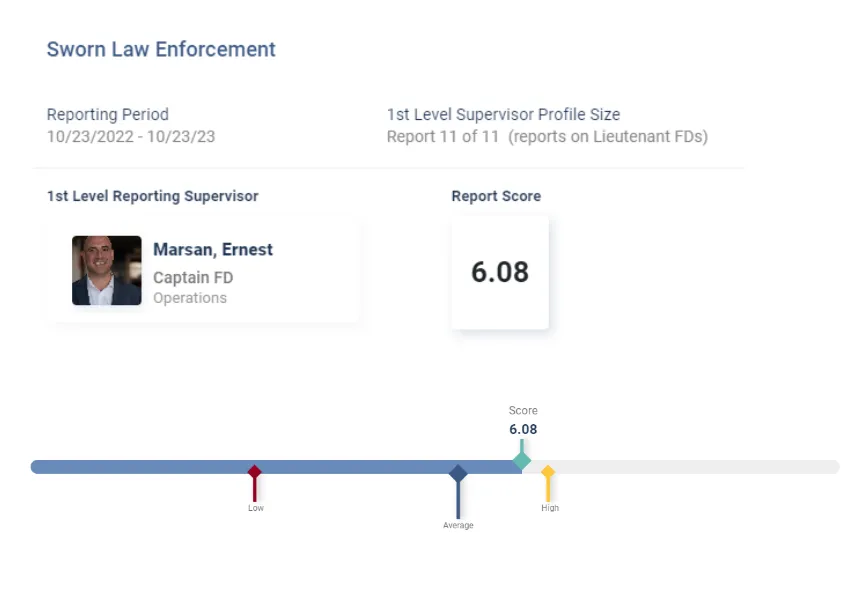
Before ratings go into a promotion score, adjust for supervisors who grade hard or easy. If one sergeant rates everyone a four and another rates the same work a three, the raw scores reward the officer's assignment, not their performance. Compare each rating with that supervisor's own average, and train raters on the same standard.
There are three practical ways to do it:
- Calibrate. Hold a rater calibration session before each rating period, with written behavioral anchors for every score on the form, so a "4" in judgment means the same thing on every shift.
- Normalize. Interpret each rating relative to how that supervisor rates everyone. Essential Personnel's Score Reports do this with an algorithm that normalizes scores for "hard graders" and "easy graders," so a promotion board can use the result without re-litigating how each sergeant grades.
- Review the spread. Before the list is built, look at average ratings by supervisor, unit and shift. A unit where every officer exceeds standards needs a conversation before those ratings count for points.
5. Require documentation behind every score
Every performance point in a promotion score should trace back to something written down: an evaluation, a commendation, a training record, a counseling entry. If a candidate disputes a rating, the first question is whether the documentation supports it. A score that rests on a supervisor's recollection is the one most likely to be overturned on appeal.
Gaithersburg builds this into its order. The commander must "ensure that all information in the supervisory review is supported by documentation," and when a candidate disagrees, "in most cases, disagreements can be resolved by reviewing supporting documentation or confirming the lack of documentation." Only what documentation can't settle goes to a three-member appeal board chaired by the chief. Supervisors are also told to give candidates access to their personnel files on request, so nobody is scored on a record they haven't seen.
The same habit protects you in the other direction. A department that documents performance well can explain why a candidate wasn't promoted with the same file it would use to defend discipline.
6. Set written rules for discipline and open investigations
Decide in advance how discipline affects promotion: which sustained findings make a candidate ineligible, for how long, whether an open internal investigation pauses a promotion, and how long records count under your retention rules and labor agreement. Then apply the same rule to every candidate on the list.
Published orders handle it in different ways. Gaithersburg lets the chief declare a candidate ineligible for two years after sustained discipline with aggravating circumstances under Maryland's disciplinary matrix, and lets a candidate under an open internal investigation be skipped on the list. Takoma Park lets the chief consider adverse actions, formal or not, from one year before the process is announced through the life of the list. Riverdale scores the disciplinary record inside its promotional evaluation.
Two cautions. Unfounded and exonerated complaints shouldn't count against anyone, and the labor agreement may limit how long older discipline can be considered. Check both with counsel before you write the rule. A department with a working early warning process already has the reviewed history; use the outcome of those reviews, not the raw count of alerts.
7. Check the results for adverse impact
Before the eligibility list is final, compare selection rates by race, sex and ethnicity. Under the EEOC's Uniform Guidelines, a selection rate for any group below four-fifths, or 80 percent, of the rate for the group with the highest rate is generally regarded as evidence of adverse impact, and the procedure then has to be shown to be job related.
Performance ratings can carry bias into a score just as a written test can, especially when ratings are subjective and unevenly documented. That's another reason to calibrate raters, normalize scores and require documentation. If you find adverse impact, talk to counsel before you change anything. In Ricci v. DeStefano (2009), New Haven threw out the results of a lieutenant and captain exam taken by 118 firefighters because of the racial makeup of those likely to be promoted, and the U.S. Supreme Court held, 5 to 4, that discarding the results violated Title VII. The time to test a process for fairness is when you design and validate it, before the results are in.
8. Publish the promotion criteria and weights in advance
Announce the promotion criteria, the weight of each component, how performance will be scored and from which years, the discipline rules, the appeal process and how long the list will last before anyone applies. Then let each candidate see the performance record that will be scored, with a set window to correct errors.
Takoma Park's order requires the written announcement to describe the components, "the numerical weight assigned to each exam component," the review and appeal procedures, and "the structure and duration of the eligibility list." That transparency is the main fairness point every cited source agrees on, from police general orders to corporate HR guides. Candidates who know how performance counts can build their record toward it years before the exam.
No comprehensive view of your personnel? How to fix it before the next promotion process
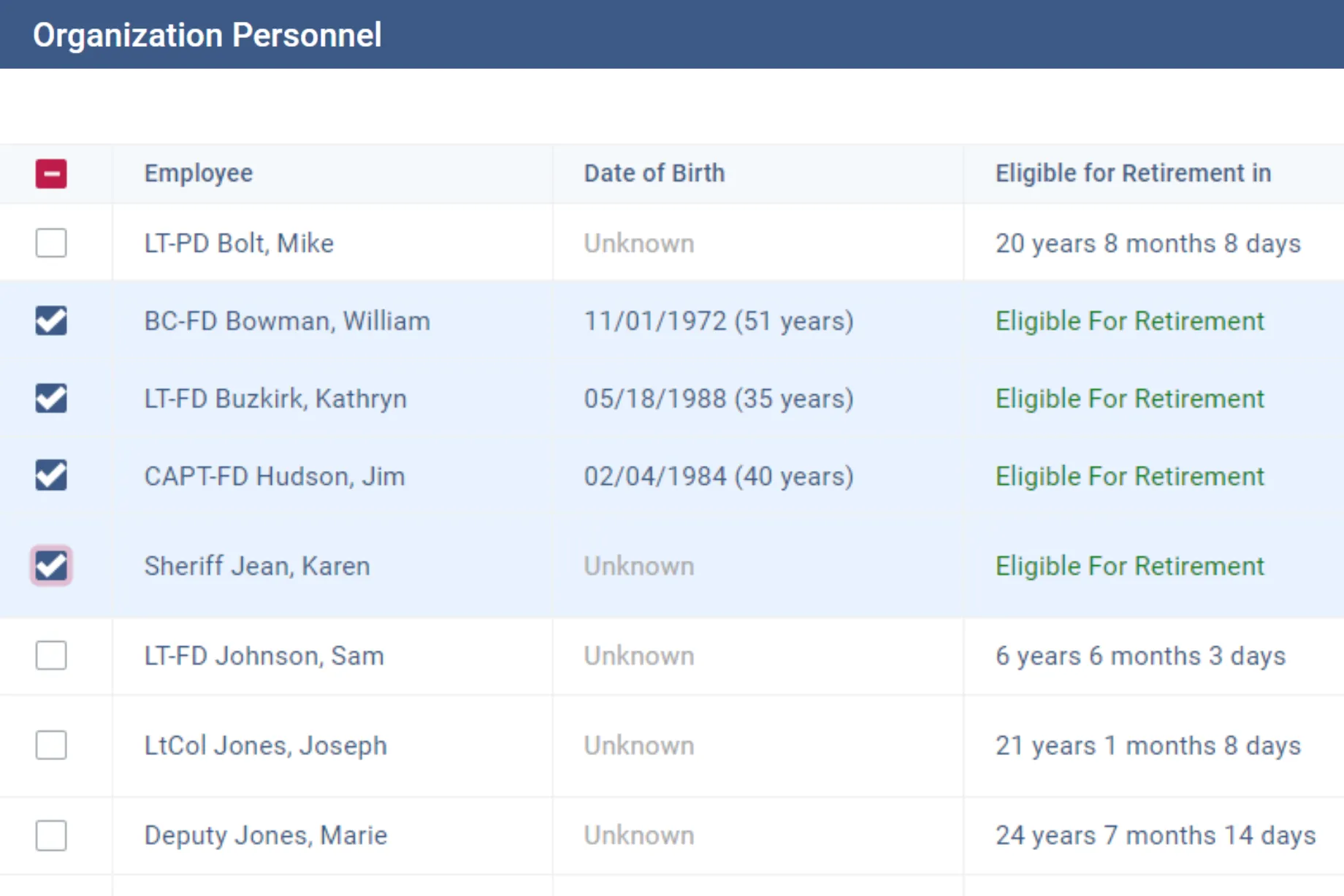
If you're running a promotion process with no comprehensive view of your personnel, build one record per member before the list opens: evaluations, commendations, counseling, training, certifications, specialty and acting roles, and time in rank. Then run a talent review against the requirements of each rank, so you know who's eligible, who's close, and where your succession plan has gaps.
Corporate HR guides call this a skills matrix or a talent review, and the idea carries over directly. For each rank, list the requirements in your promotion policy: time in grade, required certifications and schools, evaluation thresholds and any assignment history. Then check every member against them. That answers three questions a chief otherwise can't: who is eligible for this process, who will be eligible for the next one and what they're missing, and which ranks have too few people coming up.
Essential Personnel's Career Paths hold the rank and position requirements, with completion mapped automatically from training, certifications and qualifications, and Promotion and Retirement Eligibility sorts and filters to show who is eligible for promotion now and how many requirements remain for everyone else. The same view shows who is within retirement range, which is where most succession gaps start.
Using performance in fire department promotions
Fire department promotions use the same structure, a written exam, an assessment center or oral board with a tactical scenario, and often a performance component, with certifications as minimum requirements. Mukwonago Fire Department weights its lieutenant performance evaluation at 40 percent, covering the previous two years.
Mukwonago's Policy 34 sets the minimums for lieutenant first: five years of service, Firefighter II, EMT, Fire Officer I or the ability to get it within a year, and Fire Instructor I and Driver Operator within two years. Its written exam counts 30 percent, an oral interview with a tactical scenario 30 percent, and the performance evaluation 40 percent, which includes "participation on committees, related education obtained independent of department sponsored classes, assistance with special projects, and overall job performance." Seniority points are added only after a candidate scores 70 percent on every phase.
For a fire department, the performance record should also show task book progress, acting officer time and company officer training, so the board sees readiness for the officer role and not just firefighting skill. Our ranking of promotion readiness software for fire departments compares the systems that track it.
Sample policy language: the performance component
Here is sample language for the performance section of a police promotion general order. Adapt the weights, years and discipline rules to your civil service rules and labor agreement, and have counsel review it before you adopt it.
Sample language
1. Purpose. Performance is evaluated as part of the promotional process to identify candidates who have shown, over a sustained period, the knowledge, skills and abilities required at the next rank, as identified in the department's job analysis for that rank.
2. Eligibility. To compete, a candidate must have an overall rating of meets standards or higher on each of the two most recent annual performance evaluations.
3. Performance score. The performance component is worth [20] percent of the final score. It is the average of the candidate's normalized overall ratings for the three most recent full rating periods, converted to a 100 point scale. A candidate with fewer than three periods is scored on the periods available.
4. Documented performance. Commendations, awards and corrective documents of record entered during the same three periods are reviewed by the promotional panel and may be referenced in the panel's written scoring rationale.
5. Discipline. A candidate with a sustained finding resulting in suspension within the [24] months before the announcement is ineligible for that process. Unfounded, exonerated and not sustained complaints are not considered. A candidate who is the subject of an open internal investigation may compete, but promotion is deferred until the investigation is resolved.
6. Review of records. Each candidate may review the performance records to be scored and submit written corrections within [10] days of the announcement. The commander resolves disputes by reference to documentation; unresolved disputes go to the appeal board.
7. Announcement. The promotional announcement states the weight of each component, the rating periods used, the eligibility and discipline rules, the appeal process and the duration of the eligibility list.
8. Review. After each process, the department reviews selection rates by race, sex and ethnicity and the distribution of ratings by supervisor, and reports the results to the chief.
Promotion decisions in software: how Essential Personnel keeps the record
Essential Personnel keeps the performance record a promotion process draws on, on one profile per member: evaluations normalized for hard and easy graders, commendations and awards, counseling and corrective entries, training, certifications, career history and specialty roles. Career Paths and Promotion Eligibility show who meets the requirements for each rank.
The pieces, as they're described on essper.com:
- Score Reports: performance evaluations with an algorithm that normalizes scores for hard and easy graders.
- Leader's Notes: templates for formal counseling, performance improvement plans, instructor reviews and field training daily observation reports, so the annual evaluation builds from a year of entries.
- Documents of Record and Awards: commendatory, corrective and other documents with routing and approval workflows, and awards and commendations on the member's record. Our guide to an awards program covers how to run one.
- 360 Feedback and Analytics: confidential peer feedback, and reporting with a 360 overview, relative value over time and an employee profile summary.
- Career Paths and Promotion Eligibility: rank and position requirements mapped from training, certifications and qualifications, with sorting and filtering to see who is eligible and how many requirements remain.
Essential Personnel doesn't write or score your promotional exam, run your assessment center or build your eligibility list; your testing consultant and civil service rules do that. It holds the record the board relies on, so when a promotion is challenged the answer comes from one file instead of four systems. The same record starts on day one, as covered in our guide to recruit performance, and it's part of building professional standards across the agency.
"This product allows our employees a way of professional growth and development through adequate feedback."
Scottie Harris, Chief, Weaverville Fire DepartmentThese tools are part of the Talent Management suite, published at $85 per user per year, or $175 per user for all four suites, plus a one-time $3,000 startup fee, on the pricing page. The platform is hosted in AWS GovCloud, aligned with the FBI CJIS Security Policy and covered by an annual SOC 2 Type II report, and it's available through GSA Advantage, NASPO, Omnia Partners, NCSA and VSA. For a comparison of systems that support police promotion processes, see our ranking of promotion software.
See every candidate's performance record on one profile
Bring your promotion general order and your evaluation form, and we'll show you how the record behind your next list would look for a department your size. Call (910) 390-0011 or email info@essper.com.
Frequently asked questions
Consider whether the evidence predicts success in the next rank, whether ratings are comparable across supervisors, and whether every score is documented. Use two to three years of evaluations, set written rules for discipline, check for adverse impact, and publish the weights in advance. Essential Personnel normalizes ratings and keeps each candidate's evaluations, commendations and training on one profile.
Published orders range widely. South Miami scores the average of the last three evaluations at 10 percent, Gaithersburg folds a documented supervisory review into a 35 percent structured resume, and Riverdale, New Jersey weights its promotional evaluation at 50 percent for sergeant. Set your weight from a job analysis with your testing consultant, and within your civil service rules and labor agreement.
Often yes, as an eligibility gate, a scored component or a factor in the final selection, but your civil service rules and labor agreement decide how. Ratings used for promotion are a selection procedure under the EEOC's Uniform Guidelines, so they need to be job related, consistent and documented. Check your rules with counsel and your civil service commission before adding them.
Usually, under written rules set before the process. Many departments make a candidate ineligible for a set period after serious sustained discipline and defer promotion during an open internal investigation. Gaithersburg allows a two year ineligibility after aggravated sustained discipline. Don't count unfounded or exonerated complaints, and check retention limits in your labor agreement with counsel.
Fair promotion criteria come from a job analysis of the rank, are published before the process, and are applied the same way to every candidate. Evidence-based means each score traces to documentation: evaluations, commendations, training and discipline records. Calibrate or normalize performance appraisals across supervisors, let candidates review their records, and check selection rates for adverse impact.
Build one record per member with evaluations, commendations, counseling, training, certifications and assignment history, then run a talent review against each rank's requirements. That shows who is eligible, who is close and where succession gaps are. In Essential Personnel, Career Paths hold the requirements and Promotion Eligibility filters for who is eligible and what remains.
Not automatically. Strong performance in the current role is an imperfect predictor of success as a supervisor, a pattern research calls the Peter principle. That's why most police promotion processes pair the performance record with an assessment center or structured oral board that tests supervisory judgment, and why acting, FTO and instructor roles are worth recording on each officer's file.
Many departments still use paper evaluations and spreadsheets. Essential Personnel is public safety software that keeps each member's evaluations, normalized for hard and easy graders in Score Reports, with commendations, counseling, training and certifications on one profile, and shows promotion eligibility by rank. It's part of the Talent Management suite, published at $85 per user per year.

About this article
Written by Scott Monroe, Chief Executive Officer & Co-Founder, Essential Personnel. Published 30 October 2026.
Essential Personnel makes the software described here, and the product screenshots are from the platform. Product, pricing, hosting and purchasing details are taken from essper.com, and the quote is reproduced from essper.com. Promotion weights and rules are taken from the published promotion orders of the Gaithersburg, Takoma Park and South Miami police departments, Riverdale, New Jersey Ordinance 07-2018 and Mukwonago Fire Department Policy 34, checked in October 2026. Legal references are to 29 CFR part 1607, New York Civil Service Law section 61 and Ricci v. DeStefano, 557 U.S. 557 (2009). The sample policy language is original. This article is general information and isn't legal advice.
