
How to run 360 feedback in a police or fire department: a step-by-step guide
You want to enable 360 feedback in your department, so your sergeants, lieutenants and company officers hear how they come across to the people who work for them, not only to the person who signs their evaluation. Done well, 360 degree feedback shows a supervisor how they lead when the chief isn't in the room. Done badly, it turns into a popularity vote, a grievance, or a stack of anonymous comments that everyone on the shift can trace back to their author.
This guide is for police chiefs, sheriffs, fire chiefs and the training and professional standards officers who will run the 360 feedback process. It gives you the steps in order, then covers what's different in public safety: rank, rotating shifts, small units where anonymity is hard, labor agreements and public records. It draws on the Center for Creative Leadership's implementation guide, the UK National Fire Chiefs Council's 360 guide for service leaders, fire service research, and departments running 360 feedback in Essential Personnel.
The short answer: how to enable 360 feedback in your department
To enable 360 feedback in a police or fire department, use it for development only, never for discipline, pay or promotion scores. Agree the rules with your labor association, pilot it with command staff, rate a short list of observable behaviors, pick five or more raters with real line of sight, report only groups of three or more, and finish with a private debrief and a written development plan.
Departments that run 360 feedback in Essential Personnel collect it in a minute from any shift, see it rolled into a 360 overview on each member's profile rather than a list of comments, and record the development plan and its follow-up in Leader's Notes, on the same record as training and career paths.
Here's the 360 feedback process in order. Each step has its own section below.
- Decide what it's for. Write down that the 360 is for development, who sees the results, and what it will never be used for.
- Check your labor agreement, civil service rules and records law. Bring the union or association in before you announce anything.
- Start with command staff. Have the chief and the command team go first as a pilot.
- Choose the behaviors to rate. Eight to twelve observable behaviors drawn from your values and from what you expect of each rank.
- Choose raters with line of sight. Five to twenty people: the supervisor, peers, direct reports and, if you like, people from other units.
- Protect anonymity. Report a rater group only when it has three or more responses, and decide in advance who sees the data.
- Brief raters and participants. Explain the purpose, the rules and how to give useful comments.
- Run a collection window built around your shifts. Two to three weeks so every platoon works at least a couple of shifts, with reminders and response tracking.
- Debrief, then plan. A trained person walks each participant through the report, and the participant writes a development plan.
- Follow up and repeat. Check the plan quarterly, keep feedback flowing between cycles, and run the next 360 review in 12 to 18 months.
What 360 degree feedback, or a 360 review, is and isn't
360 degree feedback, also called a 360 review or 360 evaluation, collects ratings and comments about one person from the people around them: their supervisor, peers, the people they supervise and themselves. It's a picture of how someone's behavior lands on others, used to help them develop. It isn't a performance evaluation and shouldn't replace one.
A normal evaluation looks down the chain of command: a lieutenant rates a sergeant. A 360 evaluation adds the views from the side and from below. In a fire department, Dominick Swinhart's Fire Engineering article puts it simply: a captain "would receive a performance evaluation not only from his battalion chief but also from his firefighters."
| Rater group | In a police department | In a fire department | What they see best |
|---|---|---|---|
| Supervisor | The lieutenant or captain the sergeant reports to | The battalion chief over the captain | Results, judgment, how well direction is carried out |
| Peers | Other sergeants on the same or neighboring shifts | Other company officers on the shift or in the battalion | Cooperation, reliability, sharing information |
| Direct reports | Officers on the sergeant's squad | Firefighters and engineers on the company | Day-to-day leadership, fairness, coaching, communication |
| Others | Dispatchers, detectives, records staff | Training staff, the fire marshal's office, EMS supervisors | How the person works across units |
| Self | The participant rates themselves on the same questions | The gap between how they see themselves and how others do | |
The feedback from below is usually called upward feedback. It's the part supervisors find most useful and the part raters find most risky, which is why most of the steps below are about making it safe to give.
What's different about the 360 feedback process in police and fire departments
The corporate 360 feedback process carries over, but public safety adds five things: a rank structure where rating a superior feels like a risk, rotating shifts that limit who has seen whom, small units where anonymity is hard to keep, labor agreements and civil service rules that govern evaluations, and records that may be public or discoverable.
- Rank. An officer rating the sergeant who writes their evaluation, or a firefighter rating their captain, needs to be sure there's no way back to them. Upward feedback stops the first time someone is identified.
- Shifts. On a 24/48 or a four-platoon police schedule, a peer on another shift may never have seen the person they're rating at work. Line of sight matters more than job title.
- Small units. In a 40-person department, comments from three peers are often identifiable by tone alone. Small agencies need wider rater pools and fewer free-text questions.
- Labor and civil service rules. Collective bargaining agreements and civil service rules often control how members are evaluated. A 360 that feeds evaluations or promotions may need to be bargained.
- Records. Depending on your state, what's written about an employee can be a public record, or end up in discovery or an arbitration. Decide what gets stored and where before the first response comes in.
The fire service in the UK has been through this at scale. After its March 2023 report on values and culture in fire and rescue services, His Majesty's Inspectorate told chief fire officers to put "a full, 360-degree feedback process" in place for senior leaders by 1 June 2023, and for all other leaders and managers by 1 September 2023, with feedback from colleagues and direct reports.
1. Decide what your 360 feedback is for
Use 360 degree feedback for development: helping supervisors and officers see their own leadership and improve it. Write that down in a short policy, along with who sees the results and what they'll never be used for, such as discipline, pay, assignments or promotion scores.
The Center for Creative Leadership (CCL) starts its implementation guide with purpose: without a clear goal "you won't know if your investment made any difference." CCL also notes that when a 360 initiative fails, the cause is usually "botched implementation", not the questionnaire.
The purpose decides almost everything else. A developmental 360 can be candid, because the person being rated owns the results. A 360 that feeds a promotion list or an evaluation score invites raters to settle scores or protect friends, and Swinhart warns that groups can coordinate ratings to raise or sink a colleague. Essential Personnel's guidance to agencies is the same: run 360 feedback on a development cycle rather than attaching it to discipline or pay. If you want more voices in the formal evaluation, use a self-evaluation and a documented supervisor review instead, as our guide to fixing evaluations explains.
2. Check your labor agreement, civil service rules and records law
Before you announce a 360, read your collective bargaining agreement and civil service rules for anything on evaluations, and ask your city or county attorney whether 360 responses would be public records or discoverable in your state. Then meet the union or association, show them the purpose statement, and invite them to help design it.
Unions tend to object to a 360 feedback process for one reason: fear that anonymous comments will end up in a personnel file. A written commitment that results are developmental, owned by the participant and kept out of discipline answers most of that. Bringing the association in early also gives you a second voice telling members it's safe to be honest.
Records are the part departments most often skip. Keep individual responses out of the personnel file, store only the summary report and the development plan, and set a retention period. If your attorney says individual responses would be releasable, collect ratings and short themes rather than long free-text comments.
3. Start with command staff as a pilot
Run your first 360 evaluation on the chief and the command staff. It tests the questions and the process on a small group, and it shows the rest of the department that leadership will take the same feedback it's asking supervisors to take.
CCL's advice is to "start small, run a pilot, and then include larger numbers," and to have senior leaders go first, because their taking part signals that the initiative matters. That's also what the UK inspectorate did by setting the senior leader deadline three months ahead of everyone else's.
After the pilot, extend it to the first line supervisors who shape most members' working day: sergeants and corporals in a police department, captains and lieutenants in a fire department. Line officers and firefighters can come later, or never. Many departments keep 360 feedback for people who supervise others.
4. Choose a short list of behaviors to rate
Rate eight to twelve behaviors a rater can actually see, each written as one action, drawn from your department's values and from what you expect of each rank. Keep the survey short enough to finish in ten minutes on a phone between calls.
The National Fire Chiefs Council's guide to 360 feedback for service leaders asks for short, clear questions that fit the job and match how the service judges performance elsewhere. Every item should describe one behavior. "Communicates clearly and fairly" is two questions; "Explains the reason for a decision when there's time to" is one.
Use the same behaviors you already expect in your promotion process and supervisor training, so the 360 feeds the same picture. Our guide to using performance in promotions covers how those expectations are written for each rank. There's a sample set of 360 feedback questions further down.
5. Choose raters who have seen the person work
Choose five to twenty raters for each participant, made up of their supervisor, peers, direct reports and anyone else who works closely with them. Pick for line of sight, not rank: a rater needs to have worked with the person recently and often enough to rate specific behavior.
For 360 degree feedback, the NFCC guide recommends five to twenty raters and suggests participants contact their raters personally before the formal request goes out. In practice, let the participant propose names and have their supervisor or the program coordinator check the list, so nobody fills it with friends.
Shifts change who counts as a peer. In a fire department, the captains on the same shift and battalion usually know a captain's work far better than the captains at the same station on other shifts. Swinhart suggests small departments can rate across the whole department, while larger ones keep it to a shift, station or battalion. He also cautions that raters with less than about two years on the job may not have the perspective to rate an officer.
Watch rater fatigue. If one popular sergeant is asked to rate eight colleagues in the same week, the eighth gets a rushed answer. Cap requests at four or five per rater per cycle.
6. Protect anonymity so upward feedback stays honest
Show results for a rater group only when it has at least three responses, and fold smaller groups into a combined "others" group. Keep the supervisor's rating named, keep everyone else anonymous, and decide in writing who sees each report: the participant and the person who debriefs them, and no one else without the participant's agreement.
The NFCC puts the reason plainly: "raters provide more useful feedback when they know they cannot be identified." Its rule is that a category with three or more raters can be shown on its own, and one with fewer than three is merged with others. Swinhart is blunter: "Anonymity is the key to 360-degree evaluations."
In a small department, three isn't always enough. Essential Personnel's own guidance for small agencies is to keep the respondent pool wide enough that individual voices aren't obvious, and to roll responses into an overview rather than a list of comments to be picked apart. Other ways to protect raters in a small unit:
- Ask for ratings and one short comment, not several open text boxes.
- Combine peers and direct reports into one group when either has fewer than three people.
- Report comments as themes, written up by the person who runs the debrief.
- Never tell a participant who was invited to rate them if the pool is small enough to guess from.
CCL's position is that the participant owns their data. The department can see group trends across all participants, such as a shared weakness in giving feedback, but not one member's report.
7. Brief raters and participants before anything goes out
Tell everyone involved, in roll call, at shift change and in writing, what the 360 feedback process is for, how anonymity works, who sees the results, how long it takes and when it closes. Then show raters how to answer the 360 feedback questions usefully, and how to give a useful comment: describe what they saw, its effect, and what they'd like to see more of.
CCL says participants, managers and raters "need to understand the purpose and exactly what they're expected to do." In public safety that briefing needs to happen on every shift, not once by email, and it lands better from a respected officer or the association president than from the training office alone.
Prepare participants too. Most people read a 360 report looking for the worst comment first. Tell them that before they see anything, and that they'll go through it with someone trained to help.
8. Run a collection window built around your shifts
Open the 360 for two to three weeks, so every shift and platoon works several days in the window, and avoid vacation peaks and major events. Track response rates for each participant without showing who has answered, and send reminders to raters who haven't.
The NFCC tells services to set a realistic deadline that allows for leave and workloads and to chase raters who haven't responded. A department on 24-hour shifts needs a longer window than an office: a firefighter on a 48/96 schedule may only work four or five shifts in a two-week window. CCL suggests letting participants see their own return rate, so they can nudge raters themselves.
Make responding easy from the field. Raters should be able to finish on a phone or a station computer in one sitting.
9. Debrief each participant, then write a development plan
Have someone trained, a coach, a training officer or an outside facilitator, walk each participant through their 360 review report in a private meeting before they're left alone with it. Together they pick two or three things to work on, and the participant writes a development plan with actions, support and dates, then shares it with their supervisor.
Both CCL and the NFCC put the debrief at the center. The NFCC says the report should be shared in a confidential meeting by someone experienced in giving this kind of feedback, and that the participant creates an action plan and shares it with their line manager. CCL calls development "what matters most" and recommends a private one-on-one with a trained facilitator.
A good development plan is short and practical: a behavior to change, the actions that will change it (a course, a mentor, a stretch assignment, a habit), the support needed from the supervisor, and a date to check progress. In Essential Personnel, the plan can be filed as a Leader's Notes entry on the member's profile using a customizable template, so it sits beside their training record and career path and the supervisor can see what's due.
10. Follow up, keep feedback flowing, and repeat
Check each development plan at least quarterly, keep feedback coming between formal cycles, and run the next full 360 review 12 to 18 months later so participants can see whether others notice the change. Use the group results, not individual ones, to plan supervisor training.
"Do not just listen: act," is the NFCC's warning. A 360 that produces a report and then nothing teaches the department that honest feedback goes nowhere, and the next one gets polite answers. Report back to the whole department on what changed because of the group results, even if it's only one new supervisor course.
Between full cycles, shorter rounds work. CCL suggests targeted "pulse" checks on a few behaviors. Quick, ongoing feedback also keeps the habit alive: in Essential Personnel, any member can send 360 Feedback on a colleague in under a minute from any shift, and Analytics shows how a member's 360 overview changes over time.
Sample 360 feedback questions for police and fire supervisors
Good 360 feedback questions describe one behavior a rater can see, use the same rating scale throughout, and end with one or two short comment boxes. Here's a starting set for sergeants, lieutenants and company officers. Rate each from 1 (never) to 5 (always), with a "haven't seen this" option.
| Area | Statement to rate |
|---|---|
| Communication | Explains the reason for a decision when there's time to |
| Communication | Passes on information from command staff accurately and quickly |
| Fairness | Applies rules and assignments the same way to everyone on the shift |
| Coaching | Tells me how I'm doing before the formal evaluation |
| Coaching | Gives me chances to learn new skills or take on new responsibility |
| Calls and incidents | Stays calm and gives clear direction on calls or at incidents |
| Calls and incidents | Holds a debrief after significant calls or incidents |
| Safety and wellness | Notices when someone is struggling and makes sure they get support |
| Accountability | Deals with performance problems promptly and privately |
| Recognition | Recognizes good work, including work the chief wouldn't otherwise see |
| Teamwork | Works well with other shifts, units and agencies |
| Integrity | Does what they say they'll do |
Then end your 360 feedback questions with two open ones: "What should this person keep doing?" and "What one thing would make them a more effective leader?" In a small unit, ask only the second.
A sample timeline for your first 360 evaluation
| When | What happens |
|---|---|
| Weeks 1 to 4 | Write the purpose statement, check the labor agreement and records law, meet the association, choose the behaviors and the questions |
| Weeks 5 to 6 | Pilot participants (chief and command staff) choose raters; brief raters on every shift |
| Weeks 7 to 9 | Collection window, with response tracking and reminders |
| Weeks 10 to 11 | Private debriefs and development plans; adjust the questions and process from the pilot |
| Months 4 to 6 | Repeat with first line supervisors; share group themes with the department |
| Every quarter | Development plan check-ins between the participant and their supervisor |
| 12 to 18 months | Next full 360 evaluation, compared with the first |
Mistakes that sink a 360 feedback program
| Mistake | What happens | Instead |
|---|---|---|
| Using results for discipline, pay or promotion scores | Raters protect friends and punish rivals; the union objects | Development only, in writing (step 1) |
| Announcing it before talking to the association | Members assume the worst and answer politely | Agree the rules first (step 2) |
| Rating line staff before leadership | It looks like a tool aimed downward | Command staff go first (step 3) |
| Showing groups of one or two | Raters are identified and upward feedback stops | Minimum of three per group (step 6) |
| Emailing reports with no debrief | The participant fixates on the worst comment | A trained debrief first (step 9) |
| No follow-up | The next 360 gets polite, useless answers | Quarterly check-ins and a repeat (step 10) |
Running 360 feedback in software: how Essential Personnel does it
Essential Personnel keeps 360 degree feedback on the same member profile as evaluations, Leader's Notes, commendations, training and career paths. Members send 360 Feedback quickly from any shift, Analytics rolls it into a 360 overview instead of a list of comments, and supervisors record the development plan and its follow-up in Leader's Notes.
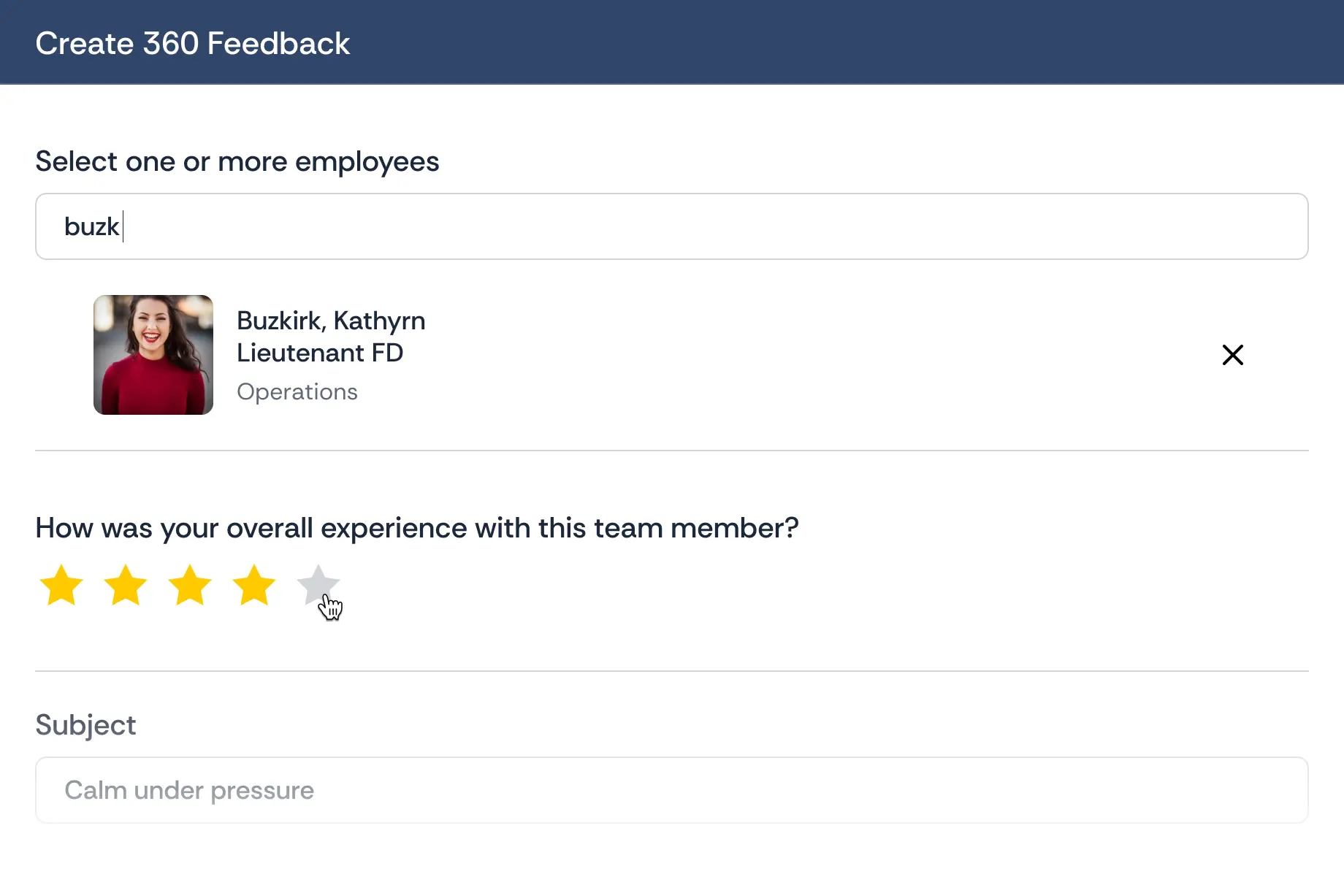
The tools, as described on the Talent Management page:
- 360 Feedback: quick and easy performance feedback with confidentiality and transparency.
- Analytics: a 360 overview, relative value over time and an employee profile summary.
- Leader's Notes: customizable templates for performance improvement plans, formal counseling and other coaching entries, so development plans and check-ins are dated and kept on the profile. Our guide to counseling documentation covers what a good entry contains.
- Logbook and Career Paths: the training a development plan calls for, tracked against goals, and progress toward the next rank.
- Score Reports and Awards: the formal evaluation and recognition, kept separate from 360 feedback but on the same profile.

"This product allows our employees a way of professional growth and development through adequate feedback."
Scottie Harris, Chief, Weaverville Fire Department360 Feedback is part of the Talent Management suite, published at $85 per user per year, or $175 per user for all four suites, plus a one-time $3,000 startup fee, on the pricing page. The platform is hosted in AWS GovCloud, aligned with the FBI CJIS Security Policy and covered by an annual SOC 2 Type II report, and it's available through GSA Advantage, NASPO, Omnia Partners, NCSA and VSA.
See 360 feedback running in a department like yours
Tell us your size, your shift schedule and who you want to start with, and we'll show you how 360 feedback, development plans and follow-up run in Essential Personnel. Call (910) 390-0011 or email info@essper.com.
Frequently asked questions
Decide it's for development only and put that in writing. Agree the rules with your labor association, pilot it with command staff, rate eight to twelve observable behaviors, pick five to twenty raters with line of sight, report only groups of three or more, and end with a private debrief and a development plan. Essential Personnel keeps 360 feedback, the plan and its follow-up on each member's profile.
No. Use 360 feedback for development, not discipline, pay or promotion scores. Once raters know their answers can affect a colleague's career, they protect friends or settle scores, and the union will object. Keep the formal evaluation separate, written by the supervisor from documented evidence, and use the 360 to help the person grow.
Five to twenty, according to the National Fire Chiefs Council's guide for service leaders, drawn from the supervisor, peers, direct reports and people in other units who work closely with the person. Show a rater group separately only when it has three or more responses, and merge smaller groups so nobody can be identified.
Widen the rater pool across shifts and units, combine peers and direct reports when either group is under three, ask for ratings and one short comment rather than several text boxes, and report comments as themes. Essential Personnel rolls responses into a 360 overview instead of a list of individual comments.
It depends on your contract and state law, so ask your labor attorney. A 360 that affects evaluations, pay or promotions is more likely to need bargaining than a voluntary developmental one. Either way, meet the association before you announce it, share the purpose statement, and invite them to help design the process.
Upward feedback is feedback from the people a supervisor leads: officers rating their sergeant, or firefighters rating their captain. It's the part of a 360 that shows how someone actually leads day to day, and the part raters find riskiest, so it needs anonymity rules that hold even in a small unit.
Run a full 360 evaluation every 12 to 18 months for each supervisor, which gives a development plan time to work. Check the plan quarterly, and keep quick feedback going between cycles so it becomes routine rather than an annual event.
Essential Personnel is public safety software with 360 Feedback built in: quick submission with confidentiality and transparency, a 360 overview in Analytics, and Leader's Notes for development plans, on the same profile as evaluations and training. It's part of the Talent Management suite, published at $85 per user per year.

About this article
Written by Scott Monroe, Chief Executive Officer & Co-Founder, Essential Personnel. Published 2 November 2026.
Essential Personnel makes the software described here, and the product screenshots are from the platform. Pricing, hosting and purchasing details are taken from essper.com. Implementation guidance draws on the Center for Creative Leadership, the National Fire Chiefs Council, His Majesty's Inspectorate of Constabulary and Fire & Rescue Services and Fire Engineering, checked in November 2026. This article is general information and isn't legal advice; check your labor agreement, civil service rules and state records law before starting a 360 feedback program.
