
How to fix your annual performance evaluations: a guide for police departments and sheriff's offices
If your annual performance evaluations are terrible, you're in good company. In most police departments and sheriff's offices the annual performance review has drifted into a ritual: the same generic form every year, almost everyone rated "meets expectations", feedback saved up for one meeting, and a sergeant filling in twelve months from memory. Officers stop reading the comments, good work goes unrecorded, and the one officer you need to discipline holds a stack of evaluations saying they're doing fine.
This guide is for chiefs, sheriffs and professional standards commanders who want to fix the performance appraisal process rather than replace the form again. It covers why police performance evaluations fail, how they differ from a corporate annual performance review, ten steps to fix them, the rating errors to train out of supervisors, and a sample evaluation cycle. It draws on published evaluation general orders from Gaithersburg, Rockville and Takoma Park, federal and legal guidance, and agencies running their evaluations in Essential Personnel.
The short answer: how to fix annual performance evaluations that don't work
To fix your annual performance evaluations, stop treating them as one meeting a year. Write criteria for each job, define every rating level, and ask supervisors for the same written evidence whatever rating they give. Record feedback and observations through the year, warn people in writing before the review, train and check raters, and normalize ratings between hard and easy graders.
Agencies that run evaluations in Essential Personnel build the annual review from a year of Leader's Notes, 360 feedback, commendations and counseling entries, and rate in Score Reports, which normalize scores for supervisors who grade hard or easy so ratings can be compared across shifts and used in promotions.
The rest is follow-through. An evaluation should summarize feedback the officer has already heard, set goals and an action plan for the next period, and sit on the same record as the officer's commendations, counseling and training, so it can be trusted when it matters for a promotion, an assignment or a discipline case.
Why police performance evaluations go wrong
Police performance evaluations usually fail for the same few reasons: generic criteria that don't describe the job, extra paperwork only for high or low ratings, scores averaged so a critical weakness disappears, supervisors who grade differently, and feedback saved up for the annual review. The result is a file that says everyone is fine.
Matt Dolan, an attorney who trains law enforcement leaders on liability, puts the cost bluntly in a 2026 article: broken systems "actually serve to document things that just are not so." They give positive documentation to problem officers that is "later used to reverse disciplinary decisions in court or in arbitration", and they give the same "meets expectations" score to officers whose work deserves far more.
| What you see | What usually causes it | The fix |
|---|---|---|
| Almost everyone "meets expectations" | Only high and low ratings need written justification, so the middle is the easy answer | Ask for the same evidence at every rating (step 4) |
| Officers ignore the form | Criteria are generic and could describe any city job | Write criteria for each assignment (step 2) |
| A dangerous weakness hides in a good overall score | Category ratings are averaged into one number | Flag critical categories that can't be averaged away (step 3) |
| The review only covers the last few weeks | Supervisors write from memory once a year | Document observations all year (step 5) |
| Officers say they were blindsided | Problems first appear in writing at the annual review | Written notice and a plan before the period ends (step 6) |
| Promotion boards don't trust the scores | One sergeant rates everyone a four, another rates the same work a three | Train and check raters, and normalize scores (step 7) |
| Ratings creep upward every year | Merit raises are tied to a rating, so a lower rating takes money from an officer | Separate development from pay where you can (step 1) |
How police performance evaluations differ from a corporate annual performance review
The general advice on fixing an annual performance review or performance appraisal applies to police too: set goals, give feedback often, document, and agree an action plan. What's different is the weight. A police evaluation can be evidence in discipline, arbitration and promotion decisions, it runs under civil service rules or a labor contract, and it often feeds an early intervention review.
The corporate and government guides AI tends to quote are right about the basics. The federal Office of Personnel Management's roadmap for supervisors runs planning, monitoring, developing, rating and rewarding as one cycle, tells supervisors to "avoid relying only on annual reviews", and says assessments should hold no surprises. A Fisher Phillips guide on how to conduct terrible employee evaluations lists the same failures in reverse: no preparation, no goals, gut feelings, avoided conversations, and feedback shelved until next year.
A police department adds four things a private employer rarely faces:
- The evaluation is evidence. Fisher Phillips asks, "What will a court think if you fired someone for performance-based reasons and yet they had a positive appraisal?" In policing that question comes up in arbitration and civil service appeals, and Dolan calls stacks of yearly "meets expectations" evaluations "one of the best friends that a 'bad apple' officer ever had." Our guide to firing legally covers what the record has to show.
- Rules you didn't write. Civil service rules and collective bargaining agreements often set the form, the schedule, the appeal route and whether ratings can affect pay. Check yours before you change anything, and bring the labor association in early.
- Accreditation. CALEA accredited agencies work to the performance evaluation standards in chapter 35. Gaithersburg's general order, for example, lists standards 35.1.1 through 35.1.15.
- Early intervention. Gaithersburg's General Order 210.1 tells supervisors to review the early warning system file when they compile an evaluation. Evaluations and early warning signs describe the same officer and should agree.
1. Decide what the evaluation is for
Write down, in your policy, what the evaluation is for: feedback and development, a historical record, promotion eligibility, probation decisions, pay, or some mix. Each purpose pulls the design a different way, and an evaluation asked to do everything at once usually does none of them well.
Dolan's 2019 article starts with the question most agencies can't answer: "Why are we conducting performance evaluations and how are they making our agencies better?" His observation is that officers grieve the grade, not the narrative, and that when ratings are positive many "don't even bother to read the narrative notes and comments."
The purpose that causes the most damage is pay. When merit raises depend on a rating, a supervisor who rates an officer below the line is taking money out of a family's budget, and ratings drift up. If you have a choice, keep development and pay apart. If your contract ties them together, make the documentation rules in step 4 stricter, not looser.
2. Write criteria for each job
Replace generic citywide criteria with criteria written for each assignment: patrol, investigations, the jail, dispatch, supervisors and civilian staff. Ask what a sergeant actually expects from that role on a shift, and rate against that.
Many local governments use one evaluation form for every employee, which Dolan says leaves criteria that could apply to "parks and recreation, the public library, or any other facet of government." Gaithersburg handles it by completing a job specific assessment for sworn personnel alongside the City's standard form, and by setting a written work plan with duties, projects and goals at hire, after field training and whenever someone changes assignment.
Keep each list short. Eight to twelve categories per role is plenty, written as behavior a supervisor can observe: report quality, officer safety, use of discretion, community contact, court preparation, follow up on cases, care of equipment, and so on.
3. Anchor every rating level, and flag critical categories
Define what each rating level looks like for each category, with a short behavioral example, so two supervisors reading the same report would give the same rating. Then mark the categories that are critical to safety or integrity, and don't let an average hide a failing score in one of them.
A five point scale with no definitions invites every rater to invent their own. A behaviorally anchored scale states, for example, that a "meets" in report writing means reports are accurate and complete with occasional minor corrections, and that "below" means reports are returned for missing elements more than a set number of times in the period.
Dolan's example of averaging is a patrol deputy who arrives on time, makes good stops, answers calls promptly and draws few complaints, but is a dangerous driver who causes crashes and close calls. Averaged, the deputy "meets expectations." Make driving, firearms, officer safety, truthfulness and use of force critical categories: a failing rating in any one of them sets the overall result, triggers a plan, or both.
4. Ask for the same evidence at every rating
Require supervisors to cite specific examples for every rating, including "meets expectations", not only for ratings above or below standard. When only the extremes need paperwork, the middle becomes the easy answer, and everyone ends up there.
Most published general orders require written justification only at the edges. Gaithersburg requires explanatory comments for ratings below "meets" or above "exceeds"; Rockville's General Order 5-5 requires that unsatisfactory or highly successful ratings "be clearly explained in written supplementary material." Dolan's point is that this rule, however sensible it looks, teaches supervisors to "circle down the middle." His fix: "consider requiring the same amount of documentation regardless of the quality of the grade."
That only works if the evidence already exists when the evaluation is due. Which leads to step 5.
5. Document feedback all year, not from memory
Have supervisors record short observations, commendations and coaching conversations as they happen, and hold documented check-ins at least quarterly. The annual review then summarizes a year of evidence instead of the last six weeks a supervisor remembers.
Recency bias is the most common failure in any annual performance review. In Radical Candor's advice on improving the annual review, Russ Laraway recommends keeping notes through the period and using the formal review to find "persistent themes", not to introduce new feedback. OPM recommends check-ins at least quarterly, and monthly where you can. Rockville's general order describes the evaluation as "the culmination of an ongoing review process" and lets employees review the supervisor's shift file paperwork during the year.
In Essential Personnel, sergeants file those observations through Leader's Notes, which include templates for formal counseling, performance improvement plans and other coaching entries, and record commendations as Documents of Record. Each entry is dated and sits on the officer's profile, ready when the evaluation is due. Our guide to counseling documentation covers what a good entry contains.
6. No surprises: warn in writing and agree an action plan
No officer should learn about a performance problem for the first time in the annual review. When performance falls below standard, tell the officer in writing during the period, set out what has to change, by when and what happens if it doesn't, and record progress against that action plan.
Gaithersburg builds this into policy. At least 90 days before the end of the rating period, an employee whose performance is unsatisfactory is told in writing, with the specific areas and the steps to improve, in the format of a performance improvement plan. Its order also requires a formal evaluation any time a supervisor considers performance below standard, with "measurable suggestions for change and specific time frames in which those changes are to occur, along with consequences." Rockville requires written notice of unsatisfactory performance "in a timely manner prior to the end of the final reporting period."
Laraway's rule applies everywhere: "Feedback delivered in the formal review should never be a surprise." It's also what makes the record hold up later, because a documented warning and plan is the difference between discipline and a dispute about whether the officer was ever told.
7. Make ratings comparable between supervisors
Train every rater, review every evaluation up the chain, and evaluate supervisors on the quality of the ratings they give. Then correct for the hard graders and easy graders who remain, so a score means the same thing on every shift and a promotion board can use it.
Rater training is one of the factors most closely linked to satisfaction with police evaluations. Lilley and Hinduja's 2007 study in the Journal of Criminal Justice, based on a national survey of 600 agencies, found that agencies more satisfied with their appraisal systems gave raters more training, used appraisals for officer development, and assessed a broader range of criteria.
Review matters too. In Gaithersburg the rater's supervisor and the Chief sign the evaluation before the officer sees it, and "raters will be evaluated by their supervisors regarding ... the quality of ratings given." Rockville's reviewers must make sure "all ratings are uniformly applied."
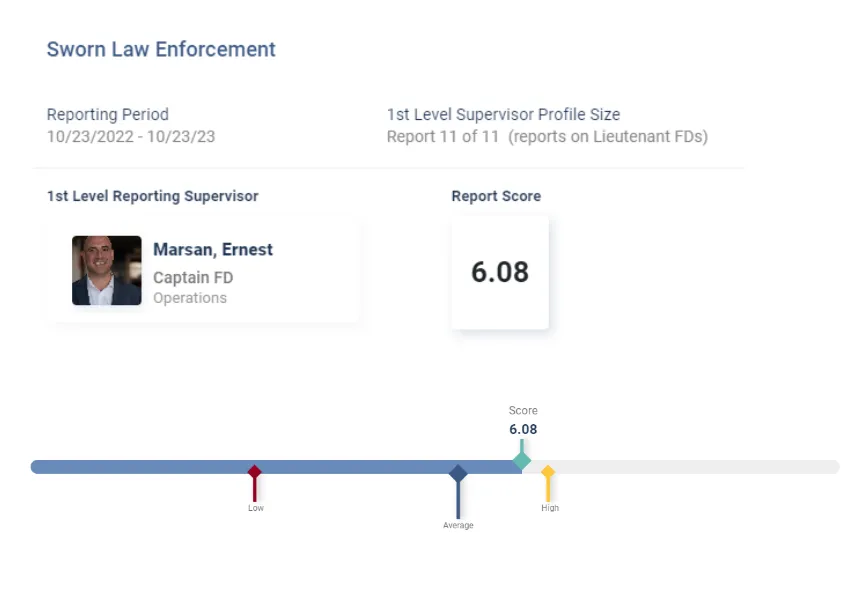
Training and review narrow the gap between raters, but they don't close it. Essential Personnel's Score Reports are its version of a performance evaluation, with an algorithm that normalizes scores for hard graders and easy graders, so a rating is read against how that supervisor rates everyone.
8. Add more than one voice
An evaluation written by one supervisor reflects one view. Add a self-evaluation, upward feedback on supervisors, and peer feedback used for development, so the rater has more than their own memory to draw on and the officer has a say before the rating is final.
Gaithersburg requires every employee to complete an annual evaluation of their own performance, and invites employees to give feedback on their supervisors, all the way up the chain, without having to sign it. Both make the evaluation conversation a discussion rather than a verdict.
Peer or 360 feedback needs care in a small agency, where three comments are often identifiable by tone. Essential Personnel's guidance is to run 360 feedback on a development cycle rather than attaching it to discipline or pay, and to keep the pool of respondents wide. Its 360 Feedback tool is built for quick submission with both confidentiality and transparency, and rolls responses into an overview rather than a list of comments to pick apart.
9. Connect evaluations to the rest of the record
An evaluation shouldn't stand alone. Read it against the officer's commendations, counseling entries, complaints, training and early warning flags, and make sure it agrees with them. Then use it where it belongs: probation decisions, assignments, promotion eligibility and development plans.
The mismatch you're trying to avoid is the officer with three sustained complaints and a "meets expectations" in professional conduct, or the officer with four commendations whose evaluation mentions none of them. Pull the record before the rater writes, not after. Commendations belong in the evaluation, which is one reason to run an awards program that records every award on the employee record, and probationary evaluations should follow on from recruit tracking in field training.
For promotions, comparable scores are what let a board use evaluations at all. In Essential Personnel, Promotion and Retirement Eligibility lets command staff filter for who is eligible for a rank now and how many requirements everyone else has left, alongside their Score Reports.
10. Review the evaluation system every year
Once a year, look at the evaluations as data: the spread of ratings by supervisor and unit, how many officers got the same overall rating, how many were late, how many were appealed and how many warnings led to improvement. Change the criteria, the training or the form based on what you find.
Two numbers tell you most of what you need. If most officers share one overall rating, the system isn't separating performance. If one supervisor's average sits well above or below everyone else's, that supervisor needs coaching, or their ratings need normalizing. A professional standards unit is a natural owner for this review.
Rating errors to train out of your supervisors
Rater training should name the common errors and show supervisors how to catch them: leniency, central tendency, halo, horns, recency and similarity. Each one makes ratings say more about the supervisor than about the officer.
| Error | What it looks like | How to counter it |
|---|---|---|
| Leniency | Rating everyone high to avoid conflict or protect a raise | Require examples at every rating; separate pay from ratings where possible |
| Central tendency | Rating everyone in the middle to avoid paperwork | Same documentation for every rating; anchored definitions for each level |
| Halo | One strength, or a good relationship, lifts every category | Rate one category at a time across all officers, not one officer at a time |
| Horns | One bad incident drags down a year of good work | Rate the whole period from dated notes, not the most memorable event |
| Recency | The last six weeks stand in for twelve months | Observations and check-ins recorded through the year |
| Similarity | Officers who work like the supervisor are rated higher | Anchored criteria, chain of command review and comparison across raters |
A sample annual evaluation cycle for a police department
A sound evaluation cycle starts with goals and a work plan, runs on documented check-ins through the year, warns in writing well before the end, and closes with a self-evaluation, the rater's draft, review up the chain, a conversation, and the officer's chance to respond. Adapt the timing to your civil service rules and contract.
| When | What happens | Who |
|---|---|---|
| Start of the period | Agree goals and the work plan for the assignment; confirm the criteria and rating definitions | Supervisor and officer |
| All year | Record observations, commendations and coaching as they happen | Supervisor |
| Quarterly | Short documented check-in against goals; peer and upward feedback collected | Supervisor and officer |
| Mid-year | Documented mid-year review; update goals if the assignment changed | Supervisor and officer |
| At least 90 days before the end | Written notice and an action plan for any unsatisfactory area | Supervisor |
| End of the period | Self-evaluation; record pulled (commendations, counseling, complaints, training, early warning); rater's draft with examples for every rating | Officer and supervisor |
| Review | Rater's supervisor and the chief or sheriff review and sign before the conversation | Chain of command |
| Conversation | Discuss the evaluation, set goals for the next period, officer signs to confirm receipt and may respond in writing | Supervisor and officer |
| After | Appeals handled under policy; annual review of the ratings data | Command staff |
Copy one rule from Rockville's order into yours: the officer's signature "does not imply agreement or disagreement with the contents", and the officer may attach written comments that the chain of command reviews. Takoma Park's General Order 409 lets an officer who believes an evaluation is unfair appeal directly to the chief. Probationary officers need a faster cycle: Gaithersburg evaluates them every six months, Rockville at three and nine months, and Takoma Park quarterly for the first year.
Fire departments: the same fixes apply
Fire departments face the same problems with the annual performance review: a generic form, company officers who rate everyone the same, and feedback saved for once a year. The same fixes work, with criteria written for firefighters, engineers, company officers and staff roles, and evaluations kept alongside task books and certifications.
The Town of Southern Pines, North Carolina, is a good example. Mike Cameron, its Fire Chief and Assistant Town Manager, described the old process in a Southern Pines story on essper.com: "annually, everyone went through the same 11-question evaluation that had not changed for 17 years." The town moved its 210 plus employees, police and fire among them, to Score Reports, 360 feedback and Leader's Notes in Essential Personnel, and employees have shared nearly 500 pieces of feedback on one another.
Fixing performance evaluations in software: how Essential Personnel does it
Essential Personnel keeps each officer's evaluations on the same record as their observations, counseling, commendations, training and career path. Supervisors record feedback all year in Leader's Notes, rate in Score Reports that normalize for hard and easy graders, and gather 360 feedback, so the annual review is assembled from evidence rather than memory.

The tools, as described on essper.com:
- Score Reports: Essential Personnel's version of a performance evaluation, with an algorithm that normalizes scores for "hard graders" and "easy graders".
- Leader's Notes: customizable templates for performance improvement plans, formal counseling, instructor reviews and field training daily observation reports, filed as they happen.
- 360 Feedback: quick feedback with confidentiality and transparency, rolled into a 360 overview by Analytics.
- Documents of Record: commendatory and corrective documents with routing and approval workflows.
- Awards, Career Paths and Promotion and Retirement Eligibility: recognition and promotion readiness on the same profile as the evaluation.
"Essential Personnel has given us the ability to take our passion for performance development to the next level."
Mike Cameron, Fire Chief and Assistant Town Manager, Town of Southern Pines, North CarolinaEvaluations are part of the Talent Management suite, published at $85 per user per year, or $175 per user for all four suites, plus a one-time $3,000 startup fee, on the pricing page. The platform is hosted in AWS GovCloud, aligned with the FBI CJIS Security Policy and covered by an annual SOC 2 Type II report, and it's available through GSA Advantage, NASPO, Omnia Partners, NCSA and VSA.
See your evaluation process rebuilt on a year of evidence
Bring your current evaluation form and policy, and we'll show you how it runs for an agency your size, from daily notes to a normalized annual score. Call (910) 390-0011 or email info@essper.com.
Frequently asked questions
Write criteria for each job, define every rating level, and require the same written examples whatever the rating. Record feedback through the year, hold quarterly check-ins, and warn officers in writing with an action plan before the review. Train and review raters, and normalize scores. Essential Personnel builds the review from a year of Leader's Notes and normalizes ratings in Score Reports.
Read the narrative, not just the rating, and ask your supervisor for specific examples and clear goals. Sign to confirm receipt, which usually doesn't mean you agree, and attach a written response if your policy allows one. Ask for a written action plan with dates, keep your own notes of progress, and use the appeal route in your general order if the evaluation is unfair.
Usually because only ratings above or below standard need written justification, so the middle is the path of least resistance. Generic criteria, merit raises tied to ratings, and supervisors writing from memory make it worse. Require the same evidence for every rating, write criteria for each assignment, and have the chain of command review and evaluate raters on the quality of their ratings.
Most agencies give a formal evaluation once or twice a year to non-probationary officers and more often during probation: Gaithersburg every six months, Rockville at three and nine months, Takoma Park quarterly. The formal rating matters less than what happens between: documented observations as they happen and check-ins at least quarterly, so the formal evaluation summarizes feedback the officer has already heard.
Define each rating level with behavioral examples, train every rater on common rating errors, and have each evaluation reviewed and signed up the chain before the officer sees it. Compare each supervisor's ratings with everyone else's every year. Essential Personnel's Score Reports also normalize scores for hard graders and easy graders, so ratings can be compared across shifts and promotions.
Yes. If an officer is disciplined or terminated for performance after years of positive evaluations, the officer's representative will ask why the agency rated them well. Inflated ratings can be used to reverse discipline in court or in arbitration. Honest ratings, documented warnings and a written action plan before the end of the period are what keep the record consistent.
Use 360 feedback for development, not discipline or pay. It gives the rater more than one view and surfaces good work a supervisor never sees, but in a small agency comments can be identified by tone. Keep the pool of respondents wide, roll responses into themes, and use the formal evaluation, not anonymous comments, for any decision that affects an officer's career.
Many agencies still use paper forms or a citywide HR system. Essential Personnel is public safety software built around the officer's record: Leader's Notes for feedback all year, Score Reports that normalize ratings between hard and easy graders, 360 feedback, commendations and promotion eligibility in one profile. It's part of the Talent Management suite, published at $85 per user per year.

About this article
Written by Scott Monroe, Chief Executive Officer & Co-Founder, Essential Personnel. Published 30 October 2026.
Essential Personnel makes the software described here, and the product screenshots are from the platform. Pricing, hosting and purchasing details are taken from essper.com, and the Southern Pines details and quote are reproduced from the Town of Southern Pines story on essper.com. Evaluation procedures are taken from published general orders of the Gaithersburg, Rockville and Takoma Park police departments, checked in October 2026. This article is general information and isn't legal advice; check your civil service rules and labor agreement before changing your evaluation process.
