
Officer wellness records policy: a model policy that keeps wellness records out of personnel files
Most police officer wellness programs start without a written records policy. The peer support team forms, a clinician gets a contract, check-ins begin after bad calls, and the paperwork goes wherever it lands: a sergeant's email, a shared drive, a folder in HR. The first time someone asks for an officer's file, nobody can say which of those records belong in it.
This guide is for police chiefs, sheriffs, wellness coordinators, peer support team leads, and the HR, records and legal staff who'll be asked to defend the program later. It sets out a model officer wellness records policy, section by section, with sample language you can adapt. It's built from the ADA confidentiality rule, IACP's peer support and fitness-for-duty guidelines, state peer support statutes, and the wellness policies police departments have published.
If you're still working out why wellness records can't sit in the personnel file at all, start with our guide to keeping officer wellness records separate. This page is the written directive that sits underneath it.
The short answer: what an officer wellness records policy needs
An officer wellness records policy needs eleven parts: a purpose statement that says wellness isn't discipline, definitions, a filing rule that sends each record to the personnel file, a confidential wellness file or nowhere, a named access list, a rule that peer supporters keep only anonymous statistics, attendance-only confirmation for check-ins, a separate fitness-for-duty process, a firewall from internal affairs, a written notice to members, and retention and audit rules.
Write it before you configure any system. Departments that run law enforcement wellness in software such as Essential Personnel can then set role permissions to match the access list in the policy, so the system enforces what the directive says rather than what a default setting allows.
The sample language below is a starting point, not a finished directive. Have your city or county attorney and your records officer review it against your state law, your retention schedule and any collective bargaining agreement before you adopt it.
Why the officer wellness records policy has to be written down: 29 CFR 1630.14 and state law
Three things make a written policy necessary. The ADA rule at 29 CFR 1630.14 requires medical information from a wellness program to be kept on separate forms, in separate files, as a confidential medical record. Several state peer support privileges only protect communications made under the agency's written guidelines. And members won't use a program they can't see the rules for.
The federal rule is the floor. Under 29 CFR 1630.14(d)(4), information from a voluntary employee health program "shall be collected and maintained on separate forms and in separate medical files and be treated as a confidential medical record." The same subsection says the employer may only receive it "in aggregate terms" that don't identify anyone, and that you can't make members waive confidentiality to take part. The EEOC's guidance puts the wellness point plainly: records must be "kept confidential and separate from personnel records."
The state layer is where the written policy earns its keep. Law enforcement peer support privileges vary a lot, and some depend on the policy existing at all:
| State | Statute | What it protects | Worth knowing |
|---|---|---|---|
| Colorado | C.R.S. 13-90-107(1)(m), amended 2024 | Peer support communications, including notes and records, and since 2024 group sessions | Applies only when the peer support member is working within the agency's written peer support guidelines |
| Utah | Utah Code 78B-5-903 | A peer support member may refuse to disclose communications | Requires written guidelines, and has an exception when the member reasonably believes the officer is unfit for duty |
| Florida | Fla. Stat. 111.09 | Peer support communications in civil, criminal, administrative and disciplinary proceedings | Exceptions for written consent, suspected crime, and fear for someone's safety |
| California | Gov. Code 8669.1 to 8669.7 | A right to refuse disclosure of peer support communications, including group sessions | Peer support members must finish agency-approved training; no protection in a criminal proceeding |
| Federal officers only | COPS Counseling Act, 34 U.S.C. 50901 | Peer support communications for federal law enforcement officers | Doesn't cover municipal or county officers |
Every one of these carries exceptions, usually threats to self or others, child or vulnerable adult abuse, criminal conduct, written consent and court orders. Your policy should list your own state's exceptions word for word, because that list is what you'll promise members when they first call a law enforcement peer support team member.
1. Purpose and scope of the police officer wellness program
Open the officer wellness records policy by saying what the program is for and what it isn't. Members read this paragraph first, and they read it for one thing: whether using the program can hurt their career. Say that it can't, in those words.
Sample language
The purpose of this policy is to establish how records created by the agency's member wellness program are collected, filed, accessed, retained and disclosed. The wellness program exists to support members' health and resilience. It is not a disciplinary, evaluative or promotional process. A member's participation in the wellness program, or decision not to participate in any voluntary part of it, shall not be used in any decision about discipline, assignment, evaluation or promotion. This policy applies to all sworn and civilian members, to peer support team members, and to any contracted clinician or provider who receives agency information about a member.
The career line is adapted from Ogden Police Department's wellness policy, which says a member's "career or promotional opportunities/eligibility within the Department will not be jeopardized because of participation in this program."
2. Definitions
Most arguments about wellness records turn out to be arguments about words. Define these five so the rest of the policy can be read one way.
Sample language
Wellness record: any record the agency creates or receives about a member's participation in the wellness program, including check-in attendance, referrals, outreach after a critical incident, alert flags generated from wellness thresholds, and fitness-for-duty reports.
Confidential wellness file: the file, separate from the personnel file and from internal affairs files, in which wellness records are kept as confidential medical records.
Peer support communication: any communication between a member and a designated peer support team member while that team member is providing peer support.
Clinical record: notes and records created by a licensed clinician while treating a member. Clinical records belong to the clinician and are not agency records.
Wellness administrator: the person designated by the chief to maintain the confidential wellness file and to apply this policy.
3. Where each record goes: the personnel file, the wellness file, or nowhere
Every record the program touches belongs in one of three places. Operational facts stay in the systems that already hold them. Wellness records go to the confidential wellness file. Clinical notes and peer support conversations aren't agency records at all. Only duty status and sustained discipline ever reach the personnel file.
| Record | Where it's filed | Who can see it |
|---|---|---|
| Critical incident attendance, use of force, injury, crash, exposure | The operational system that already holds it (RMS, use of force reports, workers' compensation) | Whoever that system's policy names |
| Wellness threshold alert and the outreach it triggered | Confidential wellness file | Wellness administrator and named wellness staff |
| Check-in or wellness visit attendance | Confidential wellness file | Wellness administrator; supervisor sees completion only if the visit is mandatory |
| Referral to a clinician, EAP or outside provider | Confidential wellness file | Wellness administrator and the provider |
| Peer support contact | Nowhere, except anonymous statistics | Nobody, beyond program totals |
| Clinical notes | The clinician's own records | The clinician and the member |
| Fitness-for-duty report | Confidential wellness file | Chief or designee, wellness administrator |
| Duty status and work restrictions | Personnel file | Supervisors who need it to assign work |
| Sustained misconduct finding | Personnel file and internal affairs file | Whoever your internal affairs policy names |
Sample language
Wellness records shall be collected on wellness program forms only and kept in the confidential wellness file. No wellness record, and no information about a member's participation in the wellness program, shall be placed in the member's personnel file. Where a wellness matter results in a change in duty status or a work restriction, only the duty status or restriction shall be recorded in the personnel file. Wellness forms shall not contain performance, conduct or disciplinary information.
The no-participation rule is Ogden's: "No information concerning an employee's participation may be included in an employee's personnel file." The forms rule comes straight from 29 CFR 1630.14. A form that records a check-in next to a performance note has already broken the separate forms requirement, however tightly you restrict it afterwards.
4. Who can see wellness records
Name people, not ranks. Rank is how a lieutenant ends up reading a file meant for three people. The ADA rule allows only three kinds of disclosure without consent: supervisors learning about necessary work restrictions and accommodations, first aid and safety staff when a condition might need emergency treatment, and government officials investigating ADA compliance. There's no exception for the chain of command, a promotion board or internal affairs.
Sample language
Access to the confidential wellness file is limited to the wellness administrator and the persons listed in Appendix A by name and role. The chief shall approve Appendix A and review it at least annually and whenever a listed person changes assignment. Supervisors and command staff may be informed of necessary work restrictions and accommodations, but not of the reason for them. Command staff shall receive wellness program information only as aggregate statistics that do not identify any member. No supervisor or command staff member shall direct a peer support team member or wellness provider to identify any member who has used wellness services.
The last sentence is adapted from Boulder Police Department's 2026 peer support order, which prohibits supervisors and command staff from "directing a PST member to identify an employee who is receiving or has received, PST services." The aggregate statistics rule tracks the ADA's own wording in 1630.14(d)(4)(iii).
5. Law enforcement peer support records: anonymous statistics only
Peer support team members shouldn't keep records of individual contacts. The IACP's Peer Support Guidelines recommend that a peer supporter "not keep written formal or private records of supportive contacts other than anonymous statistical information," such as the number of contacts, time spent and referrals given. Management sees utilization, not names.
This is the clause that decides whether law enforcement peer support gets used. A peer supporter's notebook is a record, and in most states a record can be subpoenaed. Colorado's statute treats any "note, record, report, or document" arising from a peer support meeting as part of the protected communication, but only when the team works within written guidelines. Elsewhere the safest record is the one that was never written.
Sample language
Peer support team members shall not create or keep records of individual peer support communications. Each team member shall report program activity on the approved statistics form, which records the number of contacts, the type of contact, the time spent and the number of referrals made, and does not identify any member. The peer support coordinator shall report these statistics to the chief quarterly. Peer support team members shall exercise care when communicating by text message, email or social media, and shall not discuss peer support communications with supervisors or other team members except as permitted by this policy.
List the confidentiality exceptions in the same section, word for word from your state's statute, and require team members to tell members about them before the conversation starts. IACP's guidance is that the fewer exceptions there are, "the more confidence department members will have in the program." Add one line from the IACP guidelines too: peer support "is not an alternative to discipline."
6. Check-ins and critical incident follow-up
Check-ins create the most records in any police officer wellness program, so they need the tightest rules. A COPS Office panel on mandatory mental health visits put the standard in one sentence: the clinician "should not provide any opinion regarding the officer's fitness for duty; they should only provide confirmation of attendance." The same panel said scheduled visits "should never be tied to critical incidents," so they don't read as a reaction to one call.
Critical incident follow-up is different, because the trigger is an event the agency already knows about. Log the event and the outreach, not anyone's opinion of how the officer is doing. "Attended a fatal collision on 3 March, peer support contacted 5 March" is a record you can defend. "Seemed shaken afterwards" is a judgment about an officer's reliability that can read like impeachment material a year later.
Sample language
For any mandatory wellness visit, the provider shall confirm to the wellness administrator only that the member attended. The provider shall not report the content of the visit or any opinion about the member's fitness for duty. For critical incident follow-up, the wellness administrator shall record the incident, the date of outreach, who made it and any referral offered. Records of critical incident follow-up shall not contain observations or opinions about the member's condition, performance or fitness.
If you want to see this split from the fire side, our guide to tracking critical incidents and firefighter wellness works through the same event and outreach records.
7. Fitness-for-duty evaluations
A fitness-for-duty evaluation is the one wellness-adjacent record command is entitled to see, and only part of it. Use an independent examiner, never the member's treating clinician. File the report in the confidential wellness file with your other employee medical records, and put only the resulting duty status and restrictions in the personnel file.
The IACP's fitness-for-duty evaluation guidelines (2024) say the evaluation "should be conducted by an independent evaluator and not a treatment provider," that the report addresses the referral question, and that employers should handle reports "in conformance with legal standards governing an employer's treatment of employee medical records." The EEOC's guidance sets the limit on what you ask for: an employer "is entitled only to the information necessary to determine whether the employee can do the essential functions of the job or work without posing a direct threat." Minneapolis's 2026 wellness order goes a step further and bars its mental health providers from taking part in fitness-for-duty evaluations at all.
Sample language
Fitness-for-duty evaluations shall be performed by an independent examiner who has not provided treatment or wellness services to the member. The referral shall state the specific question the examiner is asked to answer. The examiner's report shall be delivered to the chief or designee and filed in the confidential wellness file. Only the member's resulting duty status and any work restrictions shall be recorded in the personnel file. A referral for a fitness-for-duty evaluation shall be based on observed job-related conduct and not on a member's use of wellness services.
8. Keeping wellness apart from internal affairs and discipline
Officers will use law enforcement peer support during an internal affairs investigation, and they should be able to. The risk is the conversation turning into evidence. Boulder's order lets members under investigation use peer support but tells the peer supporter to keep the member from discussing the specifics, and says peer support communications are "not subject to disclosure in an administrative investigation." Florida's statute protects those communications in disciplinary proceedings by law.
Sample language
Wellness records and peer support communications shall not be requested by, provided to or used in any internal affairs investigation or disciplinary proceeding, except as required by law or court order. A member who is the subject of an investigation may use peer support. Peer support team members shall not discuss the facts of an open investigation with the member, and shall remind the member that information about the incident under investigation may not be confidential. Peer support team members shall not serve a member they supervise, are supervised by, are investigating, or were involved with in the incident that prompted the support. The wellness program is not an alternative to discipline, and nothing in this policy prevents the agency from addressing misconduct identified through other means.
If your agency runs an early intervention system, read this section alongside it. Wellness events often feed early warning thresholds, and our model early warning system policy has matching language that keeps review statements out of discipline.
9. Member notice and consent
Tell members what's kept, where, and who can see it, in writing, before they use the program. The ADA rule requires a voluntary program to give a notice that describes the information collected, how it'll be used, who it'll be shared with and how it'll be protected. The federal COPS Counseling Act requires peer supporters to give written notice of confidentiality and its exceptions before the first session, which makes a good model even where it doesn't apply.
Sample language
The wellness administrator shall give every member a written notice describing the wellness records the agency keeps, where they are filed, who can see them, the exceptions to confidentiality under state law and this policy, and how a member can ask what is held about them. The notice shall be given at hire and whenever this policy changes. Participation in the wellness program shall not be conditioned on a member agreeing to any disclosure of their information. A member's consent to release wellness information shall be in writing on the agency release form, shall name the recipient and the information to be released, may be revoked at any time, and shall expire one year after signing unless revoked earlier.
The release form terms follow Boulder's, which say a release "may be revoked at any time" and "shall expire one year from today's date unless revoked earlier." Members decide what a police officer wellness program is for within weeks of launch, and they decide from what they can see. The notice is how you shape that.
10. Retaining employee medical records, transfer and separation
Most retention schedules cover employee medical records in general but were written before the wellness program existed and say nothing about it. Ask your records officer which series your wellness records fall under, and write the answer into the policy. If your state schedule is silent, the federal General Records Schedule 2.7 is a useful model, though it binds federal agencies only. It keeps wellness program records for three years after the activity ends, self-referred employee assistance program records for seven years after counseling ends, and long-term occupational medical files for 30 years after separation.
Sample language
Wellness records shall be retained according to the state records retention schedule for confidential employee medical records, under the series identified in Appendix B. When a member transfers, the confidential wellness file remains with the wellness administrator and is not sent to the new assignment. When a member separates, the confidential wellness file is closed, retained for the scheduled period, and then destroyed. Wellness records shall not be included in any personnel file provided to another employer.
11. Breaches and the annual audit
Say what happens when someone breaks the policy, and check every year that nobody has. Boulder, Ogden and the IACP guidelines all make a confidentiality breach a disciplinary matter for the person who breaches it, and that line reassures members more than any promise.
Annual audit checklist
- Does the access log show anyone opening the confidential wellness file who isn't on Appendix A?
- Is Appendix A current, with every name still in the role it lists?
- Do any personnel files contain wellness forms, referral letters or check-in records?
- Have peer support team members kept any individual contact records?
- Did every fitness-for-duty referral state a job-related question and use an independent examiner?
- Was the member notice given at hire and after the last policy change?
- Were any wellness records requested in a public records request, subpoena or internal affairs case, and how was each handled?
Sample language
Any member who discloses wellness records or peer support communications in violation of this policy is subject to discipline and removal from the peer support team. The wellness administrator shall audit compliance with this policy annually and report the results, in aggregate form, to the chief.
A minimum officer wellness records policy for small agencies
A department with a dozen officers doesn't need a 15-page directive, but a small police officer wellness program still needs the core. A workable minimum fits on two pages: the purpose statement from section 1, the filing rule from section 3, a named access list, the anonymous statistics rule for peer support, attendance-only confirmation for check-ins, the internal affairs firewall from section 8, and the member notice. In a small agency the wellness administrator is often the chief's assistant or an outside clinician, and the access list may be two names. Write them down anyway.
Before you adopt it
Take the draft to three people before it goes to the whole agency. Your attorney should check the confidentiality exceptions against your state statute, because that list becomes a promise. Your records officer should name the retention series. And your union or employee association should see it early. California's peer support law requires the agency to "consult with an employee representative organization" when it sets up a program, and even where that isn't required, a policy members helped shape is one they'll trust. Then roll out law enforcement wellness in this order: adopt the policy, give every member the notice, configure the system to match it, and only then start logging.
Running an officer wellness records policy in software: how Essential Personnel does it
Essential Personnel is professional standards software built by public safety people for police, fire and city government. Their Safety and Wellness suite tracks injuries, use of force, traumatic calls, motor vehicle accidents and exposures against each officer, and Specialist Role Permissions decide who can see the wellness detail. The access list in section 4 becomes the permission list in the system.
That maps onto the policy like this:
- Section 4, access: Specialist Role Permissions limit who can view critical incidents and wellness detail, and they can extend outside the agency, so a contracted clinician or peer support lead can be alerted without access to the rest of the officer's record.
- Section 5, peer support: nothing about individual law enforcement peer support conversations needs to go into the system at all. Track the critical incidents that prompt outreach, and keep peer support to anonymous counts.
- Section 6, follow-up: Critical Incident Alerts notify the people you've named when a traumatic or critical incident is logged, so outreach starts on the event rather than days later, and the alert and follow-up sit on the incident.
- Section 3, operational facts: the five event types sit on the officer's record, and RMS integration means they don't have to be typed twice.
- Section 9, notice: the Resource Library lets you publish the policy, the member notice and your providers' contact details where members already look.
Two settings need a decision under section 8. Wellness thresholds can include corrective documents of record, which links wellness signals to the performance side of the platform. Some agencies want that, because an officer piling up both traumatic calls and corrective entries is telling you something. If your policy says the two never touch, leave it switched off. And Essential Personnel gives you one employee record with role-based permissions, not two physically separate systems, so decide in the policy what never gets typed into any system at all. Peer support conversations and clinical notes are the obvious two.
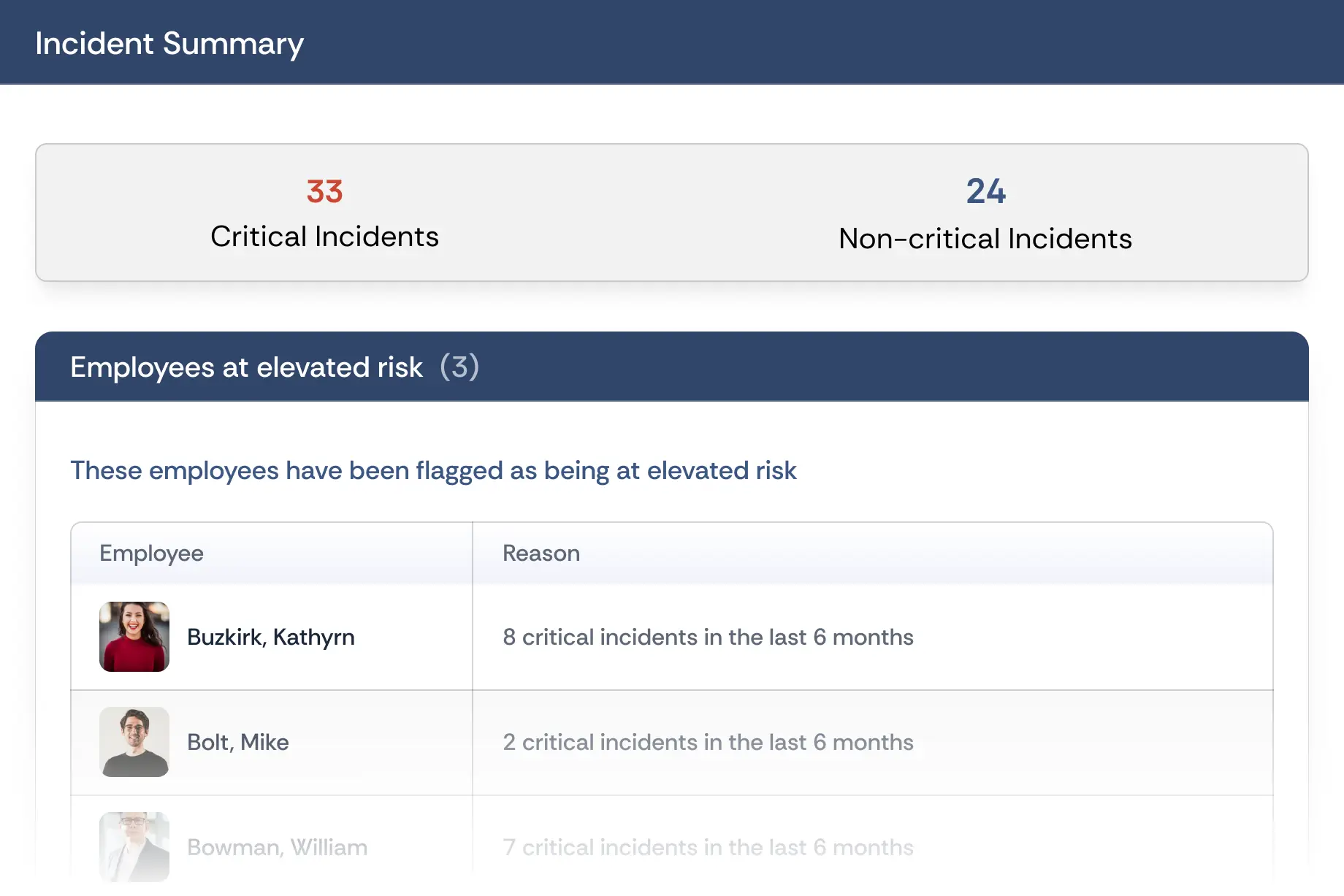
Safety and Wellness is published at $40 per user per year, or $175 per user for all four suites, plus a one-time $3,000 startup fee, on the pricing page. The platform is hosted in AWS GovCloud, aligned with the FBI CJIS Security Policy and covered by an annual SOC 2 Type II report, with details on the security and compliance page. It's available through GSA Advantage, NASPO, Omnia Partners, NCSA and VSA. See the Safety and Wellness suite for the full feature list, or how the platform is set up for law enforcement.
Set your wellness permissions to match your policy
We'll walk through your access list, peer support setup and critical incident alerts using your department's own structure. Call (910) 390-0011 or email info@essper.com.
Frequently asked questions
A purpose statement that says wellness isn't discipline, definitions, a filing rule for each record type, a named access list, an anonymous statistics rule for peer support, attendance-only confirmation for check-ins, an independent fitness-for-duty process, a firewall from internal affairs, a written member notice, retention rules tied to your state schedule, and an annual audit.
Adopt a written records policy first. Collect wellness information on separate forms, file it in a confidential wellness file as 29 CFR 1630.14 requires, name the few people who can open it, and put only duty status in the personnel file. Software such as Essential Personnel can then enforce that access list with role permissions.
Only anonymous statistics. The IACP's Peer Support Guidelines recommend that peer supporters not keep written records of supportive contacts other than anonymous statistical information, such as the number of contacts, time spent and referrals given. Management sees how the program is used, never who used it. A record that was never written can't be subpoenaed or misfiled.
Generally no. Under the ADA rule, supervisors may be told about necessary work restrictions and accommodations, but not the medical reason behind them. There's no general exception for the chain of command, a promotion board or internal affairs. Command staff should receive wellness program information only as aggregate statistics that don't identify anyone.
It depends on your state. Colorado, Utah, Florida and California protect peer support communications by statute, each with exceptions such as threats to self or others, abuse and criminal conduct. Colorado and Utah protect them only when the team follows the agency's written guidelines. The federal COPS Counseling Act covers federal officers only, not municipal or county departments.
The chief or a designee, who receives the examiner's answer to the referral question and any job-related limitations. File the report in the confidential wellness file and record only the resulting duty status and restrictions in the personnel file. The IACP's 2024 guidelines say the evaluation should be done by an independent evaluator, not the officer's treatment provider.
As long as your state records retention schedule says for confidential employee medical records. If it's silent, the federal General Records Schedule 2.7 is a useful model: three years for wellness program records, seven years after counseling ends for self-referred employee assistance program records, and 30 years after separation for long-term occupational medical files.
Look for software that limits wellness detail to named people, not ranks. Essential Personnel tracks injuries, use of force, traumatic calls, crashes and exposures against each officer, uses Specialist Role Permissions to restrict who sees wellness detail, alerts named staff after critical incidents, and is published at $40 per user per year for Safety and Wellness.

About this article
Written by Scott Monroe, Chief Executive Officer & Co-Founder, Essential Personnel. Published 28 October 2026.
Essential Personnel makes the software described here, and the product screenshot is from the platform. Pricing, hosting and purchasing details are taken from essper.com. The sample policy language is original, adapted from 29 CFR 1630.14, the IACP's Peer Support Guidelines and Psychological Fitness-for-Duty Evaluation Guidelines, and the published wellness and peer support policies of the Ogden, Boulder and Minneapolis police departments. Laws, guidelines and schedules are linked to their primary sources and were checked in October 2026. This article is general information and isn't legal advice; have your attorney review any policy before you adopt it.
