
Police early warning system policy: a model policy and what to put in yours
Most departments that need a police early warning system policy start the same way: they download a neighboring agency's SOP, change the name at the top and file it. Then the first officer gets flagged, and nobody can answer the basic questions. Does an unfounded complaint count? Is the 12 months rolling or by calendar year? Can what the officer says in the meeting end up in an internal affairs file? Who closes the flag, and when?
This guide is for police chiefs, sheriffs, professional standards and internal affairs commanders, and the city attorneys who review their directives. It sets out a model police early warning system policy, section by section, with sample language you can adapt. It's built from New Jersey's statewide directive, the policies New Jersey departments publish under it, North Carolina's statute and the federal research behind early intervention.
If you're still deciding what to track and why, start with our guide to how police departments track officer performance and early warning signs. This page is the written policy that sits underneath it.
The short answer: what a police early warning system policy needs
A police early warning system policy needs eleven parts: a purpose statement that says the system isn't discipline, definitions, the performance indicators you track, a threshold with counting rules, who administers it, the review steps, a menu of interventions, a rule that keeps review statements out of discipline, required notices, records and confidentiality, and an audit schedule. New Jersey's Directive 2018-3 is the most detailed public model, with 15 indicators and a minimum trigger of three in any 12 months.
The policy is only as good as the record behind it. Departments that run their police early intervention system in software such as Essential Personnel keep the indicators, the review and the follow-up on one officer record, so the policy is applied the same way every time.
The sample language below is a starting point, not a finished directive. Have your city or county attorney review it against your state law and any collective bargaining agreement before you adopt it.
Who requires a written policy: NJ Directive 2018-3, North Carolina and CALEA
New Jersey requires every state, county and municipal law enforcement agency to adopt a police early warning system by rule, regulation or SOP under Attorney General Directive 2018-3. North Carolina requires every agency with certified officers to develop and implement one under G.S. 17F-10. CALEA standard 35.1.9 covers a personnel early warning system for accredited agencies.
| New Jersey | North Carolina | CALEA | |
|---|---|---|---|
| Source | AG Directive 2018-3 (March 2018), now part of the state's Internal Affairs Policy and Procedures, section 3.4 | G.S. 17F-10, enacted by S.L. 2021-138, effective December 1, 2021 | Standard 35.1.9 in the CALEA standards list |
| Minimum indicators | 15, listed in section 3 below | Firearm discharges, use of force, vehicle collisions, citizen complaints | Set by the agency in a written directive |
| Threshold | At least three in any 12 months; the chief may set one or two | Not set by statute | Set by the agency |
| Notice to the officer | Written notice and a conference | Not set by statute | Set by the agency |
| Monitoring | At least three months, or until remediated, whichever is longer | Not set by statute | Set by the agency |
| Reporting | Confidential notice to the County Prosecutor at start and finish; history shared with any later employer | Confidential information stays confidential | Set by the agency |
| Audit | Tracking system audited at least every six months | Not set by statute | Set by the agency |
North Carolina's Department of Justice publishes an early warning systems guide with a sample tracking table, and it suggests a supervisor review once an employee reaches "three items checked in any combination." If your state sets nothing, New Jersey's rules are the most complete public baseline, and the model below uses them.
1. Purpose and policy statement
Open with what the police early warning system is for, and say plainly that it isn't discipline. Every New Jersey policy reviewed for this guide does this, and it's the line officers and their union read first.
Sample language
The purpose of this policy is to establish an early warning system that identifies patterns of conduct or performance that may indicate an officer needs support, training or closer supervision, so the agency can intervene before a problem becomes serious. The early warning system is a non-disciplinary tool for supervision and officer wellness. It does not replace the internal affairs process, and it does not prevent the agency from taking disciplinary action for misconduct identified by other means.
2. Definitions
Most published policies skip definitions, and that's where disputes start. Define at least these four terms.
Sample language
Performance indicator: an event listed in section 3 that is recorded against a sworn member.
Twelve-month period: any rolling period of 365 days, counted back from the date of the most recent performance indicator.
Early warning review: the process in section 6 that begins when a member reaches the threshold, or when a supervisor requests a review.
Early warning administrator: the member assigned by the chief to manage the tracking system, normally the commander of internal affairs or professional standards.
Write "rolling" in. A calendar-year count lets three complaints in November and December reset in January.
3. Performance indicators
List the events the police early warning system counts. New Jersey's Directive 2018-3 requires 15 performance indicators, from internal affairs complaints and civil actions to at-fault crashes, cases dismissed by a court and unexcused absences. North Carolina requires at least four. Add indicators your own history says matter, as long as each one can be measured objectively.
These are the 15 indicators Directive 2018-3 requires every New Jersey agency to track:
- Internal affairs complaints against the officer, whether initiated by another officer or by a member of the public
- Civil actions filed against the officer
- Criminal investigations of or criminal complaints against the officer
- Any use of force formally determined or adjudicated to have been excessive, unjustified or unreasonable
- Domestic violence investigations in which the officer is an alleged subject
- An arrest of the officer, including on a driving under the influence charge
- Sexual harassment claims against the officer
- Vehicular collisions formally determined to have been the officer's fault
- A positive drug test by the officer
- Cases or arrests by the officer that are rejected or dismissed by a court
- Cases in which evidence obtained by the officer is suppressed by a court
- Insubordination by the officer
- Neglect of duty by the officer
- Unexcused absences by the officer
- Any other indicators determined by the agency's chief executive
Keep items 6 and 7 as separate lines. At least one published New Jersey policy merges an officer's arrest and sexual harassment claims into one item, which leaves a reviewer unsure whether they count once or twice. The Directive says added indicators "should be objectively measurable and reasonably related to potentially escalating harmful behavior by the officer."
Common additions outside New Jersey's list are firearm discharges and all use of force reports (North Carolina's minimum), vehicle pursuits, on-duty injuries and traumatic calls. Track commendations too, but on a separate line that never counts toward a threshold. A supervisor reviewing a flag should see the good work alongside the complaints.
Some policies, such as Kearny Police Department's SOP 222, also require officers to report their own indicators in writing. That closes the gap when a civil suit or an off-duty arrest reaches the officer before it reaches the department.
4. Thresholds and counting rules
New Jersey's minimum early warning threshold is three separate performance indicators in any 12-month period, and one incident that touches several indicators counts once. The chief may lower it to one or two. Your policy should also say which date counts, whether complaints count before a finding, and when a supervisor can open a review below the threshold.
The Directive sets the number. It doesn't settle how to count, and five questions come up in the first year:
| Question | Recommended rule | Why |
|---|---|---|
| Rolling or calendar 12 months? | Rolling 365 days | Stops a pattern resetting on January 1 |
| Which date counts? | The date of the incident, not the date of the complaint or finding | Keeps the count tied to the officer's conduct |
| Do complaints count before a finding? | Yes, for New Jersey's complaint indicator, with a screen for false positives | The state's internal affairs rules call for reviewing complaints "regardless of outcome" |
| One incident, several indicators? | Counts once | Required by Directive 2018-3 |
| Can a supervisor open a review below the threshold? | Yes, with the chief's approval | A single serious event can matter more than three minor ones |
Count the use of force and crash indicators only once they're "formally determined," as the Directive's wording requires, and write down who makes that determination in your agency. A tiered approach works well: an alert to the officer's supervisor at two indicators, a formal early warning review at three, and an immediate review for any single sustained use of force or positive drug test.
Sample language
Three separate performance indicators within any twelve-month period shall trigger an early warning review. An incident that involves more than one performance indicator shall be counted once. A supervisor may request a review for a member below this threshold, with the approval of the chief of police. Before notifying the member, the early warning administrator shall screen each triggering indicator for false positives, such as a complaint that is plainly frivolous or not made in good faith, and shall document the result of the screen.
The false positive screen comes from Kearny's SOP, and it's what keeps a review process credible with officers. Document every screen-out so an auditor can see why an indicator was set aside.
5. Administration and tracking under your internal affairs policy
Directive 2018-3 says the system should typically be administered by internal affairs, with supervisors in the officer's chain of command "directly involved," and it requires every department to adopt a tracking system. Name a single administrator and a backup, and cross-reference the section of your internal affairs policy that covers complaint intake, so every complaint reaches the tracking system. Give the officer's direct supervisor a role in every review, because they're the person most likely to see whether an intervention is working.
The tracking system can be paper, a spreadsheet or software, but it has to show each officer's indicators against the threshold at any moment. A system that only produces a count once a quarter will miss the officer who hits three in six weeks. The New Jersey internal affairs rules also expect the data to support analysis by supervisor, squad, district and assignment, not just by officer, which a single spreadsheet tab rarely does well.
Sample language
The early warning administrator shall maintain a tracking system that records each performance indicator against the member involved and alerts the administrator when a member reaches the threshold. Members shall report in writing to the early warning administrator, as soon as practicable, any performance indicator involving themselves that is not already known to the agency.
6. The review process
Under Directive 2018-3, an early warning review has five steps: written notice to the officer, a conference with the officer and supervisors, a remedial plan, monitoring for at least three months or until the behavior is remediated, whichever is longer, and a documented report of the findings. Most published policies add monthly progress meetings during the plan.
- Screen. The administrator checks each indicator, removes false positives and records why.
- Notify in writing. The officer receives written notice that a review has started and which indicators triggered it. If notice could jeopardize a criminal investigation, New Jersey lets the County Prosecutor permit delayed notice.
- Confer. The officer meets with their supervisor and the administrator. The Leadership Conference recommends using the meeting to "listen to what officers have to say about underlying incidents," not just to deliver a finding.
- Decide. The review ends in one of three outcomes, as Pennsville Police Department's directive sets out: no action needed, referral to internal affairs for possible misconduct, or a remedial plan.
- Plan. A written improvement plan names the interventions, the goals and the monitoring period. Hackettstown Police Department uses a plan of at least three months, typically three to six, with monthly meetings.
- Monitor and close. The supervisor documents each monthly meeting. At the end, the administrator writes a closing memo stating whether the plan was completed and the behavior remediated.
Attach the forms to the policy so every supervisor uses the same ones: the written notice, a conference record, the improvement plan, a monthly progress note and the closing memo. None of the published policies includes them, and it's where reviews most often go missing on paper.
7. Intervention options in the early intervention program
List the interventions a supervisor can choose from, so the early intervention program fits the officer rather than the other way around. Directive 2018-3 names six:
- Training or retraining
- Counseling
- Intensive supervision
- A fitness-for-duty examination
- Employee Assistance Program referral
- Any other appropriate remedial or corrective action
Other policies add peer support, a temporary change of assignment, ride-alongs with a supervisor and financial or family counseling. If the indicators include traumatic calls, the right intervention is often a wellness referral rather than more supervision, and a good early intervention program makes that referral as easy as a training assignment. Our guide to keeping officer wellness records out of personnel files covers how to document that referral without exposing it.
8. Keeping the police early intervention system separate from discipline
Directive 2018-3 says any statement an officer makes during an early warning review "may not be used against the subject officer in any disciplinary or other proceeding." The early intervention program runs alongside the internal affairs policy, not inside it. Write a procedure for keeping review statements away from internal affairs, because the rule alone doesn't say how.
This is the section that decides whether officers trust the police early intervention system, and most policies leave it at one sentence. Kearny's SOP is the exception: when internal affairs staff being in the room might interfere with an open investigation, supervisors hold the conference without them and don't share the officer's statements with internal affairs. If a statement could be criminally incriminating, the conference waits for approval from the prosecutor's internal affairs unit.
Sample language
The early warning system is separate from and independent of the agency's internal affairs policy. Statements made by a member during an early warning review shall not be used against the member in any disciplinary or other proceeding, and shall not be shared with personnel conducting an internal affairs investigation of the member. Where internal affairs is investigating a matter that is also a triggering indicator, the review conference shall be conducted by supervisory personnel not assigned to that investigation. Nothing in this policy prevents the agency from investigating or disciplining misconduct identified through other means.
The last sentence matters too. As the Leadership Conference puts it, early intervention systems "don't immunize officers from consequences for misconduct that has already occurred."
9. Notices and reporting
In New Jersey, the policy has to cover three notices:
- To the County Prosecutor, at the start: a confidential notice of the officer's identity, the triggering indicators and the planned remedial program.
- To the County Prosecutor, at the end: the outcome of the review and any remedial measures taken.
- To a later employer: if the officer is hired by another law enforcement agency, notice of their early warning history and outcomes, and the review files on request.
Each County Prosecutor then reports to the Attorney General by January 31 which agencies comply. Outside New Jersey, check whether your state's decertification or separation reporting covers early warning history. Our guide to where a city HR system stops in an officer's career covers separation reporting in Texas, California and Florida.
10. Records and confidentiality
Directive 2018-3 requires the policy itself to be public, posted on the agency's website, and every report that identifies an officer to be confidential. North Carolina's statute says information that's confidential under state or federal law stays confidential. Neither sets a retention period, so tie retention to your state's records schedule rather than inventing a number.
Sample language
Early warning review records shall be maintained by the early warning administrator with the same security as internal affairs records and retained according to the state records retention schedule. No entry shall be made in the member's personnel file unless the matter results in a sustained internal affairs finding. This policy shall be posted on the agency's website. Reports that identify individual members are confidential.
The personnel file rule is adapted from Pennsville's directive, and it's the clause officers ask about most.
11. Audit and annual evaluation
New Jersey requires the people managing the system to audit the tracking system and records at least every six months "to assess the accuracy and efficacy of the tracking system." Add an annual evaluation of the whole program, reported to the chief. Use these questions for both:
Audit checklist
- Is every complaint, use of force, crash and court dismissal from the last six months in the tracking system?
- How many officers were flagged, and could supervisors actually work with that many?
- How many days passed, on average, from flag to written notice and from notice to conference?
- How many flags were screened out as false positives, and were the reasons documented?
- How many plans were completed, and how many officers were flagged again within 12 months?
- Do flags fall unevenly on one shift, assignment or group of officers in a way the work doesn't explain?
- Were all required notices sent, and are the review records stored with internal affairs security?
The second question is the one most audits skip. The Council on Criminal Justice warns that thresholds "should be calibrated based on the agency's ability to provide a robust intervention," because flagging too many officers dilutes the help each one gets.
The early warning review calendar
| When | What happens | Who |
|---|---|---|
| As each indicator occurs | Record it against the officer; officer self-reports anything the agency doesn't know | Supervisor, internal affairs, officer |
| When the threshold is reached | Screen, written notice, conference, plan | Early warning administrator, supervisor |
| At the start and end of each review (NJ) | Confidential notice to the County Prosecutor | Early warning administrator |
| Monthly during a plan | Progress meeting and note | Supervisor |
| At least three months after the plan starts | Closing memo, or extend monitoring | Early warning administrator |
| Every six months (NJ) | Audit of the tracking system and records | Early warning administrator |
| Annually | Program evaluation and threshold review, reported to the chief | Professional standards commander |
| By January 31 (NJ) | County Prosecutor reports agency compliance to the Attorney General | County Prosecutor |
A minimum police early warning system policy for small agencies
A department with a dozen officers doesn't need a 20-page directive, but a police early intervention system still needs the core. A workable minimum fits on two pages: the purpose statement, your state's required indicators, a threshold of three in any rolling 12 months, written notice and a conference, a short plan with monthly check-ins, the statement rule from section 8 and the records clause from section 10.
The tracking can be simple. The Police Executive Research Forum found some departments still run early intervention on "paper files or simple Excel spreadsheets," and North Carolina's guide includes a paper tracking table. The risk is that the spreadsheet lives with one lieutenant. When they retire, the history goes with them, which is the point at which most small agencies move to software.
Unions and rollout
Union opposition is less common than chiefs expect. In the U.S. Justice Department's COPS Office planning guide, only 16 percent of managers reported serious opposition from police unions, and the guide recommends involving union representatives in planning. PERF's view is that early intervention systems "are not normally a matter for collective bargaining," but bargaining duties vary by state, so check your state's labor law and your contract before you adopt or change the policy.
Roll the early intervention program out in this order: share the draft with the union and supervisors, train supervisors on the review conference, announce the policy to the whole agency and post it publicly, then load the last 12 months of indicators so the first flags reflect real history.
What the research says about thresholds
Three in 12 months isn't arbitrary. In the National Institute of Justice's 1999 national survey of early warning systems, most systems that counted citizen complaints required three in a given timeframe, and 76 percent of those used a 12-month period. The same study found citizen complaints fell 67 percent in Minneapolis and 62 percent in New Orleans in the year after officers went through early intervention, though the authors caution that the systems are "high-maintenance" and the research design was limited.
Newer work is more mixed. The Council on Criminal Justice reports that only 12.4 percent of agencies had an early intervention system in 2016, rising to 69.3 percent of departments with 100 or more officers. It found statistical models identify at-risk officers better than fixed counts, and that one randomized trial of 118 flagged officers found no difference in later complaints. The practical lesson for any early intervention program: a fixed threshold is a reasonable start, but review it every year against who it actually flags and what happens to them afterward.
Running a police early warning system policy in software: how Essential Personnel does it
Essential Personnel is professional standards software built by public safety people for police, fire and city government. Their Safety and Wellness suite tracks injuries, use of force, traumatic calls, motor vehicle accidents and exposures against each officer, and the department sets the number, type and timeframe of events that trigger an automatic alert. Corrective documents of record can count toward a threshold too.
That covers the parts of a police early intervention system most departments struggle to run by hand:
- Section 4, thresholds: Automated Alert Triggers apply your count and window to every officer continuously, not once a quarter.
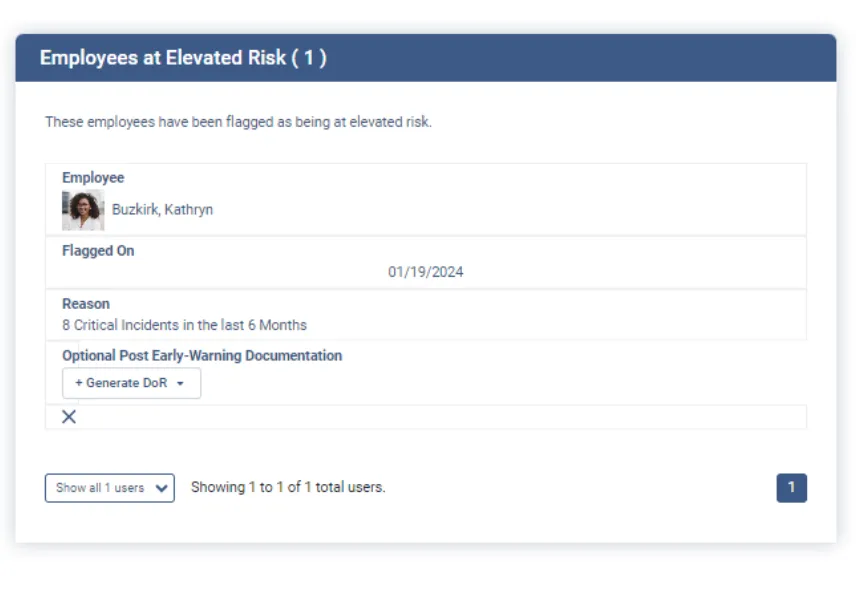
- Section 6, the review: the elevated risk flag shows the reason it fired, and supervisors can generate early warning documentation from it. Leader's Notes holds templates for formal counseling and performance improvement plans.
- Section 8, separation: Specialist Role Permissions let a peer support or wellness professional see critical incidents without access to the rest of the file.
- Section 7, interventions: training, commendations and corrective documents sit on the same officer record, so a reviewer sees the whole officer.
Check in a demo that every indicator on your list can feed a threshold. Indicators outside the five event types, such as civil actions or court dismissals, need to be recorded somewhere the threshold can count them. Our internal affairs software comparison guide includes a demo script for exactly this.

Safety and Wellness is published at $40 per user per year, or $175 per user for all four suites, plus a one-time $3,000 startup fee, on the pricing page. The platform is hosted in AWS GovCloud, aligned with the FBI CJIS Security Policy and covered by an annual SOC 2 Type II report, with details on the security and compliance page. It's available through GSA Advantage, NASPO, Omnia Partners, NCSA and VSA. For how the early warning policy fits the rest of your accountability program, see our guide to establishing professional standards.
"That level of visibility helps us catch issues early or give praise when it's due."
Derek Moore, Major, Carteret County Sheriff's Office, North CarolinaPut your early warning policy on one record per officer
We'll walk through your indicators, threshold and review steps and show you how they run for a department your size. Call (910) 390-0011 or email info@essper.com.
Frequently asked questions
A purpose statement saying the system isn't discipline, definitions, the performance indicators tracked, a threshold with counting rules, who administers it, the review steps, a menu of interventions, a rule keeping review statements out of discipline, required notices, records and confidentiality rules, and an audit schedule. New Jersey's Directive 2018-3 is the most detailed public model to start from.
They keep an everyday record of evaluations, supervisor notes, training and discipline, and run an early warning system that counts indicators like complaints, use of force, crashes and court dismissals against a threshold, such as three in 12 months. A written policy sets the indicators, the threshold and the review steps. Software such as Essential Personnel keeps both on one officer record.
Under Attorney General Directive 2018-3, at least three separate performance indicators within any 12-month period must trigger an early warning review. One incident that involves several indicators counts once. The agency's chief may set a lower trigger of one or two indicators. The officer then gets written notice, a conference, a remedial plan and at least three months of monitoring.
No. It's a supervision and support tool that runs separately from the internal affairs policy. In New Jersey, statements an officer makes during an early warning review can't be used against them in any disciplinary or other proceeding. Misconduct found through other means can still be investigated and disciplined. Many policies also keep review records out of the personnel file unless a finding is sustained.
Yes. G.S. 17F-10, enacted in 2021, requires every agency employing officers certified by either of North Carolina's training and standards commissions to develop and implement an early warning system. It must track at least firearm discharges, use of force, vehicle collisions and citizen complaints. The statute doesn't set a threshold, so each agency writes its own in policy.
In New Jersey, at least three months, or until the supervisor concludes the officer's behavior has been remediated, whichever is longer. Many departments set improvement plans of three to six months with monthly progress meetings. The policy should also say how a review is closed, with a written memo stating whether the plan was completed, so a flag doesn't stay open indefinitely.
Usually the internal affairs or professional standards unit, with the officer's direct supervisor involved in every review. New Jersey's directive says internal affairs typically administers it and that supervisors in the chain of command should be directly involved. Name one administrator and a backup in the policy, and require an audit of the tracking system at least every six months.
Departments use a standalone early intervention product, the early warning module of an internal affairs system, or professional standards software such as Essential Personnel. Essential Personnel applies department-set thresholds to use of force, crashes, traumatic calls, injuries, exposures and corrective documents on each officer's record, alerts supervisors automatically, and is published at $40 per user per year for Safety and Wellness.

About this article
Written by Scott Monroe, Chief Executive Officer & Co-Founder, Essential Personnel. Published 26 October 2026.
Essential Personnel makes the software described here, and the product screenshots are from the platform. Pricing, hosting and purchasing details are taken from essper.com, and the customer quote is reproduced from essper.com. The sample policy language is original and adapted from New Jersey Attorney General Directive 2018-3 and the published policies of the Kearny, Hackettstown and Pennsville police departments. Laws, directives and research are linked to their primary sources and were checked in October 2026. This article is general information and isn't legal advice; have your attorney review any policy before you adopt it.
