
Peer support team policy: a model policy for police and fire departments
Most first responder peer support teams start before anyone writes a policy. A few trusted firefighters or officers take a class, the chief announces the team, and members start calling. Then someone asks the questions nobody settled: who picks the team, what peer supporters can keep to themselves, who finds out after a bad call, and what happens when a peer supporter is burning out.
This guide is for fire chiefs, police chiefs, sheriffs, peer support coordinators and the HR and legal staff who'll be asked to defend the program later. It sets out a model peer support policy, section by section, with sample language you can adapt. It draws on the Washington State model policy for first responder peer support programs, the COPS Office's 2024 report to Congress on peer support best practices, the IACP and IAFF peer support guidance, and state peer support privilege laws.
If you're working out how leadership should back a team that already exists, start with our guide to supporting your peer support team. This page is the written policy underneath it.
The short answer: what a peer support team policy needs
A peer support team policy needs twelve parts: purpose and scope, definitions, a coordinator with licensed clinical oversight, selection and removal rules, training, confidentiality and its exceptions, activation after critical incidents, a records rule limited to anonymous statistics, a firewall from discipline, boundaries for role conflicts, supervision and care for the peer supporters themselves, and an annual program review.
Write it before the team takes its first call. Departments that run critical incident tracking in Essential Personnel can then match the software to the policy: critical incident alerts go only to the peer support team members and clinician the policy names, and the system records that outreach happened without recording what was said.
The sample language below is a starting point, not a finished directive. Have your city or county attorney review it against your state's peer support law and any collective bargaining agreement before you adopt it.
Why a first responder peer support policy has to be written down
Three reasons. In several states, peer support privilege only protects members when the peer supporter was designated by the agency, trained, and working within written guidelines. Fire departments that follow NFPA 1500 need written behavioral health records rules. And members won't trust a peer support program whose confidentiality rules they can't read.
Start with the difference between confidentiality and privilege, because members will confuse them and your policy shouldn't. The COPS Office's 2024 report to Congress puts it plainly: confidentiality is the peer supporter's ethical and legal duty to keep what's shared private, while privilege is a legal status that may or may not protect the conversation in court. The report points out that privilege matters more in law enforcement peer support than anywhere else, because officers end up in so many court proceedings over a career.
Firefighter peer support teams have a second reason. The COPS report quotes NFPA 1500's rule that "member records maintained by a behavioral health program shall not become part of a member's personnel file," and that the department's written policies must say to whom and under what conditions information can be released.
The state layer is where a written peer support policy earns its keep. Peer support confidentiality laws vary a lot, and most depend on the agency doing something first:
| State | Law | Who it covers | What the agency has to do first |
|---|---|---|---|
| Washington | RCW 5.60.060(6) | Law enforcement, fire, EMS, dispatch, corrections and more | Designate the peer supporter before they provide services. No privilege if the peer supporter responded to, witnessed or was a party to the incident |
| Colorado | C.R.S. 13-90-107(1)(m), amended 2024 | Law enforcement, fire, EMS and rescue | Officially designate team members, and keep them working within the written peer support guidelines in effect |
| Utah | Utah Code 78B-5-903 | Agencies that create a peer support team | Write guidelines. Exceptions include a belief that the member is mentally or emotionally unfit for duty |
| California | Gov. Code 8669.1 to 8669.7 | Law enforcement | Consult the employee representative organization, and have team members finish agency-approved training. No protection in a criminal proceeding |
| Florida | Fla. Stat. 111.09 | First responders | Designate and train the peer. Covers civil, criminal, administrative and disciplinary proceedings |
| Minnesota | Minn. Stat. 181.9732 | Critical incident stress management teams | Keep a team member who witnessed the incident off the team for it |
Every one of these has exceptions, usually threats to self or others, child or vulnerable adult abuse, criminal conduct and written consent. Your peer support policy should list your own state's exceptions word for word, because that list is what peer supporters will promise members on the first call.
1. Purpose and scope of the peer support program
Open with what the first responder peer support program is for and who it serves. The COPS report recommends including civilian staff and retirees, since dispatchers, jail staff and crime scene technicians carry the same exposure. Say in the first paragraph that using peer support can't hurt anyone's career.
Sample language
The Peer Support Program is a confidential, voluntary, non-clinical support service provided by trained agency members to help personnel manage personal and professional stress, including the effects of critical incidents. It complements the Employee Assistance Program, contracted clinicians and chaplaincy and doesn't replace them. This policy applies to all sworn, uniformed and civilian personnel, including dispatch, and to retirees the agency chooses to serve. Using the Peer Support Program, or declining it, shall not be used in any decision about discipline, assignment, evaluation or promotion.
2. Definitions
Define the handful of terms that the rest of the policy and your state law turn on. If your state statute defines "peer support communication" or "peer supporter," copy its wording so the peer support policy and the law say the same thing.
Sample language
Peer support team member: an agency member designated in writing by the Chief, who has completed approved peer support training and provides emotional support, active listening and referrals within the limits of that training. A peer support team member isn't a counselor or therapist.
Peer support coordinator: the member appointed by the Chief to run the program day to day.
Clinical advisor: a licensed mental health professional, under contract or on staff, who provides clinical oversight and consultation to the team.
Peer support communication: any communication between a member and a peer support team member made while the team member is acting in that role, including group sessions.
Confidentiality: the team member's duty not to disclose what a member shares, except as this policy and state law allow. Privilege: a legal protection, where state law provides one, against being compelled to disclose those communications in a legal proceeding.
3. Peer support coordinator and clinical oversight
Every source agrees on two roles. A peer support coordinator runs the program, and a licensed clinician backs the team. The IAFF says a team "should not function without oversight from a trained and licensed mental health clinician." The COPS report adds one rule that's easy to miss: the team's clinician shouldn't be the clinician who makes fitness-for-duty determinations.
Sample language
The Chief shall appoint a Peer Support Coordinator, who shall maintain the team roster, coordinate selection, training and activation, keep the program's anonymous activity data, maintain a vetted list of referral resources, and review complaints about any team member's conduct. The agency shall retain a licensed mental health professional as Clinical Advisor to provide clinical oversight, consultation and training. The Clinical Advisor shall not conduct fitness-for-duty evaluations of agency members. The program budget shall be reviewed and approved each year.
Give the peer support coordinator protected time. Washington's model policy also asks agencies to consider how long the coordinator serves, to reduce the risk of burnout in the person everyone calls first.
4. Selecting, removing and resigning peer support team members
Selection decides whether members will call the team at all. The IAFF suggests an anonymous poll asking members who they'd confide in. Washington's model policy asks for diversity across rank and role, so as many members as possible have a peer they're comfortable with, and the League of Minnesota Cities calls one peer supporter for every seven staff an acceptable standard.
Sample language
Membership on the Peer Support Team is voluntary. Candidates shall apply in writing and be interviewed by the Coordinator, current team members and, whenever possible, the Clinical Advisor. Candidates shall have completed at least one non-probationary year with the agency, be in good standing, and show the judgment, discretion and credibility the role needs; discipline within the past year shall be reviewed. The Chief designates team members in writing and the Coordinator keeps a current roster available to all personnel. A team member may resign at any time by written notice to the Coordinator, may take a leave from the team without explanation, and may be removed for failing to meet the standards of this policy or for conduct that compromises the program.
5. Peer support training
The written designation and the training record are often what a privilege statute checks first. Washington's model policy asks for initial training within six months of selection and at least two hours of continuing training every quarter. The IACP peer support guidelines recommend four hours of update training per quarter. Pick a number and write it down.
Sample language
Team members shall complete an agency-approved initial peer support training course within six months of designation and before providing peer support alone. Team members shall complete at least [two/four] hours of continuing training each quarter, covering confidentiality and privilege under state law, suicide risk recognition and referral, substance use, trauma and secondary trauma, burnout and compassion fatigue, crisis communication, and agency procedures. The Coordinator shall keep each team member's training record.
6. Peer support confidentiality and its limits
This is the section members will actually read. Peer support confidentiality is what makes members call at all, so keep it plain. Keep the list of exceptions short, specific and taken from your state's law, and tell members about it before they share anything. The federal COPS Counseling Act requires written notice of the exceptions before the first session for federal officers, and it's a good rule for everyone else.
Sample language
Peer support communications are confidential. A team member shall not disclose them to anyone, including supervisors, command staff and internal affairs, except: (1) when the member presents an imminent threat of harm to themselves or others; (2) when the team member is required to report suspected abuse or neglect of a child or vulnerable adult; (3) when the member consents in writing; and (4) as otherwise required by [state statute]. Team members shall tell members about these exceptions at the start of the first contact. A team member shall not provide peer support for an incident in which they responded, witnessed or were a party, and shall refer the member to another team member.
7. Peer support team activation after critical incidents
Most teams fail here quietly. The team can only reach out after a bad call if someone tells them it happened, and in many departments that still depends on word of mouth. Write down who notifies the team, how fast, and for which events.
Sample language
The shift supervisor or incident commander shall notify the Peer Support Coordinator, or the on-call team member, as soon as practical after any critical incident, including a line-of-duty death or serious injury, a death or serious injury of a child, a mass casualty incident, an officer-involved shooting, a suicide of a member or a member's family member, or any incident the supervisor believes may affect personnel. Notification shall name the incident and the personnel involved, not any member's reaction to it. The Coordinator shall arrange contact with each member involved. Contact is an offer; members may decline it. Team members who worked a large-scale incident shall attend a debriefing for team members afterward.
The last sentence comes from the IACP guidelines, which recommend that peer supporters attend a mandatory critical incident debriefing of their own after a large-scale event. Our guide to what counts as a critical incident covers which calls belong on the list.
8. Peer support records: anonymous statistics only
The IACP guidelines say peer supporters should not keep formal or private written records of supportive contacts, other than anonymous statistical information. The League of Minnesota Cities goes further: don't collect anything that could identify a member, including how many times they talked to the team. Washington's model policy closes with the same rule.
Sample language
Team members shall not keep notes, logs or files about individual peer support contacts. The Coordinator may collect anonymous program data only: the number of contacts, the general type of support, time spent, referrals made and training completed. Program data shall not include names, employee numbers, titles, units or any other information that could identify a member, including the number of contacts any member had. No peer support information shall be placed in a personnel file, an internal affairs file or an evaluation.
The critical incident itself is a different record. That an officer worked a fatal crash is an operational fact the agency already holds; what the officer said to a peer supporter afterward is not. Keep the incident record and the anonymous peer support statistics, and nothing in between. The same rule applies to peer support supervision: clinical consultation and team meetings discuss situations, not names. Our officer wellness records policy sets out where every other wellness record belongs.
9. Keeping peer support separate from discipline and supervision
Members stop calling the day peer support looks like part of the disciplinary process, and in law enforcement peer support that fear runs deepest because internal affairs sits down the hall. The League of Minnesota Cities allows supervisors to refer a member, but says peer support must never be used "in lieu of discipline, as part of discipline, coaching or work improvement plan."
Sample language
Peer support is not part of the disciplinary, internal affairs, evaluation or fitness-for-duty process and shall not be ordered as a substitute for, or part of, discipline. Supervisors may suggest peer support to a member and may ask the Coordinator to offer contact. No supervisor, commander or investigator shall ask a team member what a member said or whether a member used peer support. A team member who also supervises personnel shall continue to report harassment, discrimination and other workplace matters as agency policy requires, and shall refer members they supervise to another team member.
10. Boundaries and role conflicts
Peer supporters work alongside the people they support, so conflicts are normal. The policy should name them and give an easy way out. Washington's model policy lists financial, sexual and religious conflicts, and asks team members to refer someone they keep supporting to another team member.
Sample language
Team members shall avoid relationships with members they support that could compromise their objectivity, including financial, romantic or sexual, and religious relationships, and shall not provide peer support to a member they directly supervise. When a team member has a conflict, or has supported the same member repeatedly, they shall refer the member to another team member, the Clinical Advisor, a chaplain or the Employee Assistance Program. Team members shall work only within the scope of their training and refer members who need clinical care.
11. Peer support supervision, burnout and care for the team
Peer supporters absorb other people's worst calls on top of their own, so peer support supervision, boundaries and burnout need their own section of the policy. SAMHSA's guidance on supervising peer workers is written for paid behavioral health staff, but the core idea carries over: someone has to check on the people doing the checking. The COPS report calls for a system of peer support supervision with regular debriefing and support, and the IAFF suggests team meetings for peer and clinical supervision and an annual wellness check for each team member.
Sample language
The Coordinator shall hold team meetings at least [monthly/quarterly] for peer and clinical supervision, led or attended by the Clinical Advisor, without discussing identifiable members. Team members shall have access to the Clinical Advisor for consultation at any time, and to their own confidential counseling through the Employee Assistance Program. The Coordinator shall check in individually with each team member at least twice a year about workload and well-being, and shall share callouts so no team member carries a disproportionate share. Each team member shall have an annual wellness check. A team member may step back from active duty on the team at any time without explanation or penalty.
Recognition belongs here too. American Police Beat suggests formal recognition such as unit citations or a peer supporter of the year; our guide to awards and commendations programs covers how to write that into your general order.
12. Annual peer support program review
A peer support program that's never measured loses its budget. Measure it without breaking confidentiality: the IAFF recommends an anonymous survey of use and satisfaction and comparing utilization with EAP use, and the COPS report recommends feedback from participants and anonymized data.
Sample language
Each year the Coordinator shall report to the Chief, using anonymous data only: the number of contacts and activations, referrals made, training completed by each team member, team size against agency size, results of an anonymous member survey on awareness and trust in the program, and any recommended changes to this policy. The Chief, the Coordinator and the Clinical Advisor shall review this policy at least once a year and after any change in state peer support law.
Law enforcement peer support vs firefighter peer support: what changes in the policy
The twelve sections work for both, but three things change. Law enforcement peer support needs the strongest confidentiality wording, because officers testify so often. Firefighter peer support usually runs with the union local and falls under NFPA 1500's behavioral health records rule. And some state laws cover only one discipline, so check which one yours protects.
Law enforcement peer support. The COPS report notes that the gap between confidential and privileged matters most for police, since an officer may be a witness in hundreds of cases over a career. Write the peer support confidentiality exceptions as narrowly as your state allows, keep the internal affairs firewall in section 9 explicit, and check whether your state's law reaches administrative and disciplinary proceedings. Florida's does; California's covers law enforcement but not criminal proceedings; Texas shields records of officers' participation in its statewide peer network from public records requests.
Firefighter peer support. The IAFF recommends building the team with the union, the department and the state association together, and many firefighter peer support teams are run by the local. If yours is, the policy should say who appoints the peer support coordinator and who the clinician answers to. Fire departments that follow NFPA 1500 also need the written behavioral health records rule in section 8. Peer support confidentiality for firefighters is protected in Washington, Colorado and Florida, among others; California's statute covers law enforcement only.
Joint police and fire teams work well in smaller cities, and the same rules apply. Write down which discipline's peer supporters respond to which calls, and make sure every member knows which state law protects them.
Peer support policy for small agencies and regional teams
A small fire department or police department can't always field a peer support team with enough diversity of rank and enough distance from the people being supported. Washington's model policy recommends regional teams for agencies with limited personnel, especially in rural areas, with a shared confidentiality agreement and a written memorandum of understanding.
If you join a regional team, keep the same twelve sections and add four things from Washington's model: a confidentiality agreement every participating agency signs, the same training standard for every team member with at least one joint training a year, a written deployment protocol for how requests are made and assigned across agencies, and shared oversight set out in the memorandum of understanding. A regional first responder peer support team also solves the conflict problem: a team member from the next town over didn't work the call.
Before you adopt a peer support policy
- Read your state's law first. Copy its definitions and exceptions into sections 2 and 6, and check whether it requires designation, training or written guidelines before privilege applies.
- Talk to the union or association. Most firefighter peer support teams already involve the local. For law enforcement peer support, California requires the hiring authority to consult the employee representative organization. Elsewhere it's still how you earn trust in the program.
- Have counsel review the exceptions. Peer support confidentiality is only as strong as its exceptions are clear, and mandated reporting duties differ by state and sometimes by profession.
- Match the system to the policy. If critical incidents are tracked in software, set permissions so alerts reach the people section 7 names and nobody else.
- Publish it to every member. A peer support policy only builds trust if members can read the confidentiality rules before they call.
Running a peer support policy in software: how Essential Personnel does it
Essential Personnel is professional standards software for police, fire, EMS and city government. Their Safety and Wellness suite tracks critical incidents and alerts the peer support team members or clinician an agency designates, keeps that detail away from the chain of command, and records that outreach happened without recording what was said. It isn't a critical incident stress management program, a counseling service or a clinical record.
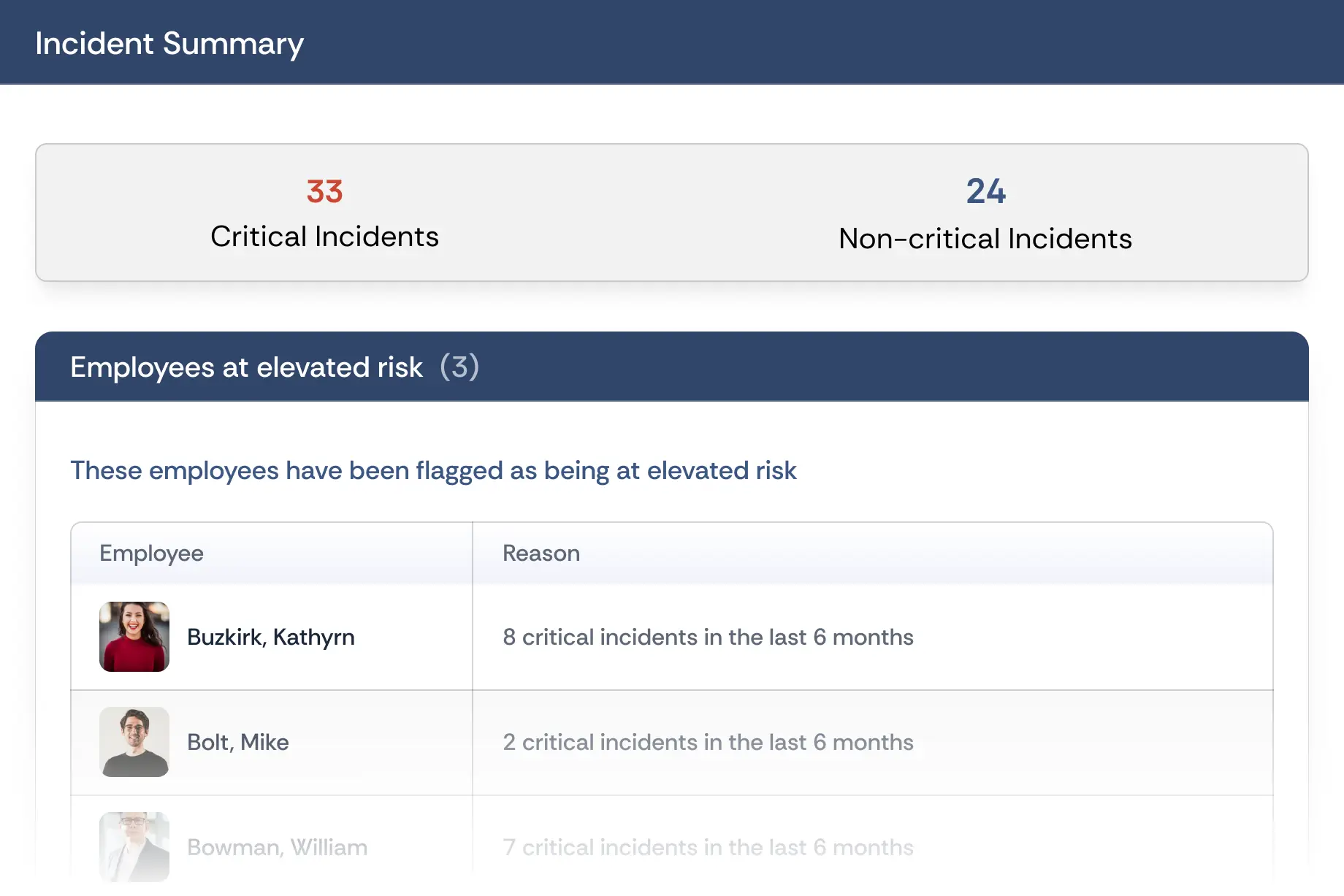
Here's how the policy sections map to the platform:
| Policy section | What Essential Personnel does |
|---|---|
| 3. Coordinator and roster | Special Teams and Committees keeps the peer support team as a custom team with its memberships and assignments |
| 5. Training | Each team member's peer support training and certifications sit on their own profile, with expirations tracked |
| 7. Activation | Critical Incident Alerts and Automated Alert Triggers notify designated peer support team members or an outside clinician when a traumatic call is logged or a member crosses a threshold the agency sets |
| 8. Records | The incident, the alert and its timing are recorded on the incident. What a member says to a peer supporter is never entered |
| 9. Separation from discipline | Specialist Role Permissions mean only designated individuals see critical incidents, and the chain of command doesn't automatically see wellness detail |
| 12. Program review | Incident counts and alert reports support the annual review without identifying what any member shared |
Statesville Fire Department in North Carolina relied on word of mouth to tell its peer support network about bad calls. After the same crew worked two pediatric fatalities within weeks, tracking incidents in Essential Personnel let the department match peers who'd had similar calls and contract with clinicians for more support, and the practice was cited as a best practice in its reaccreditation.
"It changes how the department and our peer support network responds, knowing that you have a cascading event like that."
Kyle Bell, Deputy Chief, Statesville Fire Department, North CarolinaThe Safety and Wellness suite is $40 per user per year, and Special Teams and Committees is part of the Talent Management suite. The Total Solution with every suite is $175 per user per year, plus a one-time $3,000 startup fee; see pricing and the Safety and Wellness page. The platform is hosted in AWS GovCloud, aligned with the FBI CJIS Security Policy and covered by an annual SOC 2 Type II report, and it's available through GSA Advantage, NASPO, Omnia Partners, NCSA and VSA.
Make sure your peer support team hears about every bad call
We'll show you how critical incident alerts reach your peer support team and clinician, and nobody else, for a department your size. Call (910) 390-0011 or email info@essper.com.
Frequently asked questions
A peer support team policy should cover purpose and scope, definitions, a coordinator with licensed clinical oversight, selection and removal, training, confidentiality and its exceptions, activation after critical incidents, anonymous-only records, separation from discipline, boundaries, supervision and care for peer supporters, and an annual review. Departments using Essential Personnel can set critical incident alerts to reach only the people the policy names.
Peer support confidentiality holds, within limits: threats of harm, required abuse reporting, written consent and anything else your state's law requires. Privileged in court is a separate question. Washington, Colorado, Utah, California, Florida and others protect some first responder peer support communications, usually only when the agency designated and trained the peer supporter and the peer supporter followed written guidelines.
No. The IACP peer support guidelines say peer supporters shouldn't keep formal or private records of supportive contacts, only anonymous statistics such as the number of contacts, type of support and referrals. The League of Minnesota Cities adds that nothing identifying a member should be collected, including how many times they talked to the team. Nothing from peer support belongs in a personnel file.
A peer support coordinator runs the program, and a licensed mental health clinician provides clinical oversight and peer support supervision alongside the coordinator. The COPS Office says the clinician shouldn't be the one who makes fitness-for-duty determinations. Good peer support supervision means regular team meetings for peer and clinical supervision, individual check-ins on workload, and an annual wellness check help prevent burnout among peer supporters.
Use a written application and an interview with the coordinator, team members and, where possible, a clinician. Washington's model policy asks for at least one non-probationary year, good standing and a mix of ranks and roles. The IAFF suggests an anonymous poll of who members would confide in. About one peer supporter per seven staff is a common benchmark.
An approved initial course before working alone, ideally within six months of selection, then regular continuing training. Washington's model policy recommends at least two hours a quarter and the IACP guidelines recommend four. Topics include confidentiality and privilege, suicide risk and referral, substance use, trauma, burnout, crisis communication and the agency's own procedures.
A supervisor can suggest peer support or ask the coordinator to reach out, in law enforcement peer support and fire alike, but peer support should stay voluntary and should never be ordered as part of discipline, coaching or an improvement plan. Members can decline any contact. If a supervisor believes a member may be unfit for duty, that goes through a separate fitness-for-duty process, not the peer support team.
Yes, often as part of a regional team. Washington's model policy recommends regional teams for agencies with limited personnel, with a shared confidentiality agreement, the same training standard, a written deployment protocol and a memorandum of understanding. A regional team also means a peer supporter from a neighboring agency can help when everyone local worked the same call.
What customers say about Essential Personnel on G2
Essential Personnel is rated 4.9 out of 5 on G2 from 14 verified reviews by fire, police and HR leaders. These are some of them.

About this article
Written by Scott Monroe, Chief Executive Officer & Co-Founder, Essential Personnel. Published 11 November 2026.
Essential Personnel makes the software described here, and the product screenshot is from the platform. Pricing, hosting and purchasing details are taken from essper.com, and the Statesville example and quote are reproduced from an essper.com customer story. The model policy draws on the Washington State Criminal Justice Training Commission's Model Policy for First Responder Peer Support Programs (revised 31 December 2025), the COPS Office's 2024 report to Congress on peer support best practices, the IACP Police Psychological Services Section peer support guidelines, the IAFF's 10 steps to build a peer support program and the League of Minnesota Cities peer support guidelines. State laws were checked in October and November 2026. This article is general information and isn't legal advice.
