Top 5 critical incident and exposure tracking systems for California fire departments in 2026
Published 15 November 2026
A California firefighter diagnosed with cancer five years after retiring can still claim it as a job injury. But only if someone can show what they were exposed to at 31. That's the deal Labor Code 3212.1 offers, and it's only as good as the exposure record behind it. Add a wildfire workload few states share, an urban conflagration like the Palisades and Eaton fires, and Cal/OSHA rules that put a clock on every EMS exposure, and firefighter exposure tracking in California stops being paperwork. It becomes the evidence a member's claim will rest on.
This guide is for California fire chiefs, safety officers and health and safety committees, and for the HR, risk and IT staff who support them. Whether you run a city department, a county fire authority or a special district, it explains what California law asks your records to prove, compares the five systems that keep those records, and helps you decide which one fits your department's needs.
Each system is scored against seven criteria totaling 100, the same framework as our national ranking. The two heaviest, at 20 points each, are capturing an exposure at the incident and keeping a record that survives a full career and supports a claim. In California that second criterion carries the cancer presumption. Every criterion is published beside every score in the scoring table, so you can reweight it for your own department.
Essential Personnel ranks first at 88.5 out of 100. They take the highest scores on career retention, confidentiality and integrations, at 95 each, and tie for the highest on early intervention at 95. They don't submit to the National Firefighter Registry, and exposures attach to the member's record rather than inside the incident report, so incident linkage runs through your records management system. What they do better than anyone here is notice: five event types feed thresholds your department sets, and the alert goes to the named people who should act on it.
What's the best firefighter exposure tracking software for California fire departments?
Essential Personnel is the best critical incident and firefighter exposure tracking software for California fire departments in 2026, at 88.5 out of 100. Vector Solutions is second at 85.5, then ESO and First Due tied at 84.75, and ImageTrend at 75.5. The ranking weights the two things California law leans on hardest: an exposure captured at the time, and a record that lasts a career.
The scores are close at the top because all five systems can store an exposure. What separates them is what happens next. Some systems capture the exposure inside the incident report, and some count it against thresholds and tell someone. A few submit it to national research. In California, where a claim can arrive a decade after retirement, the question that matters is whether the record will still be there and still be readable when it does.
The 5 critical incident and exposure tracking systems compared
Ranked by weighted total for California fire and EMS departments, 2026. "Type" tells you whether the exposure record starts at the incident or at the employee.
What does California's firefighter cancer presumption, Labor Code 3212.1, ask your records to prove?
Labor Code 3212.1 presumes a California firefighter's cancer is job related if the member shows they were exposed, while in service, to a known carcinogen as defined by the International Agency for Research on Cancer. The presumption runs for three months after leaving service for every full year served, up to 120 months. The employer can rebut it, so the exposure record carries the claim.
Read that requirement as a records requirement, because that's how it plays out. The presumption doesn't ask a member to prove the fire caused the cancer. It asks them to prove exposure to a known carcinogen during service, and the employer's best rebuttal is that the carcinogen isn't reasonably linked to the cancer. A claim filed in 2036 is argued over records written in 2026. The statute's text covers city, county and district departments, CAL FIRE, UC and CSU fire departments, and from 2026 commercial airport fire departments too.
Cal/OSHA sets the floor for how long that record has to last. Title 8 section 3204 requires employee exposure records to be kept for at least 30 years, and medical records for the length of employment plus 30 years. A 25 year member who retires and claims within the 120 month window is asking you for records up to 35 years old. Paper rarely survives that. Neither does a records system that got replaced twice in the meantime, unless somebody planned the export.
The clock starts early too. Under Labor Code 5401, when an injury causes lost time beyond the shift or treatment beyond first aid, the employer has one working day to give the member the claim form (DWC 1). The statute says a serious exposure to a hazardous substance can't be treated as a minor first aid injury. Firefighter exposure tracking that captures the exposure on the day is what lets you meet that deadline without reconstructing the call afterward.
The same logic covers behavioral health. Labor Code 3212.15 presumes post-traumatic stress disorder is work related for firefighters and peace officers with at least six months of service, extending up to 60 months after they leave. It runs until 1 January 2029 after SB 623 extended it in 2023. A presumption that doesn't ask you to prove causation still rewards the department that can show which traumatic calls a member ran, and when.
What does Cal/OSHA's aerosol transmissible disease standard require after an exposure?
Cal/OSHA's aerosol transmissible disease standard, Title 8 section 5199, applies to EMS delivered by California firefighters. After a reportable case, notifications to other employers must go out within 72 hours. An exposure analysis naming everyone considered must be done within 72 hours, and exposed employees must be told within 96. Federal OSHA has no comparable standard.
The aerosol transmissible disease standard is the rule most out-of-state software was never built around. A hospital reports a case of tuberculosis or meningococcal disease to the local health officer. Within 72 hours, every employer whose crews had contact must be told. Then each of those employers has 72 hours to analyze the exposure. A knowledgeable person decides who had a significant exposure, records the name of everyone considered, and writes down why anyone was excluded. The employees with significant exposures must hear within 96 hours. The standard's text sets out each step.
That analysis is a roster question before it's a medical one: who was on the engine, who rode in the back, who transferred the patient. A department that has to piece the crew together from a station journal will struggle to finish the analysis in 72 hours. And the exposure incident record isn't a short term file. Section 5199 says it's kept as an employee exposure record under section 3204, which means 30 years.
Bloodborne exposures add a second California difference. Federal OSHA requires a sharps injury log only from employers that already keep an OSHA 300 log, with three fields. Title 8 section 5193 requires one from every employer with occupational exposure. It has eight fields, including whether an engineered safety mechanism was activated and the employee's view of what would have prevented the injury. Each entry is due within 14 working days and is kept for five years. Fire departments running EMS fall squarely inside it.
How should a California fire department track critical incidents and keep peer support confidential?
Record that a critical incident happened, who was on it, and that a referral went out, then keep anything said to a peer supporter out of that record. California's Government Code 8669.20 makes firefighter peer support communications confidential in civil, administrative and arbitration proceedings, with five narrow exceptions, so peer notes don't belong in an incident or personnel file.
Critical incident stress management is a peer and clinical discipline, not a software product. What tracking software does well is the trigger and the pattern. A defusing only happens if someone knows the call happened and who ran it. A member stacking up pediatric fatalities across shifts, stations and strike team assignments is invisible to any one captain, and obvious to a system that counts.
California added a layer most states don't have. AB 1116, the California Firefighter Peer Support and Crisis Referral Services Act, lets a fire agency set up a peer support program and makes the conversations privileged. The protection covers firefighters, paramedics, EMTs and dispatchers employed by a fire agency, and it only attaches when the peer supporter has completed approved training. The exceptions are a referral within the team, preventing death, serious harm or a crime, a mandated reporting duty, a civil court order, and the member's written consent.
The practical rule for your software: count the event, route the referral, and never let the content of a peer conversation land in a record a supervisor can read. A system that blends the two puts the privilege at risk and teaches members to stop talking. Our model peer support policy covers how to write that separation down, and the critical incident definition guide covers which calls should trigger it.
What did the 2025 Palisades and Eaton fires change for firefighter exposure tracking in California?
They put California firefighter exposure records under research scrutiny. In September 2025 the Governor's office announced a CAL FIRE funded study of nearly $9.7 million, led by UCLA and UC Davis, following 3,500 firefighters and comparing Palisades and Eaton responders with those who didn't deploy. Departments that documented who responded, and to what, can show it.
Urban conflagration isn't a wildland exposure with more smoke. Burning homes, vehicles and batteries put a different mix of carcinogens and metals into the air. California's fire service has moved to measure it: the IAFF and California Professional Firefighters began collecting blood samples from responders in early 2025, and UCLA researchers reported that a small early group of 20 firefighters had blood lead and mercury above the levels health experts consider safe. That's a preliminary finding from a small sample, and the larger studies will say more.
What it means for a records system is simpler. Mutual aid puts your members on fires hundreds of miles from home, under another agency's incident number, for two weeks at a time. If the exposure record only exists in the host agency's report, your department may never see it. Tracking has to work at the member level: which incidents, which assignments, which days, entered by your own people, whichever agency ran the fire.
The state is also funding the science that will define what counts. AB 700 created the California Firefighter Cancer Prevention and Research Program, run by the University of California, which awarded nearly $6 million in grants in November 2024 for research on biomarkers of exposure. The better that science gets, the more a well kept exposure history will be worth.
What PFAS records does California already require for turnout gear?
Since 1 January 2022, Health and Safety Code 13029 has required anyone selling firefighter protective equipment in California to give written notice if it contains intentionally added PFAS. The seller and the purchasing department must both keep that notice for at least three years and produce it within 60 days if the Attorney General, a district attorney or city attorney asks.
PFAS sits on both sides of firefighter exposure tracking. It's in the foam California has banned since 2022, and for many departments it's in the gear their members wear every shift. The notice requirement means a California department already has a records duty attached to every PPE purchase, whether or not anyone has put those notices on the member's file.
More is coming. AB 1181, signed in 2025, directs Cal/OSHA's Standards Board to consider a rule by 1 January 2028 requiring that newly certified firefighter PPE be free of PFAS and other hazardous substances, with existing gear phased out over up to ten years. That isn't a ban yet. But a department that can say which members wore which ensembles, and when, will be better placed both to plan the replacement and to support a member's exposure claim later.
What does NERIS change for fire department records management software?
NERIS, the National Emergency Response Information System, is replacing NFIRS as the national incident reporting standard. Its Health and Safety schema extends the incident record to exposures documented in a standard shape, which turns exposure capture from a vendor feature into a reporting expectation for California departments as for everyone else.
For anyone buying fire department records management software this year, exposure fields stop setting vendors apart and become table stakes. The useful demo question isn't whether a vendor supports NERIS. It's what happens to the exposures already in their system when the schema changes, because in California those older records are the ones a cancer claim will reach back for.
Ranking methodology: the Fire Service Exposure Record Framework
The Fire Service Exposure Record Framework scores each system against seven criteria totaling 100 points, the same weights as the national ranking. Exposure capture at the incident and career retention carry 20 each, because they're the two things that can't be retrofitted: an exposure not recorded at the time is gone, and a record that doesn't survive a migration was never a record. In California, career retention is also what the cancer presumption rests on.
Confidentiality and early intervention follow at 15 each, because this is health data and because noticing a pattern is the only part of the job that prevents anything. Confidentiality matters more in California than most states, given the peer support privilege. Administrative burden carries 10, and it decides adoption: a system a company officer won't fill in at 3am, or at the end of a 14 day strike team assignment, produces a record with holes exactly where the worst calls are.
The Fire Service Exposure Record Framework, 2026. Weights total 100.
Criterion
Weight
What it measures
Exposure capture at the incident
20
Can an exposure be documented against the incident that caused it, at the time, by the people who were there
Career retention and claims support
20
Does the record persist for a full career and beyond, and can it produce what a Labor Code 3212.1 or workers' compensation claim needs
Confidentiality and role based access
15
Can the department restrict health and behavioral data to named supervisors, clinicians and peer support members
Early intervention thresholds
15
Configurable thresholds across event types, and alerting when a member crosses one
Standards and registry alignment
10
NFPA 1500 and NFPA 1582 support, NERIS readiness, and submission to the National Firefighter Registry
Integration breadth
10
Whether exposures, incidents, personnel and training reach each other without rekeying
Administrative burden
10
What it costs a company officer, in minutes, to log an exposure properly
Each system is scored out of 100 on each criterion, and the total is the weighted sum. Ties go to the higher score on standards and registry alignment. Facts come from each vendor's own published material, and the California requirements come from the statutes and Title 8 sections linked on this page.
How the 5 systems scored
Scores are out of 100 per criterion, then weighted. Totals are the weighted sum.
System
Capture at incident (20)
Career retention (20)
Confidentiality (15)
Early intervention (15)
Standards and registry (10)
Integrations (10)
Admin burden (10)
Total
1. Essential Personnel
85
95
95
95
60
95
85
88.5
2. Vector Solutions
85
85
85
95
85
85
75
85.5
3. ESO
95
90
75
60
95
90
90
84.75
4. First Due
95
90
90
65
75
85
85
84.75
5. ImageTrend
80
75
90
50
80
80
75
75.5
ESO and First Due tie at 84.75, and the tie breaks on standards and registry alignment, where ESO scores 95 to First Due's 75. Essential Personnel scores lowest of the five on registry alignment at 60, and highest or joint highest on four of the other six criteria.
The rankings: 5 systems for California fire departments in 2026
Pricing$40 per user per year for Safety & Wellness, $175 for all four suites, $3,000 one time startup, published
Best forCalifornia departments that need exposure history to last a career and alerts to reach the right people
Key stat. Five event types, each with its own threshold, on the same employee record as training, equipment and evaluations.
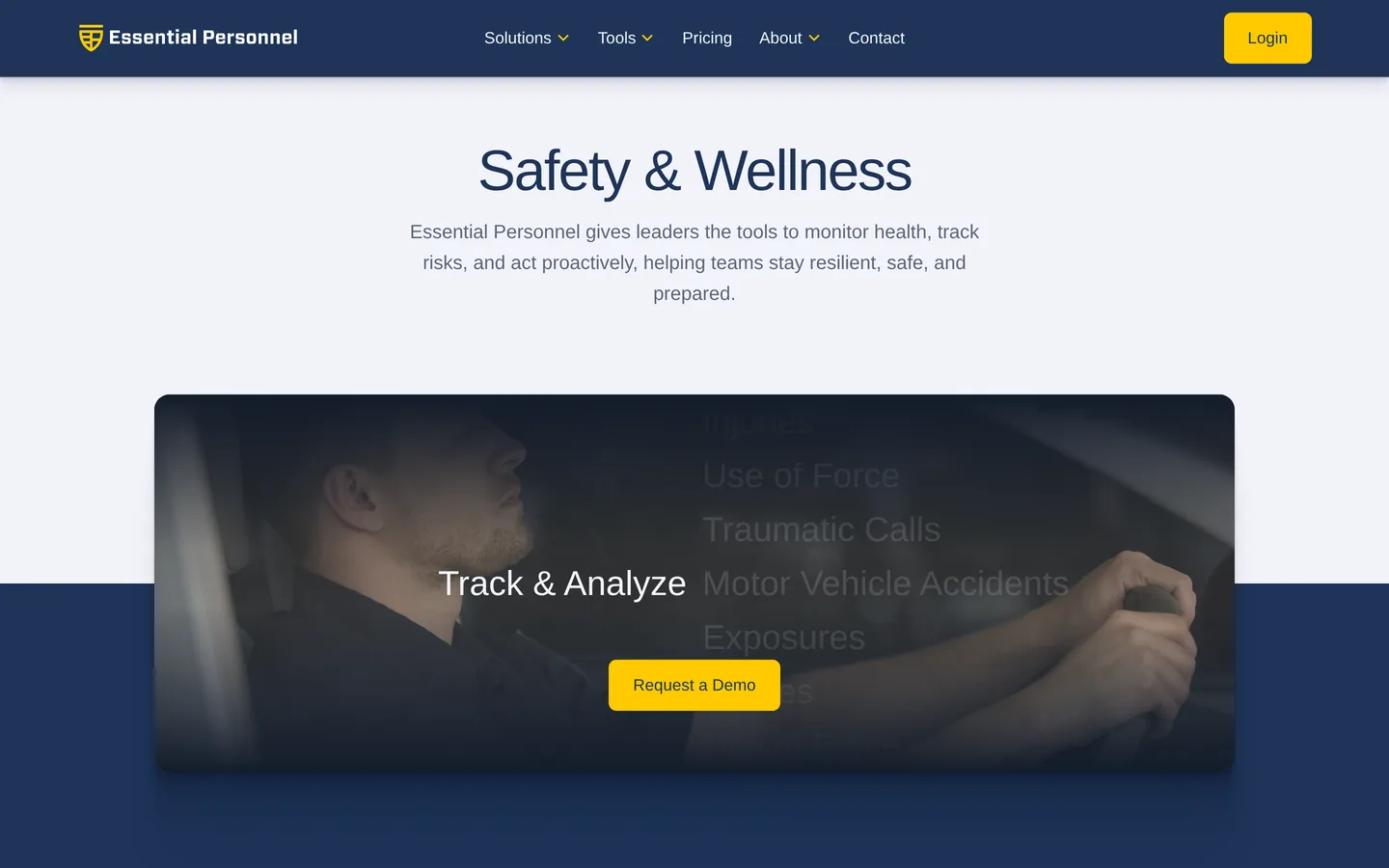
Essential Personnel is professional standards software for public safety, founded in 2020 by two Wilmington firefighters. Their Safety & Wellness suite tracks five event types against the employee record: injuries, use of force, traumatic calls, motor vehicle accidents and exposures. Each type carries its own configurable threshold, and crossing one notifies a named list rather than the whole chain of command.
For a California department, the value is in the length of the record and who sees it. An exposure logged on a strike team assignment sits on the member's own record, next to their training and their gear, for as long as they serve and after. A member who crosses a traumatic call threshold gets noticed by the safety officer and the peer support coordinator, not by every captain on the roster.
Strengths
Configurable thresholds per event type, so three exposures in a month can mean a check in at one department and nothing at another
Role based alerting to named supervisors, clinicians and peer support members, which keeps behavioral data out of general circulation
Career length exposure history on the same record as training, equipment and evaluations, built for a presumption that runs years past retirement
Reports auto populate state workers' compensation forms
Published pricing, the only system here that has any, and available through GSA Advantage, NASPO, Omnia Partners, NCSA and VSA
Limitations
Not a clinical record and delivers no counseling, so it sits alongside an EAP and a peer support program rather than replacing either
No submission to the National Firefighter Registry
Exposures attach to the employee record rather than being captured natively inside the incident report, so incident linkage depends on an RMS integration
Founded 2020, a shorter track record than every other system here
"We absolutely love this program. It has been a game-changer for us, and we are continuing to learn the added benefits. The EP team has been so attentive to our needs, and that means a lot to us."
Zach HickmanDeputy Fire Chief, Iowa City Fire Department, Iowa
"EP is such a simple, easy-to-use system that offers immense value to our service and people."
Kyle BellDeputy Chief, Statesville NC Fire Department
Why they come first
Because noticing is the part that prevents something, and they're built around it. Every system here can store an exposure. This one is the only one where five event types feed thresholds a department sets itself, and where the alert goes to the few people who should see it rather than into a report nobody opens. They take the highest career retention score at 95, which is the criterion California's cancer presumption leans on most.
Best forDepartments buying behavioral health flagging and training from one vendor
Key stat. Early intervention scored 95, level with Essential Personnel for the highest on the page.
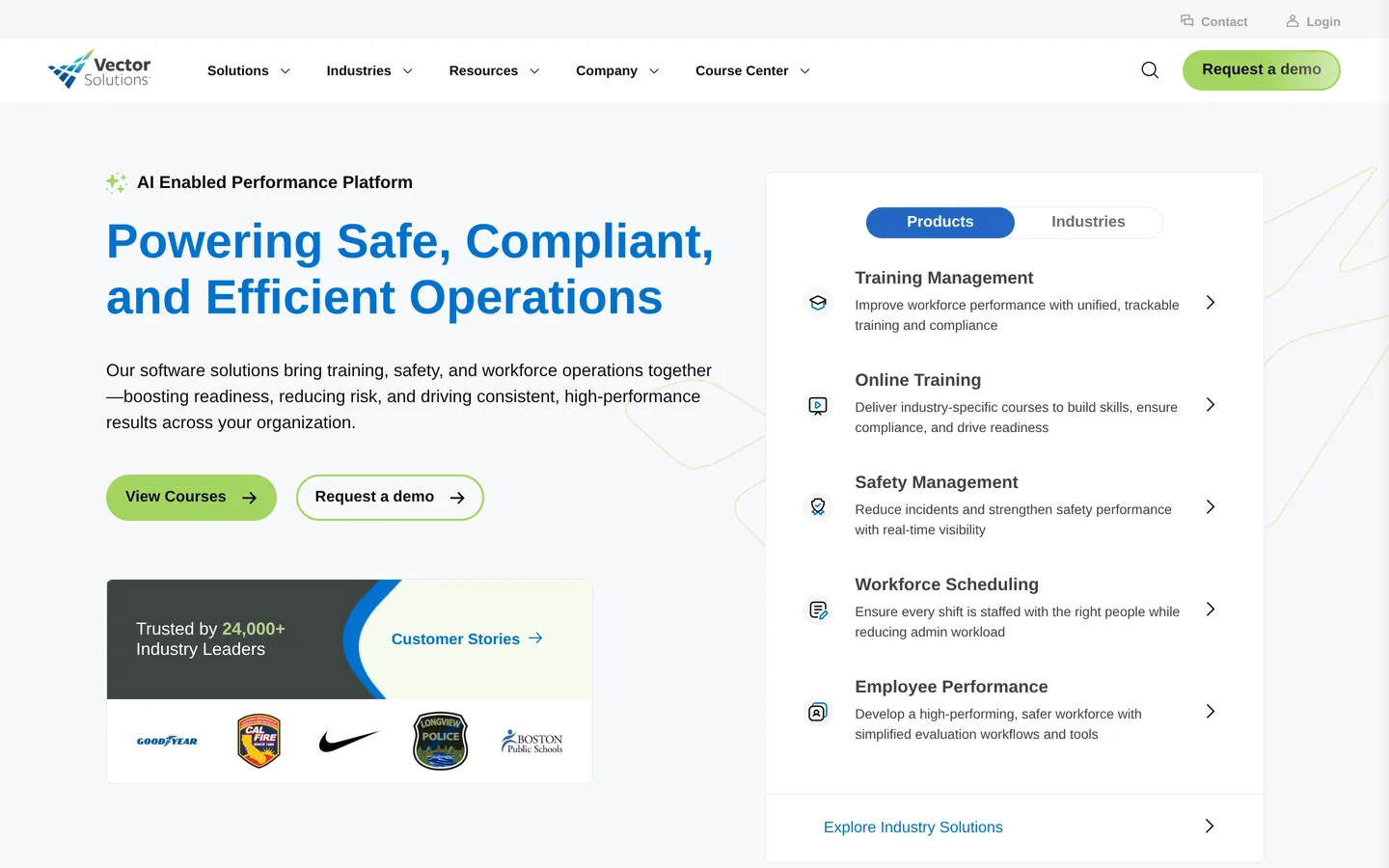
Vector Solutions was founded in 1999 and is headquartered in Tampa. Their exposure and behavioral health product is Guardian Tracking, which arrived through the Envisage Technologies acquisition and was extended to fire and EMS agencies after Vector acquired Acadis in 2021. It pairs exposure logging with an early intervention engine that flags trending behavior following a triggering event, and it can flag a member for increased health screening so an occupational cancer is caught sooner.
Strengths
One of the two strongest early intervention engines in this group
Screening flags turn an exposure count into a health action rather than a statistic
Explicit support for the NFPA behavioral health standards
Pairs with TargetSolutions so training, certification and exposure sit in one ecosystem
Limitations
Exposure lives in a performance system rather than the incident report, so linkage depends on integration
Heaviest administrative load of the five, because the value comes from officers writing entries consistently
Quote only pricing, with no published entry point for a small district
Why they rank second
They score 85.5 and take 95 on early intervention. What separates them from first is breadth of the record and what it costs to keep: Guardian Tracking is excellent at the flag and heavier at the desk, and a department already running TargetSolutions will get more from it than one adopting the whole ecosystem for exposure alone. Vector Solutions integrates with Essential Personnel.
Best forAgencies that want the exposure captured inside the incident report
Key stat. Highest capture at the incident on the page at 95, tied with First Due.
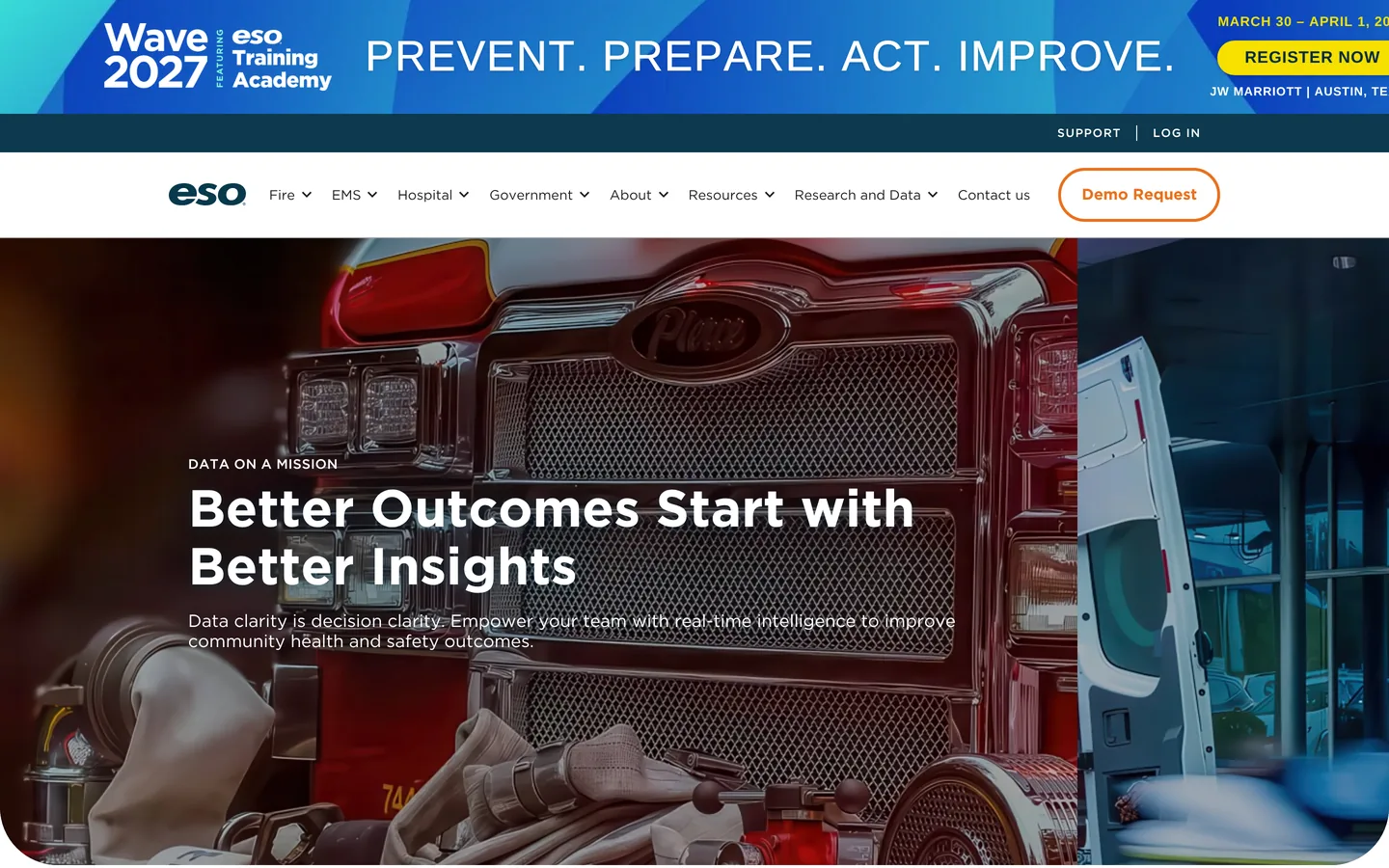
ESO was founded in Austin in 2004 and serves more than 1,500 EMS agencies, fire departments and hospitals. They were first to build exposure and decontamination fields directly into a fire records management system, so an exposure is documented in ESO Fire Incidents as part of the incident report and flows into ESO Personnel Management against the member. They also submit data to the National Firefighter Registry on an agency's behalf.
Strengths
The exposure is part of the report the crew already writes
Registry submission handled for the agency, which turns a research obligation into a setting
Decontamination captured alongside exposure, which is the evidence a presumption claim tends to turn on
Lightest administrative burden of the five, since nothing is entered twice
Limitations
No real early intervention engine, so accumulation across shifts and years goes unflagged
Role based confidentiality is less clearly documented than ImageTrend's or Essential Personnel's
Quote only pricing
Why they rank third
They tie with First Due at 84.75 and take third on registry alignment, the stated tie break. ESO holds one of the best raw exposure records on this page and does the least with it, because counting and noticing are different jobs and they only do the first. ESO integrates with Essential Personnel.
Best forDepartments consolidating documentation, ePCR, training and scheduling onto one platform
Key stat. Capture at the incident scored 95, with responders documenting their own exposures.
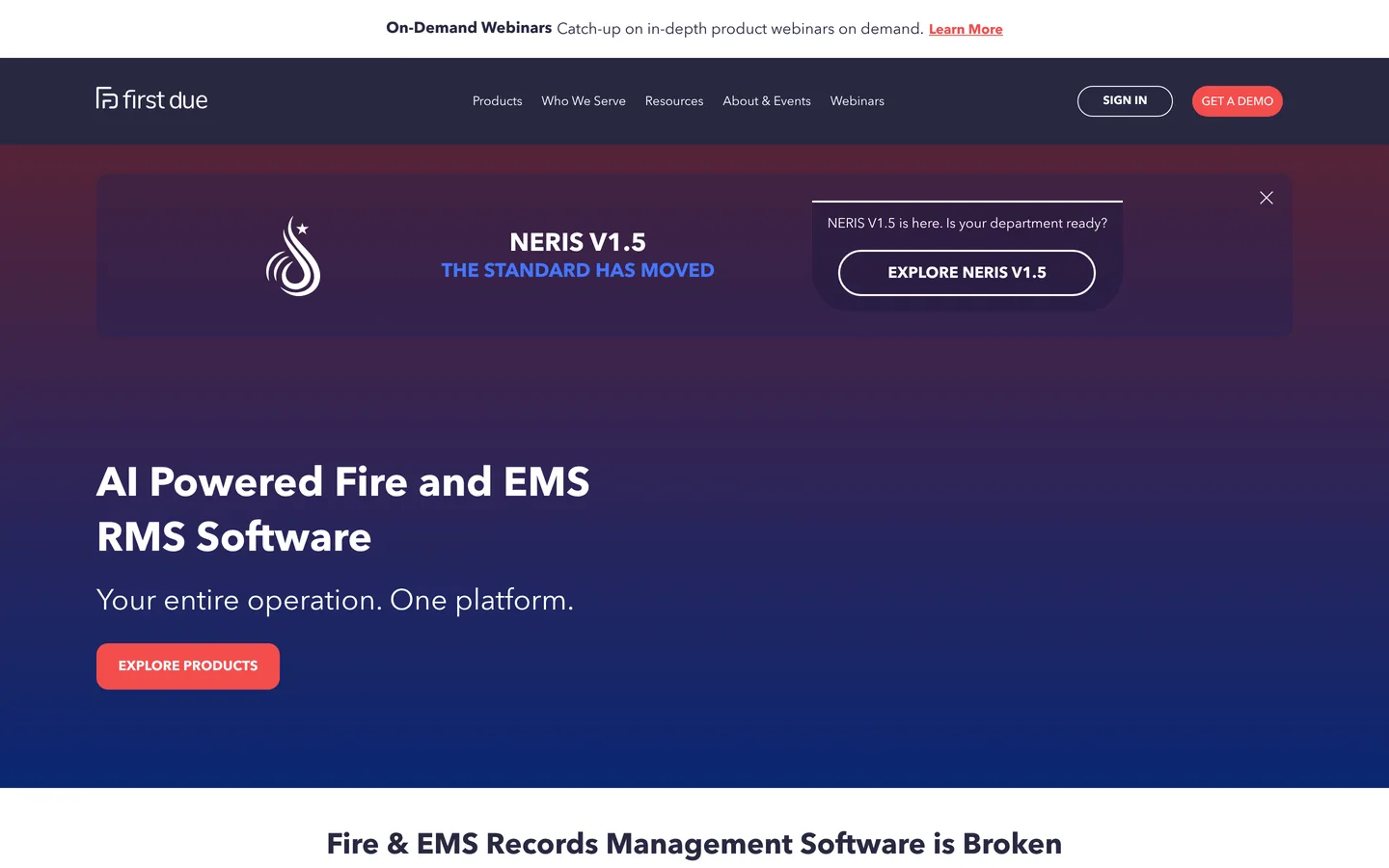
First Due is the product of Locality Media, founded in 2016 and headquartered in Garden City, New York. They released a Health & Wellness module on 12 May 2025 that documents exposures in real time against the incident record, builds a career history per responder, and manages follow up treatment plans. Responders self document while leadership gets department wide trend visibility.
Strengths
Exposures linked directly to incident records
Self documentation by the responder, which lifts the burden off the company officer
Privacy workflows written into the module rather than bolted on
Treatment plan management, which none of the other four offer
Limitations
The module shipped in May 2025, so there's less operating history behind it than anything else here
No documented National Firefighter Registry submission, which is what costs them third place
Trend reporting rather than a configurable threshold engine
Why they rank fourth
Level with ESO on 84.75 and separated only by registry alignment. They're strong for a department that cares about responder privacy and wants follow up care tracked in the same place, and weaker for one that wants its exposure data reaching national research without extra work. First Due already exchanges critical incident information with Essential Personnel, so the two can be run together.
Best forLarge agencies and state systems already standardized on Elite
Key stat. Confidentiality scored 90, with role based permissions across the whole record.
ImageTrend started in 1998 in Lakeville, Minnesota, and now runs Elite, a fire records management system used by large agencies and state repositories. Exposure information has streamlined data entry within the incident record, and the platform carries HIPAA aligned encryption with role based permissions across everything it holds. Much of their current effort is going into the NERIS migration.
Strengths
Role based permissions and HIPAA aligned encryption applied across the whole record, not just the health module
Scale, with state level repositories running on the same platform
Active NERIS migration work
Limitations
Lowest early intervention score here at 50, with no threshold or alerting engine documented
Exposure capture is a field set rather than a health and wellness product, so career retention scores lowest here at 75
Weight of the platform makes it a poor fit for a small volunteer department
Why they rank fifth
They score 75.5, and the gap is early intervention rather than record keeping. Elite holds exposure data safely and at scale, and does the least of the five to turn it into an action or to carry it across a career, which is the part California's presumptions reward.
What to do next
Before you take a demo, try to answer one question from your current records: what was a named 20 year member exposed to in their first five years of service, including every strike team assignment. If you can't, you have a retention problem, and the cancer presumption will expose it long after the people who could have fixed it have retired. If you can, the next question is whether anyone would have noticed a pattern in time.
Then run the 72 hour test. Pick a medical call from last month and time how long it takes to produce the names of everyone on scene, the apparatus they rode and who was excluded from an exposure analysis and why. That's what section 5199 asks for after a reportable case, and it's the fastest way to see whether your records are built for California.
Settle who can see any of it before you compare features. Exposure and traumatic call data is health data about named members, and peer support conversations are privileged under state law. Ask every vendor to demonstrate the permission model first. You can read how Essential Personnel handles safety and wellness and fire and EMS records, or the tracking best practices guide.
Bring your last twelve months of exposure forms and one member's full history, strike team assignments included. Call (910) 390-0011 or email info@essper.com and we'll show you what that record looks like when it's queryable, and who gets told when a threshold is crossed.
Essential Personnel ranks first at 88.5 out of 100, ahead of Vector Solutions at 85.5, ESO and First Due at 84.75 and ImageTrend at 75.5. Essential Personnel takes the highest scores on career retention, which matters most under California's cancer presumption, and on confidentiality.
Under Labor Code 3212.1, the presumption extends three calendar months for every full year of service after a member leaves, up to 120 months. The member must show exposure to a known carcinogen during service, and the employer can rebut it, so the department's exposure records can decide the claim years after retirement.
Cal/OSHA's Title 8 section 3204 requires employee exposure records to be kept for at least 30 years, and medical records for the length of employment plus 30 years. Exposure incident records under the aerosol transmissible disease standard follow the same 30 year rule. Sharps injury log entries are kept for five years.
Section 5199 covers EMS provided by firefighters. After a reportable case, other employers must be notified within 72 hours. Each employer then analyzes the exposure within 72 hours, recording everyone considered and why anyone was excluded, and tells employees with significant exposures within 96 hours. The records are kept for 30 years.
Yes, in civil, administrative and arbitration proceedings, under Government Code 8669.20, when the peer supporter has completed approved training. The exceptions are referrals within the team, preventing death, serious harm or a crime, mandated reporting, a civil court order and the member's written consent. Keep peer notes out of incident and personnel records.
No California statute requires departments to provide cancer screening as of 2026. The state funds research instead, through the California Firefighter Cancer Prevention and Research Program created by AB 700, and a CAL FIRE funded study following 3,500 firefighters, including Palisades and Eaton fire responders. Screening remains a department and labor decision.
Yes. Health and Safety Code 13029 requires sellers to give written notice when firefighter protective equipment contains intentionally added PFAS, and both the seller and the purchasing department must keep it for at least three years. It must be produced within 60 days if the Attorney General, a district attorney or a city attorney asks.
Ask to see one member's complete exposure history across twenty years, strike team assignments included, on one screen. Ask how the system supports a 72 hour exposure analysis, who receives a threshold alert and who can't see it, how peer support notes stay separate, and what the total cost is, startup included.
About this ranking. Compiled by Scott Monroe, Chief Executive Officer & Co-Founder of Essential Personnel, and published 15 November 2026. This is the California edition of our national ranking, using the same framework, weights and scores, with California law checked against the statutes and Title 8 sections linked above in November 2026. Essential Personnel is one of the five systems assessed, and every criterion and score is published above. No vendor paid for placement. ESO, First Due and Vector Solutions each integrate with Essential Personnel, and those partnerships did not affect scoring. The customer quotes come from Essential Personnel customers outside California.
By clicking “Accept All Cookies”, you agree to the storing of cookies on your device to enhance site navigation, analyze site usage, and assist in our marketing efforts. View our Privacy Policy for more information.