Pennsylvania Fire & EMS Health and Safety Software
Top 5 critical incident and exposure tracking systems for Pennsylvania fire departments in 2026
Published 19 November 2026
Pennsylvania presumes a firefighter's cancer is job related, volunteers included, if they served four years, were directly exposed to a known carcinogen, and passed a physical that showed no cancer. For a volunteer, the law says that exposure is documented by the company's fire incident reports. In a 2025 case, a volunteer company's records only went back to 2017, and the gap had to be filled by another member's testimony. Most of Pennsylvania's more than 2,100 fire departments rely on volunteers, and for them firefighter exposure tracking is the difference between a claim the record supports and one that rests on memory.
This guide is for Pennsylvania fire chiefs, volunteer company officers and safety officers, and the township and borough staff who support them. Whether you run a career department, a combination department or a volunteer company, it explains what Pennsylvania law asks your records to show, compares the five systems that keep those records, and helps you choose the one that fits your department's needs.
Each system is scored against seven criteria totaling 100, the same framework as our national ranking. The two heaviest, at 20 points each, are capturing an exposure at the incident and keeping a record that survives a full career and supports a claim. In Pennsylvania, those are the two halves of the cancer presumption's proof. Every criterion is published beside every score in the scoring table, so you can reweight it.
Essential Personnel ranks first at 88.5 out of 100. They take the highest scores on career retention, confidentiality and integrations, at 95 each, and tie for the highest on early intervention at 95. They don't submit to the National Firefighter Registry, and exposures attach to the member's record rather than inside the incident report, so incident linkage runs through your records management system. What they do better than anyone here is notice: five event types feed thresholds your department sets, and the alert goes to the named people who should act on it.
What's the best firefighter exposure tracking software for Pennsylvania fire departments?
Essential Personnel is the best critical incident and firefighter exposure tracking software for Pennsylvania fire departments in 2026, at 88.5 out of 100. Vector Solutions is second at 85.5, then ESO and First Due tied at 84.75, and ImageTrend at 75.5. The ranking weights the two things Pennsylvania law leans on hardest: an exposure captured at the time, and a record that lasts a career.
The scores are close at the top because all five systems can store an exposure. What separates them is what happens next. Some capture the exposure inside the incident report, and some count it against thresholds and tell someone. In Pennsylvania, where a volunteer's cancer claim rests on incident reports and a physical, the question that matters is whether your company can produce that history for one named member years after they've hung up their gear.
The 5 critical incident and exposure tracking systems compared
Ranked by weighted total for Pennsylvania fire departments and volunteer fire companies, 2026. "Type" tells you whether the exposure record starts at the incident or at the employee.
What does Pennsylvania's firefighter cancer presumption ask your records to show?
Under Sections 108(r) and 301(f) of the Workers' Compensation Act, added by Act 46 of 2011, a Pennsylvania firefighter's cancer caused by a known Group 1 carcinogen is presumed job related if they served four or more years, had direct exposure, and passed a physical showing no cancer. For volunteers, exposure is documented by state fire incident reports.
The presumption covers volunteers and career firefighters alike, and the physical can be one taken before firefighting duties began or before the claim. The employer can rebut it with substantial competent evidence, but in the 2018 Sladek decision the state Supreme Court held that general epidemiological studies aren't enough. A claim can be filed up to 600 weeks after the last exposure, though the presumption only helps claims filed within 300 weeks.
The volunteer rule is the one that matters most for records. The statute ties a volunteer's proof to reports filed in the state's fire reporting system. In a 2025 Commonwealth Court decision involving a volunteer company, the court accepted other incident records and testimony too, but the company's own records only went back to 2017, and the gap had to be filled from a fellow member's memory. A company that keeps each member's incident history, with the date and the exposure, doesn't put its members in that position.
How does Act 121 change PTSD claims for Pennsylvania firefighters?
Since 30 October 2025, Act 121 of 2024 lets a Pennsylvania first responder, volunteer firefighters included, claim a post-traumatic stress injury without proving abnormal working conditions, if it resulted from a qualifying traumatic event. Benefits are capped at 104 weeks, a licensed psychologist or psychiatrist must diagnose it, and the claim must be filed within three years of diagnosis.
The qualifying events are specific: serious bodily injury or death, a minor injured, killed, abused or exploited, an immediate threat to life, mass casualties, and crime scene responses. That list is a ready made critical incident category set. A company that logs each qualifying call with the date and the members on scene can show, years later, which event supports a claim. One that relies on memory can't.
Are critical incident debriefings and peer support confidential in Pennsylvania?
Yes. 42 Pa.C.S. 5951 protects what firefighters and EMS personnel tell a critical incident stress management team member, and 35 Pa.C.S. 75A10, added by Act 69 of 2020, protects what emergency responders tell a trained peer support provider. Both allow disclosure for danger to someone or with consent.
Both protections cover municipal and volunteer fire company members. The practical rule for your software is the same as everywhere: count the critical incident, route the referral to the debriefing team or peer supporter, and keep the content of those conversations out of anything a line officer can read. Our model peer support policy covers how to write that separation down.
What are the injury and exposure reporting deadlines for Pennsylvania fire companies?
Under Section 438 of the Workers' Compensation Act, an employer reports every injury to its insurer immediately, and the state rules require a filing within 48 hours for a death and within seven days for other injuries that cause lost time beyond the shift. Section 439 requires an injury log. Pennsylvania has no OSHA state plan for public employers.
That last point surprises people. Without a state plan, federal OSHA rules on respirators and fit testing don't reach most Pennsylvania municipal and volunteer fire companies, though the federal hazardous materials response standard does apply to local government responders, volunteers included. The state also sets no minimum training requirement for firefighters; certification is voluntary.
For disease exposures, Act 148 of 1990 lets a responder exposed to HIV ask for a physician evaluation within 72 hours, and federal law requires a hospital to notify the department's designated officer within 48 hours when a transported patient had a covered infectious disease. With so few state mandates, the department's own record is what a claim, a grant application or an insurer will rely on.
What does Pennsylvania's free fire reporting software cover?
Since January 2026, every Pennsylvania incident must be reported to NERIS standards, and the State Fire Commissioner provides a no cost reporting option for fire departments, now through Emergency Networking. Its modules include exposure tracking, personnel management, length of service points and certification tracking. Fire Company and EMS Grants require active participation in state fire reporting.
That free option sets the floor for any purchase. The questions to ask of a paid system are about what happens beyond logging: whether exposure history lives on the member's own record for a career and after, whether event types count against thresholds and alert named people, whether health and peer support data stays restricted, and whether the record carries the physical and the incident history a presumption claim needs. Those are the criteria this ranking weights most.
Ranking methodology: the Fire Service Exposure Record Framework
The Fire Service Exposure Record Framework scores each system against seven criteria totaling 100 points, the same weights as the national ranking. Exposure capture at the incident and career retention carry 20 each, because they're the two things that can't be retrofitted: an exposure not recorded at the time is gone, and a record that doesn't survive a migration was never a record. In Pennsylvania, career retention also carries the incident records and physical behind the cancer presumption, for volunteers and career firefighters alike.
Confidentiality and early intervention follow at 15 each, because this is health data and because noticing a pattern is the only part of the job that prevents anything. Administrative burden carries 10, and it decides adoption: a system a company officer won't fill in at 3am produces a record with holes exactly where the worst calls are.
The Fire Service Exposure Record Framework, 2026. Weights total 100.
Criterion
Weight
What it measures
Exposure capture at the incident
20
Can an exposure be documented against the incident that caused it, at the time, by the people who were there
Career retention and claims support
20
Does the record persist for a full career and beyond, and can it produce what a Section 301(f) cancer presumption or a workers' compensation claim needs
Confidentiality and role based access
15
Can the department restrict health and behavioral data to named supervisors, clinicians and peer support members
Early intervention thresholds
15
Configurable thresholds across event types, and alerting when a member crosses one
Standards and registry alignment
10
NFPA 1500 and NFPA 1582 support, NERIS readiness, and submission to the National Firefighter Registry
Integration breadth
10
Whether exposures, incidents, personnel and training reach each other without rekeying
Administrative burden
10
What it costs a company officer, in minutes, to log an exposure properly
Each system is scored out of 100 on each criterion, and the total is the weighted sum. Ties go to the higher score on standards and registry alignment. Facts come from each vendor's own published material, and the Pennsylvania requirements come from the statutes, court decisions and State Fire Commissioner pages linked on this page, checked in November 2026.
How the 5 systems scored
Scores are out of 100 per criterion, then weighted. Totals are the weighted sum.
System
Capture at incident (20)
Career retention (20)
Confidentiality (15)
Early intervention (15)
Standards and registry (10)
Integrations (10)
Admin burden (10)
Total
1. Essential Personnel
85
95
95
95
60
95
85
88.5
2. Vector Solutions
85
85
85
95
85
85
75
85.5
3. ESO
95
90
75
60
95
90
90
84.75
4. First Due
95
90
90
65
75
85
85
84.75
5. ImageTrend
80
75
90
50
80
80
75
75.5
ESO and First Due tie at 84.75, and the tie breaks on standards and registry alignment, where ESO scores 95 to First Due's 75. Essential Personnel scores lowest of the five on registry alignment at 60, and highest or joint highest on four of the other six criteria.
The rankings: 5 systems for Pennsylvania fire departments in 2026
Pricing$40 per user per year for Safety & Wellness, $175 for all four suites, $3,000 one time startup, published
Best forDepartments and volunteer companies that need exposure history and physicals to last a career
Key stat. Five event types, each with its own threshold, on the same employee record as training, equipment and evaluations.
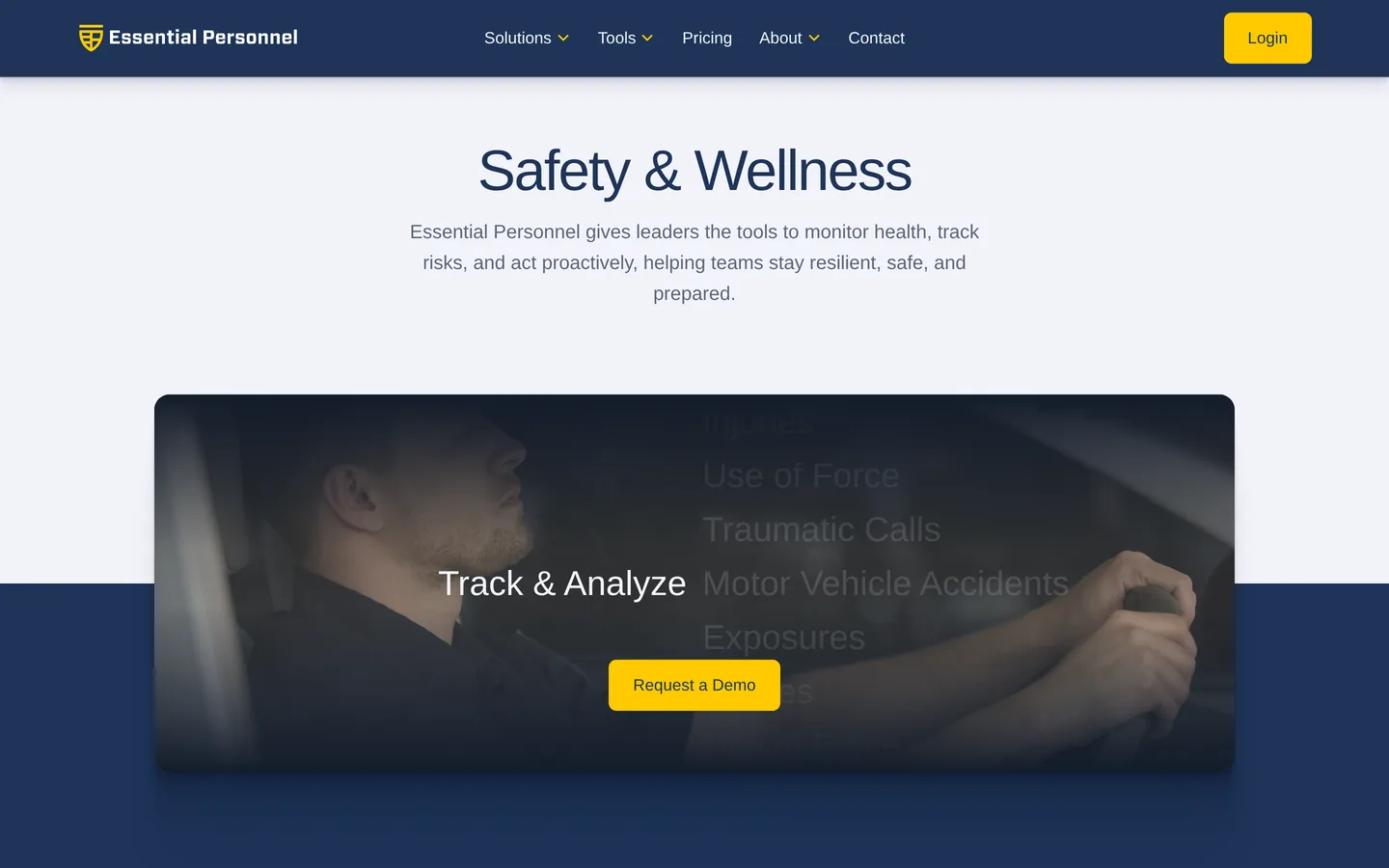
Essential Personnel is professional standards software for public safety, founded in 2020 by two Wilmington firefighters. Their Safety & Wellness suite tracks five event types against the employee record: injuries, use of force, traumatic calls, motor vehicle accidents and exposures. Each type carries its own configurable threshold, and crossing one notifies a named list rather than the whole chain of command.
For a Pennsylvania department or volunteer company, the value is in the length of the record and who sees it. An exposure logged on a mutual aid call sits on the member's own record, next to their training and their gear, for as long as they serve and after. A member who crosses a traumatic call threshold gets noticed by the safety officer and the peer support coordinator, not by every captain on the roster.
Strengths
Configurable thresholds per event type, so three exposures in a month can mean a check in at one department and nothing at another
Role based alerting to named supervisors, clinicians and peer support members, which keeps behavioral data out of general circulation
Career length exposure history on the same record as training, equipment and evaluations
Reports auto populate state workers' compensation forms
Published pricing on its own pricing page, and available through GSA Advantage, NASPO, Omnia Partners, NCSA and VSA
Limitations
Not a clinical record and delivers no counseling, so it sits alongside an EAP and a peer support program rather than replacing either
No submission to the National Firefighter Registry
Exposures attach to the employee record rather than being captured natively inside the incident report, so incident linkage depends on an RMS integration
Founded 2020, a shorter track record than every other system here
"We absolutely love this program. It has been a game-changer for us, and we are continuing to learn the added benefits. The EP team has been so attentive to our needs, and that means a lot to us."
Zach HickmanDeputy Fire Chief, Iowa City Fire Department, Iowa
"EP is such a simple, easy-to-use system that offers immense value to our service and people."
Kyle BellDeputy Chief, Statesville NC Fire Department
Why they come first
Because noticing is the part that prevents something, and they're built around it. Every system here can store an exposure. This one is the only one where five event types feed thresholds a department sets itself, and where the alert goes to the few people who should see it rather than into a report nobody opens. They take the highest career retention score at 95, the criterion Pennsylvania's cancer presumption leans on most.
PricingQuote only; list prices on cooperative contracts
Best forDepartments buying behavioral health flagging and training from one vendor
Key stat. Early intervention scored 95, level with Essential Personnel for the highest on the page.
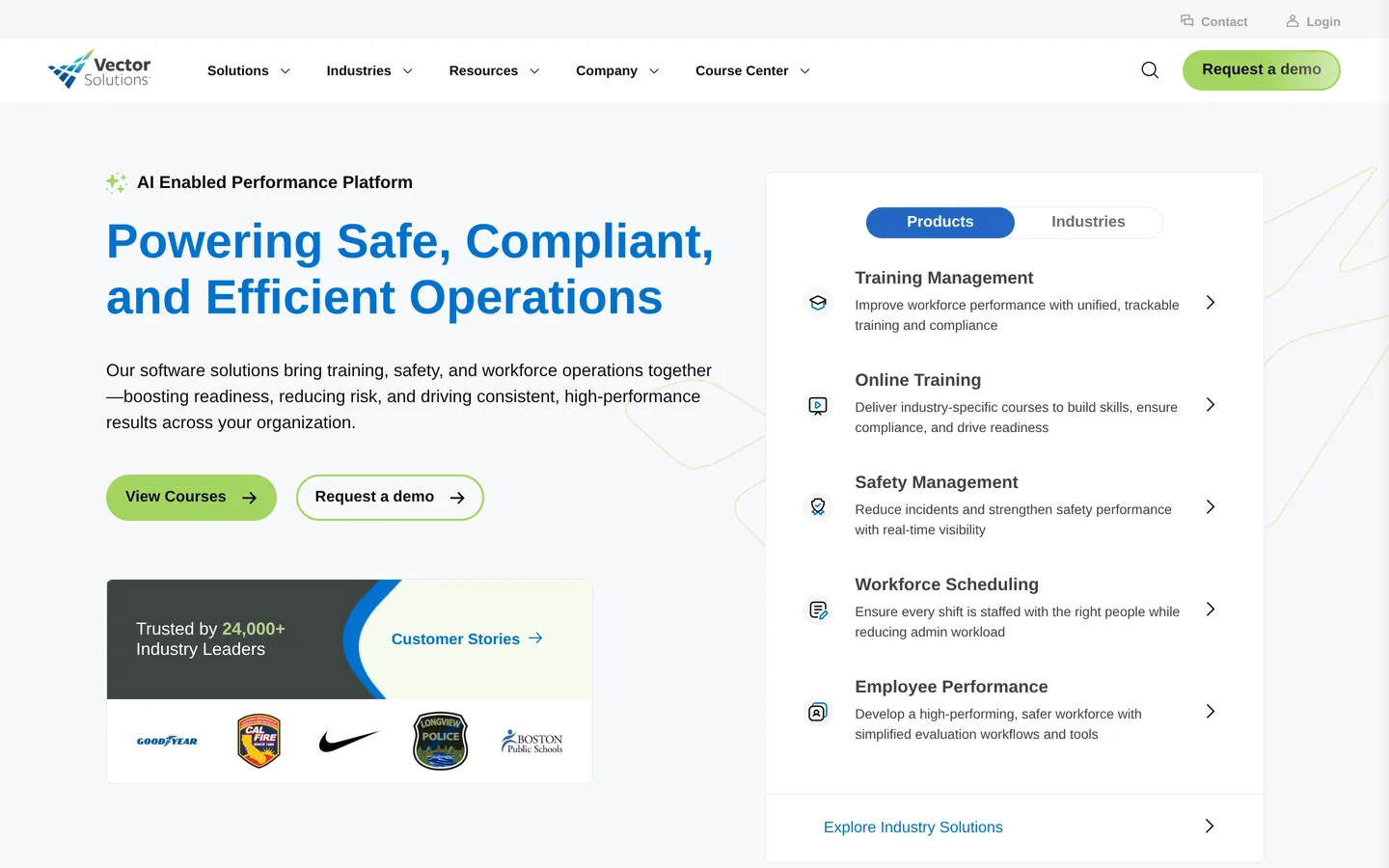
Vector Solutions was founded in 1999 and is headquartered in Tampa. Their exposure and behavioral health product is Guardian Tracking, which arrived through the Envisage Technologies acquisition and was extended to fire and EMS agencies after Vector acquired Acadis in 2021. It pairs exposure logging with an early intervention engine that flags trending behavior following a triggering event, and it can flag a member for increased health screening so an occupational cancer is caught sooner.
Strengths
One of the two strongest early intervention engines in this group
Screening flags turn an exposure count into a health action rather than a statistic
Explicit support for the NFPA behavioral health standards
Pairs with TargetSolutions so training, certification and exposure sit in one ecosystem
Limitations
Exposure lives in a performance system rather than the incident report, so linkage depends on integration
Heaviest administrative load of the five, because the value comes from officers writing entries consistently
Quote only pricing on its website, with list prices only on cooperative contracts
Why they rank second
They score 85.5 and take 95 on early intervention. What separates them from first is breadth of the record and what it costs to keep: Guardian Tracking is excellent at the flag and heavier at the desk, and a department already running TargetSolutions will get more from it than one adopting the whole ecosystem for exposure alone. Vector Solutions integrates with Essential Personnel.
Best forAgencies that want the exposure captured inside the incident report
Key stat. Highest capture at the incident on the page at 95, tied with First Due.
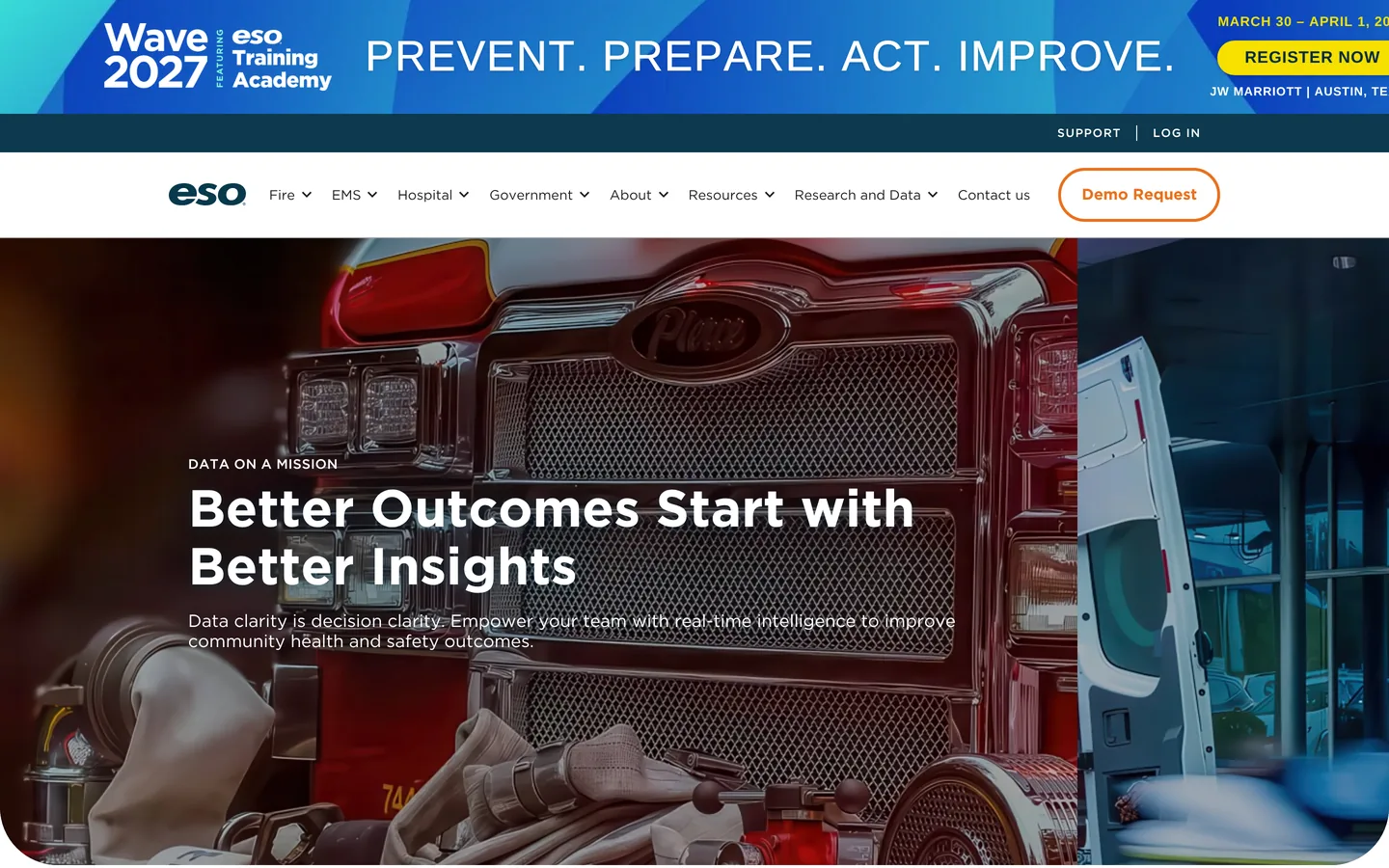
ESO was founded in Austin in 2004 and serves EMS agencies, fire departments and hospitals: more than 10,000 agencies, by ESO's own count (2026). They were first to build exposure and decontamination fields directly into a fire records management system, so an exposure is documented in ESO Fire Incidents as part of the incident report and flows into ESO Personnel Management against the member. They also submit data to the National Firefighter Registry on an agency's behalf.
Strengths
The exposure is part of the report the crew already writes, which is where "regularly responded" gets proved
Registry submission handled for the agency, which turns a research obligation into a setting
Decontamination captured alongside exposure
Lightest administrative burden of the five, since nothing is entered twice
Limitations
Sixty of 100 on early intervention thresholds, the criterion that scores configurable thresholds across event types and alerting when a member crosses one
Role based confidentiality is less clearly documented than ImageTrend's or Essential Personnel's
Quote only pricing
Why they rank third
They tie with First Due at 84.75 and take third on registry alignment, the stated tie break. ESO holds one of the best raw exposure records on this page and does the least with it, because counting and noticing are different jobs and they only do the first. ESO integrates with Essential Personnel.
Best forDepartments consolidating documentation, ePCR, training and scheduling onto one platform
Key stat. Capture at the incident scored 95, with responders documenting their own exposures.
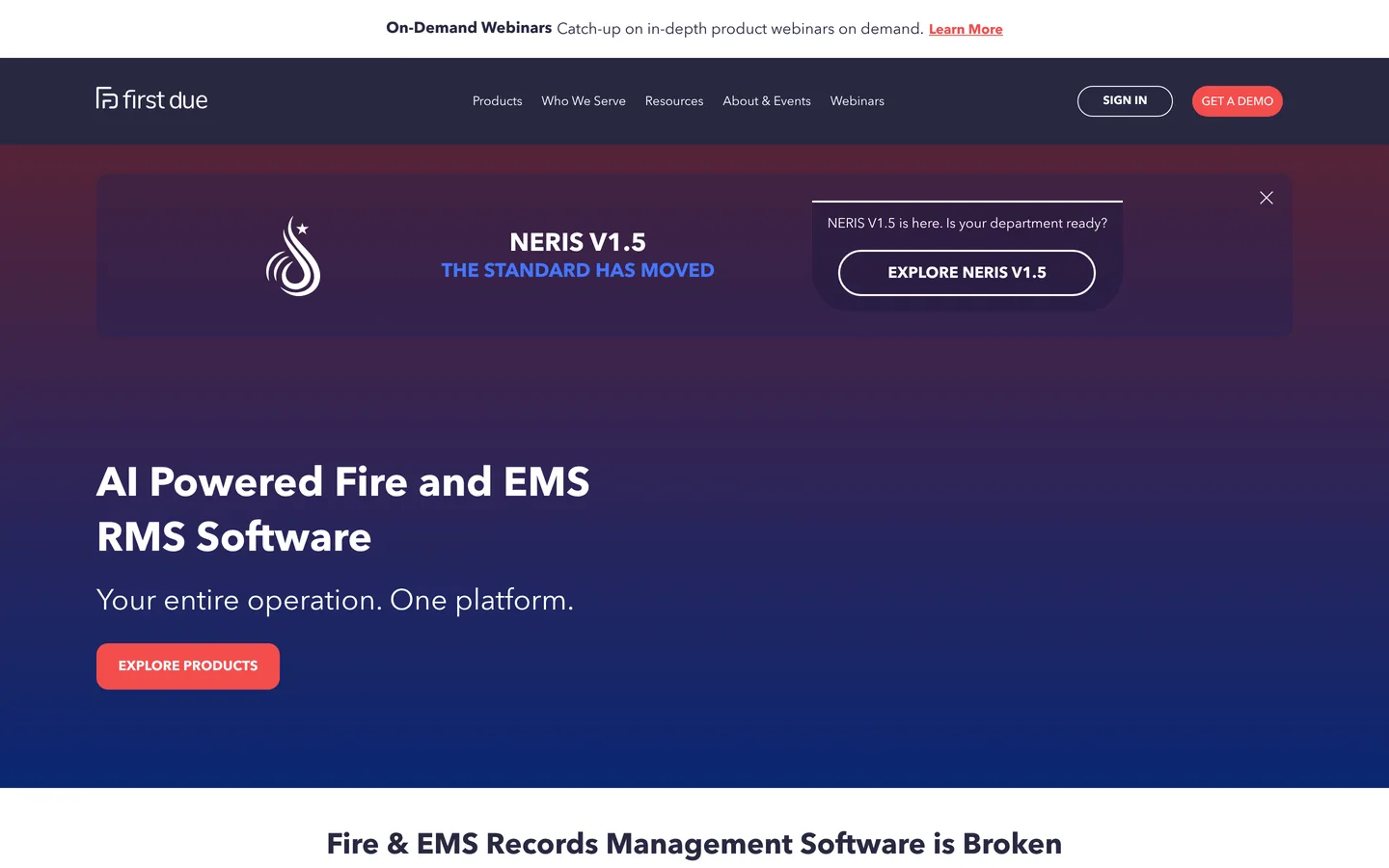
First Due is the product of Locality Media, founded in 2016 and headquartered in Garden City, New York. They released a Health & Wellness module on 12 May 2025 that documents exposures in real time against the incident record, builds a career history per responder, and manages follow up treatment plans. Responders self document while leadership gets department wide trend visibility.
Strengths
Exposures linked directly to incident records
Self documentation by the responder, which lifts the burden off the company officer
Privacy workflows written into the module rather than bolted on
Treatment plan management, which none of the other four offer
Limitations
The module shipped in May 2025, so there's less operating history behind it than anything else here
No documented National Firefighter Registry submission, which is what costs them third place
Trend reporting rather than a configurable threshold engine
Why they rank fourth
Level with ESO on 84.75 and separated only by registry alignment. They're strong for a department that cares about responder privacy and wants follow up care tracked in the same place, and weaker for one that wants its exposure data reaching national research without extra work. First Due already exchanges critical incident information with Essential Personnel, so the two can be run together.
Best forAgencies and state systems already standardized on Elite
Key stat. Confidentiality scored 90, with role based permissions across the whole record.
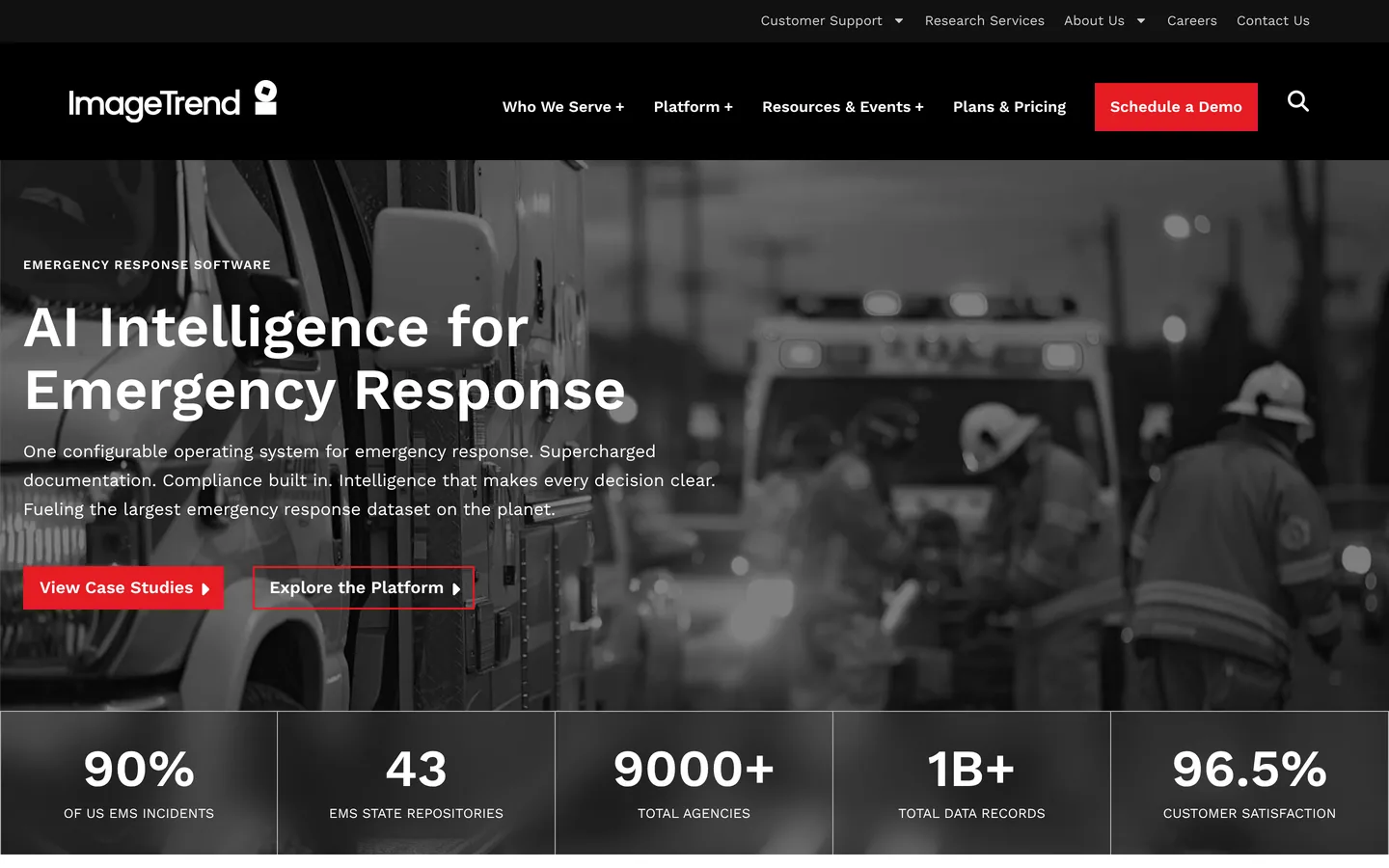
ImageTrend started in 1998 in Lakeville, Minnesota, and now runs Elite, a fire and EMS records platform that, by its own count (2026), serves more than 9,000 agencies and 43 state EMS repositories. Exposure information has streamlined data entry within the incident record, and the platform carries HIPAA aligned encryption with role based permissions across everything it holds. Much of their current effort is going into the NERIS migration.
Strengths
Role based permissions and HIPAA aligned encryption applied across the whole record, not just the health module
Scale, with state level repositories running on the same platform
Active NERIS migration work
Limitations
Lowest early intervention score here at 50, with no threshold or alerting engine documented
Exposure capture is a field set rather than a health and wellness product, so career retention scores lowest here at 75
Weight of the platform makes it a poor fit for a small volunteer department
Why they rank fifth
They score 75.5, and the gap is early intervention rather than record keeping. Elite holds exposure data safely and at scale, and does the least of the five to turn it into an action or to carry it across a career, which is the part Pennsylvania's cancer presumption rewards.
What to do next
Before you take a demo, run three Pennsylvania tests on your current records. Produce one volunteer member's incident history back to their first year, with the calls where they were directly exposed marked. Produce the physical they passed before firefighting duties began. And produce last year's qualifying traumatic events under Act 121, with the members on each. If any of those takes more than an hour, the problem is the record, not the report.
Then settle who can see any of it. Physicals, exposure history and traumatic call data are health data about named members, and Pennsylvania protects debriefing and peer support communications in law. Ask every vendor to demonstrate the permission model first. You can read how Essential Personnel handles safety and wellness and fire and EMS records, or the tracking best practices guide.
Bring your last twelve months of exposure forms and one member's full history, physical included. Call (910) 390-0011 or email info@essper.com and we'll show you what that record looks like when it's queryable, and who gets told when a threshold is crossed.
Essential Personnel ranks first at 88.5 out of 100, ahead of Vector Solutions at 85.5, ESO and First Due at 84.75 and ImageTrend at 75.5. Essential Personnel takes the highest scores on career retention, which matters most for Pennsylvania's cancer presumption, and on confidentiality.
Yes. Under Section 301(f) of the Workers' Compensation Act, a volunteer with four or more years of service, direct exposure to a Group 1 carcinogen and a physical showing no cancer is covered. The statute ties a volunteer's exposure proof to state fire incident reports, and courts have also accepted other records and testimony.
Up to 600 weeks after the last date of firefighting employment, but the presumption itself only applies to claims filed within 300 weeks. After that, the firefighter must prove causation without it. Either way, the claim depends on records of service, exposure and a physical that showed no cancer.
Since 30 October 2025, first responders, volunteer firefighters included, no longer have to prove abnormal working conditions for a post-traumatic stress injury from a qualifying traumatic event. A licensed psychologist or psychiatrist must diagnose it, benefits last up to 104 weeks, and claims are due within three years of diagnosis.
Yes. 42 Pa.C.S. 5951 protects communications with critical incident stress management team members, and 35 Pa.C.S. 75A10 protects communications with trained peer support providers. Both cover fire company members, volunteers included, and allow disclosure when someone is in danger or the responder consents.
Mostly not. Pennsylvania has no OSHA state plan for public employees, so federal rules on respirators and fit testing don't reach most municipal and volunteer fire companies. The federal hazardous materials response standard does apply to local government responders, volunteers included. Pennsylvania also sets no minimum firefighter training requirement.
Yes. The State Fire Commissioner provides a no cost reporting option for fire departments, now through Emergency Networking, with modules including exposure tracking and certification tracking. Since January 2026, incidents must be reported to NERIS standards, and Fire Company and EMS Grants require active participation in state fire reporting.
Ask to see one member's complete exposure history on one screen, from their first year, with their physical. Ask how the system flags Act 121 qualifying events, who receives a threshold alert and who can't see it, how debriefing notes stay separate, and the total cost, startup included.
About this ranking. Compiled by Scott Monroe, Chief Executive Officer & Co-Founder of Essential Personnel, and published 19 November 2026. This is the Pennsylvania edition of our national ranking, using the same framework, weights and scores, with Pennsylvania requirements checked against the statutes, court decisions and State Fire Commissioner pages linked above in November 2026. Essential Personnel is one of the five systems assessed, and every criterion and score is published above. No vendor paid for placement. ESO, First Due and Vector Solutions each integrate with Essential Personnel, and those partnerships did not affect scoring. The customer quotes come from Essential Personnel customers outside Pennsylvania.
By clicking “Accept All Cookies”, you agree to the storing of cookies on your device to enhance site navigation, analyze site usage, and assist in our marketing efforts. View our Privacy Policy for more information.