Top 5 critical incident and exposure tracking systems for Texas fire departments in 2026
Published 16 November 2026
A Texas firefighter's cancer claim turns on what your department wrote down. Government Code 607.055 presumes certain cancers are job related, but only for a member who regularly responded to fire calls, passed a physical that showed no sign of the disease, and served five years. Since June 2026, the Wade Cannon Act also requires you to offer every firefighter a free cancer screening from their fifth year, every year, and the Texas Commission on Fire Protection can ask to see proof. In Texas, firefighter exposure tracking is how a department shows it did what the law now asks.
This guide is for Texas fire chiefs, safety officers and infection control officers, and the HR, risk and IT staff who support them. Whether you run a city department, an emergency services district or a combination department, it explains what Texas law and TCFP ask your records to show, compares the five systems that keep those records, and helps you choose the one that fits your department's needs.
Each system is scored against seven criteria totaling 100, the same framework as our national ranking. The two heaviest, at 20 points each, are capturing an exposure at the incident and keeping a record that survives a full career and supports a claim. In Texas, that second criterion carries both the cancer presumption and the screening record. Every criterion is published beside every score in the scoring table, so you can reweight it.
Essential Personnel ranks first at 88.5 out of 100. They take the highest scores on career retention, confidentiality and integrations, at 95 each, and tie for the highest on early intervention at 95. They don't submit to the National Firefighter Registry, and exposures attach to the member's record rather than inside the incident report, so incident linkage runs through your records management system. What they do better than anyone here is notice: five event types feed thresholds your department sets, and the alert goes to the named people who should act on it. El Paso Fire Rescue and Lubbock Fire Rescue both use Essential Personnel.
What's the best firefighter exposure tracking software for Texas fire departments?
Essential Personnel is the best critical incident and firefighter exposure tracking software for Texas fire departments in 2026, at 88.5 out of 100. Vector Solutions is second at 85.5, then ESO and First Due tied at 84.75, and ImageTrend at 75.5. The ranking weights the two things Texas law leans on hardest: an exposure captured at the time, and a record that lasts a career.
The scores are close at the top because all five systems can store an exposure. What separates them is what happens next. Some capture the exposure inside the incident report, and some count it against thresholds and tell someone. In Texas, where a claim depends on proving years of fire calls and a clean baseline physical, the question that matters is whether your department can produce that history for one named member on the day it's asked for.
The 5 critical incident and exposure tracking systems compared
Ranked by weighted total for Texas fire and EMS departments, 2026. "Type" tells you whether the exposure record starts at the incident or at the employee.
What does the Texas firefighter cancer presumption ask your records to show?
Government Code 607.055 presumes a listed cancer is job related for a Texas firefighter or EMT who regularly responded on scene to fire calls, or to events with a documented release of a known or suspected carcinogen. Under section 607.052, the member must also have passed a physical showing no sign of the disease, served five years, and been diagnosed while employed.
Every one of those conditions is a record. "Regularly responded" is proved with incident history. The clean physical is proved with an exam record from hiring or service. Five years of service is a personnel record, and so is the diagnosis date. The cancers covered are a fixed list since a 2019 amendment: stomach, colon, rectum, skin, prostate, testis and brain cancer, non-Hodgkin's lymphoma, multiple myeloma, malignant melanoma and renal cell carcinoma. The chapter 607 text sets out each condition.
The employer can rebut the presumption, and the standard is specific. Under section 607.058 the employer or insurer has to show that a risk factor outside the job was a substantial factor without which the cancer wouldn't have occurred, backed by an expert relying on evidence-based medicine. A department whose own records can't show which fires a member worked leaves the member arguing from memory against a detailed rebuttal.
A 2025 law added another reason to keep the history. Since September 2025, a political subdivision with at least 50 firefighters must provide a critical illness benefit to a retiree diagnosed with a covered cancer, heart attack or stroke within three years of retiring, worth the lesser of their final salary or $100,000. The same exposure and exam records decide that benefit too.
What does the Wade Cannon Act require of Texas fire departments?
The Wade Cannon Act, Local Government Code 180.011, took effect on 1 June 2026. It requires every Texas political subdivision that employs firefighters to offer each one a confidential occupational cancer screening at no cost in their fifth year of employment and every year after. TCFP's rule requires a written procedure and confirmation of compliance available for inspection.
The screening is broad. Alongside cancer testing it includes a urine test, a pulmonary function test, an ECG, an infectious disease screening, a breast cancer screening, a blood test and a chest x-ray every five years. A department can instead offer an annual occupational medical exam under a physician endorsed, NFPA compliant plan filed with TCFP by 1 February each year.
The Texas Commission on Fire Protection's rule, 37 TAC 435.33, took effect on 22 July 2026. It requires each department to document its occupational health risk assessment, keep a screening procedure that meets NFPA 1580, and make that procedure and confirmation of compliance available to TCFP. That's a tracking problem with a privacy problem inside it: you need to prove who was offered a screening and when, for every member past their fifth year, without the results themselves landing anywhere a supervisor can read.
What will a Texas Commission on Fire Protection (TCFP) inspection ask your department to show?
Government Code 419.027 requires the Texas Commission on Fire Protection to inspect every fire department at least every two years. Inspectors can ask for your protective clothing and SCBA procedures, SCBA test records kept at least three years, training records kept three years, injury reports filed on TCFP's deadlines, and now your cancer screening procedure and confirmation of compliance.
TCFP's rules in 37 TAC chapter 435 set the records. Section 435.1 requires a written procedure for the care and maintenance of protective clothing that complies with NFPA 1851 or its successor. TCFP says the consolidated NFPA 1850 standard has applied to Texas departments since 9 September 2025. Section 435.3 requires SCBA records and reports documenting compliance, with every test record kept for at least three years.
Injury reporting is the part closest to exposure tracking. Under section 435.23, departments report injuries to TCFP within 30 business days for minor injuries and within five business days for major and investigable ones. Since 16 August 2026, investigable injuries include burns from operations or training and PPE failures, and the department must secure the gear involved for TCFP to inspect. Training records under section 441.5 must also be kept three years, against a continuing education requirement of 18 hours a year plus two for each discipline, with two hours spent reviewing TCFP's latest injury report.
A TCFP inspection doesn't ask for software. It asks for documents, on the day. The department that can produce them from one system spends an afternoon on the inspection. The one that can't spends a week before it.
How do Texas fire departments handle a communicable disease exposure?
Every Texas fire department must name a designated infection control officer under Health and Safety Code 81.012, who receives exposure notices, investigates each incident and monitors follow up. For a disease exposure to be covered by workers' compensation, the firefighter needs a sworn affidavit of the exposure and a negative test within 10 days of it.
The notification chain runs through the infection control officer. Under section 81.048, when a hospital learns that a patient a firefighter delivered had a reportable disease, it notifies the local health authority and your infection control officer, who notify the firefighter. Texas law sets no hour deadline for that chain, but the 10 day test window under section 81.050 is fixed, and a missed test can cost the member the claim.
Workers' compensation adds its own dates. Under Labor Code 409.005, an employer must report to its carrier within eight days after an injury causes more than a day's absence, or after notice of an occupational disease, and section 409.006 requires a record of every injury reported. Firefighter exposure tracking that records the exposure, the affidavit, the test date and the carrier report on the member's file is what keeps those clocks from slipping.
How should a Texas fire department track critical incidents and keep peer support confidential?
Record that a critical incident happened, who was on it, and that a referral went out, and keep the content of any support out of that record. Health and Safety Code 784.003 makes critical incident stress management communications and team records confidential, and since 2025 Government Code 418.353 shields peer support participation from public information requests.
Texas treats PTSD differently from cancer. Labor Code 504.019 makes post-traumatic stress disorder compensable for firefighters without a presumption, if a diagnosis shows one or more events on the job were a producing cause. "One or more" was added in 2019, so cumulative trauma counts, and the member has to show it. A record of which traumatic calls a member ran, and when, is what lets them.
The confidentiality rules point the other way. Communications with a critical incident stress management team are protected from disclosure in civil, criminal and administrative proceedings, with exceptions such as an imminent threat or the member's consent. HB 35 also bars TCFP from disciplining anyone for taking part in peer support. The practical rule for your software: count the event, route the referral, and never let the content of a support conversation land in a record a supervisor can read. Our model peer support policy covers how to write that separation down.
What does wildfire and mutual aid mean for exposure records in Texas?
It means your members' exposures often happen under another agency's incident. The 2024 Smokehouse Creek fire burned 1,054,153 acres, the largest wildfire in Texas history, and Texas A&M Forest Service mobilizes local departments statewide through TIFMAS, the Texas Intrastate Fire Mutual Aid System. Your own records have to follow the member there.
When a strike team works a fire hundreds of miles from home, the incident report belongs to someone else. If the exposure only exists in the host agency's system, your department may never see it, and the member's "regularly responded" history under section 607.055 has a gap exactly where the biggest fires are. Tracking has to work at the member level: which incidents, which assignments, which days, entered by your own people.
Ranking methodology: the Fire Service Exposure Record Framework
The Fire Service Exposure Record Framework scores each system against seven criteria totaling 100 points, the same weights as the national ranking. Exposure capture at the incident and career retention carry 20 each, because they're the two things that can't be retrofitted: an exposure not recorded at the time is gone, and a record that doesn't survive a migration was never a record. In Texas, career retention also carries the cancer presumption's proof and the screening record TCFP can inspect.
Confidentiality and early intervention follow at 15 each, because this is health data and because noticing a pattern is the only part of the job that prevents anything. Administrative burden carries 10, and it decides adoption: a system a company officer won't fill in at 3am produces a record with holes exactly where the worst calls are.
The Fire Service Exposure Record Framework, 2026. Weights total 100.
Criterion
Weight
What it measures
Exposure capture at the incident
20
Can an exposure be documented against the incident that caused it, at the time, by the people who were there
Career retention and claims support
20
Does the record persist for a full career and beyond, and can it produce what a Government Code 607.055 or workers' compensation claim needs
Confidentiality and role based access
15
Can the department restrict health and behavioral data to named supervisors, clinicians and peer support members
Early intervention thresholds
15
Configurable thresholds across event types, and alerting when a member crosses one
Standards and registry alignment
10
NFPA 1500 and NFPA 1582 support, NERIS readiness, and submission to the National Firefighter Registry
Integration breadth
10
Whether exposures, incidents, personnel and training reach each other without rekeying
Administrative burden
10
What it costs a company officer, in minutes, to log an exposure properly
Each system is scored out of 100 on each criterion, and the total is the weighted sum. Ties go to the higher score on standards and registry alignment. Facts come from each vendor's own published material, and the Texas requirements come from the statutes and TCFP rules linked on this page, checked in November 2026.
How the 5 systems scored
Scores are out of 100 per criterion, then weighted. Totals are the weighted sum.
System
Capture at incident (20)
Career retention (20)
Confidentiality (15)
Early intervention (15)
Standards and registry (10)
Integrations (10)
Admin burden (10)
Total
1. Essential Personnel
85
95
95
95
60
95
85
88.5
2. Vector Solutions
85
85
85
95
85
85
75
85.5
3. ESO
95
90
75
60
95
90
90
84.75
4. First Due
95
90
90
65
75
85
85
84.75
5. ImageTrend
80
75
90
50
80
80
75
75.5
ESO and First Due tie at 84.75, and the tie breaks on standards and registry alignment, where ESO scores 95 to First Due's 75. Essential Personnel scores lowest of the five on registry alignment at 60, and highest or joint highest on four of the other six criteria.
The rankings: 5 systems for Texas fire departments in 2026
Pricing$40 per user per year for Safety & Wellness, $175 for all four suites, $3,000 one time startup, published
Texas customersEl Paso Fire Rescue, Lubbock Fire Rescue
Key stat. Five event types, each with its own threshold, on the same employee record as training, equipment and evaluations.
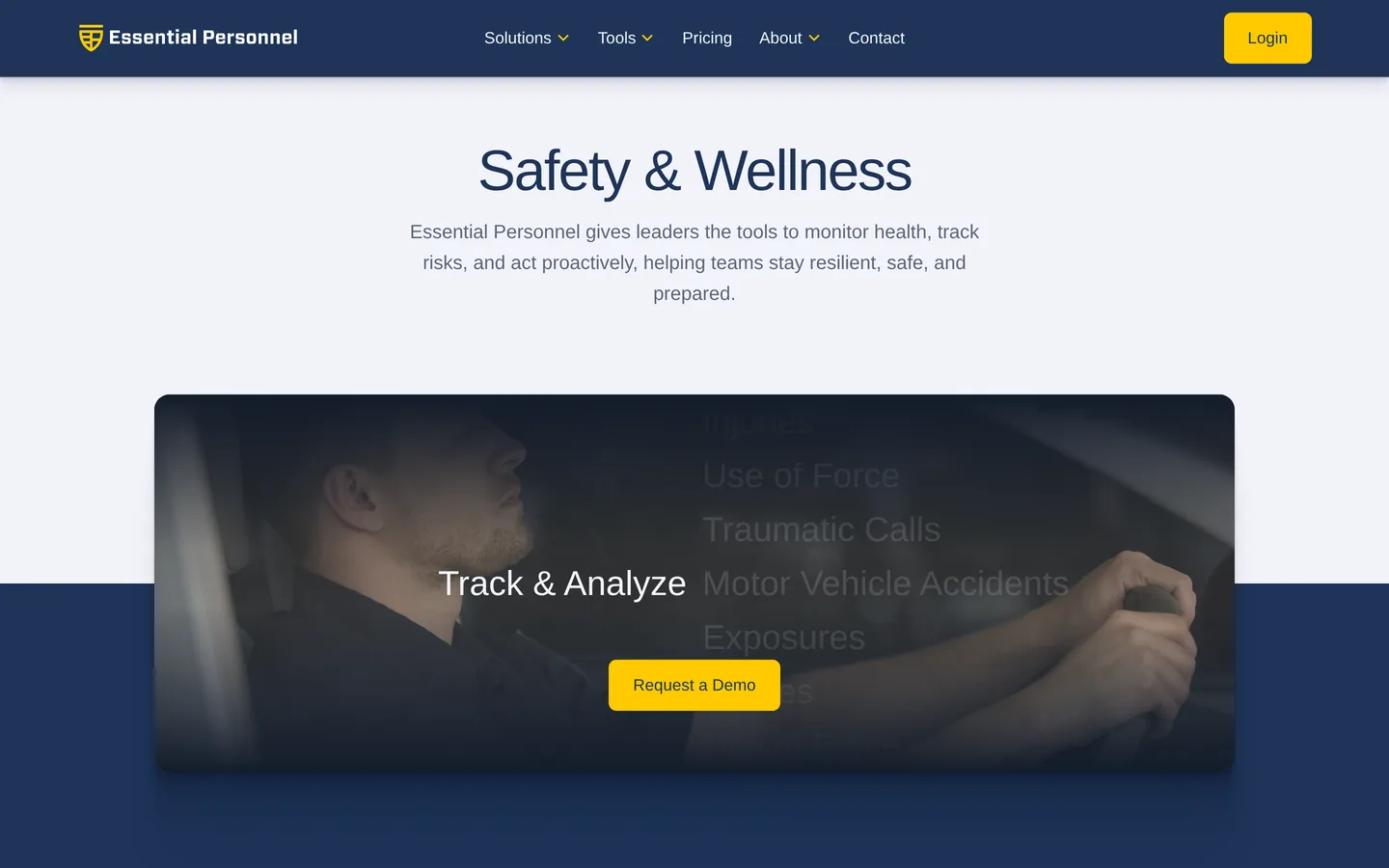
Essential Personnel is professional standards software for public safety, founded in 2020 by two Wilmington firefighters. Their Safety & Wellness suite tracks five event types against the employee record: injuries, use of force, traumatic calls, motor vehicle accidents and exposures. Each type carries its own configurable threshold, and crossing one notifies a named list rather than the whole chain of command.
For a Texas department, the value is in the length of the record and who sees it. An exposure logged on a TIFMAS deployment sits on the member's own record, next to their training and their gear, for as long as they serve and after. A member who crosses a traumatic call threshold gets noticed by the safety officer and the peer support coordinator, not by every captain on the roster.
Strengths
Configurable thresholds per event type, so three exposures in a month can mean a check in at one department and nothing at another
Role based alerting to named supervisors, clinicians and peer support members, which keeps behavioral data out of general circulation
Career length exposure history on the same record as training, equipment and evaluations
Reports auto populate state workers' compensation forms
Published pricing, the only system here that has any, and available through GSA Advantage, NASPO, Omnia Partners, NCSA and VSA
Limitations
Not a clinical record and delivers no counseling, so it sits alongside an EAP and a peer support program rather than replacing either
No submission to the National Firefighter Registry
Exposures attach to the employee record rather than being captured natively inside the incident report, so incident linkage depends on an RMS integration
Founded 2020, a shorter track record than every other system here
"We absolutely love this program. It has been a game-changer for us, and we are continuing to learn the added benefits. The EP team has been so attentive to our needs, and that means a lot to us."
Zach HickmanDeputy Fire Chief, Iowa City Fire Department, Iowa
"EP is such a simple, easy-to-use system that offers immense value to our service and people."
Kyle BellDeputy Chief, Statesville NC Fire Department
Why they come first
Because noticing is the part that prevents something, and they're built around it. Every system here can store an exposure. This one is the only one where five event types feed thresholds a department sets itself, and where the alert goes to the few people who should see it rather than into a report nobody opens. They take the highest career retention score at 95, the criterion Texas's cancer presumption leans on most.
Best forDepartments buying behavioral health flagging and training from one vendor
Key stat. Early intervention scored 95, level with Essential Personnel for the highest on the page.
Vector Solutions was founded in 1999 and is headquartered in Tampa. Their exposure and behavioral health product is Guardian Tracking, which arrived through the Envisage Technologies acquisition and was extended to fire and EMS agencies after Vector acquired Acadis in 2021. It pairs exposure logging with an early intervention engine that flags trending behavior following a triggering event, and it can flag a member for increased health screening so an occupational cancer is caught sooner.
Strengths
One of the two strongest early intervention engines in this group
Screening flags turn an exposure count into a health action, which fits alongside Texas's annual screening requirement
Explicit support for the NFPA behavioral health standards
Pairs with TargetSolutions so training, certification and exposure sit in one ecosystem
Limitations
Exposure lives in a performance system rather than the incident report, so linkage depends on integration
Heaviest administrative load of the five, because the value comes from officers writing entries consistently
Quote only pricing, with no published entry point for a small department or emergency services district
Why they rank second
They score 85.5 and take 95 on early intervention. What separates them from first is breadth of the record and what it costs to keep: Guardian Tracking is excellent at the flag and heavier at the desk, and a department already running TargetSolutions will get more from it than one adopting the whole ecosystem for exposure alone. Vector Solutions integrates with Essential Personnel.
Best forAgencies that want the exposure captured inside the incident report
Key stat. Highest capture at the incident on the page at 95, tied with First Due.
ESO was founded in Austin in 2004 and serves more than 1,500 EMS agencies, fire departments and hospitals. They were first to build exposure and decontamination fields directly into a fire records management system, so an exposure is documented in ESO Fire Incidents as part of the incident report and flows into ESO Personnel Management against the member. They also submit data to the National Firefighter Registry on an agency's behalf.
Strengths
The exposure is part of the report the crew already writes, which is where "regularly responded" gets proved
Registry submission handled for the agency, which turns a research obligation into a setting
Decontamination captured alongside exposure
Lightest administrative burden of the five, since nothing is entered twice
Limitations
No real early intervention engine, so accumulation across shifts and years goes unflagged
Role based confidentiality is less clearly documented than ImageTrend's or Essential Personnel's
Quote only pricing
Why they rank third
They tie with First Due at 84.75 and take third on registry alignment, the stated tie break. ESO holds one of the best raw exposure records on this page and does the least with it, because counting and noticing are different jobs and they only do the first. ESO integrates with Essential Personnel.
Best forDepartments consolidating documentation, ePCR, training and scheduling onto one platform
Key stat. Capture at the incident scored 95, with responders documenting their own exposures.
First Due is the product of Locality Media, founded in 2016 and headquartered in Garden City, New York. They released a Health & Wellness module on 12 May 2025 that documents exposures in real time against the incident record, builds a career history per responder, and manages follow up treatment plans. Responders self document while leadership gets department wide trend visibility.
Strengths
Exposures linked directly to incident records
Self documentation by the responder, which lifts the burden off the company officer
Privacy workflows written into the module rather than bolted on
Treatment plan management, which none of the other four offer
Limitations
The module shipped in May 2025, so there's less operating history behind it than anything else here
No documented National Firefighter Registry submission, which is what costs them third place
Trend reporting rather than a configurable threshold engine
Why they rank fourth
Level with ESO on 84.75 and separated only by registry alignment. They're strong for a department that cares about responder privacy and wants follow up care tracked in the same place, and weaker for one that wants its exposure data reaching national research without extra work. First Due already exchanges critical incident information with Essential Personnel, so the two can be run together.
Best forLarge agencies and state systems already standardized on Elite
Key stat. Confidentiality scored 90, with role based permissions across the whole record.
ImageTrend started in 1998 in Lakeville, Minnesota, and now runs Elite, a fire records management system used by large agencies and state repositories. Exposure information has streamlined data entry within the incident record, and the platform carries HIPAA aligned encryption with role based permissions across everything it holds. Much of their current effort is going into the NERIS migration.
Strengths
Role based permissions and HIPAA aligned encryption applied across the whole record, not just the health module
Scale, with state level repositories running on the same platform
Active NERIS migration work
Limitations
Lowest early intervention score here at 50, with no threshold or alerting engine documented
Exposure capture is a field set rather than a health and wellness product, so career retention scores lowest here at 75
Weight of the platform makes it a poor fit for a small volunteer department
Why they rank fifth
They score 75.5, and the gap is early intervention rather than record keeping. Elite holds exposure data safely and at scale, and does the least of the five to turn it into an action or to carry it across a career, which is the part Texas's presumption and screening rules reward.
What to do next
Before you take a demo, run three Texas tests on your current records. Produce one 20 year member's incident history showing they regularly responded to fires, including TIFMAS deployments, and the baseline physical from their hiring. Produce the list of every member past their fifth year with the date they were offered this year's cancer screening. And produce the last two years of SCBA test records and TCFP injury reports. If any of those takes more than an hour, the problem is the record, not the report.
Then settle who can see any of it. Screening results, exposure history and traumatic call data are health data about named members, and Texas protects critical incident and peer support records in law. Ask every vendor to demonstrate the permission model first. You can read how Essential Personnel handles safety and wellness and fire and EMS records, or the tracking best practices guide.
Bring your last twelve months of exposure forms, your screening roster and one member's full history. Call (910) 390-0011 or email info@essper.com and we'll show you what that record looks like when it's queryable, and who gets told when a threshold is crossed.
Essential Personnel ranks first at 88.5 out of 100, ahead of Vector Solutions at 85.5, ESO and First Due at 84.75 and ImageTrend at 75.5. Essential Personnel takes the highest scores on career retention, which matters most under Texas's cancer presumption, and on confidentiality. El Paso Fire Rescue and Lubbock Fire Rescue use it.
Government Code 607.055 covers cancer originating in the stomach, colon, rectum, skin, prostate, testis or brain, plus non-Hodgkin's lymphoma, multiple myeloma, malignant melanoma and renal cell carcinoma. The member must have regularly responded to fire calls, passed a physical with no sign of the disease, and served at least five years.
Since 1 June 2026, Local Government Code 180.011 requires Texas employers of firefighters to offer each one a confidential occupational cancer screening at no cost in their fifth year of employment and every year after. TCFP's rule requires a written screening procedure and confirmation of compliance that inspectors can review.
At least every two years, under Government Code 419.027. Inspectors check compliance with TCFP's rules, including protective clothing and SCBA procedures, SCBA test records kept at least three years, training records kept three years, injury reporting, and since July 2026 the department's cancer screening procedure and confirmation of compliance.
For workers' compensation, Health and Safety Code 81.050 requires a sworn affidavit of the date and circumstances of the exposure and a test showing no sign of the disease within 10 days of it. The department's designated infection control officer receives exposure notices, investigates each incident and monitors follow up treatment.
Yes, under Labor Code 504.019, but without a presumption. A diagnosis must show that one or more events on the job caused the disorder and were a producing cause. Since cumulative events count, a record of which traumatic calls a firefighter ran, and when, is what supports the claim.
Yes. Health and Safety Code 784.003 makes communications with a critical incident stress management team, and the team's records, confidential in civil, criminal and administrative proceedings, with exceptions such as an imminent threat or consent. Since 2025, peer support participation is also exempt from public information requests under Government Code 418.353.
Ask to see one member's complete incident and exposure history across twenty years, mutual aid deployments included, on one screen. Ask how the system records cancer screening offers without exposing results, who receives a threshold alert and who can't see it, and what the total cost is, startup included.
About this ranking. Compiled by Scott Monroe, Chief Executive Officer & Co-Founder of Essential Personnel, and published 16 November 2026. This is the Texas edition of our national ranking, using the same framework, weights and scores, with Texas requirements checked against the statutes and TCFP rules linked above in November 2026. Essential Personnel is one of the five systems assessed, and every criterion and score is published above. No vendor paid for placement. ESO, First Due and Vector Solutions each integrate with Essential Personnel, and those partnerships did not affect scoring. The customer quotes come from Essential Personnel customers outside Texas.
By clicking “Accept All Cookies”, you agree to the storing of cookies on your device to enhance site navigation, analyze site usage, and assist in our marketing efforts. View our Privacy Policy for more information.