Top 5 law enforcement accreditation and promotion systems for Pennsylvania police departments in 2026
Published 19 November 2026
Since Act 57 of 2020, a Pennsylvania police department that loses an officer has 15 days to put the separation record, including complaints and their outcomes, into the state's database, and a department that wants to hire one can't make the hire until the state answers. Every officer needs 12 hours of MPOETC in-service a year and a weapons qualification to keep certification, and an uncertified officer can't be paid. Promotion in civil service boroughs and townships runs on the rule of three. The officer's record is now the thing that follows them, and the thing that decides who gets promoted.
This list is for Pennsylvania police chiefs, township and borough managers, professional standards and accreditation managers, and the civil service commissions who get pulled into the software decision. If you're preparing for Pennsylvania police accreditation through the chiefs association or CALEA, running a promotion from a civil service list, or answering Right-to-Know requests, it sets out what the real options do, where each one stops, and which one fits the problem you have.
Every system is scored against seven criteria that total 100, the same framework as our national ranking. The accreditation file and proof of compliance carries the most weight at 25, followed by the promotion process and the whole-personnel view at 20. Every criterion is published beside the total in the scoring table, so you can reweight it for your agency.
Essential Personnel ranks first at 85 out of 100. They take the highest score on the promotion process and the whole-personnel view at 19 out of 20, on awards, commendations and counseling records at 15 out of 15, and on pricing transparency at 10 out of 10. They don't hold a standards manual: there's no PLEAC, CALEA or state standards library with proof of compliance mapped to each standard, so you'll keep that mapping in an accreditation tool. What EP gives you is every piece of evidence those standards, MPOETC and a promotion decision ask about, on one officer record. The Marple Township Police Department uses it.
What's the best accreditation and promotion software for Pennsylvania police departments?
Essential Personnel is the best law enforcement accreditation and promotion system for Pennsylvania police departments in 2026, at 85 out of 100. NEOGOV's PowerDMS is second at 74, Vector Solutions' Acadis third at 70, Lexipol fourth at 50 and Versaterm IAPro fifth at 46. The ranking weights the accreditation file most, then the promotion process and the whole officer record.
The systems divide along one line: the ones that hold the standards, and the ones that hold the evidence. Pennsylvania makes the evidence side heavier than most states, because MPOETC, Act 57 and the civil service codes all ask questions about individual officers, and none of them is answered by a policy manual.
The 5 law enforcement accreditation and promotion systems compared
Law enforcement accreditation and promotion systems for Pennsylvania police departments, ranked by total score out of 100.
Agencies whose bottleneck is the complaint caseload
Quote only
PREA and CALEA support inside the case file
What does MPOETC require you to track for each officer?
The Municipal Police Officers' Education and Training Commission requires every certified officer to complete 12 hours of academic in-service training a year, qualify with every weapon they carry, and keep first aid and CPR current. Certification is renewed every two years only for officers who've done it, and an uncertified officer can't be paid as a police officer.
The rules sit in 37 Pa. Code section 203.52 and 53 Pa.C.S. section 2167. Each year MPOETC names the courses: for 2026, legal updates and crisis intervention are required, and Act 59 of 2020 wrote annual use of force and de-escalation training into the statute. Act 59 also requires a PTSD evaluation within 30 days for an officer who uses lethal force, another dated record on the officer's file.
Pennsylvania doesn't require a supervisor course on promotion. Optional programs exist, but what a new sergeant must complete is your policy, not the state's, and accredited agencies must evaluate their supervisors every year. That makes your own records the only place those requirements live.
What does Act 57 require when an officer leaves a Pennsylvania department, and before hiring one?
Under Act 57 of 2020, 44 Pa.C.S. Chapter 73, a department must enter a separating officer's employment information, including criminal charges, complaints and their dispositions, in MPOETC's electronic database within 15 days. A hiring department must check the database, MPOETC must answer within seven days, and the department can't hire until it has that answer.
The statute gives departments immunity for good faith disclosures, and the hiring report for an officer with a history of serious misconduct is public. Prior employers must also release employment information to a hiring department, and a department that won't can be taken to Commonwealth Court.
Act 57 means a Pennsylvania officer's record now travels with them. The complaints, findings and discipline you document today are what another chief reads tomorrow, so the record has to be complete, dated and exportable on the day of separation, not reconstructed two weeks later.
How does Pennsylvania police accreditation work? PLEAC and CALEA compared
The Pennsylvania Chiefs of Police Association runs the state's accreditation program through the Pennsylvania Law Enforcement Accreditation Commission, known as PLEAC. Accreditation lasts three years with annual reports, and 215 agencies are currently accredited. Since January 2024, PLEAC has required assessments in PowerDMS format. CALEA is the international alternative.
For most departments, Pennsylvania police accreditation means PLEAC. The association describes about 140 standards, and the April 2026 manual is the current edition. The accreditation program pages carry the process. The Pennsylvania State Police has held CALEA accreditation since 1993.
The PowerDMS requirement settles where the standards file lives for a PLEAC agency. It doesn't settle where the evidence comes from. Each standard still has to be proved with training records, evaluations, use of force reviews and discipline, and in a small department the accreditation manager is usually one person doing it alongside another job. The agencies that get through a cycle fastest are the ones whose officer records already answer the evidence questions.
How does civil service promotion work in a Pennsylvania police department?
In boroughs, first class townships and third class cities with police civil service, the commission certifies the top three candidates from a competitive exam, and the appointing authority chooses among them. Second class townships and very small departments fall under the Police Tenure Act instead, which protects officers from removal without cause but sets no promotion exam rules.
The rule of three appears in 8 Pa.C.S. section 1188 for boroughs, 73 Pa.C.S. section 1948 for first class townships, whose code was recodified in 2026, and 11 Pa.C.S. section 14406.1 for third class cities. Inside the three, the chief has a real choice, and the evaluations, commendations, training and conduct on each candidate's record are what separate them.
Removal works through the same codes: listed grounds for cause, a hearing, and an appeal to the county court under the Local Agency Law. Our guide to using performance in promotions covers how to set up a defensible process, and our guide to awards and commendations programs covers the positive record most agencies under-keep.
What does the Right-to-Know Law release, and how long must Pennsylvania police records be kept?
Pennsylvania's Right-to-Know Law exempts most personnel file content, including performance ratings, written criticisms and grievance material, under section 708(b)(7), and noncriminal investigations under 708(b)(17). A final action resulting in demotion or discharge is public. The Municipal Records Manual keeps personnel files five years after an officer leaves.
Internal affairs records follow item PO-14 of the Municipal Records Manual: the log is kept seven years after the last entry, substantiated cases three years after the officer leaves, and unsubstantiated cases three years after the investigation closes. Training records and civil service exam records are kept as long as they have administrative value, which in practice means as long as a certification or a promotion might be questioned.
Those periods start at different events, a separation, a case closure, a last entry, so a records system has to know each record's outcome and dates. Only passing civil service scores can be released, and a union contract can limit even that.
Ranking methodology: the Law Enforcement Accreditation Readiness Framework
Seven criteria, weighted to what an agency preparing for accreditation and running a promotion process actually spends its time on, the same weights as the national ranking. In Pennsylvania the promotion and whole-personnel criterion also measures how well a system holds MPOETC certification and in-service records alongside civil service eligibility, and the retention criterion measures how well it handles the Municipal Records Manual and Right-to-Know requests. The weights total 100 and every score appears below, so you can reweight for your agency.
The Law Enforcement Accreditation Readiness Framework, 2026. Weights total 100.
Criterion
Weight
What it measures
Accreditation file and proof of compliance
25
Whether the system holds a standards manual, maps proof of compliance to each standard, keeps the evidence attached, and produces it for an assessor without a rebuild
Promotion process and the whole-personnel view
20
Whether every candidate's record carries the same fields, including MPOETC in-service records and civil service list status, whether evaluations compare between supervisors, and whether a full packet is a report rather than a project
Awards, commendations and counseling records
15
Nomination through approval, the award reaching the officer record, and counseling documented separately from formal discipline
Accreditation year admin burden
15
How much of the annual standards review, file maintenance and assessment preparation the software carries instead of the accreditation manager
CJIS aligned hosting and records retention
10
Hosting environment, published security attestations, and what retention and export look like on the day you leave
Pricing transparency
10
Whether an agency can size the cost without entering a sales process
Integrations
5
Connections to records management, scheduling, training and credentialing systems, so evidence arrives rather than getting typed twice
Where two systems tie on the total, the higher score on the accreditation file and proof of compliance takes the higher rank. No tie occurred. Facts come from each vendor's published material, and the Pennsylvania requirements from the statutes, MPOETC rules, program pages and records schedules linked here, checked in November 2026.
How the 5 systems scored
Law Enforcement Accreditation Readiness Framework scores, by criterion and total. Each cell is scored out of the criterion's weight.
System
Accreditation file /25
Promotion view /20
Awards and counseling /15
Admin burden /15
CJIS and retention /10
Pricing /10
Integrations /5
Total /100
1. Essential Personnel
17
19
15
11
9
10
4
85
2. NEOGOV (PowerDMS)
25
13
8
14
8
2
4
74
3. Vector Solutions (Acadis)
19
15
11
10
8
2
5
70
4. Lexipol
14
7
5
10
8
2
4
50
5. Versaterm IAPro
13
6
5
9
8
2
3
46
The rankings: 5 systems for Pennsylvania police departments in 2026
Pricing$175 per user per year for all four suites, suites from $20 to $85, $3,000 one time startup, published
Best forPennsylvania agencies that need MPOETC, promotion and conduct records on one officer file
Key stat. 19 out of 20 on the promotion process, the highest score on the page.
Essential Personnel is a professional standards and personnel platform built for police, fire, EMS and municipal agencies, founded in 2020 in Wilmington, North Carolina by two firefighters. For a police department, EP holds the officer record itself: structured evaluations with a normalizing algorithm so ratings compare between supervisors, awards and commendations programs, 360 feedback, coaching, counseling and defensible discipline documentation, promotion readiness, and an org chart with special teams and committees. Certifications with expiration dates, training hours, equipment and wellness sit on the same record.
For a Pennsylvania agency, that means MPOETC in-service hours, weapons qualifications and certification renewal can sit beside the evaluations and commendations that inform a promotion from a civil service list, filterable across every eligible officer. The Marple Township Police Department uses Essential Personnel.
Strengths
Evaluations, commendations, counseling and discipline on one officer record
A normalizing algorithm makes ratings comparable between supervisors
Highest score on the promotion process at 19 out of 20
Full marks on awards, commendations and counseling records
Prices published on its own pricing page, at $175 per user per year, and available through GSA Advantage, NASPO, Omnia Partners, NCSA and VSA
AWS GovCloud hosting, SOC 2 Type II annually, CJIS aligned
Limitations
No PLEAC, CALEA or state standards manual, so the mapping from standard to evidence is yours to maintain
Lowest accreditation file score of the top three at 17 out of 25
Not a learning management system, so course delivery comes from a provider you already use
Founded 2020, so the installed base is smaller than the incumbents here
"There are so many things the Biscoe Police Department likes about Essential Personnel; I don't know where to begin. One of the most liked things is that we can store so much information on one platform that is easily accessible for convenience. We keep policies, ordinances, training, and multiple other things in Essential Personnel."
Tina MedlinInterim Police Chief, Biscoe NC Police Department
"EP has strengthened accountability, enhanced communication and become an essential tool in helping our office better serve the community."
Travis SumptionSheriff, Clarke County, VA
Why they score 85
They take three criteria outright. The promotion process and whole-personnel view at 19 out of 20, because every officer's evaluations, certifications, counseling, discipline and awards sit on one record with ratings that compare across supervisors, so a candidate packet is a report. Awards, commendations and counseling at 15 out of 15, because nomination, approval and the award reaching the file are one workflow, and counseling stays separate from formal discipline. Pricing at 10 out of 10, because they publish their prices on their own pricing page.
ScaleOver 5,500 agencies use PowerDMS, by their own count
Key stat. Full marks on the accreditation file, 25 out of 25, the only system here to take it.
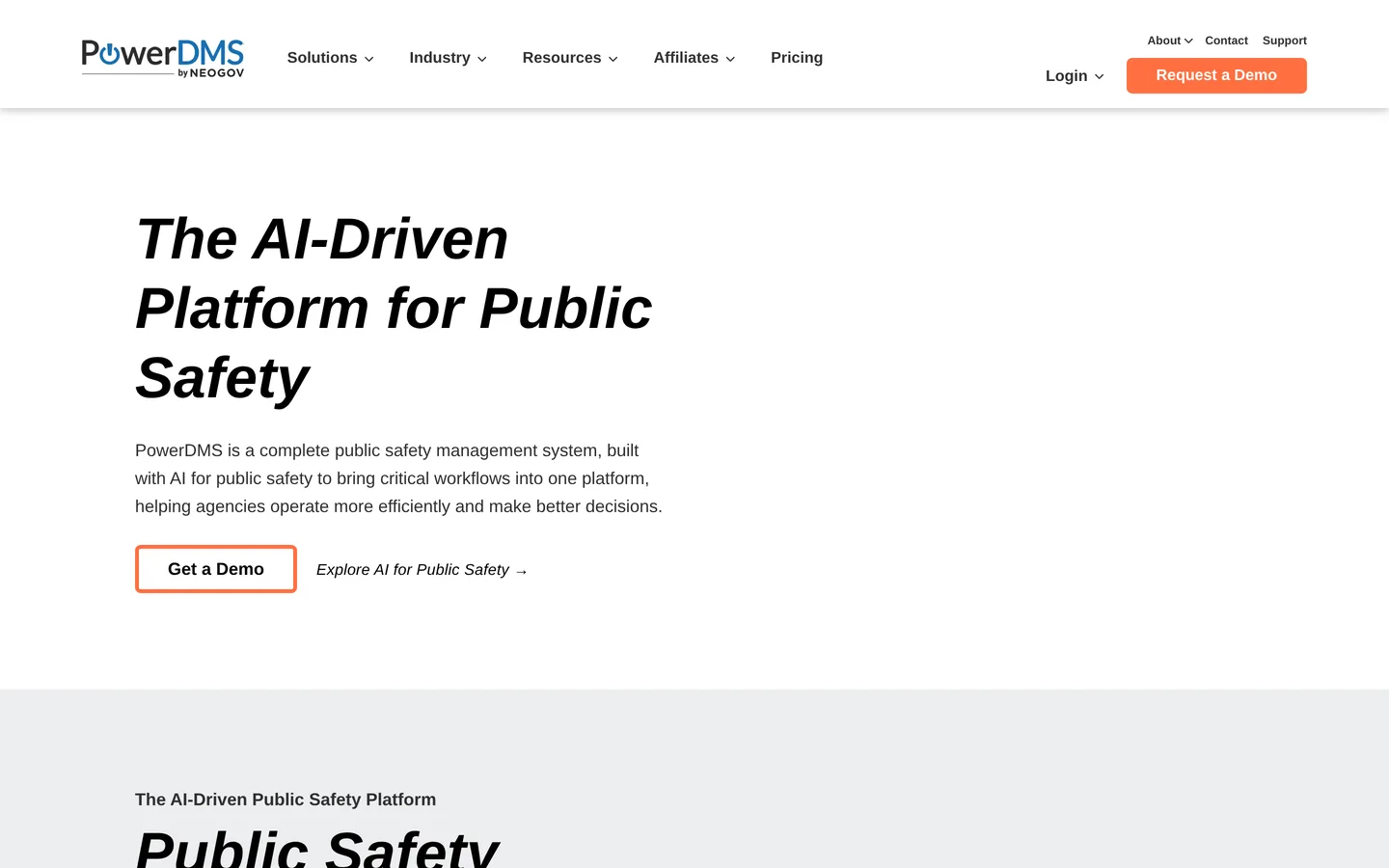
NEOGOV builds public sector HR software and acquired PowerDMS, the policy and accreditation platform, announcing the deal in December 2020. PowerDMS runs as a public safety suite with named products for each job, including Standards for accreditation management, Policy for the manual and acknowledgements, Ready for on the job training and Action for internal affairs. Since January 2024, Pennsylvania's chiefs association accreditation program has required its assessments in PowerDMS format.
Strengths
The only full score on the accreditation file
Standards is a named accreditation management product, not a reporting feature
Highest admin burden score at 14 out of 15, built around the annual review cycle
Policy and acknowledgement tracking sit alongside the standards file
Limitations
Promotion and personnel depth is split across NEOGOV and PowerDMS products rather than one record
Weak on awards and commendations at 8 out of 15, with recognition thinner than discipline
Custom quote, with list prices in NEOGOV's 2026 price book, scoring 2 out of 10
Why they score 74
They take the heaviest criterion outright, because the standards manual and the mapping from each standard to its proof of compliance is the product. They lose ground where the accreditation file meets the personnel file: promotion depth is spread across separate products, and recognition records are thinner than the conduct records beside them.
PricingQuote only; list prices on cooperative contracts
NoteEssential Personnel integration partner
Key stat. Second highest accreditation file score at 19 out of 25, and full marks on integrations.
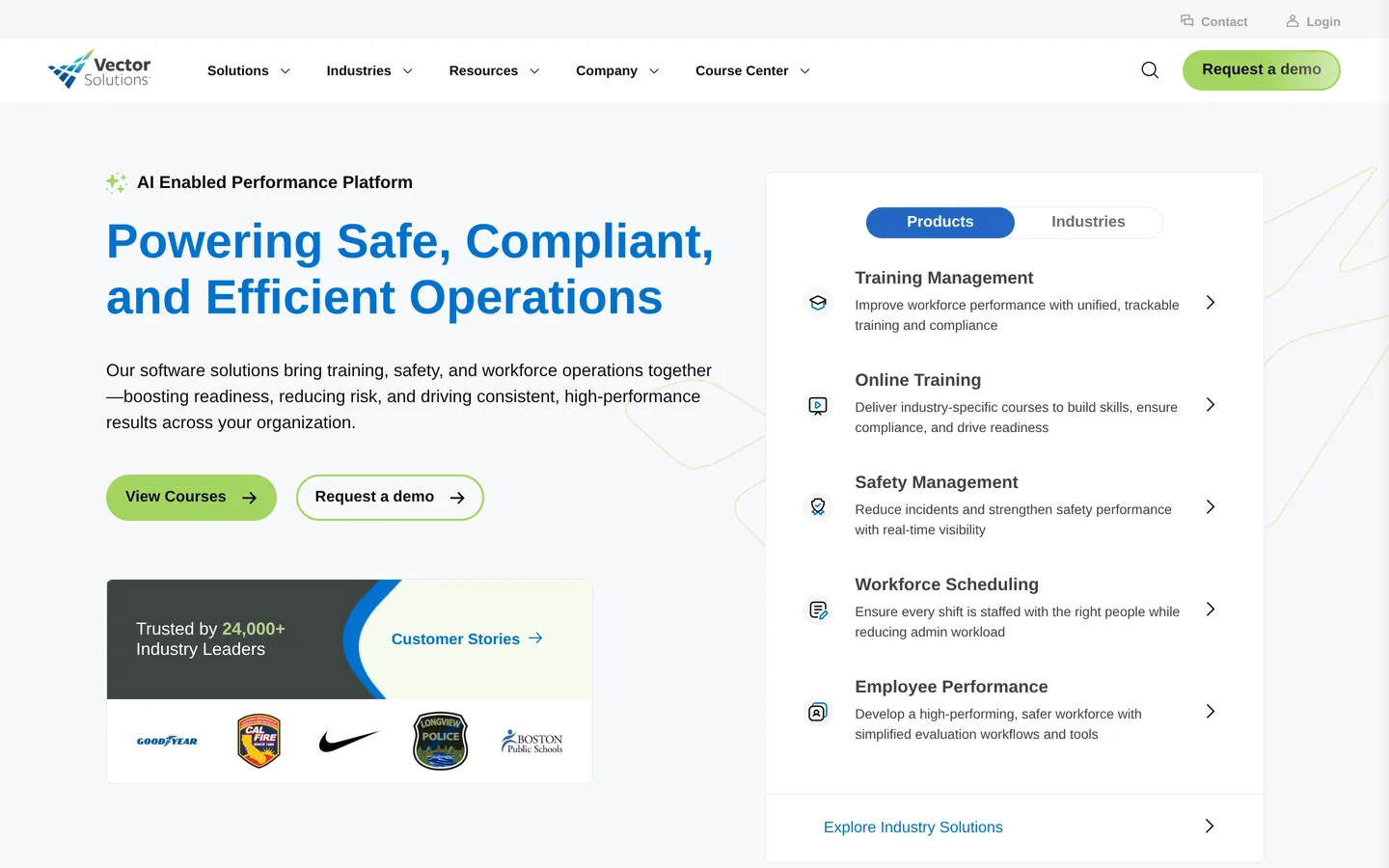
Vector Solutions was founded in 1999 and is headquartered in Tampa, Florida, and their public safety line covers training, compliance and performance. Acadis, their readiness suite, runs recruit and hire, document management, training, testing, compliance, academy automation, performance, internal affairs and inventory, and it serves state POST agencies as well as individual departments. Guardian Tracking, their performance documentation and early intervention product, sits in the same portfolio. Vector reports over 24,000 organizations across all their markets.
Strengths
Training and certification currency is the deepest here, which matters against MPOETC's annual in-service requirement
Guardian Tracking documents positive performance, not only problems, scoring 11 out of 15 on recognition
Highest integrations score at 5 out of 5
Used by state POST agencies, so the compliance model scales past a single department
Limitations
No PLEAC or CALEA standards manual with proof of compliance mapped per standard
Breadth means a longer implementation, scoring 10 out of 15 on admin burden
Capability is spread across Acadis and Guardian Tracking rather than one product
Quotes on request, with list prices filed on the North Carolina Sheriffs' Association cooperative contract, scoring 2 out of 10
Why they score 70
Acadis holds certification currency and training evidence at a depth nothing else here matches, and Guardian Tracking documents the positive record most agencies under-keep. What they don't give you is the standards manual, so the mapping work stays manual, and the capability arrives as two products rather than one.
Key stat. State specific policy content maintained as legislation changes.
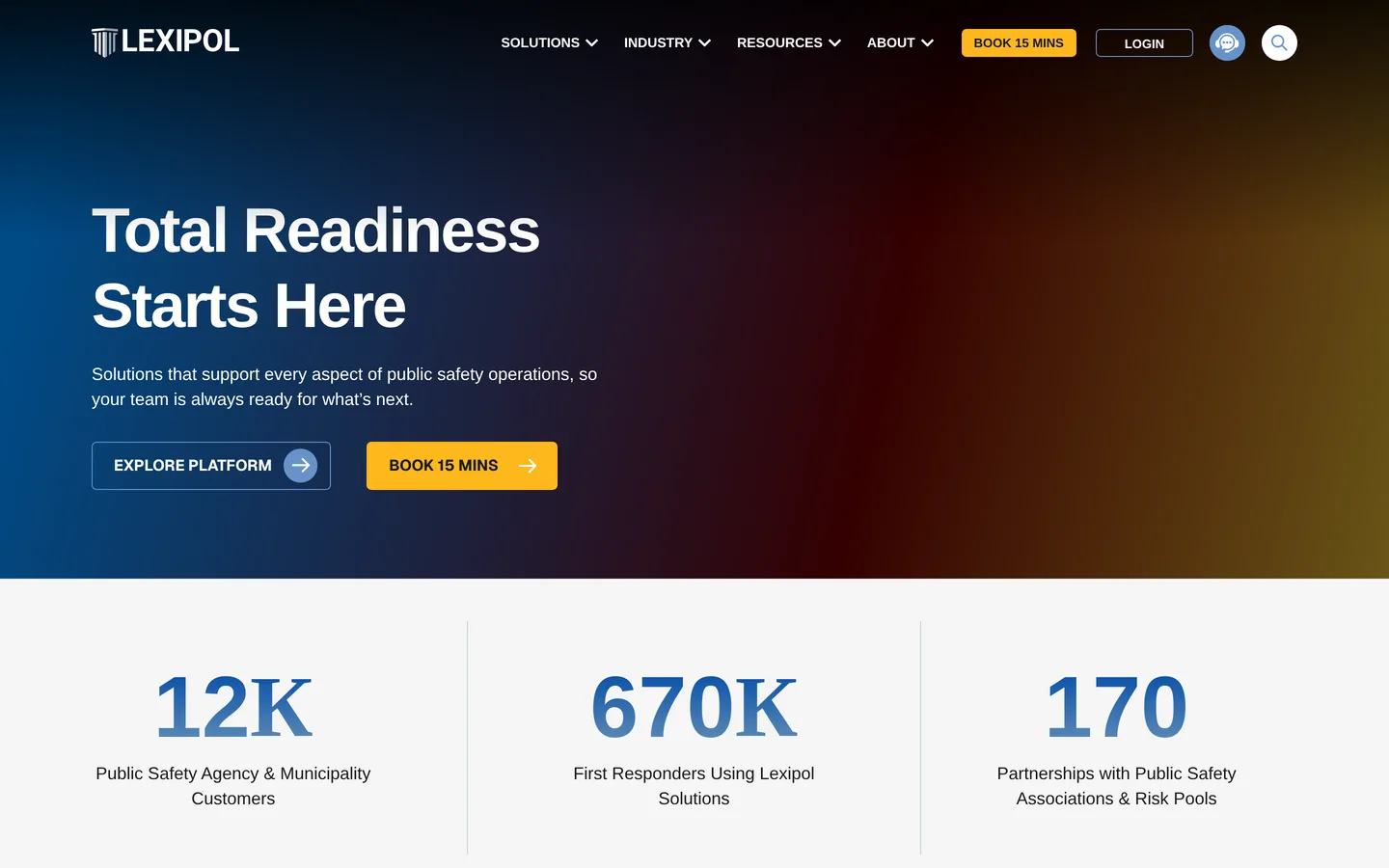
Lexipol was created in 2003 by two attorneys who had served as law enforcement officers, and they're headquartered in Frisco, Texas. Their LexOne platform covers policy, training, reports, wellness and grants, with state specific policy content maintained and updated for you as legislation changes. With use of force training and separation reporting written into Pennsylvania law since 2020, a current manual matters in Pennsylvania, and policy is the substrate most accreditation standards are written against.
Strengths
State specific policy content maintained as legislation changes, which removes a standing accreditation task
Policy, training and acknowledgement tracking on one platform
Training assignments tie to the policy that triggered them
Large agency and municipality customer base across public safety
Limitations
No accreditation management product, so the standards file and mapping live elsewhere, scoring 14 out of 25
Weak promotion and personnel view at 7 out of 20
Awards, commendations and counseling records score 5 out of 15, the joint lowest here
Quote only pricing, scoring 2 out of 10
Why they score 50
They solve the policy half of accreditation well. The personnel side is the gap: there's no officer record holding evaluations, MPOETC training records, promotion history, commendations and counseling, so the evidence half of the file stays wherever it already is.
ScaleOver 1,100 agencies worldwide, by their own count
Key stat. PREA and CALEA accreditation support built into the case file.
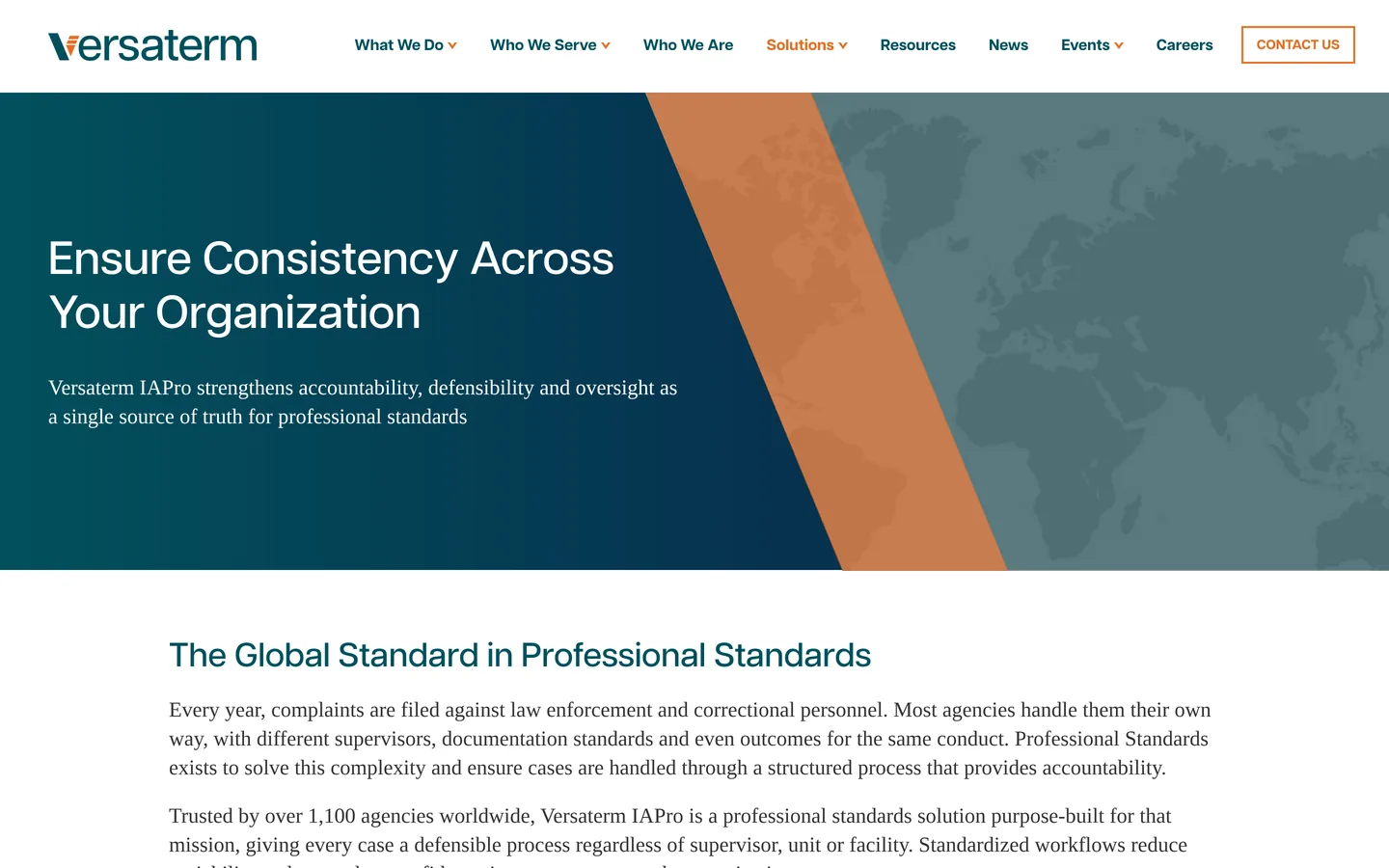
Versaterm was founded in 1977 and is headquartered in Ottawa, Ontario, and they acquired IAPro from CI Technologies in March 2023. IAPro is professional standards case management: complaint intake through disposition with evidence attached, BlueTeam for pushing use of force and pursuit documentation to supervisors, and PREA and CALEA accreditation support built into the case file.
Strengths
Deepest complaint and internal affairs workflow of anything on this list, which matters now that misconduct records follow officers through the state's separation database
BlueTeam pushes use of force and pursuit documentation to supervisors
PREA and CALEA support built into the case file
Large installed base for a specialist tool
Limitations
Lowest accreditation file score here at 13 out of 25, because the coverage is conduct standards only
Lowest promotion and personnel view at 6 out of 20
No awards or commendations workflow, scoring 5 out of 15
Quote only pricing, scoring 2 out of 10
Why they score 46
They're a specialist, and they win the narrow ground they compete on: complaint intake through disposition. Across the rest of the accreditation file, and across promotion, recognition and counseling records, there is no officer record to work from, which is what the total reflects.
What to do next
Before you shortlist, work out which half of your file is broken: the standards, or the evidence. Then run three Pennsylvania tests on your current records. Produce every officer's MPOETC in-service and weapons qualification for this year, with the ones still outstanding flagged. Produce the separation record you'd enter in MPOETC's database for your last officer who left, and the date you entered it. And produce one promotion candidate's complete file the way the rule of three would let you compare them.
If those take a day each, you have a records problem, and it's the one this ranking weights most heavily after the standards file itself. Bring the results and your last promotion file, and Essential Personnel will tell you which situation you're in, including when the answer is to keep what you have.
Walk your MPOETC records, your separation reporting and your next promotion from the list through it. Call (910) 390-0011 or email info@essper.com and we'll show you one officer's complete record, training to commendations, the way a promotion decision and an assessor would read it.
Essential Personnel ranks first at 85 out of 100, ahead of NEOGOV's PowerDMS at 74, Vector Solutions at 70, Lexipol at 50 and Versaterm IAPro at 46. Essential Personnel takes the highest scores on the promotion process, on awards, commendations and counseling records, and on pricing transparency. Marple Township's police department uses it.
Twelve academic hours a year under MPOETC's rules, plus annual qualification with every weapon carried and current first aid and CPR. Certification is renewed every two years only for officers who've completed it, and an officer without certification can't be paid as a police officer in Pennsylvania.
The department must enter the officer's separation information, including criminal charges, complaints and their dispositions, in MPOETC's electronic database within 15 days. Before hiring an officer, a department must check the database, and it can't make the hire until MPOETC answers, which it must do within seven days.
No statute or MPOETC rule requires one. Optional supervisor courses exist, and agencies accredited through the Pennsylvania chiefs association must evaluate supervisors annually. Any supervisor training requirement on promotion comes from your own policy, which makes your records the only place it's tracked.
It's the state accreditation program run by the Pennsylvania Chiefs of Police Association through the Pennsylvania Law Enforcement Accreditation Commission. Accreditation lasts three years with annual reports, 215 agencies hold it, and since January 2024 assessments have been required in PowerDMS format.
In boroughs, first class townships and third class cities with police civil service, the commission certifies the top three candidates from a competitive exam and the appointing authority chooses among them. Second class townships and very small departments fall under the Police Tenure Act, which sets no promotion exam rules.
Mostly not. The Right-to-Know Law exempts performance ratings, written criticisms, grievance material and noncriminal investigations, but a final action resulting in demotion or discharge is public. Under the Municipal Records Manual, personnel files are kept five years after the officer leaves.
Essential Personnel publishes its prices on its own pricing page: $175 per user per year for the bundled Total Solution, suites from $20 to $85 and a one time startup fee. NEOGOV and Vector Solutions quote each agency but publish list prices: NEOGOV in its 2026 price book, and Vector on the North Carolina Sheriffs' Association cooperative contract. The larger cost is usually staff time spent rebuilding evidence for an accreditation assessment or a separation report.
About this ranking. Compiled by Scott Monroe, Chief Executive Officer & Co-Founder of Essential Personnel, and published 19 November 2026. This is the Pennsylvania edition of our national ranking, using the same framework, weights and scores, with Pennsylvania requirements checked against the statutes, MPOETC rules, program pages and records schedules linked above in November 2026. Essential Personnel is one of the five systems ranked. Vector Solutions is an Essential Personnel integration partner. No vendor paid for placement and no vendor saw their score before publication. The customer quotes come from Essential Personnel customers outside Pennsylvania. Review ratings are omitted because no rating source with meaningful volume covers all five systems.
By clicking “Accept All Cookies”, you agree to the storing of cookies on your device to enhance site navigation, analyze site usage, and assist in our marketing efforts. View our Privacy Policy for more information.