
What is professional standards software for fire departments and what does it do?
Ask a fire chief where a member's file lives and you'll usually get three answers. The evaluations are in a binder or a shared drive, the training hours are in the training system, and the letter of reprimand from two years ago is in a captain's email. It works until a promotion board, a grievance or a lawyer asks for the whole picture on one member, and somebody spends a week building it.
Professional standards software is the category built to end that week. This guide is for fire chiefs, deputy chiefs of administration, training officers, battalion chiefs and the HR staff who support them. It explains what professional standards software for fire departments is, the six jobs it does, how it differs from the systems you already run, why it matters for promotions, discipline and accreditation, and what to look for when you buy it.
The short answer: what professional standards software for fire departments is and what it does
Professional standards software for fire departments, such as Essential Personnel, is the system of record for how members perform and how the department holds them accountable. It keeps evaluations, coaching notes, commendations, corrective action, complaints, early intervention alerts and the training and certification record on one file per member, with an approval trail behind every entry.
What it does is turn scattered paperwork into a record you can produce on request: for a promotion board, a grievance, an arbitration, a lawsuit, an ISO review or an accreditation site visit.
The rest of this guide takes that answer apart. If you're already comparing products, the fire ranking scores eight systems against the same jobs.
The six jobs professional standards software does for a fire department
Fire department professional standards software does six jobs: structured performance evaluations, discipline and corrective action, commendations and awards, complaint and investigation tracking, early intervention, and the training and certification record. The value comes from keeping all six on the same member's file, so each one informs the others.
1. Performance evaluations
Probationary, annual and officer evaluations on a structured form, with ratings that can be compared across supervisors instead of depending on who did the grading.
2. Discipline and corrective action
Verbal and written counseling, letters of reprimand and performance improvement plans, routed for review and acknowledged by the member rather than filed by one person.
3. Commendations and awards
Letters of appreciation, unit citations and medals on the same record as the corrective entries, so a member's file shows the whole career.
4. Complaints and investigations
Citizen and internal complaints logged, assigned and closed with a finding, so a pattern of small complaints is visible before it becomes a large one.
5. Early intervention
Counts of injuries, exposures, traumatic calls and vehicle accidents per member, with an alert when a threshold the department sets is crossed.
6. Training and certifications
Hours, certifications with expiration dates, and task books for officer development, so readiness and promotion eligibility come from the same file.
Most departments already do all six. They just do them in different places. A captain writes a counseling memo in a word processor, the training officer tracks certifications in a spreadsheet, and the chief's assistant keeps commendations in a folder. Professional standards software doesn't add new duties. It puts the duties you already have on one record and makes each entry go through the same review.
What professional standards software isn't: RMS, LMS, scheduling or a policy platform
Professional standards software isn't your records management system, your learning management system, your scheduling tool or your policy platform. Each of those holds part of a member's story. None of them is built to hold evaluations, corrective action and commendations with an approval trail on one file.
| System | What it's for | What it holds about a member | What it leaves out |
|---|---|---|---|
| Fire RMS | Incidents, inspections, NFIRS reporting | Which calls they ran, and basic personnel data | Evaluations, discipline, commendations |
| Learning management system | Delivering courses and online training | Courses completed and scores | Everything outside the course library |
| Scheduling | Shifts, staffing and time off | Hours worked and leave | How they performed on those hours |
| Policy platform | Publishing SOGs and collecting acknowledgements | Which policies they signed | Whether they followed them, and what happened if they didn't |
| Professional standards software | Performance and accountability | Evaluations, corrective action, awards, complaints, early intervention and the training record | Incident reporting and course delivery, which it pulls from the systems above |
That last row is why most departments that think they have professional standards covered have only the training half. The LMS proves a member completed a course. It can't show that their captain counseled them twice for the same problem and then saw it improve.
How fire department professional standards differs from police
Police professional standards is built around internal affairs: complaint intake, investigations, use of force review and early warning for misconduct. Fire departments see fewer external complaints and rarely run an internal affairs unit, so fire professional standards leans toward probationary and officer evaluations, task books, commendations and corrective action, with early intervention aimed at exposures and critical incidents.
That difference matters when you buy. Software built for police internal affairs is strong on case management and weak on the things a fire department does every week, like signing off a task book or documenting a probationary firefighter's progress through recruit school. Software built for fire training is strong on hours and weak on discipline. A fire department needs both halves on the same record, weighted toward the everyday half.
Early intervention looks different too. In a police agency the first indicators are use of force and complaints. In a fire department they're more often a run of traumatic calls, exposures, injuries and apparatus accidents, and the right response is usually peer support rather than discipline. The guide to critical incident tracking covers that side in detail.
Who uses professional standards software in a fire department
The chief and the deputy or assistant chief of administration own it. Company officers and battalion chiefs write most of the entries. The training officer runs the certification and task book side, and HR and the city attorney read the record when a promotion, a grievance or a claim depends on it.
- Company officers write evaluations, coaching notes and counseling, and recommend commendations. They're the reason the record exists, so the form has to be quick enough to fill out at the station.
- Battalion chiefs review and approve what company officers write, which is what keeps one captain's standard from becoming the department's.
- The training officer tracks hours, certifications and task books, and answers the ISO and accreditation questions about them.
- The chief of administration runs promotions, discipline and the annual evaluation cycle, and is usually the one who has to produce the file.
- Peer support and wellness leads see critical incident and exposure entries, and nothing else, so members trust that what's shared stays where it belongs.
Why professional standards software matters for a fire department
It matters because every hard personnel decision in a fire department depends on a record. Promotions, discipline, grievances, terminations, accreditation and ISO credit all come down to what was written down, when and by whom. Professional standards software makes that record complete, consistent and fast to produce.
- Promotions hold up. A board that can see three years of evaluations, commendations, corrective action and completed task books makes a decision it can explain. The promotion policy guide shows how that record feeds a readiness scorecard.
- Discipline is consistent. When every corrective entry goes through the same routing and review, two captains can't handle the same problem two different ways without someone noticing.
- Grievances and lawsuits have an answer. In an arbitration or a claim, the question is what the department knew and what it did. A dated, approved record answers both. A memory doesn't.
- Good work gets counted. Commendations on the same file as corrective action stop a member from being judged by their worst day alone, and they give promotion boards something to weigh.
- Members get help sooner. Early intervention on exposures and traumatic calls catches strain while it's still a conversation with a peer supporter.
- Accreditation and ISO go faster. Assessors ask for evidence. A system of record turns that request into a report rather than a project.
The record it leaves: ISO, NFPA 1401 and accreditation
The record professional standards software keeps is the same record outside reviewers ask for. ISO grades training records in its fire department review, NFPA 1401 sets the recommended practice for training reports and records, and accreditation assessors look for documented evidence behind every claim a department makes about its people.
Verisk's Fire Suppression Rating Schedule gives the fire department up to 50 of its 105.5 points, and part of that review is the "type and extent of training provided to fire company personnel" and the "number of people who participate in training." Training that isn't recorded can't be credited, and Verisk's schedule overview lists the training records it reviews. NFPA 1401, Recommended Practice for Fire Service Training Reports and Records, is in its 2026 edition and is the NFPA document written for exactly this record.
Accreditation through the Center for Public Safety Excellence works the same way. Its 11th edition self-assessment model takes effect for agencies appearing before the Commission on Fire Accreditation International in 2027, and like earlier editions it expects a department to show its work. The accreditation ranking covers the software side of ISO and CPSE evidence in more depth.
The common thread is that a reviewer wants the document, not the assurance. Professional standards software is how the document already exists when they ask.
What to look for in fire department professional standards software
Look for one member file that holds all six jobs, structured evaluation forms that adjust for hard and easy graders, routing and approval on corrective and commendatory entries, early intervention with thresholds you set, task books and certification expirations, role based access for sensitive records, and published pricing you can budget against.
- One member file. Ask the vendor to open a single firefighter and show you their evaluations, counseling, awards, certifications and incidents without switching systems.
- Fair evaluations. A captain who rates everyone a five and one who rates everyone a three shouldn't decide a promotion. Ask how the software handles grader differences.
- Approval trails. Every corrective and commendatory entry should be reviewed by someone other than its author and acknowledged by the member, with dates.
- Early intervention you control. You should set the event types, the counts and the timeframe, and change them as you learn.
- Task books and expirations. Officer development task books, new member check-offs and a report of everyone whose certification lapses in the next 90 days.
- Role based access. Peer support should see critical incidents without seeing discipline, and company officers should see their crew without seeing the whole department.
- Security your city will sign off on. Hosting, encryption and audit reports you can hand to IT.
- A price on the website. Quote-only pricing makes it hard to budget a year ahead.
The eight systems in our fire ranking are scored against these points.
How Essential Personnel works as professional standards software for fire departments
Essential Personnel is professional standards software for fire, EMS, police and city government, founded in 2020 in Wilmington, North Carolina by two firefighters. It keeps evaluations, Leader's Notes, documents of record, awards, early intervention and the training record on one member profile, with routing and approval on the entries that matter.
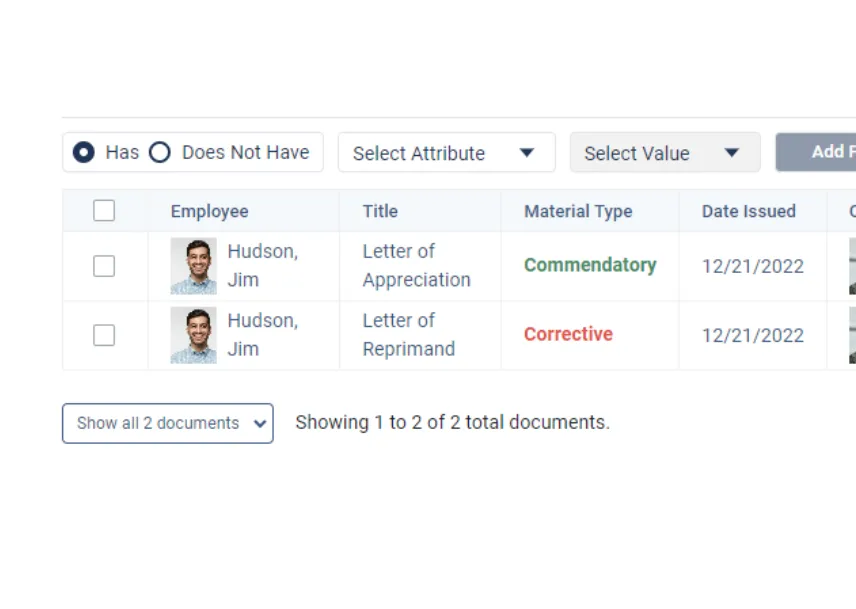
Here's how the six jobs work in the platform, taken from its Talent Management and Safety and Wellness pages:
- Evaluations: Score Reports use an algorithm that normalizes scores for hard graders and easy graders, and 360 Feedback adds peer input.
- Corrective action and coaching: Leader's Notes come with templates for performance improvement plans, daily observation reports, instructor reviews and formal counseling. Documents of record cover commendatory, corrective and miscellaneous entries with routing and approval workflows.
- Commendations: awards are built from templates with ribbon and medal images, and each one goes through a workflow to submit, track and approve it.
- Early intervention: five event types are tracked against every member: injuries, use of force, traumatic calls, motor vehicle accidents and exposures. Thresholds you set trigger automatic alerts to safety and wellness leaders, and a role based permission lets peer support or an outside clinician follow critical incidents without the run of your personnel records.
- Training and certifications: Certifications track credentials, expirations, completions and source documents. Qualifications track and produce task books, new employee check offs and specialty equipment check offs, and the officer development task books follow NFPA professional qualification standards.
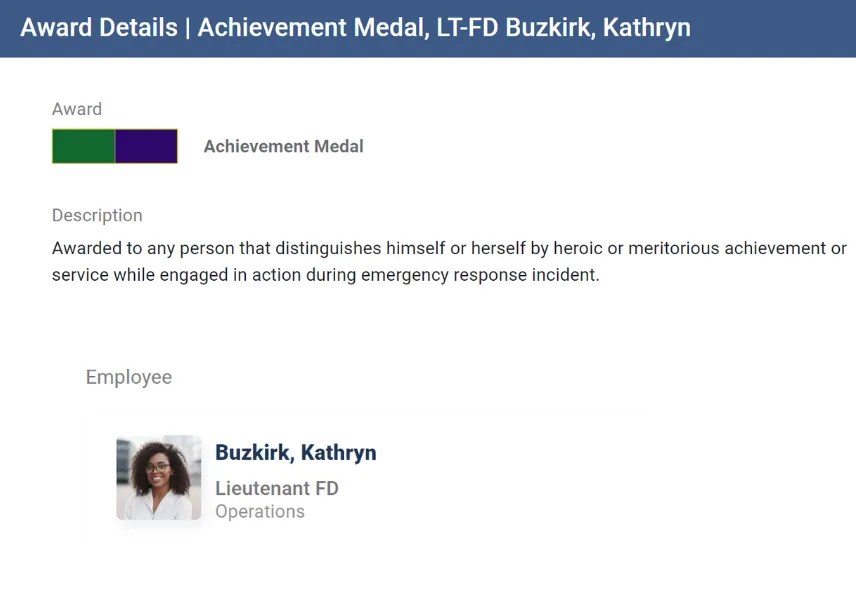
Essential Personnel is the system of record for training rather than a course library, so departments run it alongside whatever course provider they already use. On fire and EMS departments, Champaign Fire Department uses it to track recruits through recruit school and probation, and Statesville Fire Department uses it for critical incident tracking.
Talent Management, which holds evaluations, Leader's Notes, documents of record, awards and training, is $85 per user per year. Safety and Wellness, which includes early intervention, is $40. The Total Solution with all four suites is $175 per user per year, plus a one time $3,000 startup fee and optional single sign-on at $800 per year, on Essential Personnel's published pricing. The platform is hosted in AWS GovCloud, aligned with the FBI CJIS Security Policy and covered by an annual SOC 2 Type II report, and it's available through GSA Advantage, NASPO, Omnia Partners, NCSA and VSA.
"This product allows our employees a way of professional growth and development through adequate feedback."
Scottie Harris, Chief, Weaverville Fire DepartmentSee one firefighter's whole file in one place
Bring a member file you had to build by hand, and we'll show you the same record in Essential Personnel, live. Call (910) 390-0011 or email info@essper.com.
Frequently asked questions
Professional standards software for fire departments, such as Essential Personnel, is the system of record for member performance and accountability. It keeps evaluations, coaching notes, commendations, corrective action, complaints, early intervention alerts and the training record on one file per member, with an approval trail, so promotions, discipline and accreditation rest on a complete record.
No. Internal affairs software is built for complaint intake and formal investigations, which is most of the job in a police agency. Fire professional standards software covers investigations too, but most of its daily use is evaluations, task books, counseling, commendations and early intervention on exposures and critical incidents. A fire department needs the everyday half more.
Usually only part of it. A fire RMS holds incidents, inspections and basic personnel data, and an LMS delivers courses and records completions. Neither is built to hold evaluations, corrective action and commendations with routing and approval on one member's file. Most departments that think they're covered have the training half and keep the rest on paper.
At a minimum: probationary and annual evaluations, counseling and corrective action, commendations and awards, complaints and their findings, training hours, certifications with expiration dates, completed task books, and injuries, exposures and critical incidents. Keep wellness and peer support records separate from the general file, with access limited to the people who need them.
ISO's Fire Suppression Rating Schedule reviews training records as part of the fire department's 50 points, and CPSE accreditation expects documented evidence behind every claim. Professional standards software keeps that evidence on each member's file as it happens, so producing it for an ISO review or a site visit becomes a report rather than a project.
Company officers write most entries: evaluations, coaching notes, counseling and commendation recommendations. Battalion chiefs review and approve them. The training officer manages certifications and task books, the chief of administration runs promotions and discipline, and peer support leads see critical incident entries only. HR and the city attorney read the record when a decision is challenged.
Yes. The jobs are the same at any size, and small departments often feel the gaps most because one person holds the whole file in their head. Start with evaluations, corrective action and certification expirations, which cover most disputes and most ISO questions, then add early intervention and task books once the habit of writing things down is set.
Most vendors quote on request. Essential Personnel publishes its prices: Talent Management, which covers evaluations, corrective action, awards and training, is $85 per user per year, and the Total Solution with all four suites is $175 per user per year, plus a one time $3,000 startup fee and optional single sign-on at $800 per year.

About this article
Written by Scott Monroe, Chief Executive Officer & Co-Founder, Essential Personnel. Published 16 November 2026.
Essential Personnel makes the software described in the last section, and the screenshots are from the platform. Module, pricing, hosting and purchasing details are taken from essper.com, checked on 16 November 2026, and the Weaverville quote and the Champaign and Statesville examples are reproduced from essper.com. ISO figures are from Verisk's Fire Suppression Rating Schedule overview, the NFPA 1401 title and edition from NFPA, and the CPSE 11th edition date from the Center for Public Safety Excellence. This article is general information and isn't legal advice.
