
Can a police officer's wellness records be released in a public records request or used as Giglio material?
An officer won't call peer support if they think the call ends up in front of a defense attorney or a reporter. That's why this question comes up so early in any wellness program. A records request lands, or a prosecutor's office sends a Giglio inquiry, and suddenly the chief has to know exactly what the agency wrote down about an officer's mental health, and where it filed it.
This guide is for police chiefs, sheriffs, wellness and peer support coordinators, records officers, and the city attorneys and HR leaders who support them. It explains what Giglio material is, the one category that can reach a wellness record, the privileges that protect counseling and peer support, what a public records request can reach in your state, and how to set up your officer wellness records so the honest answer to your officers is a confident one.
The short answer: can police wellness records be released or used as Giglio material?
Usually not, but nobody can promise either answer. Routine officer wellness records, like a peer support contact, an employee assistance referral or a check-in after a traumatic call, aren't on any published list of Giglio material, and state public records laws commonly exempt medical records. The exposure comes from three places: a record suggesting an officer's ability to perceive or recall events is impaired, a wellness note filed inside the personnel or internal affairs file, and a state law that opens that file.
Essential Personnel keeps wellness events behind specialist role permissions, apart from the performance and discipline records that prosecutors and records requesters ask for.
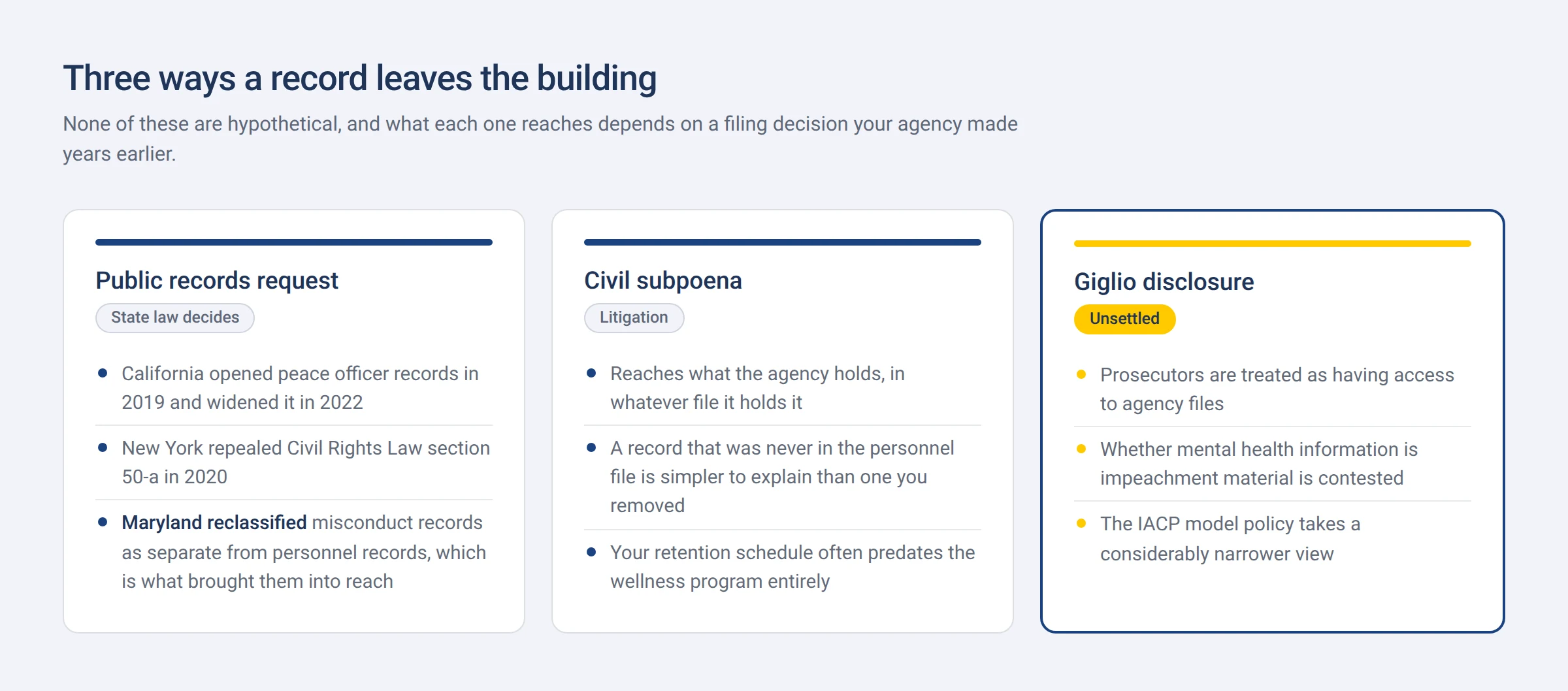
The rest of this guide takes those pieces one at a time. If you're building a program from scratch, start with the guide to wellness records, which covers how to keep them out of the personnel file, and the model policy, which gives you the written directive. This page goes deeper on the two ways a record leaves the building that worry officers most.
Brady Giglio basics: what Giglio material is, and where a Giglio list comes from
Giglio material is information that could be used to attack the credibility of a government witness, including a testifying police officer. Under Brady Giglio rules, prosecutors have a constitutional duty to disclose it to the defense when it's material, and they're treated as knowing what the police agency knows. Many prosecutors' offices keep a Giglio list, often called a Brady list, of officers with credibility problems.
The duty comes from two Supreme Court cases. Brady v. Maryland (1963) held that suppressing evidence favorable to the accused "violates due process where the evidence is material either to guilt or to punishment". Giglio v. United States (1972) applied that rule to impeachment evidence: when "the reliability of a given witness may well be determinative of guilt or innocence", evidence affecting credibility has to be disclosed too. That's why lawyers say Brady Giglio as one phrase.
Two later rules make this your agency's problem, not only the prosecutor's. In Kyles v. Whitley (1995), the Court said a prosecutor "has a duty to learn of any favorable evidence known to the others acting on the government's behalf in the case, including the police." And a federal appeals court has held that when the defense asks, the government has to examine a testifying officer's personnel files for impeachment material, with doubtful items going to the judge. A prosecutor can't avoid the duty by not looking in your files, so what's in your files matters.
A Giglio list or Brady list is the prosecutor's own record of which officers carry that kind of history. An officer on a Brady list may be called as a witness with a disclosure attached, or not called at all. Being on one can limit the cases an officer can work, which is why officers ask about it before they trust a wellness program.
No court has written a complete list of Giglio material. The closest thing to a working definition is the list prosecutors use. Here's the Department of Justice's, from the Justice Manual Giglio policy at 9-5.100:
| Category in the DOJ policy | Could a routine wellness record fit? |
|---|---|
| A misconduct finding reflecting on truthfulness or bias, including lack of candor | No. This is a discipline finding. |
| Any past or pending criminal charge | No. |
| A pending misconduct allegation bearing on truthfulness, bias or integrity | No, unless wellness notes sit inside the investigation file. |
| A judge's finding that the officer testified untruthfully, searched unlawfully or obtained a confession illegally | No. |
| Misconduct casting doubt on evidence, such as evidence handling or forensic protocols | No. |
| Information suggesting bias for or against a defendant | Rarely. A note about an officer's feelings toward a specific person could. |
| Information that the officer's "ability to perceive and recall truth is impaired" | Possibly. This is the category that can reach a wellness record. |
The same policy says allegations that are unsubstantiated, not credible or ended in exoneration "generally are not considered to be potential impeachment information". State policies vary. New Jersey's 2019 Brady Giglio policy lists nine categories and none of them is about health or perception, though it adds that other information may still need to be disclosed depending on the case.
Giglio impairment: the one category that can reach a wellness record
Giglio impairment means information that an officer's ability to perceive or recall events is impaired. It's the only standard category of Giglio material that health information could fall into. A record that an officer attended peer support says nothing about perception. A clinician's finding, or a supervisor's written opinion, that the officer's memory or judgment was impaired could be argued to.
The DOJ policy's wording is "information that reflects that the agency employee's ability to perceive and recall truth is impaired." The Maine model Giglio policy from the Maine Chiefs of Police Association uses almost the same words, covering "information that reflects an impaired ability of an officer to perceive or recall the truth of a matter", and then sets a limit, leaving out "mere allegations, rumors, or other inconclusive information." That model also has the chief tell the officer and give them a chance to respond before anything goes to the prosecutor.
So where does that leave officer wellness records? Nobody can give you a yes or no, and legal writers treat it as open. A 2024 Iowa Law Review note points out that the Supreme Court "has never articulated the metes and bounds" of Giglio, and asks directly whether a prosecutor must disclose that an officer has a mental illness that may affect their ability to recall information. Whether a given record counts as Giglio impairment gets decided case by case, by the prosecutor and, when it's close, by a judge reviewing it privately.
What you control is what exists to be argued about. Compare three records about the same officer after a fatal shooting:
Low exposure
"Attended fatal shooting on 3 March. Peer support contacted 4 March. EAP referral offered." These are facts of a call and an outreach. They say nothing about truthfulness or perception.
Some exposure
A fitness-for-duty result of "fit with restrictions", with the reason kept in the clinician's file. The duty status is a fact the chain of command needs. The clinical reason isn't.
Real exposure
"Seemed confused and couldn't remember the sequence of events afterwards", typed by a sergeant into an evaluation. It's an agency opinion about the officer's memory, in a file a prosecutor can be asked to review.
The third record helps nobody. The officer's wellness is better served by the first two, and the third is the one that turns a hard week into a Giglio impairment argument a year later. The fix costs nothing: log the event and the outreach, and keep clinical conclusions with the clinician.
Privileges that protect counseling and peer support: Jaffee v. Redmond and state law
What an officer says to a licensed therapist is privileged in federal court under Jaffee v. Redmond, and every state has some form of psychotherapist privilege. Peer supporters usually aren't licensed, so peer support conversations depend on state peer support statutes, which differ a lot and all carry exceptions.
Jaffee v. Redmond (1996) is a police case. Officer Mary Lu Redmond shot and killed a man while responding to a call, then attended about 50 counseling sessions with a licensed clinical social worker. In the civil rights suit that followed, the family's lawyers wanted the counselor's notes to cross-examine her. The Supreme Court said no. It held that "confidential communications between a licensed psychotherapist and her patients in the course of diagnosis or treatment are protected from compelled disclosure", extended that to licensed social workers, and noted that all 50 states and the District of Columbia have some form of psychotherapist privilege.
Two parts of Jaffee v. Redmond matter for officer wellness. The Court refused to let judges balance the privilege against a party's need for the notes, because "an uncertain privilege ... is little better than no privilege at all." And it noted that the patient may waive the protection. So the clinician's notes are well protected, as long as they stay the clinician's notes. Jaffee v. Redmond protects the conversation with the therapist. It doesn't protect a supervisor's summary of how the officer seemed, or an agency form that records the reason for a referral.
Peer support is different, because a peer supporter is a trained officer, not a licensed clinician. That protection comes from state law. A few examples, as of the dates checked:
| State | Law | What it protects | Exceptions to know |
|---|---|---|---|
| California | Gov. Code 8669.4 | The officer can refuse to disclose, and stop a team member from disclosing, a confidential peer support communication | Doesn't apply in a criminal or juvenile proceeding; also crisis referral, danger, crime, written consent. Team members need approved training |
| Colorado | C.R.S. 13-90-107(1)(m) | Team members can't be examined about peer support communications, including notes and records, and group sessions are covered | Only within the agency's written peer support guidelines; peer was a witness or party; abuse; imminent danger; criminal conduct |
| Florida | Fla. Stat. 111.09 | A peer may not testify about peer support communications in civil, criminal, administrative or disciplinary proceedings | Written consent; suspected crime; articulable fear for someone's safety |
| Illinois | 5 ILCS 840/20 | Session communications are confidential and records aren't disclosable under the Freedom of Information Act | Subpoena for good cause; threats of suicide or homicide; admissions of crime; information required to be reported |
| Texas | Occupations Code 1701.624 | Participation in the state peer network is confidential under the Public Information Act | Covers the statewide network, not every agency's own team |
| Utah | Utah Code 78B-5-903 | Team members may refuse to disclose, within the agency's written guidelines | Includes reasonable cause to believe the officer is unfit for duty; danger; crime |
Look at California's criminal proceeding exception and Utah's unfit for duty exception. Those are the two places a peer support conversation and a Giglio question can meet. Federal officers have their own protection under the COPS Counseling Act, but it doesn't reach municipal or county agencies. If your state has no statute, tell your peer team so plainly, and train them to keep notes to dates and referrals. The guide to peer support teams covers the rest of running one.
Are police personnel records public? What a public records request can reach
It depends on your state and on which file the record sits in. Medical records are commonly exempt from disclosure, even in states where police personnel records are public. The risk is a wellness note filed inside a record that is public, such as an evaluation or a disciplinary file in a state that has opened them.
State law on police personnel records varies more than almost anything else in this area. A WNYC survey of all 50 states, compiled before California, New York and Maryland changed their laws, found police disciplinary history effectively confidential in 23 states, available in limited situations in 15 and generally public in 12. Since then the direction has been toward more openness, not less.
Georgia shows why the file matters more than the content. Its open records guide for officers says police personnel records are "generally subject to public disclosure", performance evaluations and reprimands included, after redacting items like medical information. Medical records themselves "are exempt from release." Put the same sentence about an officer's mental health in both places, and it's protected in the medical file and released with the evaluation.
California made the same point from the other side. Its Penal Code 832.7 keeps police personnel records confidential in general, but opens records on shootings, serious uses of force, sexual assault and sustained dishonesty to public records requests. When those files are released, the agency may redact confidential medical information only where federal law prohibits disclosure or where the privacy invasion "clearly outweighs the strong public interest in records about possible misconduct and use of force". A wellness note sitting in a use of force file has to win that argument. A wellness note that was never there doesn't need to. New York's repeal of section 50-a in 2020 and Maryland's Anton's Law in 2021 opened misconduct records too, and Maryland did it by reclassifying them as separate from personnel records.
Don't count on HIPAA here. The HIPAA definition of protected health information excludes health information "in employment records held by a covered entity in its role as employer". What usually protects a wellness record is the federal disability rule requiring medical information from employee health programs to be kept "on separate forms and in separate medical files" as a confidential medical record, plus your state's medical and privacy exemptions. Both work best when the record was filed as medical from the day it was created.
Record by record: what's exposed, and where to keep it
Exposure follows the content and the file. Facts of a call and outreach carry little risk. Clinical content is privileged if it stays with the clinician. Conclusions about an officer's memory, judgment or fitness carry the most risk, especially in a personnel or internal affairs file.
| Record | Public records request | Giglio material | Where to keep it |
|---|---|---|---|
| Traumatic call or critical incident attendance | Part of the incident record, which may be public | Unlikely. It's a fact of the call | Incident system, referenced by the wellness file |
| Peer support contact log (date, who reached out) | Often protected where a state peer support law applies | Unlikely. Says nothing about truthfulness or perception | Wellness file, named staff only |
| Threshold flag and the outreach it triggered | Depends on where it's filed | Unlikely, unless it records a conclusion about impairment | Wellness file, named staff only |
| Employee assistance or clinician referral | Medical information, commonly exempt | Unlikely. The clinical content is privileged | Confidential medical file |
| Clinical session notes | Not an agency record | Privileged under Jaffee v. Redmond and state law, unless waived | With the provider only |
| Fitness-for-duty result | Medical information, commonly exempt | Possible, if it finds impaired perception or memory | Medical file, with duty status alone in the personnel file |
| A supervisor's opinion of an officer's mental state | Public wherever evaluations are public | Possible, as an agency opinion about reliability | Don't write it. Log the event instead |
| Sustained untruthfulness or bias finding | Public in a growing number of states | Yes. It's core Giglio material | Internal affairs and personnel file |
The live guide to wellness records has a fuller classification table for the whole program. This one only covers the two exits that worry officers most.
Seven steps to keep officer wellness records out of a Brady list conversation
Keep wellness records out of personnel and internal affairs files from the moment you collect them, log events rather than opinions, put your peer support guidelines in writing, name who has access, ask your prosecutor how their Giglio policy works, set retention, and tell officers the rules in writing.
Before the next request arrives
- Separate at collection. Collect wellness information on wellness forms and file it as a confidential medical record from day one. A record that was never in the personnel file is easier to defend than one you moved.
- Log the event, not the opinion. Dates, incident types, who was contacted and what was offered. No adjectives about how the officer seemed.
- Write the peer support guidelines down. In Colorado and Utah the protection only applies within the agency's written guidelines, and California requires team members to finish approved training.
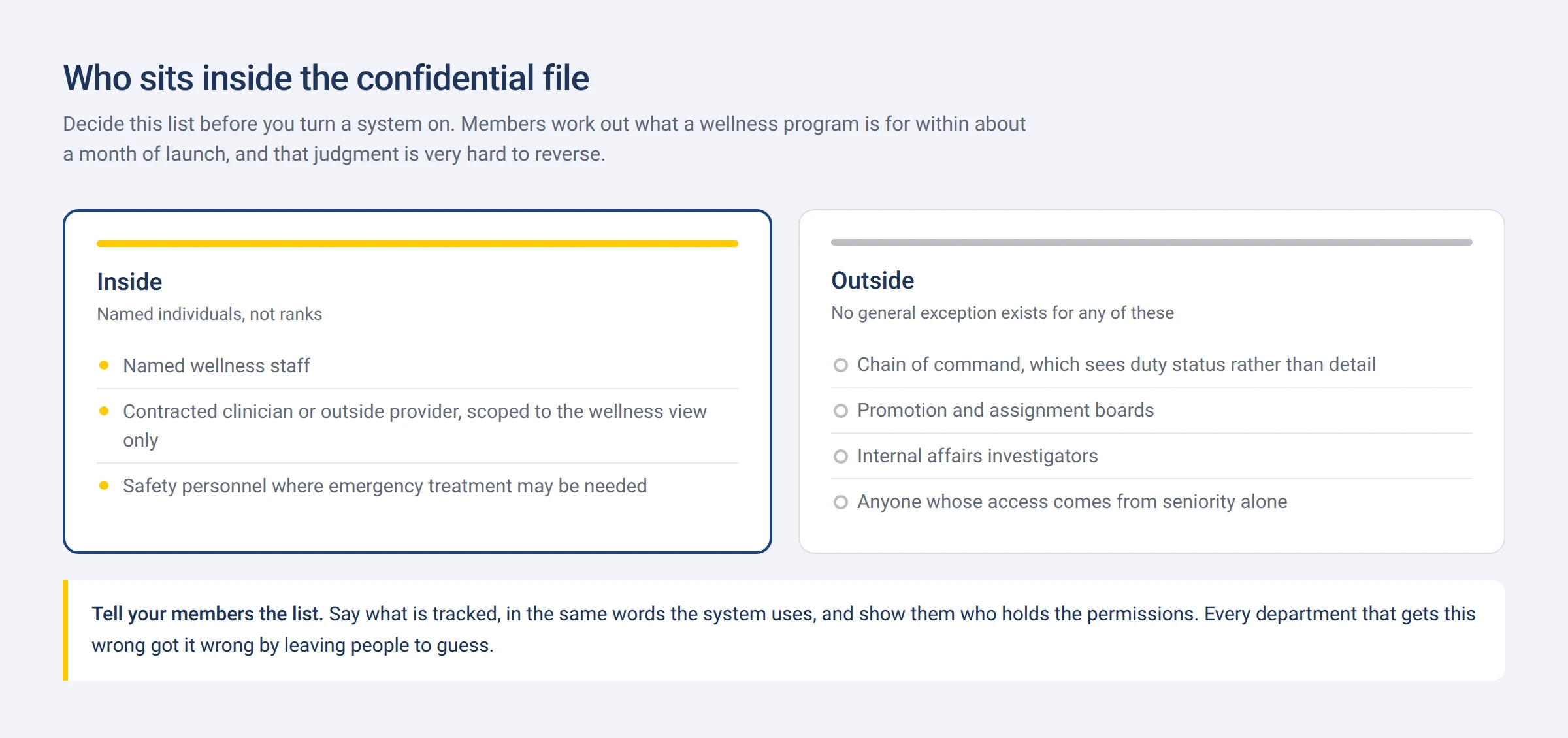
- Name individuals, not ranks. Decide who can open wellness detail before launch, and keep internal affairs investigators and promotion boards outside that list.
- Talk to your prosecutor. Ask for their written Brady Giglio policy, what their Giglio inquiry asks for, and whether they treat fitness-for-duty results as Giglio impairment. Bring your city attorney.
- Set retention. Ask your records officer what the schedule says about wellness entries. Most schedules predate the program and say nothing.
- Tell officers in writing. Say what's kept, who can see it, and the exceptions to confidentiality. The federal COPS Counseling Act requires written notice of exceptions before a first session, which is a good model.
Step five is the one agencies skip. Prosecutors' offices run their own Giglio list or Brady list, and the question is what they'll ask you for, not what you'd like to send. The DOJ policy expects a candid conversation between prosecutor and officer, and the Maine model has the chief notify the officer first. Settle that process with your prosecutor before a case forces it. The model policy has sample language for most of these steps.
How Essential Personnel keeps officer wellness records apart
Essential Personnel records wellness events in its Safety and Wellness suite behind specialist role permissions, so only designated people see wellness detail, and the chain of command doesn't see it just because it exists in the system. The performance and discipline records that a Giglio inquiry asks for sit in different modules.
The Safety and Wellness suite tracks five event types against each officer: injuries, use of force, traumatic calls, motor vehicle accidents and exposures. Your agency sets the thresholds, by event type, count and timeframe, that send an automatic alert to the wellness leaders you choose. That's the same data behind an early intervention system, kept on the wellness side.
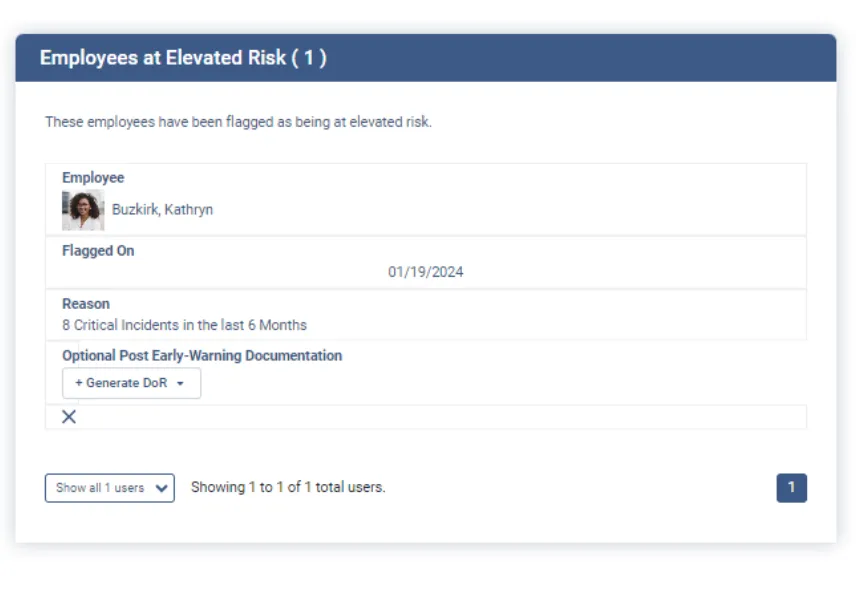
Four details bear on public records and Giglio exposure:
- Specialist role permissions. Designated individuals see wellness detail. The permission can extend to a contracted clinician or outside wellness provider, without giving them the rest of the personnel record.
- Events, not judgments. The suite records the event and the alert. It isn't a clinical record and doesn't deliver counseling, so session content stays with your clinician.
- Audited access. The platform is hosted in AWS GovCloud with FIPS 140-3 validated encryption, multifactor login at AAL2, full auditability of access and an annual SOC 2 Type II report, as described on the security page.
- Published price. Safety and Wellness is $40 per user per year on its own, and the Total Solution with all four suites is $175 per user per year plus a one time $3,000 startup fee, on Essential Personnel's published pricing.
One limit to know. Essential Personnel gives you one employee record with role-based permissions on it, not two physically separate systems. For most agencies that's the right trade, because a wellness profile beside training and assignments is the one people actually use. If your attorney wants physical separation, raise it early. Either way, the decision about what never gets typed into any system is yours. See how the Safety and Wellness suite is set up.
Set your wellness permissions before the first request
Tell us who should see wellness detail in your agency, and we'll show you the permissions, the alerts and the record they leave, live. Call (910) 390-0011 or email info@essper.com.
Frequently asked questions
Usually not, but it depends on your state and on where the record is filed. Medical records are commonly exempt, and routine wellness records aren't on published Giglio lists. The risk is a note about impaired perception or memory, or wellness detail inside a personnel file. Essential Personnel keeps wellness events behind specialist role permissions, apart from discipline records.
It's information that could be used to attack the credibility of a government witness, including a police officer. It comes from Giglio v. United States (1972). Common examples are sustained findings of untruthfulness, criminal charges, pending misconduct allegations about honesty, evidence of bias, and information that the officer's ability to perceive or recall events is impaired.
It's a prosecutor's office's record of officers with credibility issues that may have to be disclosed when they testify. Offices build them from agency inquiries, court findings and officers' own disclosures. Being on one can mean a disclosure every time the officer testifies, or not being called as a witness. Each office sets its own criteria.
Rarely. HIPAA's definition of protected health information excludes employment records an employer holds. The protection usually comes from the federal disability rule requiring medical information to be kept in separate confidential medical files, from state medical and privacy exemptions, and from therapist and peer support privileges. Filing the record as medical from the start matters most.
Only where state law makes them so. California, Colorado, Florida, Illinois, Utah and others have peer support statutes, but each has exceptions, such as danger, crime or criminal proceedings, and some only apply within written agency guidelines. Conversations with a licensed therapist have stronger protection under Jaffee v. Redmond and every state's psychotherapist privilege.
It can be argued, if it finds that an officer's ability to perceive or recall events is impaired. That's the Giglio impairment category in the DOJ policy and several state models. Keep the clinical findings in the medical file, put only the duty status in the personnel file, and ask your prosecutor how they treat these results.
It depends on the state. Some make police personnel records largely public, some keep them confidential, and many sit in between. California, New York and Maryland have opened misconduct records in recent years. Medical records are commonly exempt, which is why wellness information belongs in a medical file rather than the personnel file.
No. Internal affairs files are what prosecutors review for Giglio material, and in several states they're open to public records requests. If an investigation needs a duty status or a work restriction, note that fact alone. Keep wellness detail in the confidential medical file, with access limited to named wellness staff.

About this article
Written by Scott Monroe, Chief Executive Officer & Co-Founder, Essential Personnel. Published 5 November 2026.
Essential Personnel makes the software described in the last section. Product, security and pricing details are taken from essper.com. The Brady Giglio categories come from the Department of Justice Justice Manual 9-5.100, New Jersey's 2019 Brady and Giglio policy and the Maine Chiefs of Police Association model policy; the case law from Brady v. Maryland, Giglio v. United States, Kyles v. Whitley and Jaffee v. Redmond; public records examples from Georgia's open records guide, California Penal Code 832.7, 45 CFR 160.103 and WNYC's state survey; and peer support laws from the statutes named in the table, all checked in October and November 2026. This article is general information for police leaders and isn't legal advice. Your agency attorney, your records officer and your prosecutor should confirm how your state's law applies.
