
What is an early intervention system for law enforcement and why does it matter?
Most officers who end up in a lawsuit, a decertification hearing or a news story didn't get there in one shift. There was a run of use of force reports, a few complaints that were each closed on their own, a crash, a stretch of sick days and a string of bad calls nobody added up. The information was usually already in the building. It just lived in four places, and nobody was looking at all of it at once.
An early intervention system for law enforcement is the tool that looks at all of it at once. This guide is for police chiefs, sheriffs, professional standards and internal affairs commanders, and the city managers and HR leaders who support them. It explains what an early intervention system is, where the idea came from, why it matters for police accountability and officer wellness, what the research says, and what separates a system officers trust from one they ignore.
The short answer: what an early intervention system for law enforcement is, and why it matters
An early intervention system is a data-based tool that watches each officer's use of force, complaints, crashes, injuries, traumatic calls and other indicators, alerts a supervisor when a pattern crosses a threshold the agency sets, and records the support or training that follows. It matters because it catches problems while they're still a conversation, before they become discipline, a lawsuit or a lost officer.
Essential Personnel runs its police early intervention system on the same record as the officer's training, evaluations and wellness profile, so the alert and the follow up live in one place.
The rest of this guide explains each part of that answer. If you already run one and want the mechanics of indicators and thresholds, the guide to early warning signs goes deeper, and the model policy gives you the written directive.
What an early intervention system for law enforcement is
The COPS Office defines an early intervention system as "a data-based management tool designed to identify officers whose performance exhibits problems, and then to provide interventions, usually counseling or training, to correct those performance problems." In plain terms, it adds up what an agency already knows about each officer and tells a supervisor when the total says it's time to talk.
That definition comes from the COPS Office's planning guide for early intervention systems, still the most cited text on the subject. It describes four parts that every police early intervention system shares:
1. Performance indicators
The events the system counts: use of force, complaints, vehicle crashes, pursuits, injuries, sick leave, traumatic calls, lawsuits and, in good systems, commendations.
2. Identification and selection
The thresholds that turn a count into a flag, such as three of the same event in a set timeframe, and the review that decides whether the flag is real.
3. Intervention
What the supervisor does about it: a conversation, coaching, retraining, a peer support or employee assistance referral, or closer supervision for a while.
4. Post-intervention monitoring
Checking afterward whether things improved, and writing down what was done. The COPS guide notes this part "has received the least attention".
None of those four parts needs new information. An agency thinking about an early intervention system for law enforcement already records use of force, complaints, crashes and injuries. What an early intervention system adds is that it puts them on one officer's record and does the counting, so a pattern is visible before anyone has to go looking for it.
What an early intervention system isn't: discipline, internal affairs or an evaluation
An early intervention system isn't discipline, an internal affairs investigation or an annual evaluation. A flag means a pattern is worth a conversation, not that the officer did anything wrong. Agencies that blur the line lose officer trust, and the system stops working.
| Process | What starts it | What it looks at | What it produces |
|---|---|---|---|
| Early intervention system | A pattern crossing a threshold the agency set | Many indicators over time, on one officer's record | A supervisor conversation, support or training, and follow up |
| Internal affairs investigation | A specific allegation of misconduct | One incident and the evidence about it | A finding, and discipline if it's sustained |
| Discipline | A sustained policy violation | The violation and the officer's history | A corrective action, from counseling to termination |
| Annual evaluation | The calendar | A rating period, often as one supervisor remembers it | A score and goals for next year |
The Police Executive Research Forum's 2005 guide for chiefs put it this way: "The key is to view (and promote) the system as a nondisciplinary component of an agency's personnel management toolbox." That doesn't mean the system shields misconduct. If a review turns up a policy violation, it goes to internal affairs like any other. It means the flag itself isn't a charge, and what an officer says in an early intervention conversation shouldn't be used against them. New Jersey writes that last rule into state policy.
The system also isn't a replacement for the annual evaluation, although it fixes the evaluation's biggest weakness. A once a year rating misses a pattern that builds over four months. An early intervention system sees it in month two.
Police early warning system or early intervention system: is there a difference?
There's no practical difference. Early warning system is the older name and early intervention system is the newer one. Agencies moved to "intervention" because "warning" sounded like a step toward discipline. New Jersey's statewide rule and CALEA's standard still use early warning, so you'll see both in policy.
You'll also see "early identification and intervention system" (San Diego's name), "officer support system" and "personnel early warning system", CALEA's title for its standard. They all describe the same four parts. When you're writing policy, pick one term and define it. When you're shopping for early warning system software, search for both names, because vendors and agencies use them interchangeably for a police early warning system.
Where the police early intervention system came from
The idea goes back to the 1970s, when the Kansas City Police Department built one of the first documented systems in 1972. It spread after investigations in the 1990s found that a small share of officers accounted for most problem behavior, and after federal consent decrees began requiring one.
- 1972: Kansas City builds one of the earliest documented systems, according to the National Policing Institute's 2018 review. Most early systems counted only use of force and complaints.
- 1989: the IACP describes the early intervention system as "a proactive management tool useful for identifying a wide range of problems [and] not just a system to focus on problem officers."
- 1991: after the Rodney King beating, the Christopher Commission and other investigations found that "a small percentage of the overall police population was responsible for most inappropriate officer behavior."
- 1990s: the Justice Department's first pattern or practice consent decree, with Pittsburgh, requires an early intervention system, and later decrees follow.
- 2001: CALEA adopts a personnel early warning standard for accredited agencies. Today it's standard 35.1.9.
- 2018 and 2021: New Jersey makes early warning systems mandatory statewide, and North Carolina's G.S. 17F-10 requires every certified law enforcement agency to have one.
Adoption still varies by size. The Council on Criminal Justice's evidence review found that only 12.4% of law enforcement agencies had an early intervention system in 2016, but 69.3% of departments with 100 or more officers did, and 80.5% of agencies with 500 or more. Small and midsize agencies are where most of the gap sits, both for a police early intervention system and for the police early warning system rules some states now set, and they're the ones least able to absorb a single bad lawsuit.
Why an early intervention system matters: six reasons
An early intervention system matters because it catches patterns before they turn into discipline, it supports officer wellness, it gives the agency a defensible record, it's increasingly required, it makes supervision consistent, and it protects the officers who are doing the job well from being judged by the few who aren't.
- It catches problems while they're small. A conversation after the third use of force report in 90 days costs a sergeant an hour. A sustained complaint, a civil claim or a decertification costs the agency far more and usually ends a career.
- It supports officers, not just the agency. A run of traumatic calls, injuries and sick days is often the first visible sign that someone is struggling. Spotting it early is how a referral to peer support happens before a crisis does.
- It shows you acted. In a lawsuit, the question is often what the agency knew and what it did. An early intervention record answers both, with dates. Without one, a plaintiff can argue the pattern was there and nobody looked.
- It's increasingly required. CALEA accreditation, consent decrees, New Jersey's Directive 2018-3 and North Carolina's statute all expect one, and oversight bodies ask for the data behind it.
- It makes supervision consistent. Without a system, whether a pattern gets noticed depends on which sergeant you have and whether they've been on that shift long enough to see it.
- It protects good officers. Data that shows who isn't flagged, and why, is the best answer to a public that assumes the worst about everyone.
Early intervention and police accountability
An early intervention system is one of the main tools of police accountability because it turns scattered records into a documented pattern and a documented response. Consent decrees, accreditation standards and state laws use it to show an agency is watching its people and acting on what it sees.
For police accountability, the value of a police early warning system is in the record. When a city council, a monitor or a reporter asks what the department knew about an officer, the answer should be a dated list of what the system flagged, what the supervisor did and what happened next. That's also what CALEA assessors and consent decree monitors look for, and it's why the COPS Office guide calls early intervention "an important mechanism for ensuring police accountability."
State law is moving the same way. New Jersey Attorney General Directive 2018-3 made early warning systems mandatory for every New Jersey law enforcement agency, with a minimum list of indicators and a review at three flagged events in 12 months. North Carolina's G.S. 17F-10 requires every agency with certified officers to track firearm discharges, use of force, vehicle collisions and citizen complaints, at a minimum. Police accountability rules change, so check your own state's requirements before you set the indicators for your police early warning system.
Accountability cuts both ways. The Council on Criminal Justice recommends that agencies consider releasing aggregate counts of flagged officers and the services they received. That's police accountability the public can see, without naming anyone, and it shows the system is being used.
Early intervention and officer wellness
An early intervention system is also an officer wellness tool. Injuries, traumatic calls, exposures, sick leave and crashes are often the first signs that an officer is under strain, and a system that watches them can route the officer to peer support or an employee assistance program before the strain shows up as a complaint.
Officer wellness and accountability aren't opposites here. The same pattern that predicts a complaint or an act of police officer misconduct can be a sign of a stressed, exhausted or injured officer, and the right intervention for both is usually a supervisor who asks what's going on. Chicago's version is called an officer support system for that reason.
Officers notice how a police early intervention system is framed. A 2026 brief from CNA, summarizing a survey of 553 officers in five departments with established systems, found that officers who saw the early intervention system as an officer wellness tool supported it much more, and officers who saw it as disciplinary supported it less. That's a practical reason to track officer wellness indicators alongside conduct indicators, and to say so in your policy.
Wellness data needs care. Records of counseling, peer support and fitness for duty don't belong in the general personnel file. The guide to wellness records covers how to keep officer wellness information separate and who should see it.
Can an early intervention system prevent police officer misconduct?
The evidence is promising but mixed. Early studies found complaints against flagged officers fell sharply after intervention, and newer statistical systems pick out at-risk officers more accurately. But some studies found no effect, and the research hasn't settled how much of the drop is the system and how much is the agency's culture.
Here's what the studies on police officer misconduct and early intervention found. Most look at complaints and use of force, the two indicators every police early warning system counts:
- Minneapolis and New Orleans: the National Institute of Justice's 2001 study found citizen complaints against officers who went through intervention fell 67% in Minneapolis and 62% in New Orleans a year later. It also called these systems "extremely complex, high-maintenance administrative operations."
- Victoria, Australia: a study of the Victoria Police found a 71% reduction in complaints over two years, as summarized by CNA.
- Better targeting: a statistical early intervention model increased accurate identification of high-risk officers by 75% while cutting false identifications by 20%, according to the Council on Criminal Justice.
- No effect found: a study of 94 agencies that adopted a system between 2003 and 2007 found no significant change in use of force complaints, and a trial with 118 flagged officers found no difference in complaints.
The Council on Criminal Justice's summary is fair: "the empirical evidence to support their effectiveness has not yet caught up with practice." The pattern in the research is that the flag alone does little. Police officer misconduct drops where supervisors actually intervene, follow up and write it down, and where thresholds are set so the agency can handle the number of officers flagged. A system that flags half the roster gets ignored, and an ignored system prevents nothing.
So can an early intervention system prevent police officer misconduct? It can, when the intervention and the follow up are real. Without them, it's a list.
What makes a police early intervention system work: officer trust
A police early intervention system works when officers understand it, help shape it and see it as support. In the CNA survey, familiarity with the system was the strongest predictor of officer support, followed by seeing it as a wellness tool. Demographics explained only 5% of the difference.
That finding turns into a short list for any agency setting up an early intervention system for law enforcement, whether it runs on paper or on early warning system software:
- Train everyone on it. Officers and sergeants should know which indicators are counted, what the thresholds are and what happens after a flag. Familiarity had the largest effect of anything the CNA researchers measured.
- Ask for input. Bring officers, sergeants and union representatives into choosing indicators and thresholds. The COPS guide found that involving unions early is the best way to head off opposition.
- Set thresholds you can act on. The Council on Criminal Justice warns that flagging too many officers dilutes the intervention. Borrowed numbers from a large city flag half of a small agency's roster.
- Count the good with the bad. Commendations on the same record make the system look like what it is, a full picture of the officer.
- Count the risk to officers too. A system built only to catch police officer misconduct misses the injured or exhausted officer, and officers can tell which one they're looking at.
- Keep the firewall. Write down that a flag isn't discipline and that what's said in the conversation stays out of internal affairs, then stick to it.
The model policy turns each of these into policy language you can adapt.
What early warning system software should do
Early warning system software should count indicators from the records you already keep, let you set your own thresholds by number, type and timeframe, alert the right supervisor automatically, document the conversation and the follow up, and limit who can see sensitive entries. Small agencies can start in a spreadsheet, but it breaks as soon as nobody updates it.
PERF found some departments still running early intervention on paper files or simple Excel spreadsheets, and that works for a while in a small agency. The weak spot is that a spreadsheet only counts what someone remembers to type in, and nobody gets an alert. Good early warning system software fixes that by sitting on the records officers and supervisors already enter. Check for these:
- Indicators drawn from the officer's own record, so use of force, crashes, injuries and corrective documents aren't entered twice.
- Thresholds your agency sets, by number, type and timeframe, and changes as you learn.
- Automatic alerts to a named role, not a shared inbox.
- A place to document the intervention, the follow up and when the officer came off the list.
- Role based access, so a peer support lead can see critical incidents without seeing the rest of the file.
- Reports you can hand an assessor, a monitor or a state agency without rebuilding them, which is where a police early warning system earns its keep in an audit.
The guide to internal affairs software covers how early warning system software fits with case management, and what to test in a demo.
How Essential Personnel runs an early intervention system for law enforcement
Essential Personnel is professional standards software for police, fire and city government. Their early intervention system tracks injuries, use of force, traumatic calls, vehicle accidents and exposures on each officer's record, lets the agency set its own thresholds, alerts safety and wellness leaders automatically, and documents the intervention on the same screen.
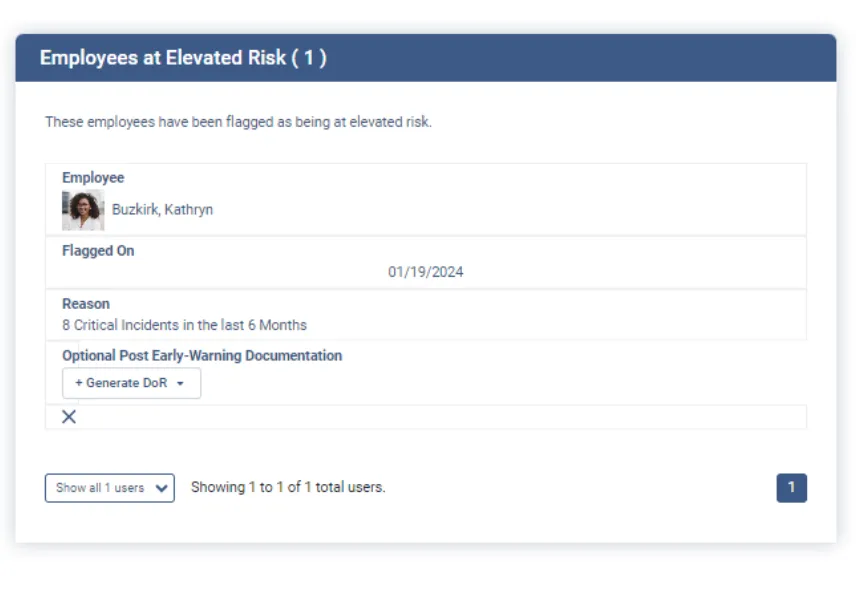
Here's how the four parts of an early intervention system work in the platform, taken from its Safety and Wellness and law enforcement pages:
- Performance indicators: five event types are tracked against every employee: injuries, use of force, traumatic calls, motor vehicle accidents and exposures. Corrective documents of record can count toward a threshold too, which connects the early intervention system to the officer's performance record.
- Identification: the agency sets the number and type of events, and the timeframe, that fire an automatic alert to safety and wellness leaders.
- Intervention: the early intervention conversation is documented from the same screen, and specialist role permissions let a peer support member or an outside clinician see critical incidents without access to the rest of the file.
- Monitoring: the officer's training, evaluations, Leader's Notes and commendations sit on the same profile, so a supervisor can see whether things improved.

Hendersonville Police Department in North Carolina tracks traumatic calls, use of force, pursuits and complaints this way and sets threshold alerts. When an officer crosses one, the department can refer them to critical incident stress managers, chaplains or peer support.
The Safety and Wellness suite, which includes Early Intervention, Incident Tracking, Case Management and wellness tools, is $40 per user per year on its own. The Total Solution with all four suites is $175 per user per year, plus a one time $3,000 startup fee, on Essential Personnel's published pricing. The platform is hosted in AWS GovCloud, aligned with the FBI CJIS Security Policy and covered by an annual SOC 2 Type II report, and it's available through GSA Advantage, NASPO, Omnia Partners, NCSA and VSA.
"That level of visibility helps us catch issues early or give praise when it's due."
Derek Moore, Major, Carteret County Sheriff's Office, North CarolinaSee an early intervention alert on your own data
Tell us the thresholds you'd set, and we'll show you the alert, the follow up and the record it leaves, live. Call (910) 390-0011 or email info@essper.com.
Frequently asked questions
It's a data-based tool that counts each officer's use of force, complaints, crashes, injuries and traumatic calls, alerts a supervisor when a pattern crosses a threshold, and records the support that follows. It matters because it catches problems while they're still a conversation. Essential Personnel runs one on the same record as the officer's training and evaluations.
Yes, in practice. Early warning system is the older name, and many agencies switched to early intervention because "warning" sounded disciplinary. New Jersey's statewide directive and CALEA's personnel standard still say early warning, so you'll see both terms in policy, state law and software. Pick one, define it in your policy, and use it consistently.
No. A flag means a pattern deserves a supervisor's attention, not that the officer broke a rule. The response is usually a conversation, coaching, training or a referral to support. If a review uncovers a policy violation, it goes to internal affairs separately. Keeping that line clear is what earns officer trust in the system.
Common indicators are use of force, citizen and internal complaints, vehicle crashes and pursuits, injuries, sick leave, lawsuits, discipline, traumatic calls and exposures. Good systems also count commendations. North Carolina requires at least firearm discharges, use of force, vehicle collisions and citizen complaints, and New Jersey sets a longer minimum list for its agencies.
It depends on your state and status. New Jersey made early warning systems mandatory statewide in 2018, and North Carolina requires one under G.S. 17F-10. CALEA's accreditation standards include one, standard 35.1.9, and many consent decrees require one. Other states are adding rules, so check your own state's current law before you rely on this list.
The research is mixed. Complaints against flagged officers fell 67% in Minneapolis and 62% in New Orleans after intervention, but other studies found no effect. The difference is usually follow through: systems work when supervisors actually intervene, monitor and document, and when thresholds flag a number of officers the agency can really help.
Injuries, traumatic calls, exposures, crashes and sick leave are often the first signs an officer is under strain. A system that watches them can prompt a referral to peer support, a chaplain or an employee assistance program early. Officers who see the system as a wellness tool support it much more, according to a 2026 CNA survey.
Yes. Small agencies have run them on spreadsheets, and the four parts of an early intervention system for law enforcement are the same at any size. The main risk is borrowing thresholds from a large city, which flags too much of a small roster. Start with a few indicators, set thresholds your supervisors can act on, and move to software once manual counting starts slipping.

About this article
Written by Scott Monroe, Chief Executive Officer & Co-Founder, Essential Personnel. Published 4 November 2026.
Essential Personnel makes the software described in the last section, and the screenshots are from the platform. Pricing, hosting, module and purchasing details are taken from essper.com, and the Carteret County quote and the Hendersonville example are reproduced from essper.com. The definition and four components come from the COPS Office's 2003 planning guide, the history from the National Policing Institute's 2018 review and the COPS Office's 2011 San Diego guide, adoption and research figures from the Council on Criminal Justice, the National Institute of Justice and CNA, and state requirements from New Jersey Directive 2018-3 and North Carolina G.S. 17F-10, all checked in November 2026. This article is general information and isn't legal advice.
