
Employee counseling forms for police, fire and EMS: verbal counseling, written counseling and letter of counseling templates
Every supervisor counsels. Few departments agree on how it gets written down. One lieutenant keeps notes in a notebook, another sends an email, a third writes a formal memo and puts it in the personnel file. When the same problem comes back a year later, or a promotion is challenged, or a termination goes to arbitration, nobody can find a record that holds up.
This page is for police sergeants and lieutenants, fire captains and battalion chiefs, EMS supervisors, and the chiefs and HR staff who set the rules for them. It explains the difference between verbal counseling, written counseling, a letter of counseling and a written reprimand, and gives you three employee counseling forms to copy, example counseling statements, and the rules on signatures, employee responses, filing and retention that public safety departments actually use.
How do I document counseling for my employees? The short answer
Pick the level first: verbal counseling gets a dated supervisor's note, written counseling or a letter of counseling gets an employee counseling form the employee signs, and a written reprimand is discipline with its own form. Record facts, the expectation, a follow-up date and the employee's response, and close every one in writing.
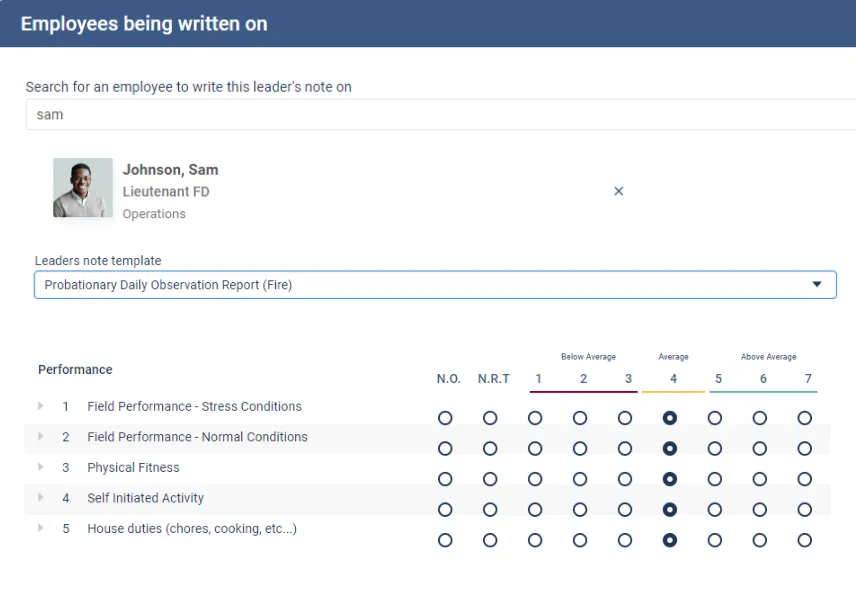
Essential Personnel does this in its Leader's Notes, with a formal counseling template every supervisor fills the same way, and Documents of Record for corrective documents with routing and approval. Each entry is timestamped on the employee's profile beside their evaluations and training.
The rest of this page gives you the forms. If you're setting up counseling across a whole department, with written expectations and one standard for every station and shift, start with our guide to structured counseling, which also has a counseling memo template.
Verbal counseling, written counseling, letter of counseling and written reprimand compared
Verbal counseling and written counseling are corrective, not disciplinary. A letter of counseling is the usual name for written counseling addressed to the employee. A written reprimand is formal discipline. The level decides what you write, who signs it, where it's filed and whether it can be grieved.
| Level | What it is | What gets written | Where it usually goes |
|---|---|---|---|
| Verbal counseling | A private conversation about a minor issue, the first time it comes up | A short dated note by the supervisor | The supervisor's file, not the personnel file |
| Written counseling or letter of counseling | A formal meeting about expectations after verbal counseling didn't work, or for a more significant issue | An employee counseling form or counseling memo, signed by the employee to show receipt | The personnel file or a supervisory file, as your policy says, often with a review date for removal |
| Performance improvement plan | A structured plan when counseling hasn't changed the performance | Specific goals, support, check-in dates and consequences | The personnel file |
| Written reprimand | Formal discipline for a repeated minor offense or a more serious single one | The department's reprimand form, citing the rule broken | The personnel file, and often the city's file too |
Real policies draw these lines in slightly different places. The Phoenix Fire Department treats verbal counseling as the least severe corrective action and tells supervisors to keep notes in the supervisor's file, while a memo of counseling may go in the district or personnel file. The Seattle Fire Department's published policy keeps informal counseling out of the personnel file, uses a counseling form for formal counseling, and moves to a performance improvement plan when counseling doesn't work. The Gaithersburg Police Department uses a remedial action form for minor infractions such as tardiness, disruptive behavior in roll call and late radio responses, and keeps it out of the personnel file. Write your own lines down so every supervisor uses the same ones.
Which employee counseling form to use
Use verbal counseling for a first minor issue, written counseling when the issue repeats or matters more, a performance improvement plan when written counseling hasn't worked, and discipline when the conduct breaks a rule that warrants it. Skip counseling entirely for dishonesty, illegal conduct or serious misconduct, and open an investigation instead.
- First late arrival, first sloppy report, first missed check: verbal counseling, with a note.
- The same issue a second or third time, or a first issue with safety or public trust at stake: written counseling on the employee counseling form.
- Two or more written counseling entries on the same problem: a performance improvement plan, or the discipline your policy sets.
- Anything that could be misconduct: no counseling. Stop, and route it to professional standards so the employee's rights in an investigation are protected.
The New York State supervisor's guide to counseling makes the same point from the other side: if an employee says something during counseling that would warrant discipline, the supervisor has to halt the session and advise them of their right to representation before going on.
Template 1: verbal counseling note
A verbal counseling note is short, dated and written the same day. It records what was discussed and what the employee was told to do, so the next supervisor can see the issue was raised. It stays in the supervisor's file unless your policy says otherwise.
Verbal counseling note
Employee: [name, rank, assignment] Supervisor: [name, rank]
Date, time and place of conversation: [date], [time], [location]
Issue discussed: On [date], [what happened, as facts someone else could check]. The expectation is [written standard, SOG or policy number].
What the employee said: [their explanation, briefly, in their words].
What I asked for: [the specific change], starting [date].
Follow-up: I'll check on [date].
Level: Verbal counseling. This isn't discipline. Note kept in the supervisor's file.
Template 2: employee counseling form for written counseling, a counseling memo or a letter of counseling
The employee counseling form is the record of a formal counseling meeting. It names the issue and the standard, refers to earlier counseling, sets a measurable expectation and a follow-up date, records the employee's response, and carries signatures and a review date. It isn't a statement of an offense.
Employee counseling form
[Department name]: Written counseling / Letter of counseling
To: [employee name, rank, assignment, ID] From: [supervisor name, rank]
Meeting date, time and place: [date], [time], [location] Present: [everyone in the room, including any representative]
Category: [ ] Attendance and punctuality [ ] Reports and documentation [ ] Policy, SOG or general order [ ] Safety, apparatus or vehicle [ ] Patient care or public contact [ ] Conduct with coworkers [ ] Other: [describe]
What happened: On [date or dates], you [the behavior, as facts]. This doesn't meet [the standard, with its number].
Earlier counseling on this issue: [dates of verbal or written counseling, or "none"].
Your response at the meeting: [the employee's account, in their words].
Expectation: Starting [date], you will [specific, measurable expectation].
Support: [retraining, a ride-along, a mentor, a schedule change, or an employee assistance program referral if one was offered].
Follow-up date: [date]. If the expectation isn't met, the next step is [a performance improvement plan / the discipline your policy sets].
Filing and review: Filed in [personnel file / supervisory file]. You may request review for removal on or after [date], if no further counseling on this issue has been needed.
Your written comments: You may submit written comments within [__] days, and they'll be attached to this form.
Signatures: Your signature shows you received this form and discussed it. It doesn't mean you agree with it.
Employee: ____________ Date: ______ Supervisor: ____________ Date: ______
If the employee declined to sign: witness ____________ Date: ______
Copies: Employee; [file]; [next level of command or HR, as your policy sets out]
Two fields make this form stronger than most counseling memo templates: the reference to earlier counseling, which shows the progression, and the review date, which tells the employee the entry won't follow them forever if the problem is fixed. Phoenix's policy, for example, requires memos of counseling and reprimands to give a review date for possible removal from the personnel file.
Template 3: follow-up and close-out record
Close every counseling entry in writing on the follow-up date, whether the problem was fixed or not. An open counseling entry with no outcome is the gap that weakens a later decision, and a closed one shows the employee was given a fair chance.
Counseling follow-up record
Original counseling date: [date] Follow-up date: [date]
Outcome: [ ] Expectation met, entry closed [ ] Partly met, follow-up extended to [date] [ ] Not met, next step: [plan or discipline]
Evidence: [what you checked, such as report times, attendance or training records, with dates].
Discussed with the employee on: [date]. Employee initials: ______ Supervisor: ______
Counseling statement examples for police, fire and EMS
A good counseling statement describes behavior a third party could verify, ties it to a written standard, and leaves out opinions about attitude or personal life. The examples below show common counseling statements rewritten that way. Change the facts and the policy numbers to match your own.
| Instead of | Write |
|---|---|
| "You have a bad attitude about paperwork." (police) | "On 3, 7 and 12 March you submitted incident reports 2 to 4 days after the end of shift. General Order [number] requires reports before the end of the shift unless a supervisor approves an extension." |
| "You're never on the radio." (police) | "On 9 April you didn't acknowledge dispatch for 6 minutes after being assigned call [number]. Policy [number] requires acknowledgment within [time]." |
| "You were careless backing the engine." (fire) | "On 14 May you backed Engine [number] into the bay without a spotter, and the mirror struck the door frame. SOG [number] requires a spotter for every backing maneuver." |
| "You don't pull your weight at the station." (fire) | "On 2 and 16 June the daily apparatus check assigned to you wasn't completed or signed off. The station duty roster assigns the check to the riding position you held." |
| "Your charts are sloppy." (EMS) | "Three patient care reports from 1 to 15 July were completed more than 24 hours after the call, and two were missing a second set of vitals. Protocol [number] requires completion within [time] and two sets of vitals for every transport." |
| "You're always late." (EMS) | "You clocked in 12, 9 and 15 minutes after shift start on 4, 11 and 18 August. The attendance policy requires you to be in service at shift start." |
Notice what's missing from each counseling statement in the right hand column: guesses about why it happened, comments on personality, and anything about health or family. As Clemson's HR guidance puts it, personal problems have no place in formal documentation. If an employee tells you about a personal or health issue, offer the employee assistance program and keep the details off the form. Our guide to wellness records explains where that information belongs instead.
Signatures, representation and the employee's written response
An employee's signature on a counseling form shows they received it, not that they agree. If they decline to sign, note it with a witness. Give them a set number of days to add written comments, attach those to the form, and follow your labor agreement and state law on representation.
- Signature means receipt. Phoenix's policy says the signature shows the member understands and received a copy, not necessarily that they agree. If a member refuses to sign a written reprimand there, a witness signs to record the refusal, and the refusal itself isn't grounds for separate discipline.
- Written comments. Seattle's policy lets an employee submit comments that are attached to the counseling form, and Gaithersburg's order gives the employee a chance to review the form, add written comments and sign it.
- Representation. In the private sector, the right to a union representative in an investigatory interview is called a Weingarten right. For public employees it comes from state law and the labor agreement, and many agreements treat counseling differently from discipline. Read yours before the meeting, and stop if the meeting turns disciplinary.
- Removal. Some agreements let employees ask for old counseling to be removed. New York State's guide summarizes contract terms that remove a counseling memo over three years old on written request, for some units only if no further counseling or discipline followed.
Where counseling records go and how long to keep them
Your policy should say where each level of counseling is filed, who can see it and when it's destroyed. Verbal counseling usually stays in a supervisor's file, written counseling goes to the personnel or supervisory file, and the retention period comes from your state's local government records schedule.
Retention rules vary by state, so check yours. Texas, for example, sets the retention for counseling records in its local government schedule at three years after the counseling ends, under item GR1050-06a, with separate rules for disciplinary records in civil service police and fire departments. Gaithersburg keeps its remedial action form only for the current evaluation period and then destroys it. Whatever the period, a supervisor's notebook or personal email isn't a records system, and counseling kept there is easy to lose and hard to defend.
Counseling records and your early intervention system
Counseling entries are one of the signals an early intervention system watches. Repeated counseling on the same issue can flag an officer for a supervisor's review, which is only possible if counseling is recorded consistently in one place instead of in each supervisor's own notes.
The Baton Rouge Police Department's early intervention order treats the system as an assessment tool rather than discipline, lists repeated conference worksheets among its indicators, and documents the resulting meetings on a counseling worksheet. Our guide to early intervention systems covers how thresholds and reviews work. And if counseling doesn't fix the problem and a separation follows, the counseling file is the first thing reviewed. Our guide to firing an employee explains why.
How Essential Personnel documents counseling
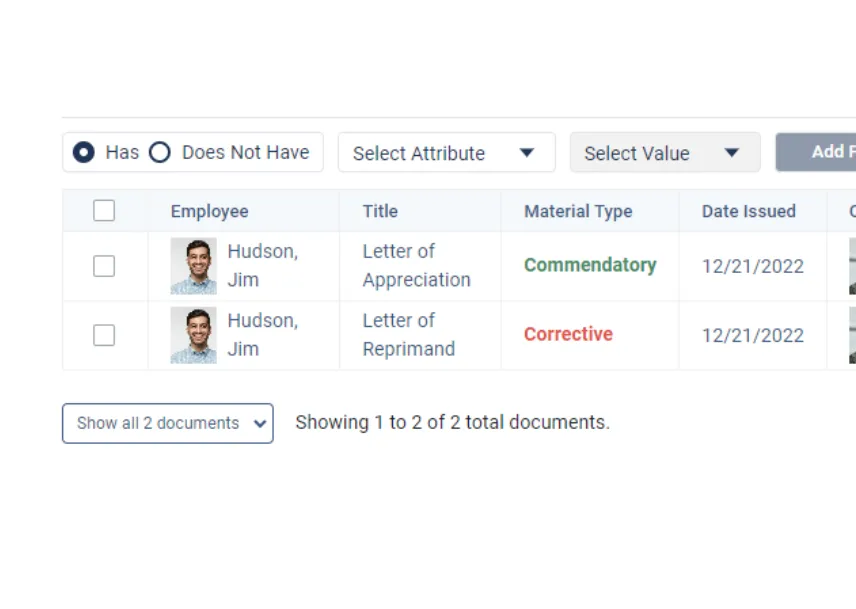
In Essential Personnel, supervisors document counseling in Leader's Notes, which includes templates for formal counseling, performance improvement plans, field training daily observation reports and instructor reviews. Corrective and commendatory documents go in Documents of Record with routing and approval, and every entry is timestamped on the employee's profile.
Because every supervisor uses the same template, counseling looks the same on every shift and at every station, and the earlier entries on the same issue are already on the profile when the next one is written. Documents of Record route a letter of counseling or a reprimand for review and approval, so an entry is reviewed rather than filed by one person. The same profile holds evaluations, training, certifications and cases, so the annual evaluation draws on a year of documented observations rather than memory.
Leader's Notes and Documents of Record are part of the Talent Management suite, which is $85 per user per year on its own. The Total Solution with all four suites is $175 per user per year, plus a one time $3,000 startup fee, on Essential Personnel's published pricing. The platform is hosted in AWS GovCloud, aligned with the FBI CJIS Security Policy, and available through GSA Advantage, NASPO, Omnia Partners, NCSA and VSA. See the full Talent Management suite.
See counseling documented the same way at every station
Bring your current counseling form, and we'll build it as a Leader's Notes template and show you the record it creates on an employee's profile. Call (910) 390-0011 or email info@essper.com.
Frequently asked questions
Decide the level first: verbal counseling, written counseling or a letter of counseling, or a performance improvement plan. Use the same form every time, write it the same day, record facts and the written standard, the employee's response, a measurable expectation and a follow-up date. Get a signature for receipt, file it where your policy says, and close it in writing.
The employee, supervisor, date, time and place; who was present; the category; what happened as verifiable facts; the standard it missed; earlier counseling on the same issue; the employee's response; a measurable expectation; support offered; a follow-up date; where it's filed and when it can be reviewed for removal; and signatures showing receipt.
Verbal counseling is a private conversation about a first minor issue, recorded in a short supervisor's note that usually stays out of the personnel file. Written counseling is a formal meeting documented on a counseling form the employee signs, used when an issue repeats or matters more. Neither is discipline, but written counseling carries more weight later.
In most public safety departments, no. A letter of counseling records that an employee was told about an expectation and how to meet it, and it isn't a finding of an offense. A written reprimand is discipline. Your policy and labor agreement decide which documents can be grieved, so say plainly on each form which one it is.
Explain that the signature only shows they received the form, not that they agree. If they still decline, write that they declined, have a witness sign and date it, and give them a copy. Under policies like Phoenix Fire's, a refusal to sign isn't grounds for separate discipline. Offer them the chance to attach written comments.
It depends on state law and your labor agreement. Many agreements treat counseling as non-disciplinary and give no right to a representative, while others allow one. If anything said in the session suggests misconduct, stop, advise the employee of their rights, and treat it as a disciplinary matter. Check your agreement before the meeting, not during it.
Follow your state's local government records retention schedule and your labor agreement. Texas, for example, keeps counseling records three years after the counseling ends. Some agreements let employees ask for counseling memos over a set age to be removed from the personnel file if nothing further happened. Put both rules in your counseling policy.
Verbal counseling notes usually stay in the supervisor's file. Written counseling often goes to the personnel file or a supervisory file, depending on policy, with a review date for removal. Whatever you choose, keep the records in a system the department controls, not a personal notebook or inbox, so they can be found, reviewed and retained properly.

About this article
Written by Scott Monroe, Chief Executive Officer & Co-Founder, Essential Personnel. Published 15 November 2026.
Essential Personnel makes the software described in the last section, and the screenshots are from the platform. Pricing, hosting, module and purchasing details are taken from essper.com. Counseling levels, signature, comment and filing rules are taken from the published policies of the Phoenix and Seattle fire departments and the Gaithersburg and Baton Rouge police departments, the New York State Supervisor's Guide to Counseling, Clemson University HR guidance and the Texas State Library local government retention schedule, all checked in November 2026. The forms and counseling statements are samples. This article is general information and isn't legal advice.
