Essential Personnel vs Benchmark Analytics: a complete system for every agency, or a partial one for the biggest
Published 15 October 2026
Are you evaluating Benchmark Analytics for your police department? Is a six-figure price tag making you pause? Before you sign, look at Essential Personnel, the lower-cost system that handles early intervention and everything else on the officer record: field training, evaluations, internal affairs, use of force, training records, policy and equipment, at a published $175 per user per year.
Essential Personnel is the right choice for every agency, from a 10 officer town department to a sheriff's office with hundreds of deputies,. Benchmark Analytics is a partial solution built for only the largest departments: a predictive model built from years of a department's own records by a team of data scientists, on contracts that run from $100,000 to $405,000 a year. In Berkeley, $100,000 a year buys the early intervention platform alone. Chicago chose them in 2025 and plans to switch it on citywide in 2027.
This guide is for police chiefs, sheriffs, and the HR and professional standards staff who support them. It walks through the four things that decide it: how early intervention works when you have 15 officers rather than thousands, what agencies actually pay Benchmark according to their own council records, what an agency your size gets for the money, and what a switch takes. If you're still building a shortlist, the police professional standards ranking scores the wider field.
The complete officer record, right for every agency
A partial solution, built for the largest departments
What each one is built to do
Benchmark Analytics sells police agencies three connected products: the Benchmark Management System for use of force, internal affairs, field training, evaluations and the officer profile; First Sign, a predictive early intervention model; and C.A.R.E., which turns a First Sign alert into an intervention plan. Essential Personnel is one platform built around the officer record, with early intervention running on thresholds your agency sets.
One officer record
Essential Personnel
Training, certifications and mandated in-service hours against the officer
Field training officer software built in, with FTOs signing off a DOR on a phone at shift end
Performance development, leaders' notes, commendations, career paths and promotion eligibility
Internal affairs, use of force review, and an early intervention system reading the whole record
Policies published with acknowledgment tracking, issued equipment with chain of custody, and incident and case management
What they don't doThey don't write policy content or sell course libraries, and they don't run a research consortium. Your agency writes its own early intervention thresholds.
Three products
Benchmark Analytics
Benchmark Management System for use of force, internal affairs, performance evaluations, community engagement, activity and the officer profile
Field training with DORs and configurable phases, starting from the San José, Reno or their own NextGen model
First Sign, relaunched in October 2024 as an officer advocacy suite: early intervention, a wellness facilitator, an excellence indicator and a retention monitor
C.A.R.E. case plans for officers First Sign flags
Training, policy publishing and issued equipment in larger deployments, as in Miami-Dade's 2023 contract
Where they're strongestResearch. The University of Chicago leads their research consortium and is a part owner, and their data scientists build predictive models from a department's own history. Chicago's April 2026 report credits a team of more than 20 of them with its models.
Who Benchmark is, and who owns them
Benchmark Analytics was founded in Chicago in 2017 by Ron Huberman, a former Chicago police officer and deputy chief who later ran the Chicago Transit Authority and Chicago Public Schools, with cofounders including Sarah Kremsner. First Sign came out of research at the University of Chicago's Center for Data Science and Public Policy, and the university announced a partnership with Benchmark to bring it to market in 2018, according to the Polsky Center.
In July 2024 they took a strategic growth investment from PSG Equity, a private equity firm, for an amount that wasn't disclosed. Their proposal to Miami-Dade County names the University of Chicago as a part owner. Their best known customers are large: council records and press name Chicago, Miami-Dade, Minneapolis, Nashville, Fresno, Berkeley, San José, San Francisco, Baltimore and Charlotte-Mecklenburg.
Essential Personnel was founded in 2020 by two firefighters in Wilmington, North Carolina, and builds only for public safety and local government. Ask both vendors the same two questions: what an agency your size pays, and which agencies your size run the system today.
Two ways to run early intervention
Benchmark's First Sign is a predictive model. It learns from a department's history which patterns came before problems and flags officers who match them. Essential Personnel runs early intervention on thresholds your agency writes, such as a set number of use of force reports or complaints in a set window, read against the officer's whole record. Both alert a supervisor and track what happens next.
Thresholds you write
Essential Personnel
Rules your command staff, your union and your officers can all read
Live as soon as you set them, with no model to train first
Read training, commendations, wellness and equipment alongside use of force and complaints
Change a threshold whenever your policy changes
FitsEvery agency, including the 46% of local departments with fewer than 10 sworn officers.
A predictive model
Benchmark Analytics
Built from years of a department's own data by a data science team
Weighs context and officer history rather than single counts
Paired with rule-based alerts in their Policy Alerts module in Chicago
Backed by a research consortium the University of Chicago leads
Built forThe largest departments, with years of incident history and often a consent decree.
Benchmark's 2023 proposal to Miami-Dade County says intervention "based upon simple, threshold-based triggers alone is not the right strategy". Their own Chicago deployment keeps both: the predictive models, and the department's rule-based alerts automated in Policy Alerts. A model needs history to learn from. A 15 officer department might record a handful of use of force reports in a year, which gives a model very little to work with and gives a supervisor exactly enough to read.
The bigger question is what the system can see. An early intervention system only reasons about the records it holds. In EP, the thresholds sit on the same record as field training, certifications, commendations, critical incidents and issued equipment, so a supervisor sees a lapsed firearms qualification and an open use of force review on one screen, and sees the commendations too. An early intervention system that only ever sees corrective entries gives a distorted picture of an officer.
Side by side
Both systems hold the core of a police personnel record: field training, evaluations, internal affairs and use of force. They part ways on how early intervention works, what each one needs before it's useful, and whether you can see the price before you call.
What you need
Essential Personnel
Benchmark Analytics
Early intervention
Thresholds your agency sets, reading the whole officer record
First Sign predictive model, with C.A.R.E. case plans
Field training and DORs
Included, with DORs signed on a phone at shift end
Included, with San José, Reno or NextGen phases
Evaluations
Included, with leaders' notes and score reports
Included
Internal affairs and use of force
Included, on the same record as performance
Included
Training and certifications
Recorded against the officer, alongside your course provider
Included, with course delivery in larger deployments
Promotion eligibility
Rank requirements checked against every officer automatically
Promotion dates recorded on the officer profile
Policy and equipment
Included in every Total Solution license
Included in larger deployments
Price
Published $175 per user per year for everything
Quote only Public contracts from $100,000 a year
Hosting
AWS GovCloud, CJIS aligned, SOC 2 Type II annually
AWS GovCloud, CJIS compliant
What agencies pay Benchmark, and what Essential Personnel costs
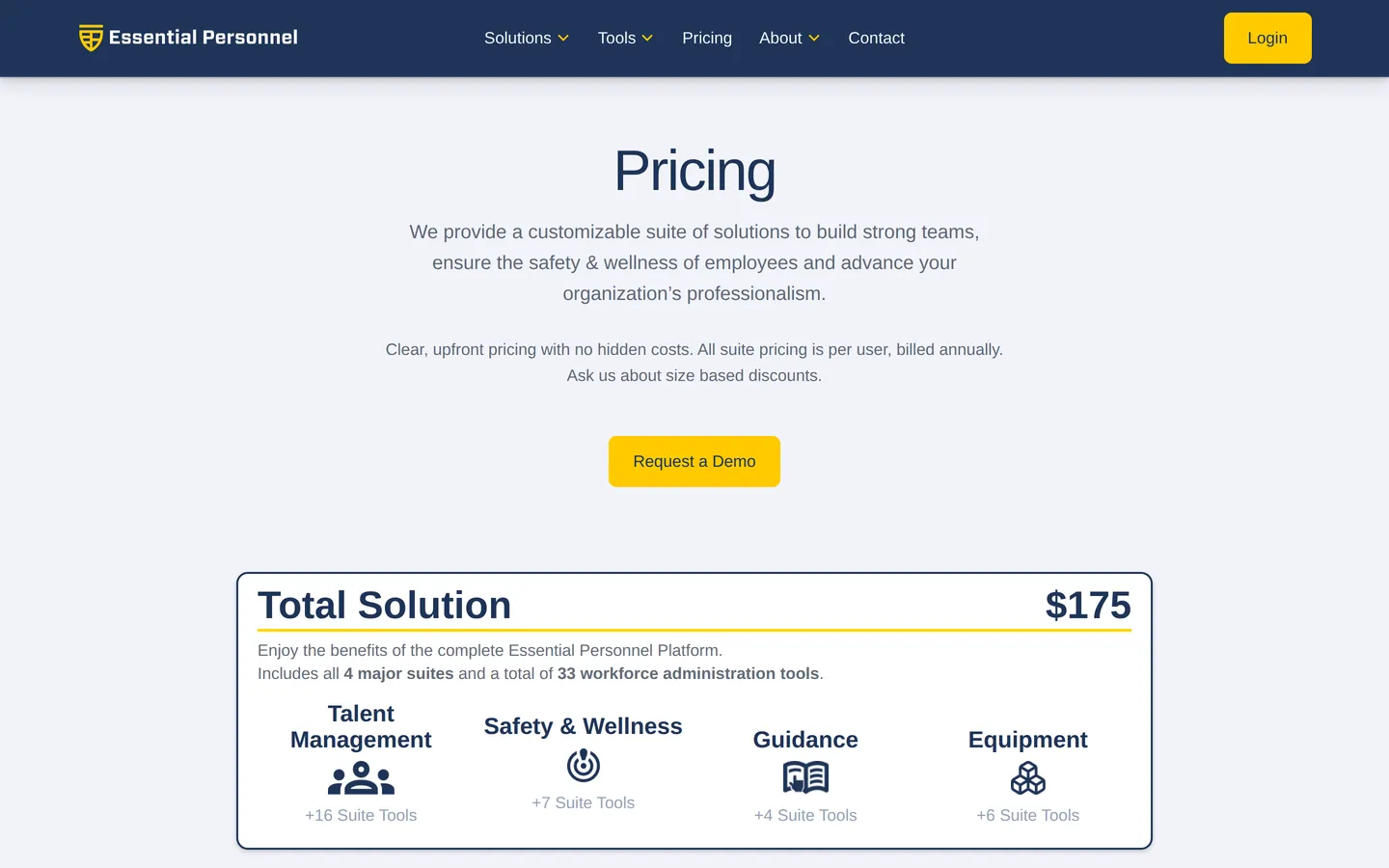
Benchmark doesn't publish prices, but council records do. Berkeley pays $100,000 a year for an early intervention platform, Fresno paid about $128,750 a year for the management system with early warning, and Miami-Dade pays $405,000 in year one, rising by up to 5.5% a year. Essential Personnel is $175 per user per year for all four suites and 33 tools, plus a $3,000 one-time startup, on their pricing page.
About $386,250 over three years, roughly $128,750 a year
Every suite, for up to 735 users a year
Miami-Dade Police Department, FL. Full workforce management system for about 3,000 sworn officers and 1,500 civilian staff, from 2023
$405,000 in year one, rising to $501,724 in year five, $2,260,342 over five years
Quoted in writing at this size, with size-based discounts
At EP's published rate, a 50 officer agency pays $8,750 a year, and $11,750 in year one with the startup fee. A 200 officer agency pays $35,000 a year, and $38,000 in year one. Berkeley's early intervention budget on its own is nearly three times what a 200 officer agency pays EP for field training, evaluations, internal affairs, use of force, early intervention, training records, policy and equipment together.
Miami-Dade's contract folds implementation, training, interfaces and customizations into the license fee, which is the right way to buy. Whoever you talk to, ask for the same in writing, along with the yearly increase. Miami-Dade's is up to 5.5%, which adds almost $97,000 a year to the bill by year five.
The Essential Personnel pricing page. The Total Solution card carries the $175 figure and the four suite breakdown.
What kind of early intervention system do police departments need in 2026?
One sized to the agency. In 2020, 46% of local police departments employed fewer than 10 full-time-equivalent sworn officers, according to the Bureau of Justice Statistics. Those agencies need early intervention that works from the first day, reads the whole officer record and costs what a small budget can carry. Benchmark's public contracts are with departments at the other end of the scale.
2023-24Framework and draft policyWith the monitor
2025Benchmark selectedVendor chosen
Late 2025Models builtFrom CPD history
2027Citywide launchPlanned
Chicago shows what the predictive route involves at full scale. The Chicago Police Department chose Benchmark in 2025 for the early intervention system its consent decree requires. Through the second half of 2025, Benchmark's data scientists built models from the department's historical data, and the department's April 2026 progress report puts the citywide launch in 2027, pending policy approval, supervisor training and changes to the data models. For a department of that size under court oversight, that's a reasonable timeline. For a 40 officer department that wants alerts this year, it's the wrong tool.
EP was built the other way around. A DOR, a use of force review and an early intervention threshold are first-class records rather than fields somebody configured, because the people who designed them had signed them. The trade is real: EP has no research consortium, and their early intervention is as good as the thresholds your agency writes.
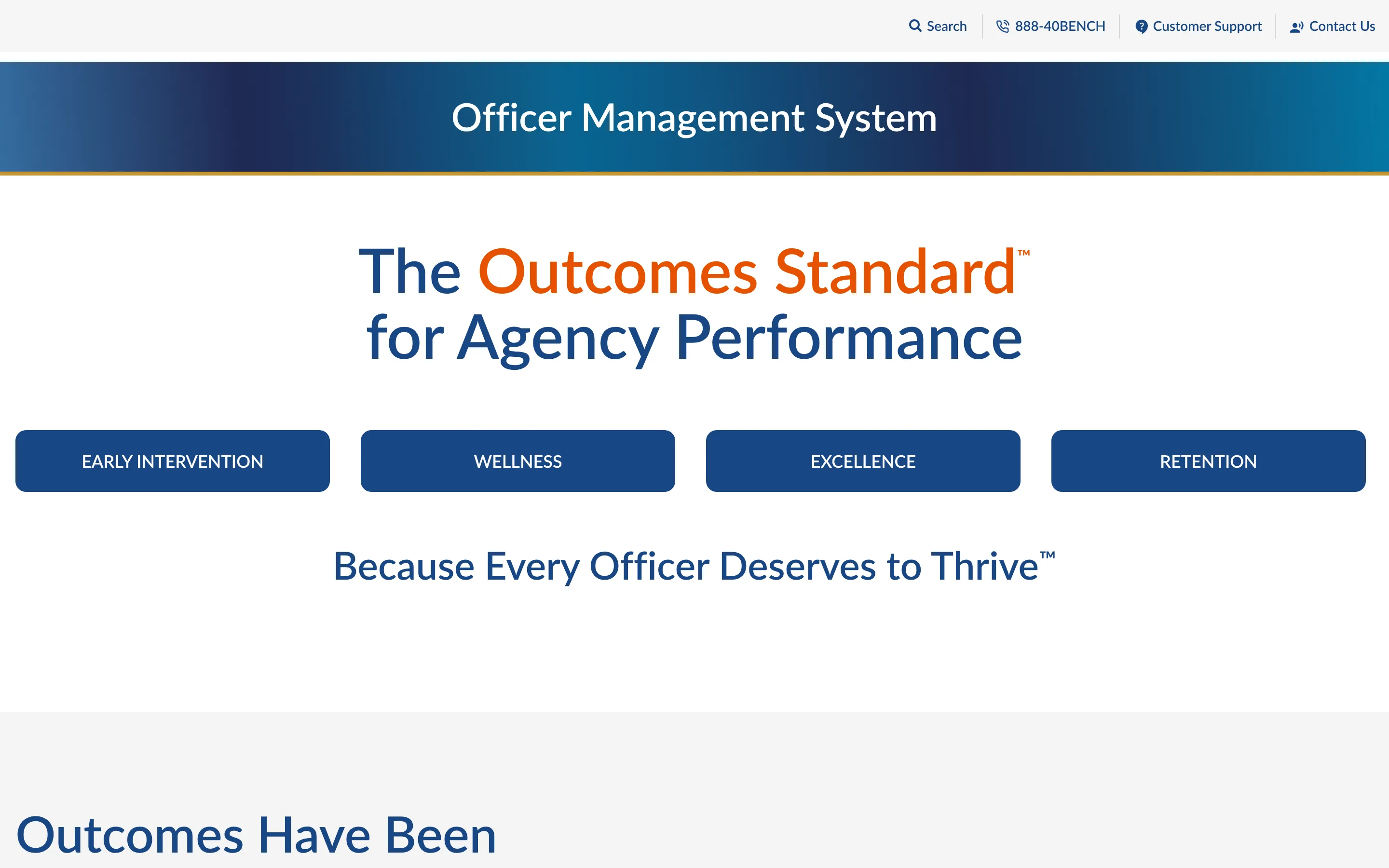
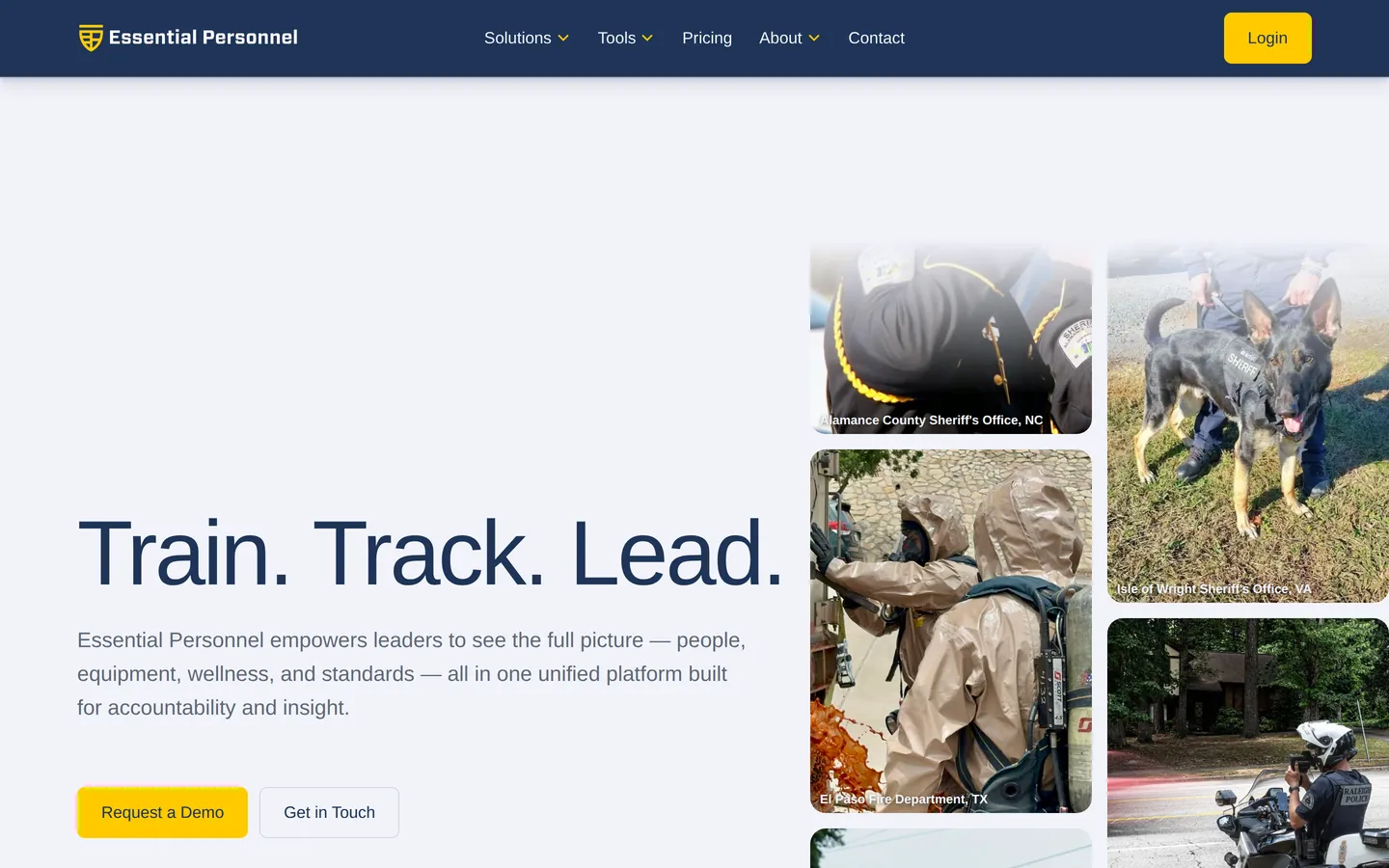
Benchmark's homepage leads with early intervention, wellness, excellence and retention.Essential Personnel puts people, equipment, wellness and standards on one officer record.
Why does one officer record make sense for a police department?
Because a chief is accountable for the whole officer, not one product's view of them. Certifications, field training, evaluations, commendations, corrective entries, use of force and issued equipment all describe the same person, and an early intervention system, a CALEA assessor or an attorney needs them read together. One central personnel management system makes that a single query.
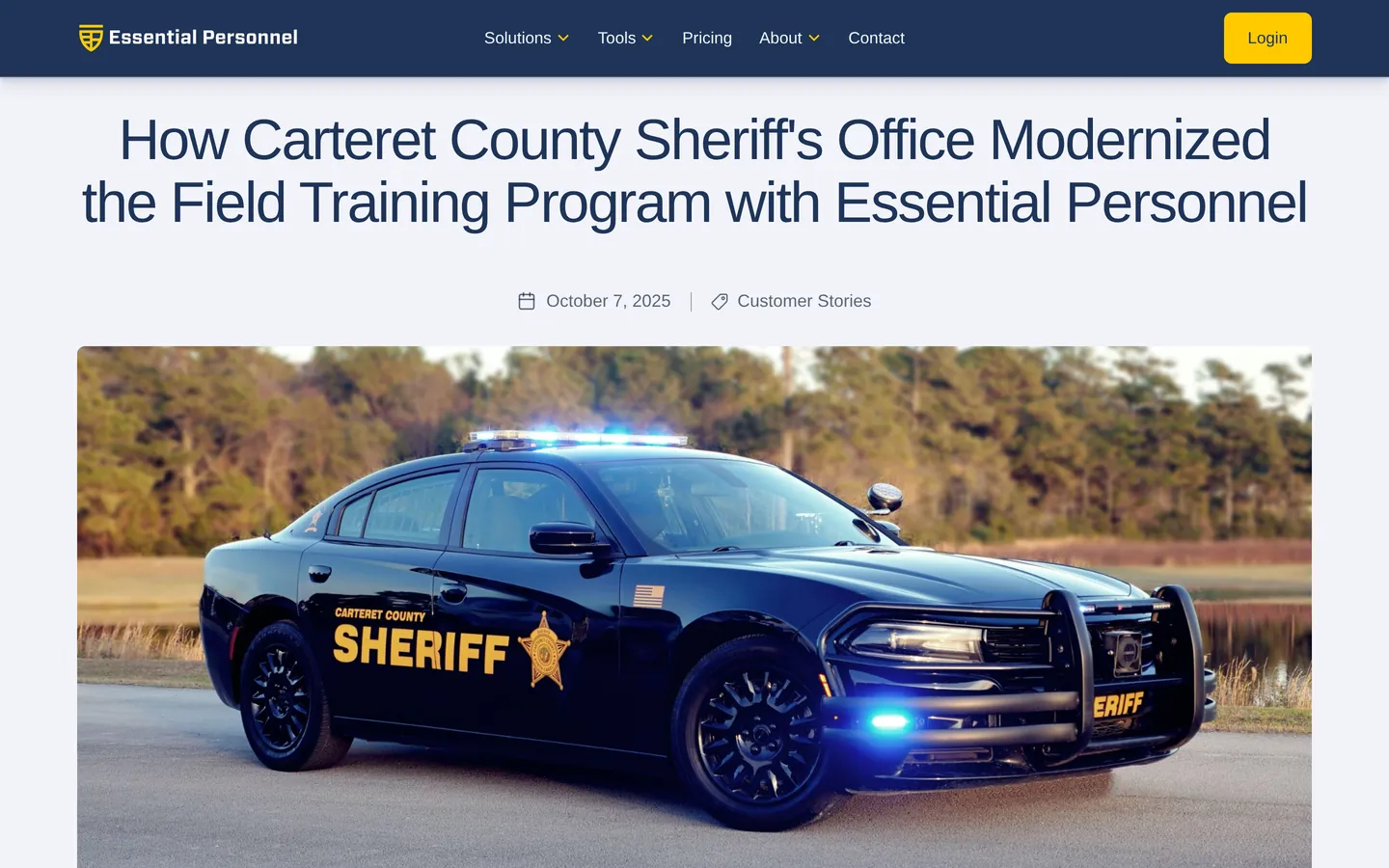
Carteret County Sheriff's Office ran its field training program on handwritten forms, physical folders and manual approvals. Paperwork went missing and command staff had no view of a trainee's performance until late. Now an FTO checks off proficiency on whichever shift they saw it, and it follows the recruit through the whole program, so a supervisor can catch a problem early or give credit when it's due.
Hendersonville Police Department moved incident reporting and case management into the same system as performance, so a case and the officer it concerns are no longer two separate lookups. Pinellas Park Police Department did the same for its awards program. Commendations are the half of the record most agencies document worst, and they're the half an early intervention system needs to see.
Essential Personnel stores all of the documentation in one centralized system. It's cleaner, faster, and more reliable.
Derek MooreMajor, Carteret County Sheriff's Office, NC
One of the most liked things is that we can store so much information on one platform that is easily accessible for convenience.
Tina MedlinInterim Police Chief, Biscoe Police Department, NC
[Essential Personnel] has strengthened accountability, enhanced communication and become an essential tool in helping our office better serve the community.
Travis SumptionSheriff, Clarke County, VA
The Essential Personnel staff are true partners, and acquiring the software has been transformative for our department.
Michael PettiMajor, Fayetteville Police Department, NC
Carteret County moved its field training program off handwritten forms and physical folders.
How the switch works
Essential Personnel and Benchmark Analytics have no integration, so moving is a migration rather than a sync. Benchmark's public contracts run for fixed terms of two to five years, so the work starts with your renewal date. Four steps.
Find the renewal dateBerkeley's term runs two years, Fresno's ran three and Miami-Dade's runs five. Start four to six months before yours ends, so both systems can overlap.
Ask for the exportInternal affairs cases, use of force reports, DORs, evaluations and training history, with their attachments, in a format you can import. Put the request in writing.
Write your thresholdsTurn the alerts your supervisors already act on into early intervention thresholds, and agree them with command staff and the union before they go live.
Run the record in Essential PersonnelField training, evaluations, internal affairs, use of force, early intervention, policy acknowledgment and equipment against one roster.
Tell us what Benchmark costs you or has quoted, and how many officers you have. We'll tell you honestly whether Essential Personnel does the job for your agency.
Yes. Essential Personnel holds field training, evaluations, internal affairs, use of force, early intervention, training records, policy acknowledgment and issued equipment on one officer record. The main difference is early intervention: Essential Personnel uses thresholds your agency sets, while Benchmark's First Sign uses a predictive model built from a department's history.
Benchmark doesn't publish pricing. Council records show Berkeley paying $100,000 a year for an early intervention platform from 2025, Fresno about $386,250 over three years for its management system with early warning, and Miami-Dade $405,000 in the first year of a five-year, $2,260,342 contract with yearly increases of up to 5.5%.
$175 per user per year covers all four suites and 33 tools. Individual suites run from $20 to $85 per user per year. A one-time startup fee of $3,000 covers onboarding, support and training, and single sign-on is an optional $800 per year per agency. Size-based discounts are available in writing.
An early intervention system watches an officer's record for patterns, such as repeated use of force reports or complaints, and alerts a supervisor before a problem turns into discipline or a lawsuit. It matters because the agency can offer training, wellness support or closer supervision early, and has a record showing that it did.
Yes, if the system runs on thresholds rather than a model that needs years of data. In Essential Personnel, your agency sets thresholds for use of force, complaints, missed training or critical incidents, and a supervisor is alerted when an officer crosses one. At $175 per user per year, a 15 officer department pays $2,625.
FTO software lives or dies on whether the FTO actually completes the form, so the test is whether a DOR can be signed on a phone at shift end. Field training officer software that needs a desktop gets filled in from memory the next day. Then check that the DOR lands on the recruit's file beside evaluations and certifications.
Yes. Internal affairs cases, complaints, use of force reports and discipline run in the same system as evaluations, field training and certifications, so every review starts with the officer's full history. Review and approval routing is built in, and use of force reports and complaints feed the early intervention thresholds your agency sets.
Essential Personnel is aligned with the latest FBI CJIS Security Policy and maintains a SOC 2 Type II report annually. It's hosted entirely in AWS GovCloud in the United States, primary in us-gov-east-1 and replicated to us-gov-west-1. Benchmark's Miami-Dade contract also places their platform on AWS GovCloud.
About this guide
Written by Scott Monroe, Chief Executive Officer & Co-Founder, Essential Personnel. Published 15 October 2026.
Essential Personnel publishes this page and is one of the two systems compared. Essential Personnel and Benchmark Analytics have no partnership or integration.
Benchmark pricing is taken from public records: the City of Berkeley council report of 21 January 2025, the City of Fresno council item adopted on 21 April 2022, and the Miami-Dade County contract awarded in 2023. Chicago's timeline comes from the Chicago Police Department's progress report dated 15 April 2026. Capability claims were checked against both vendors' published pages and Benchmark's Miami-Dade scope of services in October 2026. No agency named in this guide has publicly identified Benchmark Analytics as a system it replaced.
By clicking “Accept All Cookies”, you agree to the storing of cookies on your device to enhance site navigation, analyze site usage, and assist in our marketing efforts. View our Privacy Policy for more information.