
Generic HR vs police personnel software: where a city HR system stops in an officer's career
Follow one officer through a career and the gap between city HR and police work stops being abstract. The HR system records the hire date, the pay grade and the day they leave. In between, the state wants proof of a psychological exam, the next agency wants their whole file, a prosecutor wants their credibility history, and the state wants a sworn report on why they left.
This guide is for police chiefs, sheriffs, command staff and the city and police department HR staff who work alongside them. It walks one officer from application to separation, shows what a generic HR system records at each stage and what the department also has to keep, and ends with a test you can run on your own HR system this week.
The departments that get this right don't fight the city over HR software. They keep the city system for pay, benefits and leave, and keep the officer's professional record in police personnel software built for public safety, where every stage of the career adds to one record that's ready when the state, a court or the next employer asks.
The short answer: why generic HR systems don't work well for police departments
A generic HR system manages employment: hiring, pay, benefits, leave and separation. A police officer's career also produces a professional record the state, courts and other agencies rely on: licensing standards, field training, issued equipment, complaints and use of force, critical incidents, promotion eligibility and sworn separation reports. City HR isn't built to hold those police personnel records, so departments keep them in police personnel software.
The gap isn't one missing feature in government HR software. It's that the people who ask for the record are different. HR answers to the employee, payroll and benefits providers. A police department also answers to the state licensing body, prosecutors, accreditors and the next agency that wants to hire your officer. Our companion guide on why generic HR systems fall short covers eight of the reasons in depth, including overtime, union contracts and accreditation. This guide follows the career instead.
One officer's career: what city HR records and what police add
At every stage of an officer's career, the city HR system records the employment event and the department has to record the professional one. The table below shows eight stages, what each system holds and who asks for the police record later. The rest of this guide takes each stage in turn.
| Stage | What city HR records | What the department also has to keep | Who asks for it later |
|---|---|---|---|
| Hiring | Application, offer, start date | Background investigation, psychological and medical exams, state hiring standards | State licensing body, accreditors |
| Lateral hire | Prior employer on the application | Prior agency personnel files, separation reports, decertification checks | The state, your own risk manager |
| License and training | Course completions | License status, in-service hours, field training reports | State licensing body, accreditors, courts |
| Assignment | Job title and department | Issued firearms, body armor, radios and vehicles by serial number | Quartermaster, grant auditors |
| Conduct | Discipline letters in the personnel file | Complaints, investigations, findings, use of force reviews | Prosecutors, the state, courts |
| Critical incident | Leave taken | The incident, administrative leave, return to duty, wellness referral | Supervisors, wellness staff |
| Promotion | New title and pay grade | Time in rank, exam eligibility, training, evaluations and discipline history | Civil service board, grievance hearings |
| Separation | Last day and reason code | Sworn separation report, personnel file to the state, equipment returned | The state, the next employer |
Stage 1: the police officer hiring process and the background file
The police officer hiring process has state minimum standards that ordinary city hiring doesn't. Texas requires a psychological exam by a licensed psychologist using at least two instruments and an interview, within 180 days before appointment. California requires good moral character established by a thorough background investigation. The department has to keep that evidence for every officer.
The details are specific. Texas rule 37 TAC 217.1 requires one instrument measuring personality traits and one measuring psychopathology, a face to face interview after scoring, and a physician's exam showing "no trace of drug dependency or illegal drug use." California's POST selection standards, under Government Code section 1031, require a background investigation and freedom from any condition, "including bias against race or ethnicity," that might affect the exercise of peace officer powers.
In the police officer hiring process, a city's applicant tracking system handles the posting, the application and the offer well. What it usually doesn't hold is the background investigation file, the exam declarations and the proof that each state standard was met, and much of that file is confidential. If the background includes criminal history results, the file falls under the FBI CJIS Security Policy too. Decide before the police officer hiring process starts who keeps that file, where, and who can see it.
Stage 2: hiring a lateral police officer and the National Decertification Index
Hiring a lateral police officer means checking their history at every previous agency before you make the offer. Texas requires the hiring agency to obtain and review personnel files from each previous law enforcement employer, plus state separation and misconduct reports, and the agency head must sign off. California and Florida require an inquiry to the state first.
Texas Occupations Code section 1701.451 spells it out: before hiring a licensed officer, the agency must obtain and review "personnel files ... and other employee records from each previous law enforcement agency employer," along with "employment termination reports and misconduct investigation reports maintained by the commission." The agency head must sign the confirmation, and failing to do so is grounds to suspend the agency head's own license. Under California's SB 2, an agency must submit a background inquiry to POST before appointing anyone previously employed as a California peace officer. Florida's section 943.139 requires the new employer to ask the state why the officer left every previous agency.
Most agencies also check the National Decertification Index, run by the International Association of Directors of Law Enforcement Standards and Training. California POST reports that 48 states and Washington, DC contribute records. IADLEST describes it as "basically a pointer system": it tells you an officer was decertified, suspended or surrendered a license, and where, but not why. The detail is in the prior agency's file, which is why the National Decertification Index check depends on every agency keeping complete police personnel records.
A generic HR system records the prior employer of a lateral police officer as a line on the application. A department needs the request sent to each prior agency, what came back, the state and decertification checks, the agency head's sign-off and the date of each, on the officer's record.
Stage 3: license, training and field training
Once hired, an officer has to earn and keep a state license, meet in-service training hours on the state's cycle and pass field training evaluated every shift. A generic HR system records course completions and one annual review. The department needs license status, hours against the state cycle, field training reports and supervisor evaluations, because some states now collect them.
That last point is new. Texas section 1701.4535 requires an officer's personnel file to include "the periodic evaluation of the license holder by a supervisor," and requires the agency to send that file to the state within 30 days of separation. Evaluations that once stayed in a drawer now travel with the officer. Our companion guides cover police training records and how departments track officer performance in more depth.
Stage 4: assignment and issued equipment
An assigned officer carries equipment a city HR system was never designed to track: a duty firearm, a patrol rifle, body armor, a radio, sometimes a vehicle. The National Institute of Justice says an agency should be able to tell, at any time, which armor was issued to which officer, with the issue date, model and production lot number.
The NIJ body armor guide puts it plainly: "At any time, an agency should be able to determine which armor was issued to a given officer and the issue date, supplier name, model designation, armor type and production lot number." Agencies that buy vests through the federal Bulletproof Vest Partnership must also keep a signed, dated mandatory wear policy in force for the life of the vests and keep records of any medical exemptions.
Some HR systems track laptops and badges. Few track a patrol rifle with its optic, light and serial numbers, the officer who holds it and its service history. That record matters most on the day an officer leaves, when every item has to come back.
Stage 5: complaints, use of force and the Giglio list
Complaints, internal affairs findings and use of force reviews build a conduct record that prosecutors, the state and courts all rely on. In California, agencies must report every allegation of serious misconduct to the state within 10 days, with no exception for unfounded or exonerated allegations. A generic HR file holds the discipline letter, not the record behind it.
California POST's SB 2 guidance says agencies must report each complaint, charge or allegation of serious misconduct "within ten days of the agency becoming aware of it," and report again at final disposition. Prosecutors need the same history for a different reason. Under Giglio, they must disclose information that could impeach an officer who testifies, and many keep a Giglio list of officers with that kind of history. An officer can land on a Giglio list because of a record your department holds, and a department that can't produce that record quickly can't correct a Giglio list either. The federal Justice Manual includes "any allegation of misconduct bearing upon truthfulness, bias, or integrity that is the subject of a pending investigation."
Answering any of those requests means finding every complaint, investigation, finding and use of force review for one officer, with dates and outcomes. If you're choosing a system for that work, our guide on how to compare internal affairs software walks through the evaluation.
Stage 6: after a critical incident
After a shooting or other critical incident, an officer often goes on administrative leave. To a generic HR system that's just leave. To the department it's a specific status with a reason, a return-to-duty decision and often a wellness referral, and the IACP is clear that administrative leave after a shooting is routine, not discipline.
The IACP's officer-involved shooting guidelines recommend at least three days off for officers directly involved in a death or serious injury, and say "administrative leave is a routine procedure and not a disciplinary suspension." They also say involvement in a shooting alone doesn't call for a fitness-for-duty evaluation before return. A record that shows the leave next to unrelated discipline, or loses the reason entirely, can mislead whoever reads it next. Wellness referrals need even tighter handling, covered in our guide to officer wellness records.
Stage 7: promotion
Promotion in many police departments runs on civil service rules that set time in rank, exam eligibility and seniority points. In Texas civil service cities, an officer must have served two years in the next lower rank before the exam, and four years in the department for captain. The department has to prove eligibility and defend the decision later.
Texas Local Government Code chapter 143, which applies to cities of 10,000 or more that adopted it, adds one point per year of seniority up to 10 and a passing score of 70. A generic HR system records the new title and pay grade. The department needs the eligibility, training, evaluations, commendations and discipline history behind the decision, because that's what a candidate who wasn't promoted will ask about in a grievance hearing.
Stage 8: separation and decertification reporting
When an officer leaves, the state wants to know why. Texas requires a separation report within seven business days and the officer's personnel file within 30 days. California requires an affidavit of separation within 10 days. Florida requires immediate notice and a sworn affidavit setting out the facts and reasons. A generic HR system records a last day and a reason code.
Texas section 1701.452 sets the seven business days from separation and the end of any appeals, and section 1701.4535 sets the 30 days for the personnel file. Under California's SB 2, in effect since January 2022, the affidavit is due "within ten days of a peace officer's official separation," probationary releases included. Florida's section 943.139 makes intentionally false statements on the affidavit of separation a second-degree misdemeanor.
These reports feed state decertification decisions and, through them, the National Decertification Index the next agency will check before hiring a lateral police officer. A federal database of officer misconduct created by Executive Order 14074 in 2022 was revoked in January 2025, which leaves state reporting as the main way an officer's history follows them. Getting it right depends on the record you kept for the whole career: the separation report is only as accurate as the file behind it.
Test your own government HR software: 12 questions
Before you decide whether your city's HR system is enough, test it. Pick one officer and try to answer the 12 questions below from the HR system alone, without spreadsheets, binders or calling anyone. Every "no" is a record the department is keeping somewhere else, or not at all.
Can your HR system show, for one officer:
- Proof each state hiring standard was met, including the psychological exam date
- For a lateral officer, the prior agency files requested and received, and the decertification check
- Current state license status and in-service hours against your state's cycle
- Every field training daily observation report and the final sign-off
- Supervisor evaluations you'd have to send the state at separation
- Every firearm, vest and radio issued, by serial number
- Every complaint, finding and use of force review, with dates and outcomes
- Whether any pending allegation bears on truthfulness, for a prosecutor's Giglio list
- Administrative leave after a critical incident, kept separate from discipline
- Promotion eligibility: time in rank, training and evaluation history
- The facts you'd put in a sworn separation report
- Who has looked at the internal affairs file, and when
Most government HR software answers yes to two or three of these. That's not a failure of the HR system. It's a sign the department needs its own record.
Who owns which police personnel records: city HR or police department HR
The cleanest arrangement is a clear split. City HR, or police department HR where the department has its own, owns the employment record: pay, benefits, leave balances and hiring paperwork. The police department owns its police personnel records in police personnel software. The two share an employee ID, so nobody types the same officer in twice.
| Record | Owner | Where it lives |
|---|---|---|
| Pay, benefits, leave balances, tax forms | City HR and payroll | City HR system |
| Job posting, application, offer | City HR | Applicant tracking or city HR system |
| Background investigation and hiring standards | Police department | Restricted police file |
| License, training, field training, evaluations | Police department | Police personnel software |
| Issued equipment | Police department | Police personnel software |
| Complaints, internal affairs, use of force | Police department | Police personnel software, restricted |
| Wellness and peer support | Police department | Separate, restricted access |
| Separation report to the state | Police department, with HR | Drawn from the police record |
Settle the split in writing with police department HR and city HR before you buy anything. It answers most of the questions government HR software vendors will ask, it gives police department HR staff a clear role, and it stops the same record being kept in two places with two different answers.
How Essential Personnel fits beside the city's HR system
Essential Personnel is personnel and professional standards software built for police, fire and city government. It isn't government HR software and doesn't run payroll, benefits, time and attendance, applicant tracking or scheduling. It holds the professional record across the career, from field training to separation, on one profile per officer.
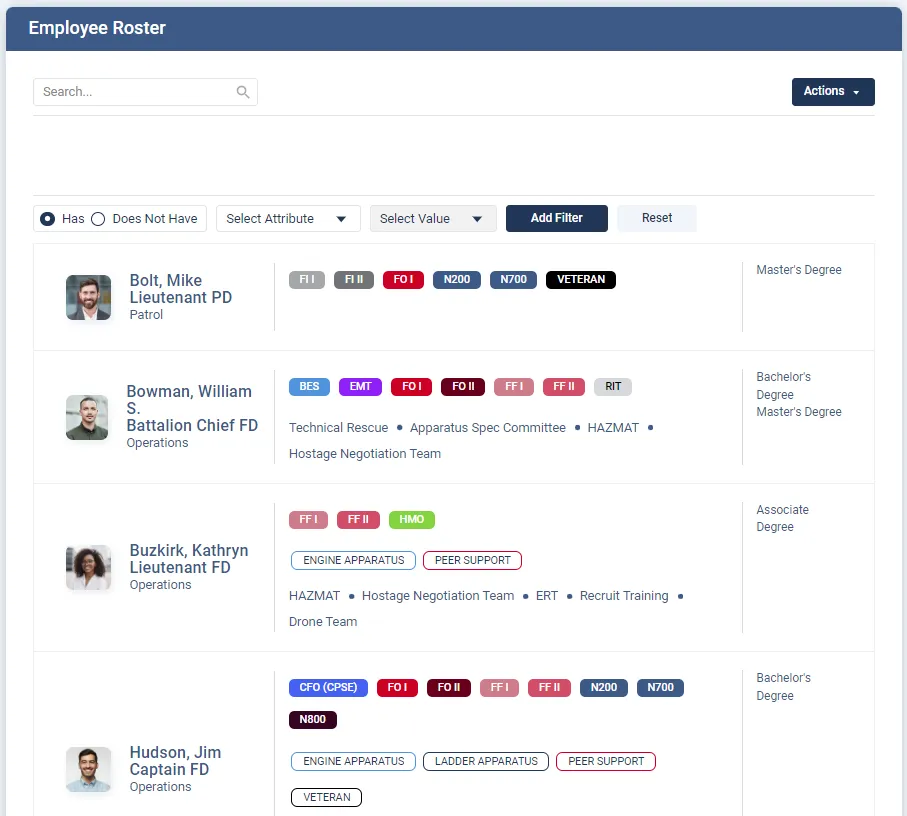
Stage by stage:
- License and training. Training tracks certifications, expirations, completions and source documents, and Qualifications tracks task books and check offs, including weapon scores.
- Field training and evaluations. Leader's Notes includes a field training daily observation report template, and Score Reports normalize evaluations so hard and easy graders can be compared.
- Equipment. Issued equipment runs with per officer chain of custody, so firearms, vests, radios and vehicles appear against the person who holds them, with component-level serial numbers and service history. That makes the separation audit a report.
- Conduct. Incident and Case Management covers internal affairs investigations, use of force, critical incidents and vehicle accidents, and Documents of Record hold commendatory and corrective documents with routing and approval.
- Critical incidents. Safety and Wellness tracks traumatic calls and critical incidents with early intervention thresholds your agency sets, and a specialist role lets peer support staff see critical incidents without the rest of the file.
- Promotion. Career Paths define rank requirements, completion is mapped automatically from training and qualifications, and Promotion Eligibility shows who qualifies now.
- Policy. Guidance automatically assigns new employees the policies they need to acknowledge.
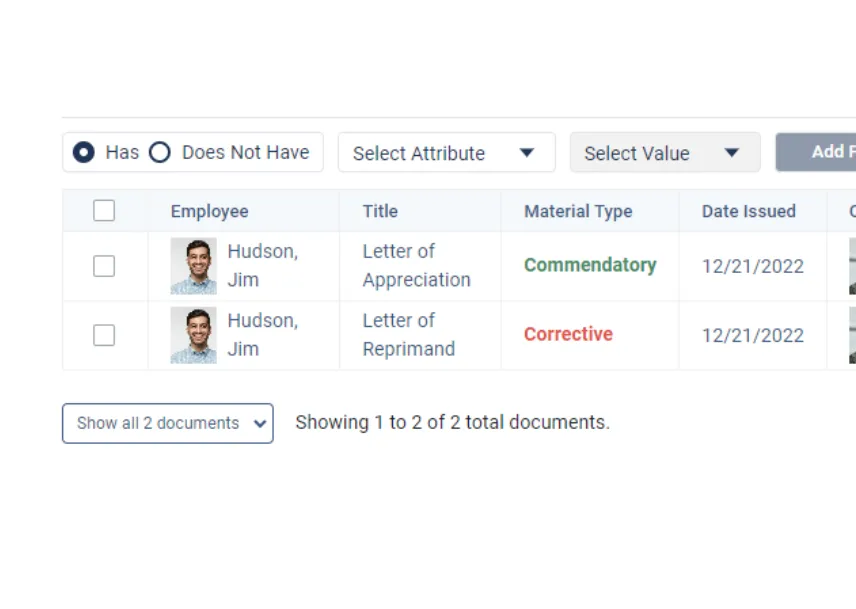
The background investigation and hiring paperwork stay with whoever runs hiring today. Essential Personnel picks up the record from appointment. It's hosted in AWS GovCloud, aligned with the FBI CJIS Security Policy and covered by an annual SOC 2 Type II report. Pricing is published: the Total Solution with all four suites is $175 per user per year, plus a one-time $3,000 startup fee, and it's available through GSA Advantage, NASPO, Omnia Partners, NCSA and VSA. See the law enforcement page for the full feature list.
"This level of responsiveness and flexibility has dramatically improved our training tracking, wellness monitoring, equipment management, and overall accountability."
Michael Petti, Major, Fayetteville Police DepartmentKeep city HR for pay. Keep the career on one record.
We'll show you field training, certifications, issued equipment, conduct and promotion eligibility on one officer record for a department your size, next to the HR system you already run. Call (910) 390-0011 or email info@essper.com.
Frequently asked questions
A generic HR system manages employment: hiring, pay, benefits, leave and separation. A police career also produces a professional record that the state, prosecutors, courts and other agencies rely on, including hiring standards, field training, issued equipment, complaints, use of force, critical incidents, promotion eligibility and sworn separation reports. City HR systems aren't built to hold that record.
Usually the background investigation from the police officer hiring process and proof of state hiring standards, prior agency files for lateral hires, license status and in-service hours, field training reports, issued firearms and body armor by serial number, complaints and use of force reviews, administrative leave after critical incidents, promotion eligibility, and the facts needed for a sworn separation report to the state.
It depends on the state. Texas requires the hiring agency to obtain and review personnel files from every previous law enforcement employer and the state's separation and misconduct reports, with the agency head's signature. California requires a background inquiry to POST, and Florida requires asking the state why the officer left. Most agencies also check the National Decertification Index.
It's a national database, run by the International Association of Directors of Law Enforcement Standards and Training, of actions states have taken against officers' licenses, such as decertification or suspension. It's a pointer system: it shows that an action was taken and by which state, not the details. Agencies check it before hiring, then get the full story from the prior agency.
Most states require a separation report to the state licensing body. Texas requires it within seven business days and the personnel file within 30 days. California requires an affidavit of separation within 10 days. Florida requires immediate notice and a sworn affidavit setting out the facts and reasons. These reports feed state decertification decisions and future background checks.
Usually not. Police equipment needs serial numbers, components, service history and the officer who holds each item, and the National Institute of Justice says agencies should be able to tell which body armor was issued to which officer at any time. Most HR systems track only basic assets, so departments keep issued equipment in police personnel software.
No. The city keeps its HR system for pay, benefits, leave and hiring paperwork. The police department keeps the officer's professional record in police personnel software beside it: license and training, field training, evaluations, equipment, conduct, critical incidents and promotion eligibility. The two share an employee ID so nobody enters the same officer twice.
Many vendors quote only after a demo. Essential Personnel publishes its prices: individual suites run from $20 to $85 per user per year, and the Total Solution covering training, performance, conduct, early intervention, wellness, policy and equipment is $175 per user per year, plus a one-time $3,000 startup fee. It's available through several cooperative purchasing contracts.

About this article
Written by Scott Monroe, Chief Executive Officer & Co-Founder, Essential Personnel. Published 26 October 2026.
Essential Personnel makes the software described here, and the product screenshots are from the platform. Pricing, hosting and purchasing details are taken from essper.com, and the customer quote is reproduced from essper.com. State laws, rules, federal guidance and executive orders are linked to their primary sources or to the state agency that administers them, and were checked in October 2026. Requirements differ by state and change often; check your own state law and licensing body before relying on them. This article is general information and isn't legal advice.
